Lift and elevator maintenance software for Malaysian lift contractors

Run the monthly service, three-monthly examination and certificate of fitness renewal for every lift and escalator, with each report kept on the lift.

Book a demo
Updated 16 Oct 2026
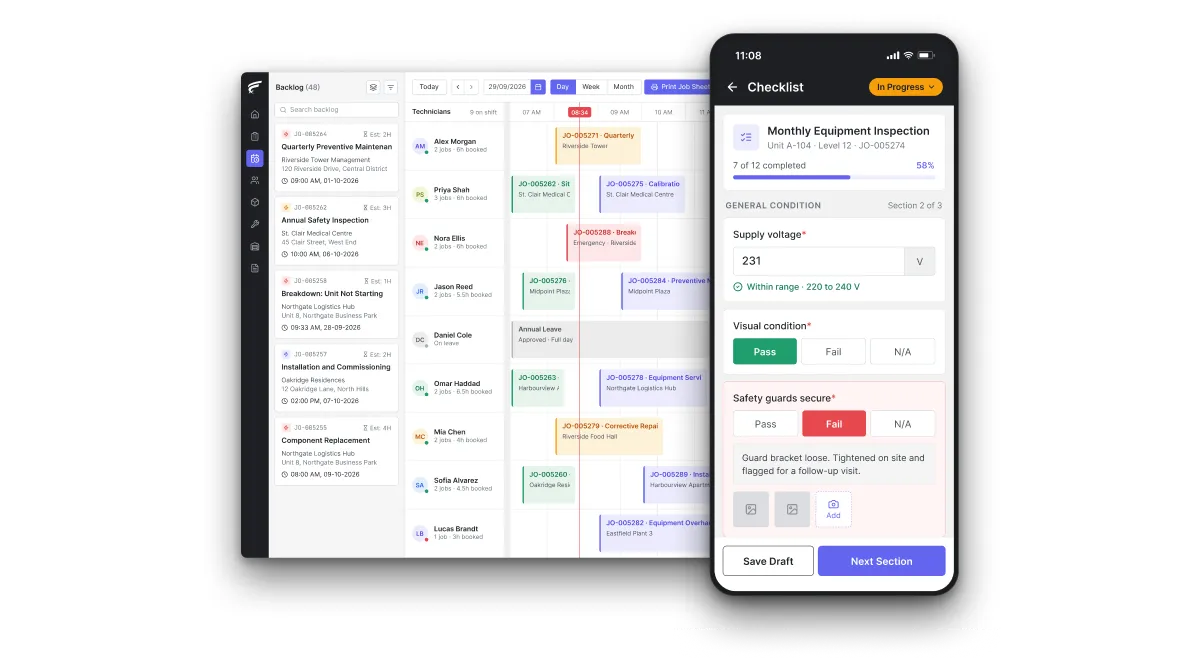
FieldEx scheduling board on desktop with a technician's inspection checklist open on the mobile app, as used by lift and escalator contractors

FieldEx is a field service and asset management (FSM+CMMS) application for lift and escalator contractors and building owners in Malaysia. For elevator maintenance, each lift keeps its own history. FieldEx schedules monthly servicing, comprehensive examinations and certificate of fitness (CF) renewals. It times breakdowns, and every report stays with the lift.

What FieldEx does for Malaysian lift contractors

Under the 2024 certificate of fitness regulations, a lift in Malaysia needs a monthly service and a comprehensive examination every 3 months. It also needs an agreement of at least a year with a competent person, and a CF that lasts 15 months. A contractor looking after hundreds of lifts is juggling all four dates for each one. FieldEx keeps them on the lift itself. Book a demo with your own lift list.

Each lift and escalator on record

  • One asset per lift, escalator and walkalator, in Asset Management.
  • Make, model, DOSH registration number, capacity and photos on each record, with drawings attached.
  • Drive components under each unit, such as the traction machine and controller.
  • Other components, such as landing doors, ropes and safety gear.
  • A separate history for every component.
  • Units grouped by building and client, with the building's address, map pin and management office contacts.
  • A QR sticker in the machine room, so the technician scans to open the lift's record and checklist.

Monthly service and three-monthly examination

  • Planned preventive maintenance (PPM) plans per lift, in Preventive Maintenance.
  • The monthly service and the three-monthly comprehensive examination raised as separate visit types, each with its own checklist.
  • A shorter interval where the manufacturer's manual asks for one, set per unit.
  • Missed visits rescheduled automatically after a set overdue period, and every overdue visit visible on the dashboard.

CF dates and DOSH paperwork

  • Track each 15-month CF renewal as a maintenance plan.
  • Reminders by email, in the app or both, before each CF expires.
  • Contracts with start and end dates for each maintenance agreement, linked to the lifts and plans they cover.

Breakdowns and passengers trapped

  • Breakdown calls logged by your call center, by the building through a branded portal, or by a QR code in the lobby without logging in.
  • Service-level agreements (SLAs) with stages for arrival and restoring service, set per client or per lift, with warnings before a target is missed.
  • A flag when a lift has a repeat breakdown soon after the last job, so it gets a senior technician.
  • Automatic assignment by skill, availability, shift and leave, in Work Order Management.
  • Assignment that also weighs service zone and live location.

Technicians on the route

  • Jobs offered by skill, availability, shift and leave, in Scheduling and Dispatch.
  • Service zone and live location used to pick the technician.
  • A drag-and-drop scheduler.
  • The FieldEx Mobile App on each technician's phone.
  • The lift's history, checklists, watermarked photos and the building manager's signature, all in the app.
  • Van stock for each technician, with transfers, reorder alerts and parts booked to the lift, in Spare Parts Inventory.

Your own chain blocks, test weights and vans

  • Chain blocks, slings, load test weights and meters recorded as company assets, with serial numbers and the van or store holding each one.
  • Examination and calibration due dates for each item, with reminders and the certificate filed on its record.
  • Company vans serviced on a plan by date or odometer reading, each with its own history.

Reports for owners and your office

  • A branded portal where building owners and management offices see their lifts and last-serviced dates, in Service Requests and the Customer Portal.
  • Upcoming asset maintenance, open breakdowns and downloadable job sheets in the same portal.
  • A job sheet PDF for every service and examination, with the parts, photos and time on site.
  • Each job sheet emailed, with a record of when it went out.
  • FieldEx reports MTBF, MTTR and downtime for every machine.
  • Reports exported or emailed on a timetable.

Contracts and owner records

  • Maintenance contracts with start and end dates, linked to the units and maintenance plans they cover.
  • A branded portal where building owners see their units with last-serviced dates and upcoming asset maintenance, through Service Requests and the Customer Portal.
  • Open callbacks and job reports in the same portal.
  • A completion PDF for each visit, and reports on callbacks per unit, response times and maintenance cost, exported or emailed on a schedule.

How often must a lift be serviced under DOSH's 2024 regulations?

At least once a month. The Department of Occupational Safety and Health (DOSH) enforces it. The Eleventh Schedule of the Occupational Safety and Health (Plant Requiring Certificate of Fitness) Regulations 2024 sets the interval. Service and adjustment of lifts, escalators and walkalators shall be carried out not less than once a month. Regulation 8(2) requires the owner to ensure a competent person maintains the equipment following those procedures. DOSH's director-general repeated the rule in an interview with The Star on 11 September 2026. Lifts must be serviced and adjusted monthly, with a comprehensive inspection at least once every 3 months.

What FieldEx does about it

  • A monthly plan per lift: the service and adjustment visit is raised automatically every month, with the Eleventh Schedule items on its checklist.
  • Competent persons only: the visit requires the competent-person skill, so it is offered only to qualified technicians.
  • Each visit dated and signed: check-in and check-out times, checklist answers and the building manager's signature are recorded on the job.
  • Reminders for the office: certification reminders go out before each test is due, so the inspection agency and the mechanic can be booked together.

How often must a competent person carry out a comprehensive examination of a lift or escalator?

At least once every 3 months, or more often if the manufacturer's manual says so. Regulation 14(1) of the 2024 regulations requires a comprehensive examination by a competent person at least once every 3 months. The manufacturer's manual may set a different period, and the more frequent of the two applies. Under regulation 14(2), the competent person must provide a comprehensive examination report with the particulars set out in the Fourteenth Schedule.

What FieldEx does about it

  • Three-monthly or shorter: the comprehensive examination runs as its own visit type, quarterly or at the manual's shorter interval for that unit.
  • The report as the checklist: the Fourteenth Schedule checks can be set up as the examination checklist, so none is missed on site.
  • The report generated on completion: a job completion PDF is produced when the job closes and can be emailed to the owner.
  • Defects raised at once: a failed item creates the repair job before the technician leaves.

How long is a lift's certificate of fitness valid, and can a lift run without one?

Fifteen months, and a lift may not operate without a valid one. Under regulation 5(6) of the 2024 regulations, a CF is valid for 15 months from the date of inspection. The CF was previously known as the PMA. The Malay text adds that the periodical inspection must be carried out before the CF expires. DOSH's director-general told The Star that section 27D of the Occupational Safety and Health Act requires a valid CF. All lifting machinery, including lifts, must have one before it can operate.

What FieldEx does about it

  • CF renewals on a plan: each lift's 15-month CF renewal runs on a maintenance plan, with the current CF attached to the lift's record.
  • A 15-month maintenance plan tracks the CF renewal date.
  • Status that shows the risk: the dashboard lists lifts whose CF is overdue or due in the next 7 days.
  • Previous records brought across: attachments from the previous contractor can be added to the unit's record when the account transfers.

Must the building owner hold a lift maintenance agreement, and for how long?

Yes. Regulation 8(3) of the 2024 regulations requires the owner to enter into an agreement with a competent person. The agreement covers the servicing, adjustment and comprehensive examination of lifts, escalators and walkalators. It must last not less than one year.

What FieldEx does about it

  • The agreement as a contract record: each agreement has its start and end dates, the lifts it covers and the PPM plans linked to it.
  • Lifts and contracts side by side: the contract is visible from each lift's record, and the lift list from the contract.
  • Renewal in view: contract reports list agreements by end date, so renewals are raised in good time.

What notices and machine room rules must a lift owner follow?

A contact notice in every lift, and machine rooms and pits kept for lift equipment only. The Thirteenth Schedule of the 2024 regulations requires a notice in each lift, escalator or walkalator. The notice gives the contact details of a person to call in case of a service disruption. Machine rooms and pits may be used only for lift equipment. No additional accessories may be added to the existing components unless a competent person permits it.

What FieldEx does about it

  • Checked on every service: the monthly checklist includes the notice, the machine room and the pit, with photos attached to the job.
  • Unauthorized items flagged: a failed answer, such as storage in the machine room, raises a follow-up job.
  • Changes approved first: any added accessory is recorded as a job with the competent person's approval attached.
  • Serious defects flagged: a failed answer on the checklist can set the unit's status, so a car taken out of service shows as such.

Where must lift examination reports and maintenance records be kept?

On site. The Eleventh Schedule of the 2024 regulations requires the comprehensive examination report to be kept where the lift, escalator or walkalator is installed. Regulation 20 requires the employer to keep certain documents at the place of work. They cover design verification, construction, installation and operation. The employer must also keep the records of testing, inspection, repair and alteration.

What FieldEx does about it

  • Records the building can open: the owner or building manager can see the customer's jobs, their status and upcoming asset maintenance in the portal.
  • Print for the machine room file: each examination's PDF can be printed and filed on site after every visit.
  • Design and installation documents attached: drawings, installation records and alteration approvals are attached to the lift's asset record.

Must DOSH be told before a lift is repaired, and who may repair it?

Yes. Regulation 9(1) of the 2024 regulations covers repairs on any plant that requires a CF. Before the repairs, the owner or occupier must give written notice to the officer or licensed person. Regulation 9(2) requires a competent person to carry out the repairs.

What FieldEx does about it

  • Notice first, repair second: tasks on the repair job can be ordered so the repair cannot start until the notice task is completed.
  • The notice attached: a copy of the written notice is attached to the job.
  • Competent persons on the job: the repair requires the competent-person skill before it is assigned.

Does a lift modernization or alteration need DOSH approval?

Yes. Regulation 11(1) of the 2024 regulations covers alterations to plant requiring a CF. An owner must not make, or cause to be made, any such alteration without written approval from the Director General. DOSH's director-general also told The Star that only competent companies approved by DOSH may carry out lift installation.

What FieldEx does about it

  • The modernization as a project: the project holds its site, lifts, jobs, tasks and attachments, including the written approval.
  • Approval before work: ordered tasks on the job keep the site work waiting until the approval task is completed.
  • New components on record: replaced machines, controllers and doors become new components on the lift, with their warranty.

How fast should a lift contractor respond to a breakdown or entrapment?

As fast as the maintenance agreement sets, because the 2024 regulations don't fix a response time. The Thirteenth Schedule of the regulations does require a notice in every lift with a contact for service disruptions. That call should reach someone who can act straight away, with entrapments ahead of every other breakdown.

What FieldEx does about it

  • Entrapment as its own job type: with its own SLA, priority and alerts, separate from routine breakdowns.
  • Nearest qualified technician: automatic assignment uses skill, availability, shift and live location.
  • Every minute recorded: call, arrival and release times are on the job and in SLA reports for each client.
  • Visit frequency per unit: each unit's plan can have its own visit frequency, set to its usage and age.

Which lifting equipment in a building needs a certificate of fitness?

Lifts, escalators and other lifting machinery, along with steam boilers and pressure vessels. Regulation 3 of the 2024 regulations prescribes three types of plant that need a CF: steam boilers, pressure vessels and lifting machinery. Regulation 2 defines lifting machinery as any equipment for lifting, raising, transporting or lowering loads.

What FieldEx does about it

  • Every unit by type: each asset type, such as lifts, escalators, hoists and other lifting machinery, has its own CF schedule.
  • One dashboard for all CFs: the dashboard lists every CF due or overdue across your buildings.
  • Certificates attached: each CF is filed on its unit's completed certification.

How often should a lift contractor examine its own chain blocks and slings?

Follow the manufacturer's interval, with the UK's LOLER intervals as an international benchmark. LOLER sets 6 months for slings and other lifting accessories, and 12 months for other lifting equipment. The UK's HSE thorough examination guidance sets these intervals unless a competent person's examination scheme sets others. The report must give the next due date and any defect that is or could become a danger to people.

What FieldEx does about it

  • Lifting gear as assets: each chain block, sling set and beam clamp has its own record, with serial number and where it is kept.
  • Due dates you can see: each examination runs as a recurring certification, so the dashboard shows what is due or overdue.
  • Weights and meters calibrated: load test weights and electrical meters carry their own calibration dates and certificates.
  • Vans serviced on time: each company van follows a plan by date or odometer reading.

How often must a lift contractor's own hoists and slings be examined?

In Great Britain, slings and other lifting accessories are examined every 6 months, and chain hoists and other lifting equipment every 12 months. HSE's thorough examination guidance sets these intervals under LOLER, unless a competent person's examination scheme sets others. Equipment used to lift people is examined every 6 months.

What FieldEx does about it

  • Your lifting gear on record: each chain hoist, sling set and beam clamp has its own record, with serial number and the van or store holding it.
  • Examinations that come round on time: each item's examination runs as a recurring certification with reminders, and the report is filed on the record.
  • Test weights and meters too: load test weights and electrical meters carry their own calibration dates in the same way.
  • Vans on a plan: each company van is serviced on a plan by date or odometer reading.
Customer story

Chubb, an integrated security provider with more than 300 professionals across 18 branches, runs alarm, surveillance and access control maintenance on FieldEx. It's a different trade, but the same work: planned visits and callbacks against service-level agreements across a route of customer sites. Its story describes jobs assigned automatically by skill, availability and location. It also covers service-level agreement (SLA) reminders that help avoid penalties, and mandatory photos as proof of completion. Jobs cannot be marked complete until every standard operating procedure step is done. Chubb recorded a 20% boost in first-time fix rates.

Read the Chubb Story

Sime Industrial, a heavy equipment provider serving 191 locations across Asia Pacific, runs its field service on FieldEx. It represents more than 30 machinery brands. It's a different industry, but the same need: seeing every technician's jobs and reports across many sites. Its story describes live technician locations and task progress in one view. It also covers management reports on job durations, coverage and technician performance. Reports that once took hours are now ready in a few clicks.

Read the Sime Industrial Story

What Malaysian lift contractors ask about FieldEx

Which lift maintenance software suits a Malaysian lift contractor?

One that schedules the monthly service and three-monthly comprehensive examination for every lift. It should also track 15-month CF dates and maintenance agreements, time breakdowns and keep reports on site. FieldEx does each of these, as the sections above describe, and adds an owner portal and SLA reports per building. See our guide to Field Service Management Software.

Can FieldEx follow the manufacturer's interval if it is shorter than 3 months?

Yes. Each lift's plan can use its own frequency, so units whose manual asks for more frequent examinations follow it.

Can the building manager see the lift's reports without calling us?

Yes. The branded portal shows each lift with its last-serviced date, upcoming asset maintenance, open breakdowns and downloadable reports.

Can we record escalators and walkalators as well as lifts?

Yes. Each is an asset with its own type, PPM plan, checklists and CF schedule.

Will FieldEx warn us before a lift's CF expires?

Yes, as the certificate of fitness section shows. The dashboard also lists every CF due in the next 7 days across all your buildings.

Can technicians fill in the checklist in Bahasa Malaysia?

Yes. The FieldEx mobile app runs in English, Bahasa Malaysia and Chinese. Jobs and tasks can be downloaded and worked offline, with check-in, check-out and travel synced later.

Can we see which lifts break down most often?

Yes. Reports show breakdowns by lift, building and client, and FieldEx flags a repeat job on the same lift.

Can our technicians carry van stock and book parts to each lift?

Yes. Each technician has their own stock, parts used are recorded on the job and the lift, and reorder alerts go out when stock is low.

How quickly can our lift contracts be running on FieldEx?

There's no setup fee. Once we know your requirements and your data is ready, FieldEx can be implemented in as little as a week with standard features for small businesses. Larger setups and custom work take longer. Customers, buildings and lifts can be uploaded. FieldEx helps with setup, and training is included. Onboarding is in person in Malaysia as well as online. See Setup and Training.

How long does it take to move our units onto FieldEx?

There's no setup fee. Once we know your requirements and your data is ready, FieldEx can be implemented in as little as a week with standard features for small businesses. Larger setups and custom work take longer. Customers, buildings and units can be uploaded. FieldEx helps with setup, and training is included. See Setup and Training.

Keep every lift's service, examination and CF on one record

Book a Demo