HVAC field service software for aircond and ACMV contractors in Malaysia

Run chiller plant PPM, aircond breakdowns and cold-room servicing from one record per unit, and close each job with a countersigned job sheet.

Book a demo
Updated 16 Oct 2026
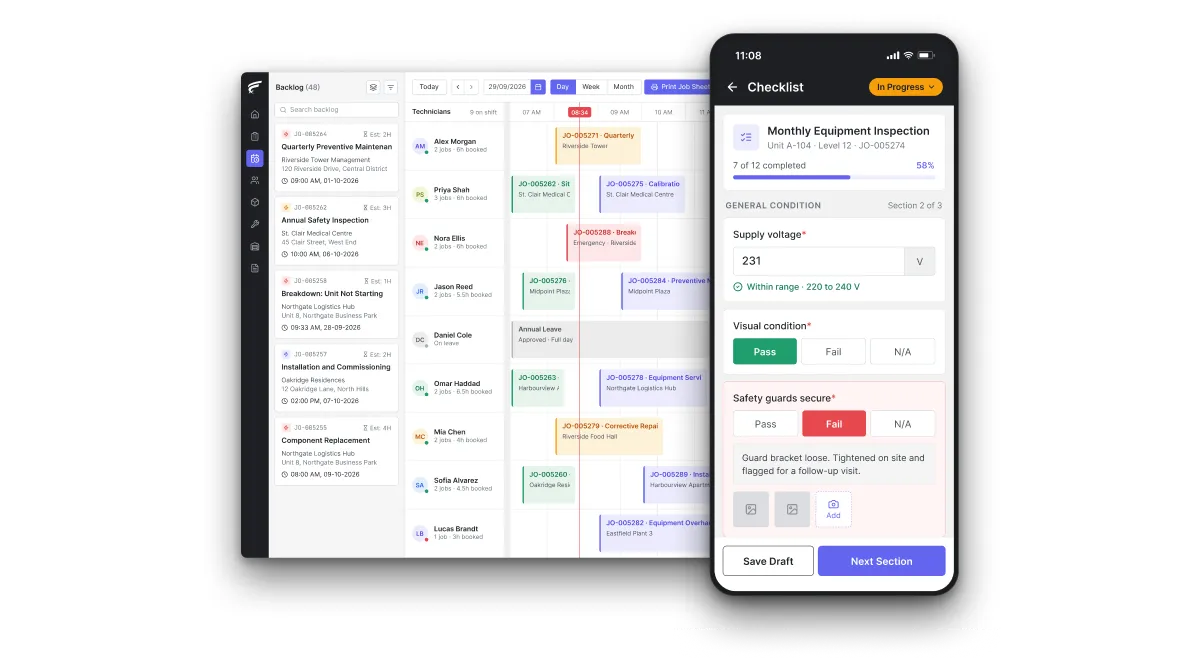
FieldEx scheduling board on desktop with a technician's inspection checklist open on the mobile app, as used by HVAC service teams

FieldEx is a field service and asset management (FSM+CMMS) application for Malaysian aircond and air-conditioning and mechanical ventilation (ACMV) teams. Every chiller, air handling unit (AHU), fan coil unit (FCU), cooling tower and VRF system has its own record, and so does every cold room. Planned preventive maintenance (PPM) runs by date or running hours. Certifications send reminders before their due date. Inspections record the result, who performed them and any remarks., and technicians close jobs with photos and a client signature.

What FieldEx does for aircond and ACMV contractors

ACMV contracts in Malaysia are measured visit by visit: monthly plant checks, six-monthly cleaning and yearly overhauls. Each one needs a signed record. FieldEx keeps that work on the unit it belongs to. Planned visits, breakdown calls, certificates and job sheets all point back to the same chiller or AHU. Book a demo and bring your equipment list.

One record per unit, from plant room to ceiling void

  • A record for every chiller, AHU, FCU, VRF unit and split unit.
  • Records for cooling towers, pumps and cold rooms too.
  • Each record holds the client and site, serial numbers and specifications, photos and warranty details.
  • Components kept under their parent unit in Asset Management. Compressors, pumps, fan motors and coils carry their own history.
  • QR or barcode labels printed for every unit. A scan opens the record and the right checklist.
  • Running-hour readings, attached manuals and drawings, and a change history of every edit.

PPM that follows the contract schedule

  • Maintenance plans that create the monthly, quarterly, six-monthly and yearly visits by themselves. Each visit has its own checklist and technician.
  • Triggers by calendar, running hours, or whichever comes first.
  • A fixed calendar, or a schedule that counts from the date the last visit was actually completed. Fixed calendar dates apply to time-based plans.
  • Overdue visits rescheduled automatically after a set number of days.
  • Plans in Preventive Maintenance that pick up newly installed units at covered sites. Every unit shows its last and next service dates.
  • Last and next maintenance dates on every plan and unit, in Preventive Maintenance.

Certificates, inspections and water tests

  • Recurring certifications for each unit in Compliance Documentation. Each holds its due date, repeat frequency, certifying authority and certificate file, and sends reminders.
  • Recurring inspections for leak tests, cooling tower water tests and indoor air checks. Each shows as due, overdue or completed, with the result, the person who did it and remarks.
  • Asset-matched checklists with sections and reference photos. Build them by hand, or generate them with AI from your existing checklist or procedure.
  • A failed answer raises the repair job.
  • Certifications can send reminders before the due date. Inspections are tracked on the asset record. A completed certification records the result, who performed it and any remarks. You can manually attach a certificate or report when marking it complete.

Breakdown calls and response times

  • Breakdown jobs matched automatically to a technician on skills, working hours, leave, service area and live location.
  • Backlog jobs dragged onto technician calendars. The technician is notified of every assignment or change.
  • Service-level agreements timed in business hours for each client and unit, with at-risk and violation alerts.
  • A repeat-job warning when a unit is called out again soon after its last job.
  • Faults reported by building staff through the client portal, or through a QR code at the unit with no login.

Technicians on site

  • Today's jobs, the unit's history and its checklist on the phone, opened by scanning the unit's label.
  • Jobs downloaded to the phone, so technicians can work without coverage in basements and plant rooms. Work syncs when they are back online.
  • Parts taken from the technician's own stock, watermarked photos with annotation, and the client's signature on completion, all on the FieldEx Mobile App.

Van stock and spare parts

  • Each technician's own stock, shown on the phone.
  • Stock moved between store and van by barcode scan, with approval where it is required.
  • Every transfer, adjustment and part used on a job kept in a movement history.
  • Reorder and low-stock alerts for each stock location, in Spare Parts Inventory.
  • Parts used recorded on the job and on the unit, with warranty periods kept on each part.

Your own recovery machines, gauges and vans

  • Your company's recovery and recycling machines, leak detectors, gauge sets and vacuum pumps kept as assets, each with its serial number and location.
  • Calibration and check due dates for each instrument, with reminders and the calibration certificate on the record.
  • Service vans on maintenance plans by date or odometer reading, with each van's road tax and insurance renewal as a recurring certification.

Contracts, client portal and job sheets

  • Maintenance contracts linked to the units they cover and the PPM plans that serve them.
  • A branded client portal. Clients see their equipment, last-serviced dates, upcoming maintenance and job progress, and download job reports.
  • A completion PDF created as each job closes. FieldEx emails it and records when it was sent.
  • The PDF holds the fault and resolution, parts, check-in and check-out times, attachments and the client's signature.
  • Unit reliability, cost and age reports, sent by email on a schedule or exported.

How often should a chiller plant be serviced in Malaysia?

Service a chiller plant every month, with a bigger service once a year. The Public Works Department (JKR) specification for water-cooled chillers requires a plant inspection at least once a month. Each visit records:

  • Motor amps and volts
  • Refrigerant pressures and temperatures
  • Chilled-water and condenser-water in and out temperatures
  • The load

Once a year, the technician changes the compressor oil and oil filter, tops up refrigerant as needed and leak-tests the system. Pumps are checked monthly, with noise and vibration recorded every 3 months.

What FieldEx does about it

The full year in one plan

One PPM plan can hold the monthly checks, the three-monthly pump readings and the yearly oil change. Each has its own checklist and technician, so month 12 opens the annual list without anyone switching templates.

Running hours alongside the calendar

Plans can trigger on running hours, on the calendar, or on whichever comes first. Each chiller can use its own meter interval, or the plan can use one interval for every unit. A technician's reading at the end of an inspection updates the unit.

Late visits don't squeeze the next one

A plan can keep a fixed calendar or count from the date the last visit was actually done. FieldEx reschedules visits left overdue past a set number of days.

The chiller and its parts

The chiller can sit as a parent asset, with its compressors, pumps, starter and controls as components. Each one keeps its own service and replacement history. For the monthly log JKR asks for, forms on the job add number fields for amps, volts, refrigerant pressures and water temperatures. The technician keys in the exact values on site, and each reading stays with that job.

What does aircond servicing for AHUs and FCUs involve?

Clean and inspect AHUs and FCUs every six months, and condensate trays every month. Those are the default intervals in the Department of Occupational Safety and Health (DOSH) Industry Code of Practice on Indoor Air Quality 2010, where the manufacturer sets none:

  • Every 6 months: inspect the mechanical ventilation and air-conditioning system, clean AHU fans and dampers, and clean cooling coils and condensate pipes.
  • Monthly: clean condensate trays.
  • After the first year, then at least every 2 years: check airflow, temperature and humidity against 23 to 26°C and 40 to 70% relative humidity.

JKR's specification adds monthly AHU filter and coil checks and a yearly coil jet-wash.

What FieldEx does about it

  • Monthly, six-monthly and yearly visits in one cycle: the plan creates each visit with the right checklist, from the monthly filter check to the yearly coil wash.
  • Every FCU on the plan: new units at a covered site join the plan when they match its criteria. A new FCU on level 12 isn't left off the PPM list.
  • Indoor air checks on schedule: the two-yearly airflow, temperature and humidity check runs as a 24-month certification with reminders. The readings report is attached.
  • Defects raised on the spot: a failed filter or blocked condensate answer creates the repair job and its tasks. It can also book a follow-up inspection.

How do you manage cooling tower servicing and water treatment records?

Check the tower monthly, service it every three months, and record a water test with each service. JKR's specification sets a monthly check of the fan and motor bearings, belt tension and float valve. Every 3 months, a service cleans the water screens and nozzles, flushes the tank when needed and treats the water against microbial growth, scale and corrosion. The field water test result is recorded. The DOSH indoor air quality code adds a six-monthly inspection wherever standing water could collect.

  • Filters, belts and bearings
  • Coil and drain pan condition, and condensate drainage
  • Electrical connections, controls and safety devices
  • For chillers, the refrigerant, oil and pressure checks

Standard 180 adds a documentation rule. Each task is documented and archived, with condition assessments and measurements recorded, and any degradation the technician sees is written down.

What FieldEx does about it

  • The tower as its own unit: cooling tower work stays on the tower's record, not mixed into the chiller's.
  • Monthly and three-monthly visits: the plan schedules both, each with its checklist.
  • Water test results on record: each three-monthly water test is a recurring inspection with its result and remarks. Record the inspection outcome and remarks on the tower’s inspection record. Capture water test readings on a custom job form, where each reading is recorded against the job.
  • Visible to the client: the building owner sees upcoming maintenance and downloads job reports from the Customer Portal.
  • Readings update the asset: completing an inspection can update the unit's status and its meter reading.

Does a chiller need a DOSH certificate of fitness?

Usually not the chiller package itself. The Occupational Safety and Health (Plant Requiring Certificate of Fitness) Regulations 2024 cover steam boilers, pressure vessels and lifting machinery. Each needs a certificate of fitness (CF), valid for 15 months from the inspection. Their Second Schedule excludes a pressure vessel that is a component of a chiller package used in a building. Other pressure vessels on the same site still need a CF unless excluded, with maintenance records of safety-device condition, repairs and alterations.

What FieldEx does about it

  • CF dates on the asset: record the CF on the pressure vessel’s asset record, with its due date and certifying authority. and the certifying authority.
  • Reminders before expiry: FieldEx sends them by email, in-app notification or both, so the re-inspection is booked in time.
  • The certificate kept with the unit: upload the CF and inspection report to the completed record. FieldEx notifies a chosen team when it's done.
  • Maintenance records alongside: repairs, parts and inspections sit on the same asset record, ready when DOSH asks.

What refrigerant rules apply to aircond servicing in Malaysia?

Only trained technicians may service equipment using refrigerant. Anyone trading, recycling or disposing of refrigerant keeps records for at least 3 years. Under the Department of Environment's (DOE) Environmental Quality (Refrigerant Management) Regulations 2020, the person servicing aircond and refrigeration equipment with refrigerant must have attended a certified refrigerant-handling course. Each refrigerant container carries a label showing its type. Anyone who trades, reclaims, recycles or disposes of refrigerant keeps inventories at the premises and submits an inventory report by 31 January each year.

  • United States: from 1 January 2026, the Environmental Protection Agency's leak repair rule (40 CFR 84.106) covers appliances with 15 pounds or more of hydrofluorocarbon (HFC) refrigerant. Above a 10% leak rate for comfort cooling, or 20% for commercial refrigeration, leaks are repaired within 30 days and verified twice.
  • European Union: the F-gas Regulation (EU) 2024/573 sets leak checks by the charge in CO2 equivalent. They are due every 12 months from 5 tonnes, every 6 months from 50 tonnes and every 3 months from 500 tonnes.

What FieldEx does about it

  • The right technician on refrigerant work: assignment rules can match jobs to technicians by skill, so refrigerant jobs go only to trained staff.
  • Who did the work, on every job: each job and inspection records the technician who completed it, against the unit.
  • Leak tests on schedule: each unit's leak test runs as a recurring inspection with its result, remarks and report attached.
  • Refrigerant logged in kilograms: set refrigerant up as a spare part measured in kg. Each job logs the amount used, takes it off stock and prints it on the completion PDF. The amount recovered goes in the job's resolution details.
  • Records for inspection: the unit's full job history can be exported or shared as reports when DOE asks.

What records should an ACMV maintenance contractor keep?

Keep a signed job sheet for every attendance, a written defect report, and a maintenance history for at least 5 years. JKR's specification asks for a service and maintenance record book in the plant room, and a Maintenance/Repair Sheet countersigned by the Superintending Officer at each attendance. Defects are reported in writing with their cause and a repair estimate. The DOSH indoor air quality code adds that records of all maintenance work are kept for at least 5 years.

Singapore's National Environment Agency (NEA) sets a similar rhythm for registered towers. Its rules ask for a monthly bacteria count, kept for 12 months, and a quarterly Legionella count reported to NEA.

What FieldEx does about it

  • The job sheet, signed on the phone: the client's representative signs on the technician's phone at completion.
  • The PDF goes out by itself: at completion, FieldEx produces a PDF, emails it and records when it was sent. It covers the job and equipment, addresses, the fault and resolution, and the work carried out. It also lists parts with quantities and prices, check-in and check-out times, attachments and the client's signature. Admins can design custom layouts to match a JKR or client format, and FieldEx can send the PDF automatically to anyone else who needs it.
  • The history log builds itself: every job, checklist, part and photo is kept on the unit's record. The equipment history log is always up to date.
  • Monthly reports on a schedule: build the monthly client report once in Reporting and Analytics, and FieldEx emails it automatically.

How do you keep cold rooms within food hygiene temperatures?

Keep chilled food between −1°C and 10°C and frozen food at −18°C, with a recording device accurate to ±1°C. The Food Hygiene Regulations 2009 under the Food Act 1983 set four storage rules:

  • Chilled food between −1°C and 10°C, and frozen food at −18°C
  • A temperature-recording device accurate to within ±1°C
  • Defrosting whenever necessary
  • Storage records kept for inspection

For a cold-room contractor, that means servicing coils, defrost, door seals and the temperature device on a schedule.

What FieldEx does about it

  • Each cold room on record: chillers, freezers and their condensing units each have their own history.
  • Servicing and device checks on schedule: the PPM plan books the coil, defrost and door-seal service. The temperature device's accuracy check runs as a recurring certification with reminders.
  • Faults found become jobs: a failed door seal or iced coil on the checklist raises the repair job on the spot.
  • A temperature log per room: each reading is saved as a meter reading on the cold room's asset record, which builds a timestamped history. Technicians key it in from the asset, or FieldEx prompts them when they finish the checklist.
  • Fast response when a room warms up: service-level agreements send at-risk and violation alerts, so breakdown response stays inside the agreed time.

How do you avoid missed PPM and repeat complaints on aircond contracts?

Create every PPM visit before it falls due, and catch a repeat call-out before the client does. JKR's specification requires at least monthly service and emergency repair when asked, so the client checks the visit schedule and call-out record.

  • Door gaskets, door sweeps and heated vents
  • Evaporator and condenser coils
  • Drain lines and defrost operation

A yearly visit adds electrical connections, refrigerant leak checks, and controls and alarms. The technician also reviews the temperature logs to plan replacements, and writes every finding against the unit it belongs to.

What FieldEx does about it

  • PPM visits created ahead: plans create the jobs before they are due and reschedule visits left overdue.
  • Repeat-job warning: when a unit is called out again soon after its last job, the team gets an email or in-app notification. The second call-out is checked before it becomes a complaint.
  • Response times tracked: service-level agreements can time each stage in business hours and alert supervisors when a job is at risk or in breach.
  • Contracts tied to units: each contract links to the units and PPM plans it covers.

How do large buildings tie ACMV maintenance to energy management?

Run a preventive maintenance system for the plant that uses the most energy, and keep its records ready for the energy manager. Since 1 January 2025, the Energy Efficiency and Conservation Act 2024 (EECA) has applied to buildings using 21,600 GJ or more in 12 months. They appoint a Registered Energy Manager and report every year. MS 1525, the Malaysian Standard for energy efficiency in non-residential buildings, recommends that the owner run a preventive maintenance system. It covers compressors, cooling towers, pumps, condensers and air handlers.

What FieldEx does about it

  • A PPM system the owner can show: every planned visit, its checklist and its outcome are recorded against the unit.
  • Running hours on record: meter readings and their history sit on each chiller and AHU.
  • Lifecycle figures: reports on each unit's reliability, maintenance cost and age support repair-or-replace decisions.
  • Manuals kept with the unit: attach the operation and maintenance manual and drawings to the asset record.

How do you send aircond technicians to breakdowns across several sites?

Send each call to a trained technician who is free and in the right zone, then choose the nearest and least busy. Refrigerant work goes only to technicians who have attended the DOE-certified course.

What FieldEx does about it

  • Automatic assignment: FieldEx matches the job to a technician on skills, availability and service area. It respects shifts and leave and uses live location.
  • Manual changes when needed: in Scheduling and Dispatch, dispatchers drag jobs onto calendars, reassign or reschedule. The technician is notified each time.
  • Faults reported from the unit: building staff scan a QR code at the unit to report a fault without logging in. The request arrives as a job.
  • Parts on the van: technicians check their own stock on the phone and request a transfer from the store before they set off.

Which rules apply to an aircond contractor's own recovery machines and test tools?

Use recovery and recycling machines built to a recognized standard, and keep every test tool on a calibration cycle. The Refrigerant Management Regulations 2020 require reclamation and recycling machines to meet AHRI 740, ISO 11650 or EN 35421. Gauges, thermometers and leak detectors follow the manufacturer's calibration interval. Use a laboratory accredited under Standards Malaysia's Laboratory Accreditation Scheme of Malaysia (SAMM) for traceable calibration certificates.

What FieldEx does about it

  • Your machines on record: each recovery machine, gauge set and leak detector can have its own asset record, with serial number, model and location.
  • Calibration dates that don't lapse: each instrument's calibration runs as a recurring certification. FieldEx shows each calibration as due or overdue, sends reminders and holds the certificate on file.
  • Vans on their own plans: each van's servicing runs on a maintenance plan by date or odometer reading, and its history stays on its record.
  • Available later: the client can download the job report from the customer portal whenever an auditor asks.

How often should HVAC leak detectors and test instruments be checked?

Check electronic leak detectors at least every 12 months. Under the EU's leak-checking rules, Commission Regulation (EC) No 1516/2007, portable gas detectors are checked every 12 months. Each must pick up a leak of 5 grams a year. Gauges, thermometers and other test instruments follow the manufacturer's calibration interval.

What FieldEx does about it

  • Your tools as assets: each leak detector, gauge set, recovery machine and vacuum pump can have its own record, with serial number and location.
  • Check dates that don't lapse: each instrument's yearly check runs as a recurring certification. FieldEx marks each detector or gauge set due or overdue, sends reminders and keeps its certificate on the instrument's record.
  • Vans on their own plans: each HVAC service van follows a maintenance plan by date or odometer reading, and its record keeps the service history.
Customer story

Royal Facilities Management runs facilities maintenance for properties in Oman on FieldEx. It's a different trade, but the same job: planned maintenance and breakdowns on every site's equipment. QR codes at each site take work requests and equipment faults, and maintenance work orders are created automatically by time and equipment. "A lean team of three can now manage multiple sites smoothly."

Read the Royal Facilities Management Story

DKSM is a mechanical, electrical and plumbing (MEP) and fire safety contractor in Malaysia. It uses FieldEx to automate compliance scheduling and inventory tracking across 300+ client sites. Maintenance reminders and work orders follow each account's schedule, and team leads log parts on their phones.

Read the DKSM Story

Questions aircond and ACMV contractors ask about FieldEx

Which software do aircond contractors in Malaysia use for PPM and breakdowns?

Contractors with chiller plants and multi-site contracts need one system for the unit history, PPM, certificates and signed job sheets. FieldEx keeps service jobs and maintenance on the same unit record. See how it compares in the FieldEx guide to Field Service Management Software.

Can FieldEx remind us before a DOSH certificate of fitness expires?

Yes. Record the CF as a recurring certification on the pressure vessel, with a 15-month frequency. FieldEx sends reminders before it falls due, by email, in-app notification or both. The certificate file is kept on the completed record.

Can the client's building manager sign the job sheet on site?

Yes. The client signs on the technician's phone when the job is completed. FieldEx then emails the completion PDF to the client and records when it was sent.

Can we schedule chiller PPM by running hours?

Yes. Each chiller's running hours are logged as meter readings, and the next PPM falls due when they reach the plan's interval. A plan can also run on time and hours together, whichever comes first.

Can FieldEx record cooling tower water test results?

Yes. Set the water test as a recurring inspection on the tower. Each test records the result, remarks and who did it, with the water treatment report attached.

Can tenants or building staff report an aircond fault by QR code?

Yes. Building staff scan the QR code on the unit or at the site, describe the fault and add photos or video. They submit it without logging in, and it arrives in FieldEx as a job ready to assign.

Can FieldEx track chiller and cold-room warranties?

Yes. Each unit's record holds its warranty details, and each spare part holds its warranty period. The office knows what is still covered before quoting a repair.

Can technicians use FieldEx without mobile coverage?

Yes. Jobs and tasks can be downloaded and worked offline, with check-in, check-out and travel synced later.

What languages is the FieldEx app available in?

Technicians can use the FieldEx web and mobile apps in English, Bahasa Malaysia or Chinese, whichever they read best.

How long does it take to get FieldEx running?

There's no setup fee. Once we know your requirements and your data is ready, FieldEx can be implemented in as little as a week with standard features for small businesses. Larger setups and custom work take longer. Units can be uploaded. FieldEx helps with setup, and training is included. Onboarding is in person in Malaysia as well as online. See Setup and Training.

How does setup, implementation and training work?

There's no setup fee. Once we know your requirements and your data is ready, FieldEx can be implemented in as little as a week with standard features for small businesses. Larger setups and custom work take longer. Units can be uploaded. FieldEx helps with setup, and training is included. See Setup and Training.

Run your ACMV contracts and PPM in FieldEx

Book a Demo