Farm equipment maintenance software for Malaysian plantations and palm oil mills

Keep mill boilers and sterilizers inside their CF dates and lorries ahead of PUSPAKOM. Service every tractor, pump and genset on time.

Book a demo
Updated 16 Oct 2026
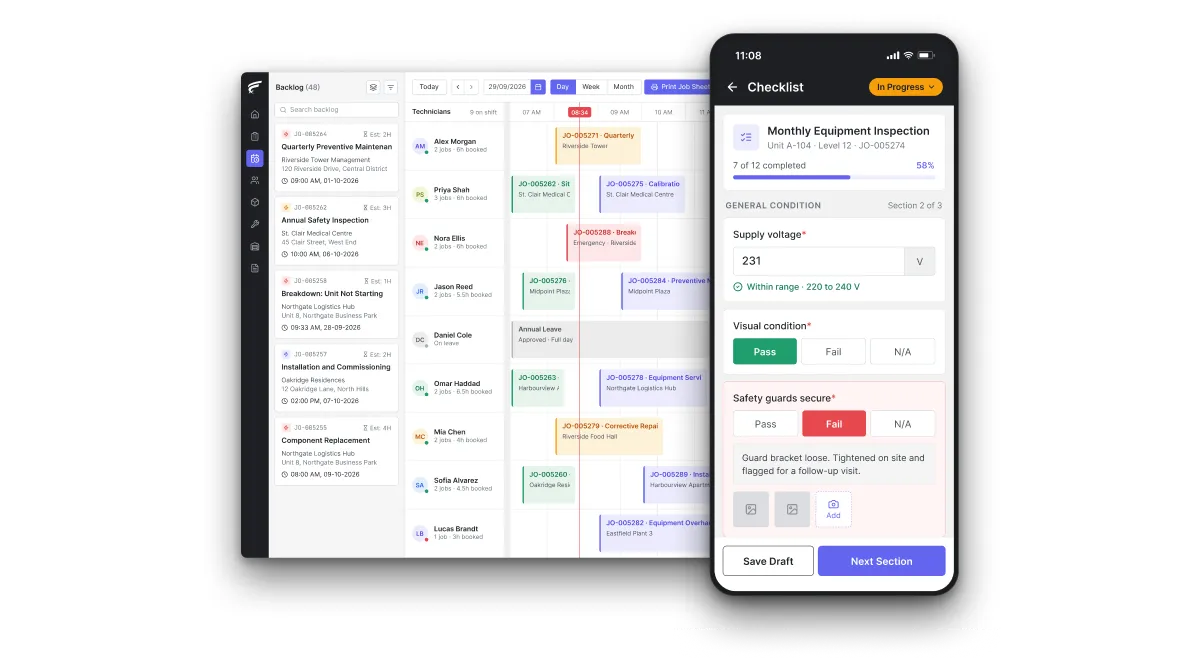
FieldEx scheduling board on desktop with a technician's inspection checklist open on the mobile app, as used by estate and mill maintenance teams

FieldEx is a field service and asset management (FSM+CMMS) application for Malaysian plantation groups, estates and palm oil mills. It records every boiler, sterilizer and weighbridge by estate or mill, and every tractor, lorry and pump too. FieldEx runs planned preventive maintenance (PPM) on hours or dates and tracks DOSH certificates and PUSPAKOM due dates. It sends mechanics to breakdowns with the parts they need.

What FieldEx does for plantation and mill maintenance teams

A plantation group answers to several bodies at once:

FieldEx keeps the work behind each of those on the machine's own record. The PPM, the breakdown and the certificate for each boiler or lorry sit in one place. Book a demo to see it with your own estates and mills.

Mills, estates and machinery under one register

  • One site per mill, estate, division or central workshop. Each site holds its map pin, contacts and service zone, plus the machines and PPM plans attached to it.
  • One asset per boiler, sterilizer, screw press, weighbridge or genset in Asset Management.
  • One asset per water pump, tractor, lorry and excavator as well.
  • Serial numbers, photos, warranty and drawings on each asset.
  • Components under their parent, such as a sterilizer and its door, gasket and safety valve, each with its own history.
  • A QR or barcode sticker on every machine, and a log of each edit with the user and the time.
  • Machines grouped by asset type, with a default meter unit per type, such as engine hours for tractors and distance for lorries.

PPM by running hours, kilometers or date

  • PPM plans that raise jobs on their own. A job is raised when the hour meter, the odometer or the date says a machine is due, or on whichever comes first.
  • Separate checklists and mechanics for the minor service and the major overhaul in the same cycle.
  • A fixed calendar or a schedule counted from the last completed service. Missed PPM moves forward after a set overdue period. Fixed calendar dates apply to time-based plans.
  • One plan covering every estate in Preventive Maintenance. The plan adds new tractors or pumps that fit its criteria.
  • One plan applied across many estates in Preventive Maintenance. The plan picks up new machines that match its criteria.

DOSH, PUSPAKOM and calibration dates

  • Recurring certifications per asset type on standard frequencies, such as a six-monthly PUSPAKOM inspection. The certifying body is recorded.
  • Each due date shown as due, overdue or done, with reminders by email, in the app or both.
  • The inspector, date, result and remarks on each record, plus a copy of the certificate, in Compliance Documentation.
  • A dashboard of what is overdue, what falls due in the next 7 days and what was closed in the last 7 days. It filters by mill or service zone.

Breakdowns and inspection findings

  • Inspection checklists per machine type, with single-select answers grouped into sections. Mechanics start one by scanning the machine's sticker.
  • A failed answer that opens the repair work order and its tasks, and can schedule a follow-up inspection.
  • A QR code for each mill or estate office. Staff report a fault with photos or video without logging in, and the report lands in the backlog.
  • Jobs given to mechanics by skill, shift and leave, plus service zone and live location.
  • A drag-and-drop scheduler in Scheduling and Dispatch.

Mechanics working in the field

  • The FieldEx Mobile App in English, Bahasa Malaysia and Chinese.
  • The machine's past repairs, its checklist and number fields for readings such as pressure or hour meter, on the phone.
  • Jobs and tasks can be downloaded and worked offline, with check-in, check-out and travel synced later.
  • Watermarked photos and video, and a sign-off signature when the job is finished.
  • Travel to each job logged with its distance and duration, viewable on a map.

Parts in the mill store and the workshop van

  • Spare parts held per mill store, estate workshop and each mechanic's van stock.
  • Transfers, barcode scanning and approvals where needed.
  • Reorder and low-stock alerts for each location, in Spare Parts Inventory.
  • Every part used logged on the job and on the machine, with a full movement history.

Your own workshop, service lorries and tools

  • Workshop cranes, compressors, welding sets and lathes on record as assets with their own PPM plans.
  • Service lorries on PPM by date or odometer reading, with each mechanic's van stock alongside.
  • Pressure gauges, torque wrenches and test tools with calibration due dates and reminders.
  • Parts used recorded on the job and on the machine, with a movement history of every transfer and part fitted.

Job sheets and maintenance reports

  • A job sheet PDF for every finished job with the machine, fault, fix, parts and prices.
  • Time on site and sign-off on the same job sheet, with photos attached to the job.
  • Reports on breakdowns, PPM done against PPM due, maintenance cost and machine age, in Reporting and Analytics.
  • Reports by mill, estate or period, exported or emailed on a timetable.
  • Access limited by estate or region. Each team sees its own machines, and managers see the whole group.

Machine histories and reports

  • Every service, check, examination, repair and part kept on the machine's record.
  • A change history showing who edited what and when.
  • Completion PDFs with the machine, the fault and resolution, and parts with quantities and prices.
  • Each PDF also shows time on site and the signature, and photos stay attached to the job. It is emailed, with a record of when it was sent.
  • Reports on machine reliability, maintenance cost, utilization and age, in Reporting and Analytics.
  • Reports exported as CSV, Excel or PDF, or emailed on a schedule.

Do palm oil mill steam boilers and sterilizers need a DOSH certificate of fitness?

Yes. Steam boilers and pressure vessels such as sterilizers need a certificate of fitness (CF), valid for 15 months from the date of inspection. The Plant Requiring Certificate of Fitness Regulations 2024, P.U.(A) 99/2024, came into operation on 1 June 2024. Every steam boiler must be available for internal inspection at each periodical inspection. So must every pressure vessel, unless it was designed not to be internally inspected. Under the Special Scheme of Inspection Regulations 2025, P.U.(A) 25/2025, a CF can be valid for up to 60 months.

  • Every 10 hours or daily: check the engine oil, coolant and air filter indicator, and grease the fittings.
  • Every 100 hours: change the engine oil and filter.
  • Every 500 hours: replace the fuel filter and change the transmission oil.

What FieldEx does about it

  • A CF on every vessel: each boiler and sterilizer carries its CF as a recurring certification. DOSH is recorded as the certifying authority, and the due date sets the reminders.
  • Shutdowns planned early: reminders go out ahead of each CF expiry. The mill can fit the internal inspection into its processing schedule.
  • Preparation as a job: the cleaning and opening-up work before the inspector arrives runs as its own job with ordered tasks.
  • Certificates on file: the CF and the inspection report are attached to the completed record on the vessel.

Who must be in charge of a mill steam boiler in Malaysia?

A certified steam boiler operator or engineer, graded by the boiler's heating surface. The Twelfth Schedule of the 2024 CF regulations sets the grades:

Heating surface (single or combined)Person in charge
100 m² or lessOperator grade 2
Over 100 to 200 m²Operator grade 1, on each shift
Over 200 to 500 m²Operator grade 1, plus engineer grade 1 or 2 (can be visiting)
Over 500 to 2,000 m²Engineer grade 1 or 2
Over 2,000 m²Engineer grade 1

What FieldEx does about it

  • Boiler jobs to certified people: boiler work orders can require a matching skill, such as "steam boiler engineer grade 1". FieldEx offers them only to people holding it. Skills can be named after any DOSH competency grade and carry an expiry date.
  • Heating surface on the record: each boiler's asset record stores its specifications, including its heating surface. The grade it needs is clear.
  • Who ran each check: every boiler inspection and repair records the person by name. Repair jobs also record check-in and check-out times.
  • The machine marked out of use: the checklist can update the tractor's status. A supervisor can see it should not go out until it is repaired.

What should be inspected on a sterilizer door in a palm oil mill?

Check the alignment of door, locking ring and shell, every door component and every safety device, and get DOSH approval for any repair. DOSH's safety alert on a sterilizer explosion lists the checks. Inspect the alignment while the door is being opened and closed. Inspect and maintain every door component, especially the adjuster bolt and bearing. Do the same for the gasket, safety interlock, safety valve and door alignment. DOSH must approve any modification or repair, and a competent person and firm must carry it out.

What FieldEx does about it

  • A door checklist per sterilizer: the operator scans the sterilizer's sticker. The operator then answers questions on alignment, the locking ring and the gasket, plus the interlock and safety valve.
  • Door parts as components: the door, locking ring and safety valve can sit as components under each sterilizer. Each has its own repair history.
  • A failed check stops the line: a fail answer raises a corrective job and can change the sterilizer's status. Supervisors see it should not be used.
  • Repairs with their approvals: the DOSH approval and the competent firm's report are attached to the repair job on the sterilizer.

What maintenance records do MSPO and MPOB expect from a palm oil mill?

Plan and record maintenance for all equipment, including portable units, and keep records of how SOPs are followed. MPOB launched the third edition of its Code of Good Milling Practice on 11 August 2026. Its public-comment draft says maintenance activities shall be planned and recorded for equipment and devices, including portable units. The Malaysian Palm Oil Certification Council's (MPOCC) guidance on MSPO Part 4-1 asks mills to set standard operating procedures (SOPs) that specify responsibilities. Mills also keep records of how they put the SOPs into practice.

What FieldEx does about it

  • The plan and the record together: each machine's PPM plan shows its last and next service, and every job it generated, done or overdue.
  • SOPs as job procedures: your SOP steps become ordered tasks in the job template, each with an owner. The record shows who did which step.
  • Portable units included: portable pumps, welding sets and gensets are assets too, with their own plans and histories.
  • Evidence on demand: reports of PPM done against PPM due, by mill and period, export to Excel or PDF for the auditor.

How often must mill weighbridges and measuring instruments be calibrated?

Calibrate the weighbridge every year through an accredited body, and other instruments periodically, and record the result. MPOB's draft Code of Good Milling Practice says the weighbridge shall be calibrated annually by an accredited competent authority. It adds that measuring, regulating and recording equipment shall be periodically calibrated, recorded and maintained. That applies where it may affect quality, the environment, health or safety. Under the MPOB (Licensing) Regulations 2005, using or holding an inaccurate weighing or measuring instrument for trading oil palm products is an offence.

What FieldEx does about it

  • Calibration as a certification: each weighbridge carries a yearly calibration, and each scale and instrument its own interval. The calibration body is recorded.
  • Certificates attached: the calibration certificate is stored with the completed record on the instrument.
  • Nothing slips: due and overdue calibrations appear on the dashboard with reminders, filtered by mill.
  • Adjustments and repairs logged: any repair to a load cell or indicator is a job on the weighbridge's own history.

How often must a competent person inspect a palm oil mill's electrical installation?

A competent person must inspect at least once a month, or at least twice a month for installations above 600 volts and up to 11,000 volts. The Electricity Regulations 1994 set the monthly visit for installations up to 600 volts supplied through switchgear of 100 amperes or more. Installations above 600 volts and up to 11,000 volts need at least two visits a month. Under regulation 67, the visiting competent person is an Electrical Services Engineer, Competent Electrical Engineer or Electrical Supervisor. Above low voltage, only the two engineer grades can visit.

What FieldEx does about it

  • Visits on the right count: each switchroom or substation gets a PPM plan for its monthly or twice-monthly competent-person visits.
  • The right competent person only: the visit's job type requires its matching skill, so it reaches only your registered electrical supervisor or engineer.
  • Readings and defects recorded: switchboard and motor readings go in number fields on the job form. A defect opens a repair job.
  • Guards as parts: replacement guards and shields are stocked spare parts. Each has reorder alerts and a record of where it was fitted.

How should estate machinery be locked out during maintenance?

Use approved lock-out and tag devices, and keep guards on until the machine is stopped and isolated. DOSH's Guidelines on Occupational Safety and Health in Agriculture (2002) say these devices stop anyone starting machinery by accident during maintenance. All energy sources are neutralized first. As an international reference, the UK Health and Safety Executive's INDG241 also has all power sources isolated in its Safe Stop procedure.

What FieldEx does about it

  • Lockout written into the job: templates for mill and estate repairs open with the isolation steps as ordered tasks. Typical steps are stop and isolate, then lock, tag and test.
  • Steps that cannot be skipped: a procedure can require each task to be finished before the next begins and before the work order closes.
  • A record of who isolated what: the mechanic checks in and out of each step on the phone. The job history shows when the lock went on and came off.
  • The right checklist for each machine: each machine type has its own isolation questions. A combine, a feed mixer and a conveyor each get the steps that fit them.

What checks do DOSH guidelines expect on estate pumps, compressors and electrical equipment?

Check the guarding on compressors, pumps, motors and augers, and keep electrical equipment in good condition and regularly maintained. The DOSH agriculture guidelines ask for guarding checks on compressors, pumps, electric motors and grain augers. Employers also keep these items in good condition and regularly maintained:

  • electrical fittings, fixtures, plant and equipment
  • wiring, insulation and switches
  • power cords, plugs and earth wires
  • guarding and welding equipment.

What FieldEx does about it

  • A round per estate: a site PPM plan for each estate raises the guarding and electrical round on its own date. The round's job goes to the estate's assigned mechanic.
  • Each pump on its own record: pumps, compressors and motors are assets with stickers. The mechanic scans each one and records its result.
  • Faults become repairs: a frayed cord, missing earth or broken guard marked as a fail creates a repair job straight away.
  • Rounds you can prove: managers can report completed rounds and their answers by estate and export them for the safety committee.

How often should estate tractors be serviced?

Service estate tractors by the hours in the manufacturer's manual, not by the calendar alone. Penn State Extension in the US says the operator's manual for a new tractor sets the hours between maintenance intervals. John Deere's international 4100 operator's manual is one example. It lists daily or 10-hour checks and an engine oil and filter change every 100 hours.

What FieldEx does about it

  • Hour-meter PPM: each tractor's plan triggers on its hour-meter readings, on a date, or on whichever arrives first.
  • Readings entered in the field: drivers or mechanics key in the hour meter on the phone. The reading history moves the next service.
  • Model defaults: each tractor model's asset type holds its meter unit and service frequency. New units join the right plan.
  • Daily checks in the app: the driver's daily check is a checklist on the tractor. Any fail opens a repair job for the workshop.

Do estate lorries need PUSPAKOM inspection?

Yes, if they're registered as commercial goods vehicles: once a year in the first 2 years, then every 6 months. PUSPAKOM says the Road Transport Act 1987 requires all commercial vehicles to undergo a routine inspection every 6 months. APAD's safety code for goods vehicle operators checks that new vehicles go once a year until they are 2 years old.

What FieldEx does about it

  • A PUSPAKOM date per lorry: each lorry carries its routine inspection as a recurring certification. It is set yearly for new vehicles and six-monthly after that.
  • Reminders before the slot: reminders go out in advance. The workshop services the lorry and books it in before its date.
  • Service by kilometers: lorry PPM plans can run on odometer readings. The pre-inspection service falls due on distance as well as date.
  • Results on the record: the inspection result and any repairs needed to pass are kept on the lorry's history.

How often must a palm oil mill report effluent results to the DOE?

Every quarter, within 14 days after the quarter ends. The Crude Palm-Oil Regulations 1977, P.U.(A) 342/77, require that quarterly return to the Director General. The mill samples and measures palm oil mill effluent (POME) flow on a set timetable. It need only do so on any one day in each of the weeks or months in the regulations' schedule.

What FieldEx does about it

  • Sampling days on a plan: a recurring plan on the effluent treatment plant raises the sampling and flow-measurement job on each scheduled day. The job has its own checklist.
  • Readings and lab reports kept: flow readings go into number fields. The lab report is attached to the completed job.
  • The return on the calendar: a recurring job falls a few days after each quarter end. It reminds the environmental officer to file the return within the 14 days.
  • Kept beyond the next inspection: each new check adds to the machine's history instead of replacing the last one. Earlier results are still there when someone asks for them.

Does changing mill machinery need DOE approval?

Yes, if the change would make the effluent worse: it needs the Director General's prior written approval. Under the 1977 crude palm oil regulations, that covers any change of, to or in any plant, machine or equipment at the premises. MPOCC's guidance on MSPO Part 4-1 adds that the mill should update its environmental assessment whenever process, equipment or technology changes.

What FieldEx does about it

  • Every change logged on the asset: the mill adds or retires new and replaced machines on its register. Each record's edit history shows who changed what and when.
  • Approvals attached: the DOE approval letter and the updated assessment are attached to the asset or the installation job.
  • The old machine's history kept: a replaced press keeps its full repair record after its status changes to retired.
  • Who did each check: every completed check records the person by name. Supervisors can see who checked each machine and when.

Do workshop overhead cranes and hoists need a certificate of fitness?

Yes, if they are powered. Lifting machinery, including overhead traveling cranes, mobile cranes and hoists, is plant requiring a CF, valid for 15 months from inspection. Manual lifting machinery is excluded. Regulation 3 of the 2024 CF regulations lists lifting machinery alongside steam boilers and pressure vessels. Its definitions describe an overhead traveling crane as a crane with a girder that raises and lowers loads and moves on a fixed runway. The 15-month validity comes from regulation 5(6).

What FieldEx does about it

  • A CF on each crane and hoist: each workshop or mill crane carries its CF as a recurring certification, with DOSH recorded.
  • Reminders before expiry: reminders go by email, in the app or both, so the inspection is booked in time.
  • Slings and hooks on record: lifting tackle can be assets with their own inspection dates and results.
  • Workshop machines on PPM: compressors, welding sets and lathes run on their own PPM plans.
Customer story

Agri Sumber Prestari (ASP) is an agricultural manpower and training company under SD Guthrie Agri Bio. It runs 92 agricultural estates on FieldEx. Its story covers centralized operational data and preventive maintenance scheduled on usage or time. Work orders and inspection checklists are generated automatically, and job progress and stock levels are live. Planning time fell by 50%. A region's plan that once took a full day is now done in half a day.

Read the Agri Sumber Prestari Story

What plantation and mill engineers in Malaysia ask about FieldEx

Which maintenance software suits a Malaysian plantation group with mills?

Look for software that holds every mill and estate machine and tracks DOSH CF, PUSPAKOM and calibration dates. FieldEx does this in one system, as described above. See our guide to the Best CMMS Software.

Can FieldEx remind us before a boiler or sterilizer CF expires?

Yes, as the CF section shows. Reminders go by email, in the app or both, early enough to plan the shutdown.

Can we track PUSPAKOM dates for the whole estate fleet?

Yes, as the PUSPAKOM section shows. The dashboard lists which lorries are overdue or due in the next 7 days.

Can mechanics use FieldEx in estates with no phone coverage?

Yes. Jobs and tasks can be downloaded and worked offline, with check-in, check-out and travel synced later.

Can one system cover several mills, estates and regions?

Yes. Access can follow your regions, so an estate team sees its own machines and head office sees the whole group.

Can FieldEx schedule weighbridge calibration and electrical inspection visits?

Yes, as the calibration and electrical sections show. Both appear on the maintenance dashboard, filtered by mill.

Can we see spare parts across the mill store and workshop vans?

Yes. Transfers between the mill store and workshop vans can need approval, and each one is kept in the movement history.

Can FieldEx show which estates have the most breakdowns?

Yes. Reports group jobs by estate, machine type or period and split breakdowns from planned work. They also show maintenance cost per machine.

How soon can our estates and mills be running on FieldEx?

There's no setup fee. Once we know your requirements and your data is ready, FieldEx can be implemented in as little as a week with standard features for small businesses. Larger setups and custom work take longer. Estates and machines can be uploaded. FieldEx helps with setup, and training is included. Onboarding is in person in Malaysia as well as online. See Setup and Training.

What does it take to get FieldEx running across our estates?

There's no setup fee. Once we know your requirements and your data is ready, FieldEx can be implemented in as little as a week with standard features for small businesses. Larger setups and custom work take longer. Estates and machines can be uploaded. FieldEx helps with setup, and training is included. See Setup and Training.

Keep every mill vessel, estate tractor and lorry on schedule

Book a Demo