Building services software for Malaysian M&E contractors, from switchroom to rooftop

Keep each client's switchrooms, boilers, lifts, fire systems and ACMV plant on record, plan every competent-person visit and send signed job sheets the same day.

Book a demo
Updated 16 Oct 2026
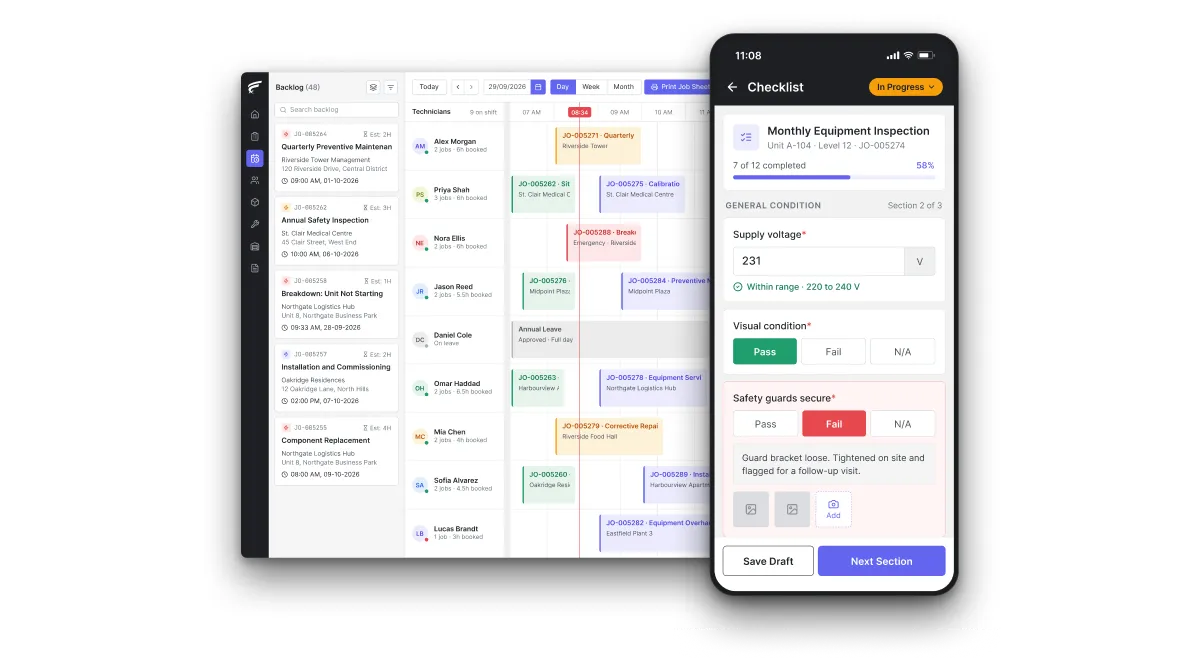
FieldEx scheduling board on desktop with a technician's inspection checklist open on the mobile app, as used by building services engineers

FieldEx is a field service and asset management (FSM+CMMS) application for Malaysian mechanical and electrical (M&E) maintenance contractors. Each client building's plant has its own history. FieldEx schedules planned preventive maintenance (PPM), competent-person visits, certificate of fitness renewals and Bomba deadlines. It times breakdowns against the contract and sends job sheets out signed.

What FieldEx does for Malaysian M&E contractors

An M&E contractor in Malaysia answers to its client and to several regulators at the same time. Suruhanjaya Tenaga (ST) oversees the electrical installation. The Department of Occupational Safety and Health (DOSH) covers boilers, pressure vessels, lifts and indoor air quality. Bomba covers the fire certificate. FieldEx holds all of that on the plant itself. The visit, the reading, the defect and the certificate for each switchboard or chiller sit in one place. Book a demo and bring one of your current contracts.

Each client's plant, one record per item

  • Clients as customers, with each building, tower or development as a site.
  • Each site holds the address, map pin, contacts and service zone.
  • One asset for each main switchboard, transformer, genset and boiler.
  • One asset for each pressure vessel, chiller, air handling unit, fire pump and lift.
  • Nameplate details, serial number, photos, warranty and attached drawings on each asset, in Asset Management.
  • Parent and component levels, such as a chiller plant with its chillers, pumps and cooling towers, each keeping its own history.
  • A QR or barcode sticker on each item, so the technician scans it to open the record, the checklist or a new job.

PPM per contract schedule

  • Asset PPM and site PPM plans that raise the jobs by themselves, with separate checklists and technicians for monthly, quarterly and yearly visits.
  • Frequencies by day, week, month or year, fixed to the calendar or counted from the last visit.
  • Presets such as every two weeks and every 3 years.
  • Genset and chiller PPM by running hours, by date or whichever comes first, in Preventive Maintenance.
  • A missed PPM rescheduled automatically after a set overdue period, and one plan copied across all the buildings on the contract.
  • One plan applied across many client buildings, picking up new plant that matches its criteria and rescheduling missed visits after a set overdue period.

CF, Bomba and ST deadlines

  • Recurring certifications and inspections per asset type on set frequencies, with the authority that certified each one.
  • Certifications can show due, overdue and completed status, with reminders before the due date. Inspection records show the completion date, result and linked checklist.
  • The date, the competent person, the result, remarks and a copy of the certificate or report, through Compliance Documentation.
  • A dashboard of overdue items and those falling due in the next 7 days, by service zone or asset type.

Breakdown complaints against the contract

  • Complaints from your helpdesk, from the client's branded portal, or from occupants through a site QR code without logging in.
  • Each complaint arrives time-stamped in the backlog.
  • SLAs use business-hours calendars and timed steps with at-risk and violation alerts. They can apply to all customers or selected customers, with optional asset scoping, or match job conditions.
  • A notice when a new breakdown repeats a recent job on the same asset, so the repeat is caught before the van leaves.

Technicians, chargemen and van stock

  • Jobs offered by skill, availability, shift and leave, and by service zone and live location. Chargeman work reaches chargemen.
  • A drag-and-drop scheduler in Scheduling and Dispatch.
  • The FieldEx Mobile App on every technician's and chargeman's phone.
  • The plant history, the checklist and number fields for readings on the phone, plus watermarked photos and the client's signature.
  • Jobs and tasks can be downloaded and worked offline, with check-in, check-out and travel synced later.
  • Each technician's van stock and each store tracked, with transfers, reorder alerts and parts booked to the job, in Spare Parts Inventory.

Your own vans, access equipment and meters

  • Company vans, scissor lifts, chain blocks and test meters on record as your own assets, each with its serial number and who holds it.
  • Vehicle inspections, thorough examinations and meter calibrations as recurring certifications, with reminders ahead of each due date.
  • Service plans for vans by date or odometer reading, and for workshop machinery by date.

Job sheets, contracts and monthly reports

  • Maintenance contracts with start and end dates, linked to the plant and PPM plans they cover.
  • A job sheet PDF for every job, with a record of when it was emailed.
  • Each job sheet shows the equipment, the fault, the fix, and parts and prices. It also shows time on site, photos and the client's sign-off.
  • Monthly reports in Reporting and Analytics of PPM done against PPM scheduled, SLA performance, breakdowns per asset and maintenance cost per client.
  • Reports exported or emailed on a timetable.

Contracts, service reports and client reporting

  • Maintenance contracts with start and end dates, linked to the plant and maintenance plans they cover.
  • A service report PDF for each visit, emailed with a record of when it was sent.
  • Each report shows the equipment, the fault and resolution, and parts and prices. It also holds time on site, photos and the client's signature.
  • Reports in Reporting and Analytics on PPM completed against scheduled, response times, asset reliability and maintenance cost per client. Reports can be exported or emailed on a schedule.

FieldEx also runs this kind of work for Electrical Contractors, Property, Strata & Building Management, Facilities, Building Management and Cleaning, HVAC, Fire, Security and CCTV and Elevator & Escalator.

How many competent-person visits a month does each client's switchroom need?

It depends on the voltage and the incoming switchgear. Regulation 67 of the Electricity Regulations 1994 sets the minimum, as published by Suruhanjaya Tenaga (the Energy Commission). Take an installation of up to 600 volts that receives electricity through switchgear rated at 100 amperes or more. It needs at least one inspection visit a month. An installation above 600 volts and up to 11,000 volts needs at least two visits a month.

What FieldEx does about it

  • A PPM plan per switchroom: each low-voltage or high-voltage installation gets its own plan, monthly or twice monthly, so no visit falls through.
  • Visits to the right competent person: the job type carries its required skill, and automatic assignment offers it only to an electrical supervisor or engineer who holds it.
  • Proof of each visit: check-in and check-out times, checklist answers and photos are stored on the job against the switchboard.
  • One cycle, several visit types: a single plan can hold a different checklist and engineer for the monthly, quarterly and annual visits.

What inspection report must the competent person give, and what record book must the owner keep?

A written report within 2 weeks of each inspection, kept in a record book open to Suruhanjaya Tenaga. Under regulation 68 of the Electricity Regulations 1994, the competent person must give an inspection report within 2 weeks of the inspection. The report covers findings, recommendations and instructions on the installation. The records and reports must be kept in a book that is open to inspection by Suruhanjaya Tenaga at all times.

What FieldEx does about it

  • The report built from the visit: findings and recommendations entered on site appear on the job sheet PDF, generated when the job is completed.
  • Sent and tracked: the job sheet is emailed to the client from the job, with a log of when it went out.
  • The full run on file: every visit's report stays on the installation's asset record. The book can be printed or exported for an ST audit.
  • Defects followed up: instructions that need work become corrective jobs, linked to the visit that raised them.

Which registrations must an M&E maintenance contractor hold before taking on building work?

CIDB registration for the company, and Suruhanjaya Tenaga registration for electrical work. The Construction Industry Development Board (CIDB) says every contractor, local or foreign, must register with it under section 25 of Act 520 (amended 2011). For electrical work, Suruhanjaya Tenaga registers electrical contractors by category under the Electricity Regulations 1994.

What FieldEx does about it

  • Skills on every technician: each technician's competencies, such as wireman or chargeman, sit on their profile as skills used by automatic assignment.
  • Jobs that need a license go to licensed people: electrical, gas and lift jobs require their matching skill before they are offered.
  • Company documents where they are needed: registration certificates can be attached to the client's customer record or project for tender submissions. Each technician's competency certificates are tracked too, with their own renewal schedule, due dates and automatic reminders.
  • Defects closed out: record the failed result on the inspection. Track repair work in a separate job.

How far ahead must the Perakuan Bomba renewal for a client's building be lodged?

At least 30 days before the yearly certificate expires. Section 28 of the Fire Services Act 1988 makes the fire certificate for designated premises renewable every year. Regulation 4 of the Fire Services (Fire Certificate) Regulations 2001 requires the renewal at least 30 days before expiry, on the Third Schedule form. Section 32 of the Fire Services Act 1988 covers the time while the certificate is in force. In that period, the Director General may have any part of the premises inspected at any reasonable time.

What FieldEx does about it

  • A 12-month certification per building: the Perakuan Bomba sits on the building's main fire panel as a yearly certification. Reminders go out well before the 30-day cut-off.
  • The fire systems on their own PPM: sprinkler pumps, hose reels, hydrants, alarm panels and extinguishers each run on their own inspection schedule.
  • Ready for a spot inspection: the dashboard shows any overdue fire item, by building, at any time of the year.
  • Technicians record readings on the job form or as meter readings on the asset. A certificate or report can be attached to a completed certification.

What does Bomba need to see before it issues the fire certificate?

Adequate fire-fighting equipment and fire safety installations, all in good working condition. Section 29 of the Fire Services Act 1988 sets the test for the fire certificate. The Director General issues it on being satisfied that the designated premises have adequate fire-fighting equipment or fire safety installation for their use. Bomba's customer charter adds a timeline: the certificate is issued within 5 days of the fee being paid. All designated premises must hold a fire certificate.

What FieldEx does about it

  • System-by-system status: each fire safety installation is an asset with its own last inspection, result and open defects.
  • Pre-inspection checklist: a site inspection before the Bomba visit walks every system, and each failed answer raises its repair.
  • Evidence for the officer: service records, test results and photos for each system can be shown from the phone or printed as job sheets.
  • The log, on the generator: every exercise, test, service and repair stays on the generator's asset record, ready to show an inspector.

How long is a certificate of fitness for a steam boiler or pressure vessel valid?

Fifteen months from the date of inspection. The Occupational Safety and Health (Plant Requiring Certificate of Fitness) Regulations 2024, P.U.(A) 99, list three types of plant that need a certificate of fitness (CF). They are steam boilers, pressure vessels and lifting machinery. Under regulation 5(6), the CF is valid for 15 months from the date of inspection.

What FieldEx does about it

  • CF renewals on a plan: each boiler, air receiver and pressure vessel has its 15-month CF renewal on a maintenance plan, with the current CF attached to its record. The custom 15-month frequency counts from the inspection.
  • Reminders that move with it: they go out ahead of each expiry, by email, in the app or both.
  • Inspection prep as PPM: the cleaning and preparation work before the DOSH inspection runs on the vessel's own PPM plan.
  • Certificate attached: the CF and the inspector's report are filed on the completed record.

Must a lift or escalator in a client building have a year-long maintenance agreement?

Yes. Regulation 8(3) of the 2024 certificate of fitness regulations requires the owner to enter into an agreement with a competent person. The agreement covers the servicing, adjustment and comprehensive examination of lifts, escalators and walkalators, for not less than one year. Regulation 8(2) requires a competent person to maintain escalators, walkalators and other listed equipment, following the procedures in the Eleventh Schedule.

What FieldEx does about it

  • The agreement as a contract: each lift maintenance agreement is a contract with start and end dates. It links to the lifts and the PPM plans it covers.
  • Schedule procedures as checklists: the servicing and examination steps become the checklist on each visit, with photos attached to the job where needed.
  • Every unit's history: each lift and escalator keeps its own record of servicing, breakdowns, parts and CF renewals.
  • Reports for the duty holder: completed and outstanding electrical PPM can be reported by building and exported as CSV, Excel or PDF.

How often must air handling units, coils and drain trays be cleaned under the DOSH indoor air quality code?

Trays monthly, coils and the system every 6 months, and air balancing every 2 years. DOSH's Industry Code of Practice on Indoor Air Quality 2010 sets this rhythm in clause 3.3. The building and its mechanical ventilation and air-conditioning system must be inspected at least every 6 months. Coils and condensate pipes are cleaned at least every 6 months, and the trays at least once a month. The system is checked and adjusted for air flow, temperature and humidity after its first year of operation and at least every 2 years after that.

What FieldEx does about it

  • Four frequencies, one plan: each air handling unit and fan coil unit carries one PPM plan. The monthly tray clean, the six-monthly coil clean and inspection, and the two-yearly balancing run as separate visit types.
  • Readings on the visit: number fields record air flow, temperature and humidity at the two-yearly check.
  • Photos before and after: watermarked photos of the coil and tray are attached to each cleaning job.
  • Reminders ahead of the date: sent by email, in-app notification or both.

How long must ACMV maintenance records be kept, and what must they show?

At least 5 years, showing when and what work was done. The DOSH indoor air quality code, clause 3.3.7, requires records of all maintenance work. Clause 5.1.1 requires every record generated under the code to be kept for not less than 5 years. Assessment reports are kept for not less than 30 years. DOSH's 2025 indoor air quality FAQ adds that building management may engage any company to maintain the building. The work follows standards such as ANSI/ASHRAE 62.1-2013 and the Uniform Building By-Laws 1984.

What FieldEx does about it

  • When and what, on every job: each job records the date, the technician, the checklist answers and the work done, against the unit.
  • Kept for as long as the client needs: job history and attachments stay on the asset record, and can be exported by building and period.
  • Assessment reports filed: the indoor air quality assessor's report is attached to the building or the ACMV asset.

What does the Energy Efficiency and Conservation Act 2024 ask of large commercial buildings?

A registered energy manager, a yearly report and an energy audit every 5 years. Suruhanjaya Tenaga's EECA guidance on the Energy Efficiency and Conservation Act 2024 (EECA) covers energy consumers using 21,600 GJ or more in 12 consecutive months. They must appoint a Registered Energy Manager within 3 months of the notice. They must also submit an energy efficiency and conservation report every year. An energy audit report is due within 1 year of the notice and every 5 years after that.

What FieldEx does about it

  • Meter readings with a history: energy and running-hour readings recorded on the main incoming meter and major plant build a time-stamped history on each asset.
  • The audit cycle tracked: the five-yearly audit report can run as a recurring certification on the building, with reminders.
  • Plant data on request: asset age, maintenance cost and reliability reports per building help the energy manager plan improvements.
  • Signed proof for the client: the service report PDF carries the work done, parts used, time on site and the client's signature.

What response and rectification times should an M&E breakdown contract set?

The contract sets them, usually by how critical the plant is. The UK government's Crown Commercial Service RM6232 facilities management framework specification is an international example. It includes reactive maintenance and helpdesk services alongside PPM. Its annex of service delivery response times holds a table of response and rectification times for on-site work. The principle carries over to Malaysian contracts. A chiller trip or a lift breakdown has one target for attending and another for putting it right.

What FieldEx does about it

  • Separate response and rectification targets: each SLA can have several stages, each with its own warning and breach thresholds.
  • Critical plant on tighter terms: an SLA can apply to selected clients and be scoped to a specific asset such as a chiller or lift.
  • Working hours from the contract: timers count only the hours in the contract, which can differ by day, and pause on agreed job conditions.
  • Proof in the monthly pack: SLA results for every job are available in reports and on each job record.

How often should an M&E contractor's own vans and meters be inspected?

Every 6 months for commercial vans at PUSPAKOM, and at each meter's calibration interval. PUSPAKOM's inspection guide says the Road Transport Act 1987 requires routine inspection of all commercial vehicles every 6 months. Under regulation 67 of the Electricity Regulations, an electrical services engineer, competent electrical engineer or electrical supervisor visits each qualifying installation every month. Keep each tester's calibration certificate on file with the readings it took.

What FieldEx does about it

  • Vans with two schedules: servicing runs on a plan by date or odometer reading, and the six-monthly PUSPAKOM inspection is a recurring certification.
  • Meters with calibration dates: each tester has its own record, calibration certification and reminders.
  • Lifting gear examined: your own chain blocks and scissor lifts carry their examination dates and reports.
  • Kit on the job: the meter used on a visit can be noted on the job, so its calibration stands behind the readings.
Customer story

A large American facility services company with a regional presence in Singapore manages more than 100 technicians and contractors across trades on FieldEx. Its story describes mechanical and electrical maintenance scheduled by equipment type and location alongside cleaning rosters. The work is tracked floor by floor across multi-storey buildings. Technicians check in, complete inspection forms on the mobile app and produce a finished PDF report the moment a job is done. It's the same pattern as an M&E contract: planned and reactive work on each building's equipment, with a report for every visit.

Read the Facility Services Case Study

Chubb runs its field maintenance on FieldEx. It is an integrated security provider with 18 branches across Malaysia. Its more than 300 professionals deliver alarm monitoring, surveillance, safes and access control. Its story describes jobs assigned automatically by skill, availability and location. SLA reminders help avoid penalties, and jobs cannot be closed until every standard operating procedure (SOP) step is done. Chubb recorded a 50% increase in daily completed tasks and a 20% boost in first-time fix rates. It's a different trade, but the same work: scheduled maintenance across many client sites, against SLAs and step-by-step procedures.

Read the Chubb Story

What Malaysian M&E contractors ask before switching to FieldEx

Which building services software suits an M&E contractor in Malaysia?

One that holds every client's plant and runs PPM and competent-person visits. It should track CF, Bomba and ST deadlines and time breakdowns against the contract. It should also send signed job sheets. FieldEx does this in one system, as the sections above explain. Compare options in our guide to Field Service Management Software.

Can FieldEx schedule monthly competent-person visits for every switchroom we look after?

Yes, as the competent-person visit section shows. The monthly calendar also shows every switchroom's visits done and still due.

Can we set different SLAs for each client's contract?

Yes. Each SLA can cover all clients or selected ones, with its own working hours, stages and thresholds. It can also be narrowed to a single asset such as a chiller.

Can one PPM plan cover the same plant across several client buildings?

Yes. A plan can apply to many sites and add new plant that matches its criteria. Each building keeps its own last and next PPM dates.

Can chargemen and technicians work in Bahasa Malaysia on the app?

Yes. The FieldEx mobile app runs in English, Bahasa Malaysia and Chinese. Jobs and tasks can be downloaded and worked offline, with check-in, check-out and travel synced later.

Will FieldEx warn us before a boiler or lift CF runs out?

Yes, as the certificate of fitness section shows. The dashboard also lists any CF falling due in the next 7 days across all clients.

Can our client's building manager see PPM and breakdown status?

Yes. The branded customer portal shows their equipment, last-serviced dates, upcoming asset maintenance, job status and downloadable job sheets.

Can we record chiller and genset readings on site?

Yes. Number fields on the job take pressures, temperatures and currents, and running-hour readings on each asset can trigger the next PPM.

Can we track parts in the store and in each technician's van?

Yes. Every store and van stock is tracked, and transfers can need approval. Reorder alerts go to the group that manages each store, and parts used are booked to the job.

How quickly can our M&E contracts move onto FieldEx?

There's no setup fee. Once we know your requirements and your data is ready, FieldEx can be implemented in as little as a week with standard features for small businesses. Larger setups and custom work take longer. Clients, buildings and plant can be uploaded. FieldEx helps with setup, and training is included. Onboarding is in person in Malaysia as well as online. See Setup and Training.

How soon can our maintenance contracts be running on FieldEx?

There's no setup fee. Once we know your requirements and your data is ready, FieldEx can be implemented in as little as a week with standard features for small businesses. Larger setups and custom work take longer. Clients, buildings and plant can be uploaded. FieldEx helps with setup, and training is included. See Setup and Training.

Bring every client's PPM, CF dates and breakdowns into one system

Book a Demo