Wind turbine maintenance software for scheduled service, component history and repairs

Plan every six-monthly and annual service, track each turbine's major components as separate assets, and send qualified crews with the right checklist and parts.

Book a demo
Updated 16 Oct 2026
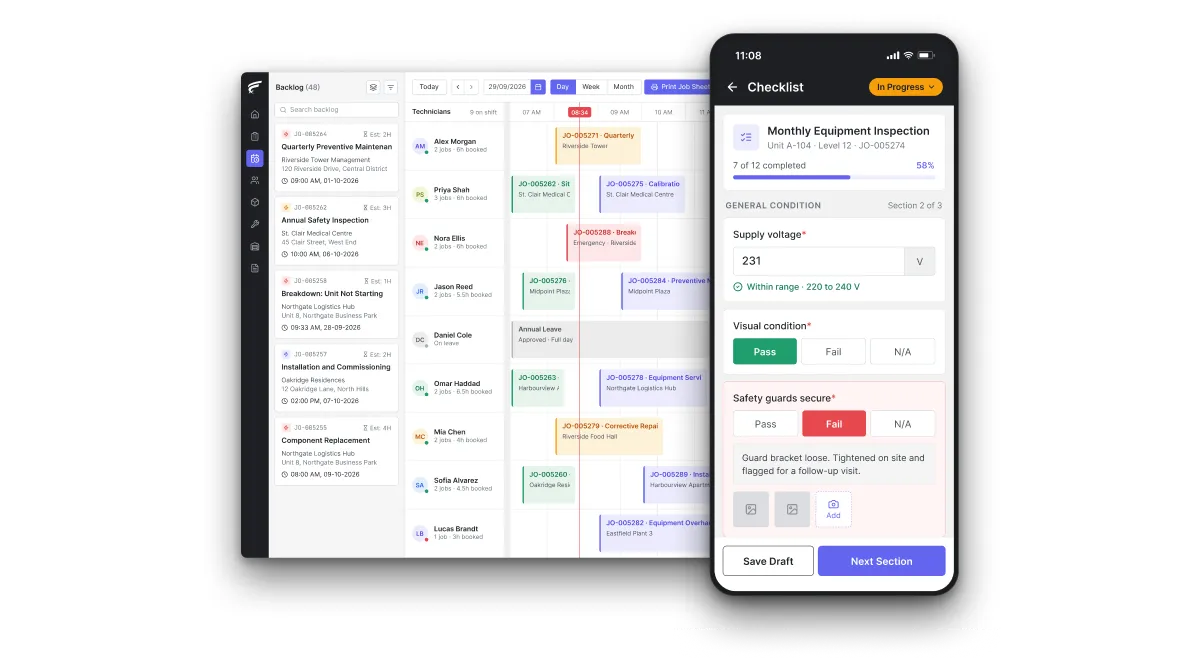
FieldEx scheduling board on desktop with a technician's inspection checklist open on the mobile app, as used by wind turbine technicians

FieldEx is a field service and asset management (FSM+CMMS) application for wind farm owners and turbine service companies. It keeps each turbine on its own record. The gearbox, blades, generator, yaw and pitch systems and service lift have records too. FieldEx runs scheduled service by date or running hours. It sends qualified technicians to site with the checklist, parts and history they need.

What FieldEx does for wind farm owners and turbine service teams

Wind operations and maintenance (O&M) starts with a calendar of scheduled service set by each turbine's service manual. Add a cycle of structural, blade and lifting equipment inspections. Then comes expensive corrective work when a gearbox or generator fails. FieldEx runs all of it on the turbine's own asset records. Every service, finding, repair and part fitted stays with the component it belongs to. Book a demo to see it on your own fleet.

Turbines and their components on record

  • A site record for every wind farm, with its address, map pin, service zone and access contacts. The record also holds the turbines, jobs and maintenance plans that belong to it.
  • An asset record for every turbine, with its make, model, serial number and specifications. Photos, warranty details, manuals and drawings are attached.
  • Parent and component levels in Asset Management. The gearbox, generator, main bearing and blades each keep their own history. So do the pitch and yaw systems, converter, transformer and service lift.
  • Asset types with their own statuses, such as running, stopped or awaiting parts, and a change history of who edited what and when.

Scheduled service by date and running hours

  • Maintenance plans that create each service visit automatically, with different checklists and crews for the six-monthly, annual and multi-year visits.
  • Triggers on the calendar, on meter readings such as operating hours, or on whichever comes first.
  • Fixed calendar schedules, or schedules that recalculate from the last completed service, with missed visits rescheduled after a set overdue period. Fixed calendar dates apply to time-based plans.
  • One plan applied to every turbine of the same model across the fleet, picking up new turbines that match its criteria, in Preventive Maintenance.

Inspections, examinations and certificates

  • Recurring inspections per asset type, on the schedule each one needs.
  • Certifications can be scheduled, with the certifying body recorded., with the certifying body recorded.
  • Each turbine examination shows as due, overdue or completed, with reminders by email, in-app notification or both.
  • The date, the inspector, the result and remarks on each certification, with the report or certificate attached, through Compliance Documentation.
  • A dashboard of overdue turbine inspections and certifications, those due in the next 7 days and those completed in the last 7 days.

Findings, defects and corrective work

  • Checklists for each component. A defect answer raises the corrective work order and its tasks, and can open a follow-up checklist.
  • Custom job forms with number fields for readings such as oil temperatures, pressures and bolt torque values, recorded against the job.
  • Photos of blade damage, oil leaks or worn parts, annotated and watermarked in the app and attached to the job.
  • An alert when a new job repeats a recent job on the same component, so recurring faults show up early, in Work Order Management.

Crews on remote wind farms

  • Each job on the FieldEx Mobile App with the turbine's history, the component checklists, photos and the site supervisor's signature.
  • Jobs and tasks can be downloaded and worked offline, with check-in, check-out and travel synced later.
  • QR or barcode labels on each turbine and component, scanned to open the right asset and launch its checklist.
  • Ordered task procedures, with designated safety steps such as lockout and rescue kit checks required before the job can close.

Dispatch, skills and response

  • Automatic assignment in Scheduling and Dispatch, matching jobs on skills, zone and availability first, then nearest and least busy. A drag-and-drop scheduler handles exceptions.
  • Crews set up as groups, with jobs assigned to the group and tasks assigned to each person on it.
  • Service-level agreements in stages, such as respond and restore, with at-risk and violation alerts per customer or turbine.

Parts, stores and service contracts

  • Spare parts such as filters, brake pads, slip rings, pitch batteries and bearings, in Spare Parts Inventory. Stock is held in each store and in each crew's own stock, with transfers and approvals.
  • Reorder and low-stock alerts per stock location, warranty periods on each part, and a history of every part fitted to each turbine.
  • Service contracts with start and end dates, linked to the turbines and maintenance plans they cover.

Your own harnesses, tools and vehicles

  • Harnesses, rescue kits, gas monitors and torque tools on record as company assets, each with its serial number and holder.
  • Detailed inspections and calibrations as recurring certifications, with reminders before they fall due and the record attached.
  • Crew vehicles on maintenance plans by date or odometer reading, each with its own service history.
  • Workshop machinery used to refurbish components on its own maintenance plan.

Reports for owners and lenders

  • Completion PDFs with the equipment, fault and resolution, and parts used. They also show check-in and check-out times, photos and signature.
  • Each PDF can be sent automatically to the owner or anyone else, with a record of when it was sent.
  • Reports on component reliability, maintenance cost, age and job history by site or turbine model, in Reporting and Analytics. Owners and lenders can receive them as CSV, Excel or PDF exports, or by scheduled email.
  • A branded Customer Portal where the owner sees each turbine's last-serviced date, upcoming asset maintenance and downloadable job reports.

FieldEx also runs this kind of work for Solar & Microgrid O&M, Battery Storage, EV Chargers, Generators & Standby Power, Power Utilities, Water Works and Sewerage and Waste Water.

How often do wind turbines need to be serviced?

Follow the intervals in each turbine's service manual, and never let a service slip past the legal limit. Germany's DIBt wind turbine guideline allows a 4-year inspection cycle only with at least yearly maintenance by manufacturer-authorized staff. Denmark's Executive Order No. 648 requires the next service to follow the service manual. If the manual sets no fixed interval, the next service is due within 1 year.

What FieldEx does about it

  • The manual's intervals on a plan: each turbine model gets a maintenance plan built from its service manual. Six-monthly and annual visits have their own checklists.
  • Inside the legal limit: fixed calendar schedules keep the next service tied to its due date, and overdue visits show on the dashboard straight away. Fixed calendar dates apply to time-based plans.
  • Hours as well as dates: plans can trigger on operating hours or the calendar, whichever comes first.
  • A plan for the whole fleet: one plan covers every turbine of the same model. New turbines join it automatically when they match its criteria.

Which wind turbine inspections are needed beyond routine service?

Add a structural inspection every 2 to 4 years, and keep stopped turbines on a yearly service. The German Institute for Building Technology's wind turbine guideline requires recurring expert inspections of the machine, rotor blades, tower and accessible foundation. They are due at most every 2 years, or every 4 with ongoing yearly maintenance. The Danish Energy Agency says a stopped turbine must be secured, and service must still be done at least once a year.

What FieldEx does about it

  • Structural inspections as certifications: the recurring inspection runs as a certification on a 24-month cycle. The inspecting body is recorded and the report attached.
  • Stopped turbines still on the calendar: a turbine marked as stopped keeps its annual service plan, so the visit still comes due.
  • Findings into jobs: defects found on the tower, foundation or machine raise corrective jobs with tasks on the component affected.
  • Reports kept with the turbine: each inspection report stays on the turbine's record for the life of the asset.

How often should wind turbine blades be inspected?

Inspect blades at least at each structural inspection, every 2 to 4 years, and after every lightning strike. NREL's Report on Wind Turbine Subsystem Reliability (June 2013) says about 2% of turbines a year need blade replacements, on average, through 10 years of operation. Lightning strikes are the most commonly noted cause of failure. Germany's DIBt guideline also names the rotor blades in every recurring expert inspection.

What FieldEx does about it

  • Each blade on record: each blade is a component of the turbine, with its serial number and its own inspection and repair history.
  • Blade inspections on a cycle: blade inspections run as recurring inspections with their own checklist, by drone, rope access or ground camera.
  • Lightning strikes logged: a lightning event becomes a job on the affected turbine, with a blade inspection as one of its tasks.
  • Damage photographed: annotated, watermarked photos of each defect are attached to the job on that blade.

How often must the service lift and lifting gear in a turbine be examined?

Examine a service lift and other people-lifting equipment every 6 months, and other lifting equipment every 12 months. Those intervals come from the UK Health and Safety Executive's guidance on LOLER thorough examinations. All lifting accessories also need an examination every 6 months. If an examination finds a dangerous defect, the equipment must not be used until it is remedied.

What FieldEx does about it

  • Every lift and winch as an asset: the service lift, internal crane and winches are components of each turbine. Each has its own thorough examination as a recurring certification.
  • Six-monthly and annual cycles: people-lifting equipment runs on a six-month cycle and other lifting equipment on 12 months, with reminders before each due date.
  • Out of use until fixed: a dangerous defect on the examination checklist can set the lift's status to out of service. It can also raise the repair job.
  • The examiner recorded: each examination records who carried it out, the result and the report attached.

What safety checks should come before wind turbine maintenance?

Check the rescue kit, fall protection and confined-space gas readings before the climb, and confirm whether the lift works. The European Agency for Safety and Health at Work's E-fact 79 on the wind energy sector names work at height and confined spaces as the main risks. Reaching the nacelle can mean climbing very tall vertical ladders, for example 80 meters high, when there is no lift or it has failed. Any technician entering a confined space, such as the hub or the inside of a blade, should carry a portable gas monitor.

What FieldEx does about it

  • Safety steps before work: each job's procedure can start with required tasks, such as rescue kit and harness checks or a gas test. These must be completed before the job can close.
  • Lift status visible: a service lift marked out of service shows on the turbine's record. The crew knows before arriving that the climb is by ladder.
  • Qualified crews only: assignment rules send each job only to technicians with the required skill. Skills can be named after certificates such as GWO Basic Safety Training, each with an expiry date.

Who is allowed to service a wind turbine?

Where a law applies, only a licensed or certified service company, and otherwise whoever the warranty and service agreement name. The Danish Energy Agency requires a licensed or certified company to service turbines with a rotor area over 40 square meters. That service is reported to the agency. Under Executive Order No. 648, the owner must report damage that poses a safety risk to the agency without undue delay.

What FieldEx does about it

  • Work to authorized providers: jobs can be assigned to the groups and technicians authorized for each turbine model or customer.
  • Major damage escalated: a workflow can send an email or in-app notification to named managers. It fires as soon as a job is raised with a major damage type.
  • The service company on each record: every job shows who did the work, when they checked in and out, and what they found.

What service records must wind turbine owners keep?

Keep every service report for at least 10 years, plus the thorough examination records for its lifting equipment. Denmark's Executive Order No. 648 requires owners to keep service reports for 10 years. The Danish Energy Agency adds that owners of small turbines, with a swept area of 40 square meters or less, don't report service but must keep a service log. For lifting equipment, HSE's LOLER guidance requires records of thorough examinations and inspections to be kept.

What FieldEx does about it

  • The full history on the turbine: every service report, inspection, reading, photo and part fitted stays on the turbine's asset record. It stays there for as long as the turbine stands.
  • An edit log: the change history shows who changed what and when on each asset.
  • Records the owner can reach: the customer portal lets the owner see each turbine's equipment, last-serviced dates and planned work, and download job reports.
  • Exports when asked: report service records by turbine, site or period, and export them as CSV, Excel or PDF.

How often should a wind technician's harness and fall arrest kit be inspected?

Check fall arrest equipment before each use, and give it a recorded detailed inspection at least every 6 months. In the US, OSHA's rule 29 CFR 1910.140 requires personal fall protection systems to be inspected before first use in each workshift. Defective components must be removed from service, and a system that has arrested a fall stays out of use until a competent person clears it. In Great Britain, HSE's leaflet INDG367 recommends a detailed inspection at least every 6 months, or every 3 months for frequently used lanyards on towers and masts. Detailed inspections should be recorded.

What FieldEx does about it

  • Each harness as an asset: every harness, lanyard and rescue kit has its own record, with serial number and the technician who holds it.
  • Detailed inspections on a cycle: each item's six-monthly or three-monthly inspection runs as a recurring certification, with reminders and the result recorded.
  • Pre-use checks on the job: the harness check can be a required task at the start of every turbine job.
  • Out of service when it fails: a failed checklist answer can set the item's status to out of service and raise a replacement job.
Customer story

AMRTUR, a Southeast Asian oilfield services contractor, runs offshore and onshore maintenance in harsh rig environments on FieldEx. Its story describes maintenance jobs created automatically when a machine reaches 300 hours of use or 6 months, whichever comes first. Complex machines have separate maintenance schedules for each component across a 5-year service plan. A log records who pushed back any maintenance date and why. It's a different industry, but the same pattern: hours-or-calendar service on component-level assets at remote sites.

Read the AMRTUR Story

Questions wind O&M teams ask about FieldEx

What maintenance software do wind turbine service companies use?

They use a maintenance system that covers the service, inspections and corrective work described above. FieldEx adds field service management on the same turbine records, so dispatch, mobile work and each turbine's history share one set of data. Compare approaches in our guide to CMMS Software.

Can FieldEx track gearbox, blade and generator history separately?

Yes. Each component is a child asset of the turbine, with its own serial number and warranty. It also holds its own readings, repairs and parts fitted.

Can FieldEx take work orders from our turbine monitoring system?

Yes. Through the FieldEx API, outside systems such as turbine monitoring platforms can create jobs and exchange data with FieldEx. FieldEx can connect to any open system through REST APIs and has connectors for QuickBooks and Xero.

Can service be planned on operating hours as well as dates?

Yes. Meter readings on each turbine build a history, and a plan can trigger on hours, on the calendar or on whichever comes first.

Can crews complete jobs up in the nacelle without a signal?

Yes. Jobs and tasks can be downloaded and worked offline, with check-in, check-out and travel synced later.

Can we manage several wind farms and owners from one account?

Yes. Each owner is a customer with its own sites, turbines, contracts and service-level agreements. You can limit access by hierarchy.

Can FieldEx remind us before a service lift examination is due?

Yes, as described in the lifting gear section. Reminders go by email, in-app notification or both, and the dashboard lists every examination due in the next 7 days.

Can we keep spare parts at each wind farm and in each crew's van?

Yes. Each store and each crew's own stock is tracked, and transfers between them can need an approval.

Can the turbine owner see completed service reports?

Yes. The branded customer portal shows each turbine with its last-serviced date, upcoming asset maintenance, job status and downloadable reports.

What does it take to get our wind fleet running on FieldEx?

There's no setup fee. Once we know your requirements and your data is ready, FieldEx can be implemented in as little as a week with standard features for small businesses. Larger setups and custom work take longer. Wind farms, turbines and components can be uploaded. FieldEx helps with setup, and training is included. See Setup and Training.

Run every turbine's service, inspections and repairs in one system

Book a Demo