Cell tower maintenance for Malaysian telco towers, rooftop sites and fibre routes

Track every structure audit, earthing test and power system on one record, and follow every fault until service is restored.

Book a demo
Updated 19 Oct 2026
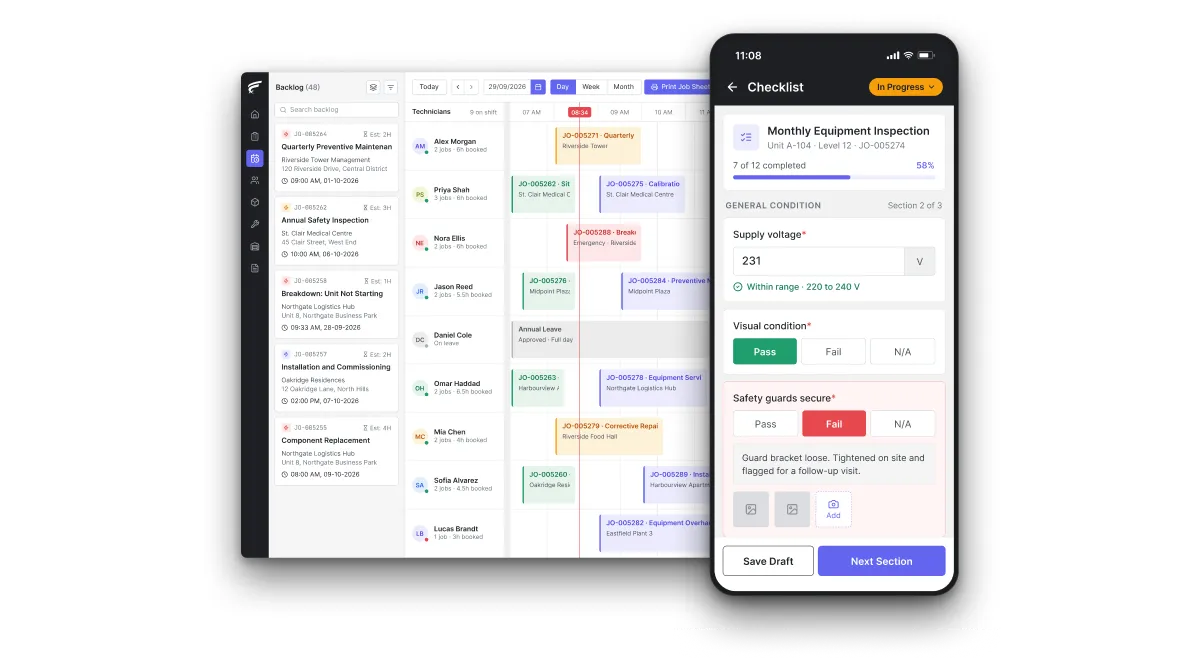
FieldEx scheduling board on desktop with a technician's inspection checklist open on the mobile app, as used by telecom tower crews

FieldEx is a field service and asset management (FSM+CMMS) application for Malaysian tower owners and telco maintenance contractors. It keeps every site's structure, antennas, rectifiers, batteries and genset on record. FieldEx schedules MTSFB audits and planned preventive maintenance (PPM) and turns network faults into tracked jobs against restoration targets. It files the reports, readings and photos from each visit.

What FieldEx does for telco tower owners and contractors

Maintaining telco sites in Malaysia means working to several sets of rules at once:

FieldEx keeps all of it on the site's own records. The audit, the PPM visit and the fault repair for each tower sit together. Book a demo to see it with your own sites.

Every telco site and its equipment

  • One site per greenfield tower, rooftop or monopole location.
  • Each site holds its address, map pin, landowner or building contacts, service zone and the operators it serves.
  • One asset per structure, antenna, earthing system and aircond unit, in Asset Records.
  • One asset per rectifier, battery bank and genset.
  • Each asset holds serial numbers, photos, warranty and drawings.
  • Components under each parent, such as a power system with its rectifier shelf and battery banks, each with a separate history.
  • Permits, approvals and site layout drawings kept as attachments on the site.

PPM for structures and power

  • Site PPM for the full monthly or quarterly visit, and asset PPM for each genset, battery bank and aircond unit, with jobs raised automatically.
  • Genset PPM triggered by date, by running hours, or by whichever is reached first.
  • Tower and power PPM on a fixed calendar or counted from the last completed visit, with missed PPM rescheduled after a set overdue period. Fixed calendar dates apply to time-based plans.
  • One plan across every site in a region, picking up new sites' assets that fit its criteria, in Preventive Maintenance Planning.

MTSFB audits, earthing and obstacle lights

  • Yearly internal inspections and PE inspections every 2 or 5 years as recurring certifications per structure type, with the inspecting party recorded.
  • Due, overdue or done status for every record, and reminders by email, in the app or both.
  • The PE-endorsed report attached to the completed certification record, with earthing test sheets and obstacle light photos kept on the job, through Compliance Documentation.
  • A dashboard of what is overdue, what is due in the next 7 days and what was finished in the last 7 days.

Faults and restoration clocks

  • Faults raised by the NOC team, by the operator through a branded portal, or from a failed checklist answer.
  • Each fault lands as a job in the backlog, in Work Order Management.
  • Restoration targets per operator or per asset, counted in working hours or around the clock.
  • A warning before each target is missed, and a flag when it is.
  • An alert when a fresh fault repeats a recent job on the same equipment.

Riggers and technicians on the move

  • Jobs assigned by skill, availability, shift and leave.
  • Assignment also follows service zone and live location, in Scheduling and Dispatch.
  • A drag-and-drop scheduler for changes.
  • The FieldEx Mobile App in English, Bahasa Malaysia and Chinese.
  • On each job, the app shows the site's history, its checklist and a job form with number fields for ohms and volts. Photos taken on the job are watermarked automatically.
  • Journeys to site logged with distance and duration, and check-in and check-out at each task.
  • Jobs and tasks can be downloaded and worked offline, with check-in, check-out and travel synced later.

Van stock and regional stores

  • Rectifier units, batteries, obstacle lamps and filters held in each regional store and each technician's van stock, with scanning and transfers.
  • Reorder and low-stock alerts per store, with approval on transfers where needed, in Spare Parts Inventory.
  • Every part used logged against the job and the asset it went into.
  • Parts used recorded on the job and the asset, with a movement history of every transfer.

Your own climbing gear, test sets and vans

  • Harnesses, lanyards, fall arrest blocks and rescue kits on record as company assets, each with its serial number.
  • Earth testers, battery testers and power meters with calibration due dates and reminders.
  • Service vans on PPM plans by date or odometer reading.
  • Generators and tools at the depot on their own maintenance plans.

Reports for operators and tower owners

  • A job sheet PDF for every finished visit.
  • The job sheet holds the equipment, fault, fix and parts. It also shows time on site and the client's sign-off, and photos stay attached to the job.
  • A portal where the operator or tower owner sees its equipment, upcoming asset maintenance, job status and downloadable job sheets, in the Customer Portal.
  • Reports on jobs, inspections, last site visits and restoration times, in Reporting and Analytics.
  • Reports can be exported or emailed on a timetable.

FieldEx also runs this kind of work for Oil & Gas, Manufacturing Plant Maintenance, Heavy Machinery, Calibration & Test-Equipment Services, Biomedical Equipment, Equipment Rental & Leasing and Fleet Asset Management.

How often must a telco tower in Malaysia be inspected under MTSFB TC G041?

Every telco tower needs a yearly internal visual inspection, plus an external inspection by a Professional Engineer (PE) or consultant at most every 3 to 5 years. MCMC MTSFB TC G041:2023 sets both layers for radiocommunications structures. The Malaysian Technical Standards Forum Bhd (MTSFB) publishes it, and it is registered with the Malaysian Communications and Multimedia Commission (MCMC). The structure owner carries out the yearly internal inspection. The companion code, TC G040:2023, says site maintenance must meet TC G041's audit requirements.

What FieldEx does about it

  • Two schedules per structure: the yearly internal inspection and the PE inspection each run as their own recurring certification. One runs every 12 months and the other every 24 months or every 5 years.
  • Rolling programs, site by site: each site keeps its own due date. The PE program can be spread across the years rather than bunched into one.
  • Owner and inspector recorded: each completed record shows who carried it out, the date, the result and any remarks.
  • Reminders that start early: sent before each due date, by email, in the app or both.

What does a telco tower audit checklist in Malaysia cover?

The audit checks members such as legs and bracing, the earthing connections and the structure's overall stability, and a PE endorses the external report. TC G041 lists what the internal audit looks at, including damaged members and the earthing connections. Under TC G040, the structure owner checks overall stability against overturning, deflection, sway and stress ratio. When the external inspection is finished, TC G041 requires a Professional Engineer to endorse the inspection report.

What FieldEx does about it

  • The audit as a sectioned checklist: the checklist groups questions by foundation, members, earthing, lights and mounts. Each is answered on the phone at the base of the tower.
  • Reference photos in the questions: each question can carry a reference photo. A new rigger then knows what a damaged member or a loose earth bond looks like.
  • Defects raise their own jobs: a failed answer opens the corrective job with its tasks and books a follow-up inspection.
  • The PE's endorsement on file: the endorsed report is attached to the tower's certification record.

What earthing resistance is allowed at a telco tower site in Malaysia?

No more than 10 ohms at any earth chamber connected as part of the earth grid. TC G040 sets that impedance limit for the measurement at each chamber. The earthing inspection in TC G041 covers the connections between the earthing electrodes and earth.

What FieldEx does about it

  • Ohms entered as numbers: number fields on the job capture the reading at each earth chamber, recorded against the earthing system's asset.
  • High readings trigger work: an out-of-limit answer on the checklist raises the remedial job and schedules a retest.
  • A history per site: earlier readings stay on the earthing asset, so a slow rise over the years can be seen before it fails.

What does CAAM require for aviation obstruction lights on telco towers?

Monitor high-intensity obstacle lights continuously or check them visually every 24 hours, and light the top of any mast 45 meters or higher. The Civil Aviation Authority of Malaysia (CAAM) sets this in CAGM 1412, its guidance material on obstacle management. TC G040 adds that aviation light fixtures should be rated IP65. They should also be able to raise a remote alarm if any luminaire fails.

What FieldEx does about it

  • Obstacle lights as their own assets: the controller and each luminaire sit under the tower, with their own history of faults and lamp replacements.
  • Regular checks on a plan: the visual or controller check runs as a recurring inspection with its own checklist, and photos attached to the job.
  • Failures logged and timed: a reported lamp failure becomes a job with a restoration target, so its repair is tracked from the first report.
  • Two years and beyond: job history stays on the asset and can be reported or exported whenever the FCC asks for it.

How long should telco tower inspection reports be kept in Malaysia?

Keep the external inspection report for up to 10 years, and keep a record of every inspection of climbing equipment. TC G041 recommends that retention period for the external report. The Department of Occupational Safety and Health (DOSH) covers the people who climb. Its work at height guidance says to keep records of any inspections.

What FieldEx does about it

  • Reports kept on the structure: the PE report stays attached to the tower's certification record, alongside every earlier report.
  • Climbing equipment on record: harnesses, lanyards and rescue kits can be assets with their own inspection schedules and results.
  • Exports when MCMC or an operator asks: reports show job and restoration times.
  • Weak cells become jobs: a failed answer on the checklist, such as a cell out of tolerance, raises the replacement job. It can also schedule a recheck.

What fault restoration times does MCMC set for broadband service providers?

For wired broadband, at least 95% of restorations must be done within 24 hours and all of them within 48 hours. MCMC's quality of service guidelines for wired broadband (Determination No. 2 of 2016) also cap disruptions. No single disruption may last 3 hours or longer while affecting 500 or more customers. Providers tell customers through their website and social media within 90 minutes. MCMC's quality of service page sets fixed line and digital leased line restoration at 80% within 24 hours and 90% within 48 hours.

What FieldEx does about it

  • Restoration as a staged target: a service-level agreement on each fault times attendance and restoration. It warns at each stage before the 24-hour or 48-hour mark.
  • Targets per operator: SLAs can apply to all customers, to selected customers for a validity period with an optional asset, or to jobs that meet conditions such as job type, fault type or status.
  • Restoration rates you can show: SLA data in reports shows how many faults were restored within each target, by period, region or operator.
  • Parts and fuel filters from van stock: filters and belts used on the job come out of the technician's own stock. FieldEx logs them against the generator.

How do MCMC quality of service reports and audits work?

Service providers send MCMC audited quality of service reports every 6 months, plus a full report within 7 business days of any major disruption. MCMC's Kualiti Perkhidmatan page describes the six-monthly audited reports. The wired broadband guidelines set the deadline for major disruptions. It applies to any single disruption affecting 500 or more customers for 3 hours or longer.

What FieldEx does about it

  • Six-monthly data in one export: you can report fault jobs, attendance and restoration times for any six-month period. The report can go to the operator on a schedule.
  • Incident detail for the 7-day report: each major fault job holds its times, the work done, the parts replaced and photos. The operator can use them in its 7-day report.
  • Operators see progress live: through the customer portal, the operator follows job status and downloads the job sheet once work is done.
  • Evidence on the job: the completed checklist and photos of the equipment inspection are kept on the job record. Each technician's yearly tie-off certification is tracked with its due date and automatic reminders.

What are MCMC's RF EMF limits for base station sites?

MCMC's mandatory standard recommends limits of 4.5 W/m² at 900 MHz, 9 W/m² at 1800 MHz and 10 W/m² at 2000 MHz and above. MCMC's RF-EMF standards page describes the Mandatory Standard for Electromagnetic Field (EMF) Emission from Radiocommunications Infrastructure. It applies to network facility and network service providers that own and operate infrastructure such as base station transmitters. Where residents object to a new tower, the KPKT tower development procedure lists a radiation report from the Malaysian Nuclear Agency (ANM) as possible technical evidence.

What FieldEx does about it

  • EMF reports on the site: each site's measurement report is attached to the site or to a recurring EMF certification with its own due date.
  • Exposure steps before climbing: the job procedure includes coordination with the operator as a task that must be done before work near live antennas.
  • Who worked where: task check-in and check-out times show which technicians were on each site and when.

What DOSH rules apply to riggers working at height on telco towers?

Check every place where riggers will work at height each time before use, and keep a record of every equipment inspection. DOSH's work at height guidance notes that Malaysian regulation sets the fall distance at 10 feet. It says every place where workers will work at height is checked every time, before use. Records are kept of any inspections.

What FieldEx does about it

  • A pre-climb check on every job: the climbing job opens with the work-at-height check as a task. The climb task can't start until that check is finished.
  • Climbing jobs to trained riggers only: the job type requires its matching skill, so it is assigned only to riggers who hold it. Each rigger's competency certificate is tracked with its due date and automatic reminders.
  • Photos of the check: the technician photographs the anchor points and equipment on the task, and each photo is watermarked automatically.

What local council approvals and site access records apply to telco towers in Malaysia?

A telco tower needs planning permission (Kebenaran Merancang) from the local planning authority (PBT), and every site visitor signs the log book. KPKT's procedure for communications tower development says any development, including a communications tower, needs that permission. Under Act 172, the application for communications equipment goes in together with the building plan application. Once the site is live, TC G040 requires anyone who accesses the property to fill in the visitors' log book.

What FieldEx does about it

  • Approvals filed with the site: the planning permission, building plan approval and landowner agreement are attached to the site record.
  • Every visit time-stamped: check-in and check-out on each task, with the technician's location, give a digital record alongside the site's own log book.
  • Access contacts in the app: the landowner or building manager's contacts are on the site, so the technician can call ahead from the phone.
  • Qualified people on record: each technician holds the skills that job types require, so climbing, power and fiber work reach the right people. Training and certification records are tracked with due dates and reminders, so they can be shown to carriers when asked.

How often should rectifier batteries at telco sites be checked?

Inspect valve-regulated lead-acid (VRLA) batteries at least every 2 months, and capacity-test critical banks every 2 years, following international guidance. India's Telecommunication Engineering Centre (TEC) asks for that inspection in its VRLA monitoring guidelines. TEC says a conductance or impedance change of more than 40% points to imminent cell or battery failure. The US Air Force pamphlet AFPAM 32-1186, based on IEEE 1188, recommends the two-yearly capacity test for critical installations.

What FieldEx does about it

  • Each battery bank tracked: every bank sits under its rectifier system with its install date and warranty, so its age is visible on every visit.
  • Conductance readings recorded: number fields capture voltage and conductance per bank, building a history against which a 40% change stands out.
  • Bimonthly and two-yearly work together: the two-monthly inspection and the capacity test run on one PPM plan at their own points in the cycle.
  • Replacement from van stock: new batteries used on the job are deducted from the technician's van stock and logged on the asset.

How often should a telco site genset be test-run?

Run each genset at least once a month for at least 30 minutes, following the international NFPA 110 standard. NFPA 110 also has the system's storage batteries, including electrolyte levels or battery voltage, inspected weekly.

What FieldEx does about it

  • Running hours as the trigger: each genset's PPM follows the calendar for the monthly run and running hours for servicing, whichever comes first.
  • Run results recorded: number fields log run time, fuel level and starting battery voltage against the genset.
  • Weekly battery checks: where the site needs them, weekly battery inspections run as a recurring inspection with a short checklist.

How often should riggers' harnesses and lanyards be inspected?

Check harnesses and lanyards before every climb, and give them a detailed, recorded inspection at intervals set by how hard they're used. DOSH's work at height guidance says equipment is maintained and inspected regularly. Inspection intervals depend on the environment, such as adverse weather or accidental damage, and on usage. The UK Health and Safety Executive's INDG367 leaflet is an international reference. It recommends a detailed inspection of fall arrest lanyards at least every 6 months, and every 3 months on steel masts and towers.

What FieldEx does about it

  • Each harness as an asset: every harness, lanyard and fall arrest block sits on record with its serial number and the rigger or van it's issued to.
  • Detailed inspections on a cycle: each item's detailed inspection runs as a recurring certification, every 6 months or every 3 months, with reminders before it's due.
  • Results on file: the inspector's result and remarks stay on the record, with photos attached to the job.
  • Test sets calibrated too: earth testers and battery testers carry calibration due dates, with the certificate attached.
Customer story

AlanDick Brunei is part of a telecom infrastructure group with operations in Brunei, Malaysia and the UK. It sends up to 26 people a day to onshore and offshore work sites and manages more than 70 jobs a month on FieldEx. The story covers dispatch by skill, availability and proximity, a live view of job progress, and reminders that keep inspections and certifications on time.

Read the AlanDick Story

Questions Malaysian telco contractors ask about FieldEx

Which software suits cell tower maintenance in Malaysia?

One that keeps every site's structure and power equipment on record and times faults against each operator's targets. FieldEx does this in one system, as described above. See our guide to CMMS Software.

Can FieldEx schedule TC G041 internal and PE inspections for every structure?

Yes, as the TC G041 section shows. The dashboard also lists which PE inspections fall due in the next 7 days.

Can riggers record earthing readings on the phone?

Yes. The rigger enters the reading for each earth chamber on the job, and photos of the test can be attached to the job.

Can each operator have its own restoration targets?

Yes, as the restoration section shows. Targets can also be scoped to particular assets.

Can FieldEx take faults straight from our NOC system?

Jobs can be raised automatically from other systems, as well as from checklists, the customer portal and QR forms. FieldEx can connect to any open system through REST APIs and has connectors for QuickBooks and Xero.

Can operators follow our progress on their faults?

Yes, through the customer portal described above. Job sheets can also be emailed when each job is done.

Does the app work at rural sites without coverage?

Yes. Jobs and tasks can be downloaded and worked offline, with check-in, check-out and travel synced later.

Can we see which spares sit in each van and regional store?

Yes. Low-stock alerts per store flag when a region is running short of batteries or obstacle lamps.

Can one PPM plan cover all our sites in a region?

Yes, as the PPM section shows. Each point in the cycle can use its own checklist, so monthly and quarterly visits differ.

How fast can our telco sites go live on FieldEx?

There's no setup fee. Once we know your requirements and your data is ready, FieldEx can be implemented in as little as a week with standard features for small businesses. Larger setups and custom work take longer. Sites and assets can be uploaded. FieldEx helps with setup, and training is included. Onboarding is in person in Malaysia as well as online. See Setup and Training.

Keep every telco site's audits, PPM and faults on one record

Book a Demo