Heavy equipment maintenance software for Malaysian cranes, excavators and fleets

Keep every crane's certificate of fitness, every excavator's running hours and every site breakdown on one record. DOSH, customers and planners see the same history.

Book a demo
Updated 16 Oct 2026
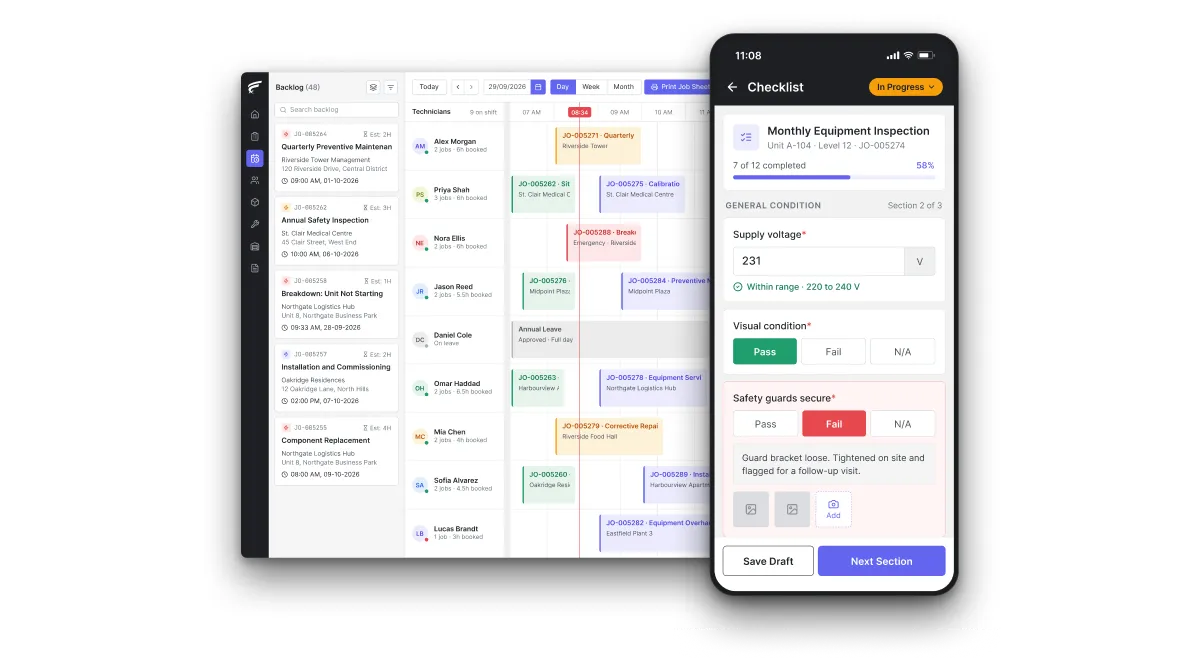
FieldEx scheduling board on desktop with a technician's inspection checklist open on the mobile app, as used by heavy equipment service teams

FieldEx is a field service and asset management (FSM+CMMS) application for Malaysian machinery dealers, service companies and plant owners. As heavy equipment maintenance software, it runs servicing on running hours or dates. It tracks DOSH certificate of fitness and PUSPAKOM due dates for each crane and lorry. FieldEx records every inspection and repair against the machine. It dispatches technicians to project sites with parts in their van stock.

What FieldEx does for machinery dealers and plant owners

A Malaysian plant fleet answers to more than one calendar. The Department of Occupational Safety and Health (DOSH) sets the certificate of fitness cycle for cranes and air receivers. PUSPAKOM sets the inspection cycle for lorry cranes and prime movers, and the manufacturer sets the service hours. FieldEx keeps them all on each machine's record, together with the breakdowns your customers report from site. Book a demo to see it with your own machines.

One record per crane, excavator and genset

  • A record for each mobile crane, tower crane and lorry crane.
  • A record for each excavator, backhoe, forklift, air compressor and genset.
  • Each record holds the serial number, specs and photos. It also holds the warranty, location and purchase or depreciation details.
  • Components kept under the main machine, such as the engine, the hydraulic pump or the boom, each with its own repairs, in Asset Management.
  • Each machine tagged to the customer and project site it is working on. Its status shows as working, under repair or not to be used.
  • A printed QR or barcode sticker on each unit, plus a log of every edit with the user and the time.

Servicing by running hours and by date

  • PM plans that raise the service job at a set number of running hours, on a date, or at whichever arrives first.
  • Each unit's own hour interval, or a common interval for the whole plan, with default meter units and service frequencies per machine type.
  • Separate checklists and technicians for the small service and the major service in the same plan.
  • New units that fit the plan's criteria joined to it automatically, in Preventive Maintenance.
  • New machines that match the plan's criteria added to it automatically, in Preventive Maintenance.

CF, PUSPAKOM and competent person checks

  • CF, PUSPAKOM and other recurring certifications per machine type on set frequencies, with the inspecting authority recorded.
  • Each certificate shown as due, overdue or done, with reminders by email, in the app or both.
  • Who inspected it, when, the result and remarks, with a scan of the certificate or the competent person's report attached, through Compliance Documentation.
  • A dashboard counting overdue certificates, plus what falls due within 7 days and what was done over the past 7 days.

Breakdown calls from project sites

  • A QR sticker on each machine that opens a breakdown form without logging in. The site crew's form takes the machine's location, the fault, a contact number and photos or video.
  • A branded customer portal where contractors raise requests, ask for a visit date and see their machines with the date each was last serviced.
  • Every request arriving as a job in the backlog, in Work Order Management.
  • Each job assigned by skill, availability, shift and leave, as well as service zone and live location.
  • Response and repair targets per customer or per machine, counted in working hours, with a warning before the target is missed.

On the phone at the machine

  • The FieldEx mobile app in English, Bahasa Malaysia and Chinese.
  • The app shows the machine's past jobs and the checklist for the visit. Technicians fill in number fields for readings, take watermarked photos and get the customer's sign-off.
  • A warning if the same machine had a job only recently, so a repeat fault is caught early.
  • The drive to site logged with distance and time, and check-in and check-out on each task, which also backs up mileage claims.
  • Jobs and tasks can be downloaded and worked offline, with check-in, check-out and travel synced later.

Parts in the store and in the van

  • Spare parts held in each branch store and in every technician's van stock, moved by barcode scan, with approval steps where you want them.
  • Reorder and low-stock alerts for each stock location, and a quick check of which branch or technician has a part, in Spare Parts Inventory.
  • Each part used logged against the job and the machine, with the manufacturer and warranty period on the part.

Your own service lorries, workshop cranes and tools

  • Service lorries and vans on maintenance plans by date or odometer reading, with PUSPAKOM, road tax and insurance renewals as recurring certifications.
  • Workshop overhead cranes, hoists, presses and vehicle lifts as company assets, each with its own CF or inspection cycle.
  • Torque tools, gauges and diagnostic kits with calibration due dates, reminders and the certificate on the record.

Job sheets, contracts and fleet reports

  • A job sheet PDF for every completed job, emailed with a log of when it was sent.
  • The job sheet shows the machine, the fault and the fix, and parts and prices. It also holds time on site, mileage, photos and the customer's signature.
  • Service agreements with a start and end date, tied to the machines and PM plans each one covers.
  • Reports on machine reliability, maintenance cost, utilization and age, exported or emailed on a timetable.
  • Fleet reports export or go out by email on a schedule, in Reporting and Analytics.

How often does DOSH inspect a crane for its certificate of fitness?

Every 15 months. DOSH's Lifting Work page (updated 16 March 2026) says DOSH officers inspect the entire crane every 15 months. The Certificate of Fitness Regulations 2024, P.U.(A) 99/2024, make the certificate of fitness (CF, still widely called the PMA) valid for 15 months from the inspection date. The next inspection takes place before it expires, but not earlier than the first day of the twelfth month after the last one. That gives each crane a booking window of about 3 months.

See how to track crane inspections and records under OSHA

What FieldEx does about it

  • Schedule the 15-month CF work through a maintenance plan. Keep the completed job in the crane's job history.
  • Reminders inside the window: email or in-app reminders can be set well ahead of the expiry date, so the booking is made inside the window.
  • The certificate on file: the CF is attached to the completed certification, with the inspection date, the result and the officer's remarks.
  • Fleet-wide view: the dashboard lists every crane whose CF is overdue or falls due in the next 7 days. You can filter it by machine type or service zone.

What do the 2024 CF regulations require between crane inspections?

They require the owner to keep the crane in a safe and good working condition at all times, not only on inspection day. The Certificate of Fitness Regulations 2024 were gazetted on 2 April 2024 and came into operation on 1 June 2024. Beyond the 15-month CF, they place that standing maintenance duty on every plant that needs a certificate of fitness.

What FieldEx does about it

  • Maintenance between CFs on record: monthly and running-hour servicing runs on its own PM plan. Every visit between two CF inspections is logged on the crane.
  • Both histories side by side: the CF certifications and the service jobs sit on the same machine record, ready to show an officer.
  • Edits traceable: every change to the crane's record is logged with the user and the time.
  • Reports for management: reports on completed servicing can be emailed on a timetable.

How should an owner get a crane ready for the DOSH periodical inspection?

Have it ready on the date in DOSH's written notice, which comes at least 14 days ahead, available for testing under safe working load conditions. Under the Certificate of Fitness Regulations 2024, an officer or licensed person may give that notice at least 14 days before the periodical inspection. Lifting machinery other than lifts, escalators and walkalators must be available for testing, with its safety devices working. DOSH's Competent Person Guidelines add a step for tower cranes. The competent person carries out a load test, a function test and a foundation test before the DOSH officer inspects.

What FieldEx does about it

  • A pre-inspection job from the notice: the preparation work can be raised as a job straight away. It comes with a checklist for the load, function and foundation tests.
  • Tests in order: the job's tasks can run as an ordered procedure, so the load test is finished before the function test starts.
  • Test values recorded: number fields on the job capture the test load and readings taken on site.
  • The right competent person: assignment rules send the job to a technician with the matching skill in the crane's service zone.

How often must a tower crane be serviced and examined by a competent person?

A competent person services a tower crane at least monthly and examines it comprehensively at least every 3 months, or more often if the manufacturer asks. Those intervals are in the Certificate of Fitness Regulations 2024. DOSH's Competent Person Guidelines add that each crane competent person inspects every crane under their supervision and reports at least once a month. One tower crane therefore carries four cycles: a monthly service, a monthly report, a three-monthly examination and the 15-month CF.

  • the safe working load
  • the latest date for the next thorough examination
  • any defective parts, with a description of the defect

What FieldEx does about it

  • Four cycles on one crane: the monthly service, the monthly report, the quarterly comprehensive examination and the CF each run on their own. Each is a recurring job, inspection or certification.
  • Whichever is more frequent: quarterly is a preset interval, and a monthly interval is also preset where the manufacturer's manual asks for more frequent examination.
  • Reports kept with the crane: each competent person report and each comprehensive examination report is attached to the crane's record.
  • A planner's calendar: the dashboard calendar shows every crane's open, overdue and completed work across all project sites.

Who is responsible for inspecting a crane in Malaysia?

Three parties inspect at different intervals: the crane's Responsible Person (ROP), DOSH officers and, for some plant, a competent person. DOSH's Lifting Work page says the ROP inspects the crane in more detail at the manufacturer's recommended intervals. DOSH officers inspect the whole crane every 15 months. Under the Certificate of Fitness Regulations 2024, the owner makes sure a competent person maintains the plant in the Eleventh Schedule. That covers tower cranes, quay cranes, launching gantries and passenger hoists, among others.

What FieldEx does about it

  • Each inspector's work on one crane: the ROP's manufacturer-interval inspection, the competent person's servicing and the DOSH CF are separate records on the same machine.
  • Owner and contractor see the same thing: the crane owner uses the customer portal to see the machine, its last-serviced date and its upcoming asset maintenance. The owner can also download the job sheets.
  • Named on every record: each certification and inspection records who carried it out, picked from your user list.
  • Contracts linked to cranes: the maintenance contract is linked to the cranes and PM plans it covers, with its start and end dates.

What crane records must be ready when a DOSH officer visits the site?

Keep the crane's inspection and test records, thorough examination reports and lifting plan where a DOSH officer can review them on site. DOSH's Lifting Work page says the lifting plan covers the maintenance and inspection of cranes and their equipment. It also says inspection and test records must always be available for DOSH officers to review. The Certificate of Fitness Regulations 2024 require the competent person's comprehensive examination report to hold the particulars in the Fourteenth Schedule.

What FieldEx does about it

  • Records on the phone: certification and inspection lists, with their details, can be opened in the mobile app on site.
  • Record the examination date, result, remarks and linked checklist in the inspection record.
  • Checklists built from the schedule: the particulars the report must contain can become checklist questions, so nothing is left off.
  • Filtered for the visit: the dashboard filters inspections by time range, machine type and service zone, so they are quick to find.

How long is a DOSH crane operator's competency certificate valid?

Two years. DOSH's Crane Operator page (updated 16 March 2026) says the competency certificate DOSH issues is valid for 2 years. The operator renews it within one year of expiry, or is reassessed. DOSH requires competent persons who have attended a recognized crane operator course to operate mobile cranes, derricks and tower cranes.

What FieldEx does about it

  • Operators matched to cranes: assignment rules send crane jobs only to people holding the matching skill, such as a mobile crane or tower crane operator.
  • Shift and leave respected: assignment also checks each operator's shift, approved leave and service zone.
  • Certificate expiry dates: each operator's competency certificate is tracked with its own renewal schedule, due dates and automatic reminders, so none lapses unnoticed.
  • Who operated which crane: every job shows the assigned operator, the crane and the check-in and check-out times.

Do lorry cranes and heavy lorries need a PUSPAKOM inspection every 6 months?

Yes. PUSPAKOM says commercial vehicles have a routine inspection every 6 months, and APAD's code expects yearly inspections for lorries under 2 years old. PUSPAKOM's Inspection Types page says the Road Transport Act 1987 requires routine inspection of commercial vehicles every 6 months. It classes heavy lorries as those with a gross vehicle weight (berat dengan muatan, BDM) of 6,000 kg or more. For lorries under 2 years old, APAD's operator safety code expects a PUSPAKOM inspection every year. A lorry crane also keeps its separate DOSH CF.

What FieldEx does about it

  • Two certifications on one lorry crane: the PUSPAKOM inspection and the DOSH CF each run as their own recurring certification on the same machine.
  • Yearly, then six-monthly: the PUSPAKOM schedule can be set to yearly for a new lorry and changed to six-monthly from its third year.
  • Pre-inspection servicing: a service job can be raised before each PUSPAKOM date, with a checklist for lights, brakes and tires.
  • Reports attached: the PUSPAKOM report is attached to the completed certification, and the next due date and reminders follow from it.

Do air receivers and compressors need a certificate of fitness and an internal inspection?

Yes, where they are pressure vessels that need a certificate of fitness. Under the Certificate of Fitness Regulations 2024, each such vessel is available for internal inspection at every periodical inspection, unless it was designed not to need one. Its CF lasts 15 months. DOSH's Industrial Safety Division handles design verification of pressure vessels and applications to alter plant that needs a certificate of fitness.

What FieldEx does about it

  • The receiver as its own component: the air receiver sits under the compressor as a component, with its own CF certification.
  • Servicing kept separate: compressor servicing by running hours runs on a PM plan, while the receiver's CF stays a certification.
  • Preparation on the checklist: the pre-inspection job can include depressurizing and opening the vessel, as tasks that must be done in order.
  • Approval letters on file: design verification and alteration approvals can be attached to the receiver's record.

Should excavator service intervals be shorter on dusty or wet sites?

Often, yes: severe, dusty or wet conditions can call for more frequent lubrication, filter changes and oil sampling. There is no Malaysian rule on this, so the reference is the manufacturer. Caterpillar's international manual, Machine Fluids Recommendations (SEBU6250-30, December 2020, since revised as SEBU6250-35), says severe applications may need oil sampling at half the normal interval or more often. It also tests cooling systems for supplemental coolant additive at 250-hour intervals. Caterpillar's S·O·S Fluid Analysis guidance keeps sampling every 100 hours once an extended interval is reached.

What FieldEx does about it

  • A shorter interval for harsh sites: machines working on dusty or wet sites can be put on a plan with a custom, shorter hour interval.
  • Sampling as its own job: oil sampling and coolant testing at 100 or 250 hours run as separate jobs from the oil change.
  • Readings and lab reports: hour-meter readings are entered on the job, and fluid analysis results are attached to the machine.
  • Plans that follow the machine: when a machine moves to a different site, it can be moved to the plan for that site's conditions.

What should happen when a defect is found on a crane or machine on site?

Stop using it, tag it and record the defect against the machine until the repair is done. DOSH's Competent Person Guidelines require crane competent persons to inform the State DOSH office of defects found on crane structures and components under their supervision. There is no Malaysian rule on tagging other mobile machines. The US mining rule MSHA 30 CFR 56.14100, an international reference, requires a tag or other effective marking on defective items. The tag prohibits further use until the defects are corrected.

What FieldEx does about it

  • A condition grade in a checklist can update the machine's status and raise a follow-up job automatically.
  • Not to be used: the same checklist can change the machine's status. Planners see straight away that it is off hire or out of use.
  • Photos as proof: watermarked photos and video of the defect are attached to the job.
  • A record for the State DOSH report: the defect, the repair and the follow-up inspection are all on the crane's history. They are ready for the competent person's report.

Does the workshop's own overhead crane need a certificate of fitness?

Yes. The Certificate of Fitness Regulations 2024 prescribe lifting machinery as plant requiring a certificate of fitness. Their schedules list cranes other than mobile, tower and quay cranes, as well as hoists. Each CF lasts 15 months. The regulations exclude manual lifting machinery and the loading equipment fixed at the back of a vehicle (Third Schedule). For vehicle lifts in the service bay, the US standard ANSI/ALI ALOIM, an international reference, sets an inspection by a qualified lift inspector at least once a year.

What FieldEx does about it

  • Workshop cranes and hoists as company assets: each overhead crane, hoist and vehicle lift in your workshop has its own record, kept apart from customers' machines.
  • The CF on its own cycle: each workshop crane's CF runs as a recurring certification, with reminders and the certificate attached.
  • Service lorries on plans too: your own service lorries run on maintenance plans by date or odometer, and their PUSPAKOM dates sit on the same record.
  • Tools with calibration dates: each torque tool and gauge carries its calibration due date, with the certificate kept on the record.
Customer story

Sime Industrial supplies, services and rents heavy machinery to construction, mining and energy customers. It represents more than 30 machinery brands. Its central planners use FieldEx in place of Excel and WhatsApp. They see where technicians are, how jobs are progressing and how long they take. Real-time logs back their mileage and job claims.

Read the Sime Industrial Customer Story

FieldEx questions from Malaysian plant and machinery teams

Which heavy equipment maintenance software suits a Malaysian machinery dealer?

One that holds DOSH CF dates, running-hour servicing, parts and site breakdowns together. FieldEx does all of these on each machine's record, with job sheets your customers can download. See our guide to CMMS Software.

Can FieldEx remind us before a crane's CF expires?

Yes, as the CF section shows. Reminders go by email, in the app or both, to the users or groups you choose, such as the branch planner for that crane's zone.

Can PM be triggered by running hours instead of dates?

Yes. Default meter units and service frequencies can be set per machine type, so each new excavator starts on the right interval.

Can contractors report a breakdown from the project site?

Yes, through the machine's QR sticker described above. The request lands in the backlog as a job, with the contractor's photos or video attached.

Can we keep PUSPAKOM and DOSH dates on the same lorry crane?

Yes, as the PUSPAKOM section describes, and both dates show on the same dashboard as the rest of the fleet.

Can technicians claim mileage from their FieldEx trips?

Yes. Each trip to site is logged as a task journey with distance and duration, and mileage can be shown on the job's PDF.

Can we see which branch or technician has a part in stock?

Yes. You can check part availability by branch, store zone or technician van stock, with transfers between them.

Can our customers see their machines' service records?

Yes. The branded customer portal shows each machine with its serial number, status, last-serviced date and upcoming maintenance, plus job sheets to download. Job sheets can also be sent automatically to the customer or anyone else you choose.

Does the app work at quarries and estates without coverage?

Yes. Jobs and tasks can be downloaded and worked offline, with check-in, check-out and travel synced later.

How soon can our machinery team start on FieldEx?

There's no setup fee. Once we know your requirements and your data is ready, FieldEx can be implemented in as little as a week with standard features for small businesses. Larger setups and custom work take longer. Machines and parts can be uploaded. FieldEx helps with setup, and training is included. Onboarding is in person in Malaysia as well as online. See Setup and Training.

Keep every crane's CF, every service and every breakdown on one record

Book a Demo