Solar asset management software for Malaysian rooftop, LSS and hybrid solar sites

Track every inverter, string, battery bank, wind turbine and genset on its own record. Keep each Suruhanjaya Tenaga and SEDA record, and close every fault.

Book a demo
Updated 16 Oct 2026
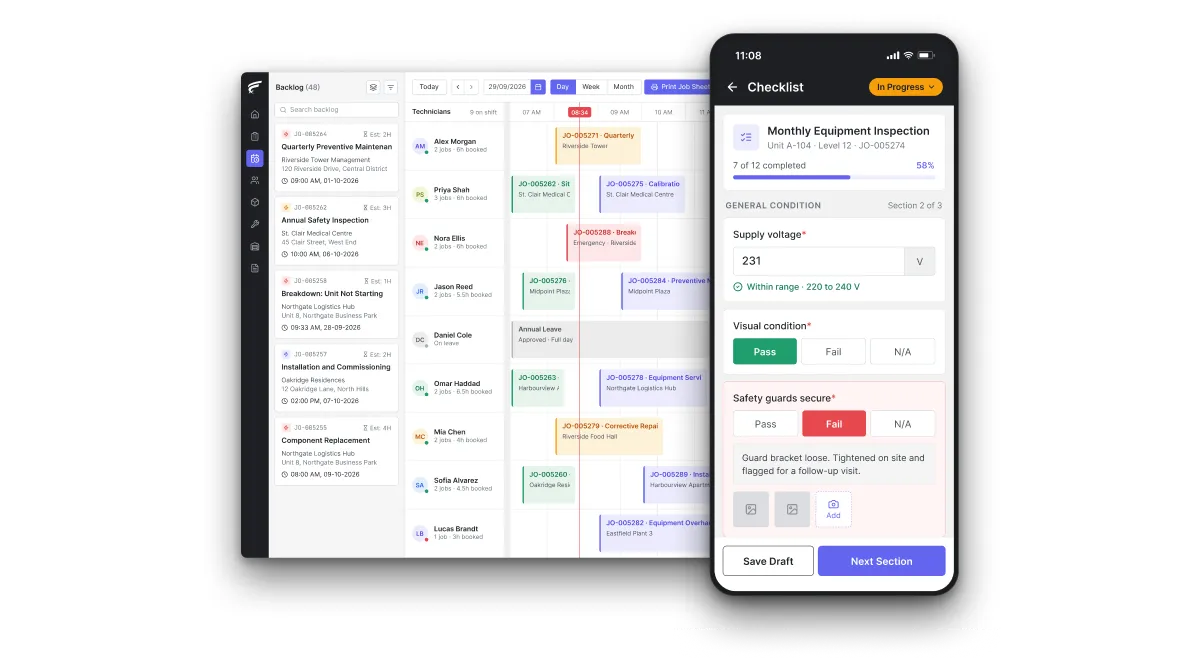
FieldEx scheduling board on desktop with a technician's inspection checklist open on the mobile app, as used by solar O&M teams

FieldEx is a field service and asset management (FSM+CMMS) application for Malaysian solar and microgrid operations and maintenance (O&M) teams. It keeps every rooftop, Large Scale Solar (LSS) plant and hybrid station's equipment on record. FieldEx schedules planned preventive maintenance (PPM) and inspections and turns inverter trips into tracked jobs. It also files the Form G and H certificates and test reports owners must keep.

What FieldEx does for Malaysian solar O&M contractors

A Malaysian solar portfolio mixes NEM rooftops on factories and homes with SELCO and NOVA installations. It also holds LSS plants with their own interconnection duties and off-grid hybrid stations such as those in Sabah. Each comes with Suruhanjaya Tenaga guidelines, a competent person's duties and an owner who stays responsible for maintenance up to the point of interconnection. FieldEx keeps the PPM, the faults and the certificates for every site on that site's own records, in Solar Asset Management. Book a demo to see it with your own sites.

Every PV site and its equipment

  • One site per rooftop, LSS plant or hybrid station.
  • Each site holds its address, map pin, owner contacts, scheme (NEM, NOVA, SELCO or LSS) and service zone.
  • One asset per inverter, string, combiner box and transformer, and per battery bank and genset.
  • Serial numbers, photos, warranty and datasheets on each asset.
  • Parent and component levels, such as an inverter room with its inverters and an inverter with its own repairs.
  • Attach Form G and H certificates to the relevant PV system asset record.
  • Single-line diagrams, layout drawings and handover documents attached to the site, and a change history on each asset of who edited what and when.

Wind and solar hybrid sites

  • Wind turbines at hybrid stations as assets on the same site as the arrays, batteries and standby genset.
  • Each turbine's gearbox, blades and generator as components, so a replaced part keeps its own history.
  • Turbine PPM from the maker's service manual, on the calendar, on running hours or whichever comes first.
  • Generator and hybrid plant service triggered on running hours, on the calendar, or on whichever comes first.
  • One plan applied across a whole portfolio, picking up new assets that match its criteria, in Preventive Maintenance Planning.

PPM across rooftops and plants

  • Site PPM for washing, vegetation and full-plant visits, and asset PPM for each inverter, battery bank and genset, raised automatically, in Preventive Maintenance.
  • Genset PPM on a quarterly calendar, on running hours, or whichever comes first.
  • A fixed calendar or a schedule counted from the last finished visit, with missed PPM rescheduled after a set overdue period. Fixed calendar dates apply to time-based plans.
  • One plan across every NEM rooftop in a region, adding new inverters that fit its criteria.
  • Thermal images, test sheets and reports are attached to the job.
  • A dashboard of overdue array and microgrid inspections, those due in the next 7 days and those completed in the last 7 days.

Competent person checks and certificates

  • Five-yearly installation testing and two-yearly relay and protection calibration as recurring certifications, with the competent person recorded.
  • Due, overdue or done status, and reminders by email, in the app or both.
  • Inspection reports, test sheets and commissioning documents stay with the related job, and certificates sit on the asset record.
  • A dashboard of what is overdue, due in the next 7 days and done in the last 7 days.
  • A notification when a new fault repeats a recent job on the same inverter, so recurring trips get a root-cause visit.

Inverter trips and breakdowns

  • Faults from your monitoring desk, from owners on their branded portal, or from a failed checklist answer.
  • Each fault lands in the backlog, in Work Order Management.
  • Response and repair targets per owner, counted in working hours, with a warning before each target is missed and a flag when it is.
  • A warning when an inverter that was just repaired comes back with another fault.
  • Ordered tasks with safety steps that must be finished before the next task can start.
  • Jobs and tasks can be downloaded and worked offline, with check-in, check-out and travel synced later.

PV technicians on site

  • Jobs matched on skills, zone and availability first, then nearest and least busy, with shifts and leave taken into account.
  • Jobs moved by drag and drop on the scheduler, in Scheduling and Dispatch.
  • The FieldEx Mobile App in English, Bahasa Malaysia and Chinese.
  • The asset's history and checklist on the phone, and custom job forms with number fields for insulation resistance, voltage and current.
  • Automatically watermarked photos.
  • Jobs and tasks can be downloaded and worked offline, with check-in, check-out and travel synced later.

Van stock and spare inverters

  • Spare inverters, fuses, MC4 connectors and batteries in each store and each technician's van stock, with scanning and transfers.
  • Reorder and low-stock alerts per store, in Spare Parts Inventory.
  • Warranty periods on each part, and every part used logged on the job and the asset.
  • Workshop machinery used to repair boards and trackers on its own maintenance plan.

Your own testers, vans and tools

  • Insulation testers, clamp meters, thermal cameras and torque wrenches kept as company assets, each with its serial number and location.
  • Each tester's calibration due date runs as a recurring certification, with reminders and the certificate on the record.
  • Company vans and washing equipment on maintenance plans by date or odometer reading.
  • Workshop machinery on its own maintenance plan, with its repair history.
  • Reports on jobs and sites, exported or emailed on a schedule.

Job sheets and reports for owners

  • A job sheet PDF for every finished visit, with the equipment, fault, fix and parts. It goes automatically to the owner or anyone else.
  • Time on site, photos and the owner's sign-off on the same sheet.
  • A portal where the owner sees its equipment, upcoming asset maintenance, job status and downloadable job sheets.
  • Reports on PPM done, faults, asset reliability and maintenance cost per site, in Reporting and Analytics.
  • Reports exported or emailed on a timetable.

FieldEx also runs this kind of work for Battery Storage, EV Chargers, Power Utilities, Water Works, Sewerage and Waste Water, Wind Infrastructure and Generators & Standby Power.

Who is allowed to maintain and test solar PV systems in Malaysia?

Only electrical contractors and competent persons registered with Suruhanjaya Tenaga may carry out and supervise PV electrical work, testing and commissioning. Suruhanjaya Tenaga's SELCO guidelines (GP/ST/No.51/2024) set this for self-consumption systems in Peninsular Malaysia. SEDA's terms for Registered PV Service Providers (RPVSP) add a rule for the provider. It must be a registered electrical contractor under regulations 75 to 79 of the Electricity Regulations 1994, or appoint one.

What FieldEx does about it

  • Registered work to registered people: testing, commissioning and electrical repair jobs require their matching skill. FieldEx assigns them only to the competent persons who hold it.
  • Who did it, on record: each certification and inspection records the person who carried it out, picked from your user list.
  • Subcontractors kept separate: an appointed electrical contractor's team can be set up as its own group, seeing only the jobs assigned to it.
  • Next visit always visible: each plan shows the last and next maintenance date for every site and inverter it covers.

Who is responsible for solar PV O&M under NEM, NOVA and SELCO?

The owner or consumer on site is responsible for O&M up to the point of interconnection, under each scheme's guideline. Suruhanjaya Tenaga's NEM guidelines (GP/ST/No.27/2021) make the NEM consumer responsible for safely operating and maintaining the PV installation in its premises. The NOVA guidelines give the NOVA consumer the same duty. Under the SELCO guidelines, the owner or occupier is responsible for operation, maintenance and safety up to the point of interconnection.

What FieldEx does about it

  • The owner as the customer: each owner sits as a customer with its sites, contracts and assets. Every job and report is tied to the party responsible.
  • O&M contracts with dates: each O&M contract has its start and end dates, linked to the assets and PPM plans it covers.
  • Owners see their own records: through the customer portal, each owner views its equipment, upcoming asset maintenance and job sheets.
  • The scheme on the site: NEM, NOVA, SELCO or LSS is recorded on each site, so reports can be filtered by scheme.

How often must a non-domestic installation with solar PV be inspected under the Electricity Regulations 1994?

A competent person must inspect and test a non-domestic installation at least once every 5 years, and its relays and protective devices at least once every 2 years. Those intervals come from the Electricity Regulations 1994 (P.U.(A) 38/1994). For larger installations, the regulations also set a minimum number of competent person visits. Installations up to 600 V supplied through switchgear of 100 A or more need one a month. Installations above 600 V up to 11 kV need two a month.

What FieldEx does about it

  • Three clocks per installation: the five-yearly test, the two-yearly relay calibration and the monthly or twice-monthly visit each run on their own schedule.
  • Competent-person visits as PPM: the competent person's visits are a site PPM plan with their own checklist and readings.
  • Calibration results attached: relay test sheets are attached to the completed certification on the protection asset.
  • Defects raise their own jobs: a failed answer at any visit opens the repair job straight away.

What records must be kept after solar PV testing and commissioning in Malaysia?

Keep copies of the Form G and Form H certificates, and every competent person's inspection report, in the installation's record book. The SELCO guidelines say the consumer must keep copies of Form G and Form H for record and reference. Under the Electricity Regulations 1994, the competent person gives the owner an inspection report within 2 weeks of the inspection. The report holds findings, recommendations and instructions, and the owner keeps a book of all records and reports.

What FieldEx does about it

  • Certificates on the site: Form G and Form H are attached to the site or the PV system's asset. They are available on the web and the phone.
  • Reports sent on time: the inspection's job sheet PDF is emailed to the owner, with a record of when it was sent.
  • A digital record book: every inspection report, test result and repair stays on the site's history and can be exported on request.
  • The right technician first: jobs are matched on skills, zone and availability first, then nearest and least busy, so the response clock isn't lost to driving.

What does MS 2692 require for testing and commissioning grid-connected PV?

MS 2692:2020 sets the procedures to verify and inspect a grid-connected PV system after installation, and at each later re-inspection or modification. That scope is set out in the Department of Standards Malaysia catalog entry. The SEDA and SIRIM STS training brochure lists its contents: pre-commissioning test procedures, testing and commissioning procedures, reliability run test procedures and a report template. The standard is written for grid-connected PV systems without energy storage.

What FieldEx does about it

  • Commissioning as a procedure: pre-commissioning tests, commissioning tests and the reliability run are ordered tasks inside one job, each finished before the next can start.
  • Readings captured on site: custom job forms record the test values on the phone as numbers, against each string and inverter.
  • The report goes out on its own: the job's completion PDF can be sent automatically to the owner or anyone else you choose.
  • Later re-inspections linked: the commissioning record stays on the asset, so each re-inspection can be compared with it.

What O&M duties apply to Large Scale Solar plants?

The LSS developer designates a registered competent person to operate the interconnection facilities inside its boundary, and pays for the plant's periodic testing. Those duties come from Suruhanjaya Tenaga's LSS connection guidelines (GP/ST/No.1/2016, amended 2024). An independent engineer certifies the testing reports. The developer submits them to the Commission and the distribution licensee in the 10th and 15th year of the contract term.

What FieldEx does about it

  • Plant-wide PPM: inverter stations, transformers, switchgear and trackers each run on their own PPM plan, with the whole plant on one site.
  • Long-range due dates: the year-10 and year-15 test reports are tracked as certifications with their due dates, so they stay visible on the calendar.
  • The competent person assigned: interconnection work requires its matching skill and goes only to the designated competent person.
  • Exports on request: maintenance data can be reported by site, asset type or period and exported as CSV, Excel or PDF.

How often should solar panels be cleaned in Malaysia's tropical climate?

Set each site's washing interval from its own soiling, starting from one wash a year and adding more after haze or heavy dust. International guidance from Solar Energy UK says cleaning frequency depends on the manufacturer's requirements, local soiling, the environment and the installation. NREL in the US uses a model scope of one wash a year, or as a soiling study recommends.

What FieldEx does about it

  • Washing on a site plan: each site's cleaning runs on its own PPM plan, monthly, quarterly or yearly as the site needs.
  • Cycles that follow the season: a schedule counted from the last clean shifts automatically when a wash is brought forward after haze or heavy dust.
  • Photos before and after: the crew attaches before-and-after photos on the job, each watermarked automatically.

How are solar hybrid stations in Sabah maintained?

Sabah Electricity (SESB) maintains each hybrid station's diesel generators every 3 months or after 250 operating hours, and replaces island battery banks every 5 years. TNB's report on SESB's hybrid stations gives those intervals. It says 35 solar hybrid stations, 3 rural power stations and 1 minor station run around the clock in Sabah, and that rough seas make the maintenance trips hard.

What FieldEx does about it

  • Genset PPM at 3 months or 250 hours: each genset's plan triggers on the calendar or on running hours, whichever comes first.
  • Battery replacement on the calendar: each battery bank carries a five-yearly replacement as a recurring record, planned well before the date.
  • Trips planned around the weather: jobs can be moved on the scheduler when a boat can't sail. Missed PPM is rescheduled after a set overdue period.
  • Offline on the island: jobs and tasks can be downloaded and worked offline, with check-in, check-out and travel synced later.

How do you set up maintenance for a wind and solar hybrid system on an island?

Treat the island as one site, with each turbine, array, battery and standby generator on its own maintenance plan. TNB's Tenaga Link describes the Pulau Perhentian system. It pairs 100 kW of solar capacity with two wind turbines of 100 kW each. A battery stores 480 kWh, and a standby generator provides 550 kW of backup power. The generator covers a lack of wind or sun, or a low battery.

What FieldEx does about it

  • One site, every asset type: turbines, inverters, the battery bank and the standby generator sit under the same island site. Each has its own PPM plan.
  • Genset running hours: the standby generator's PPM can trigger on running hours, on the calendar or whichever comes first. Fixed calendar dates apply to time-based plans.
  • Trips planned together: jobs for the same island can be grouped in the scheduler, so one boat trip covers several jobs.
  • Generators on the same plan: hybrid generators run on running-hour and calendar triggers alongside the batteries.

How often should a wind turbine at a hybrid site be serviced?

Service each turbine at the intervals in its maker's service manual. Service a stopped turbine at least once a year. Denmark's Energy Agency, through its certification and service scheme, requires every turbine to be serviced to its service manual's intervals. A stopped turbine must still be secured and serviced at least once a year. Turbines with a rotor area over 40 m² must be serviced by a licensed or certified company, and smaller ones keep a service log.

What FieldEx does about it

  • Service intervals by model: each turbine model gets a PPM plan built from its manual, with separate checklists for each visit type.
  • A yearly floor: each turbine's plan includes a yearly service, set up to run even while the turbine is stopped.
  • A service log per turbine: every visit, finding and part replaced stays on the turbine's asset history.
  • Certified crews only: turbine jobs require their matching skill, so they go only to technicians who hold it.

What anti-islanding settings must a solar inverter meet under NEM?

Under NEM, a smart inverter on low voltage (LV) disconnects within 2 seconds and reconnects after 2 minutes. On medium voltage (MV), it disconnects within 2 seconds and reconnects after 5 minutes. Those settings are in Suruhanjaya Tenaga's NEM guidelines. The NOVA guidelines cover a TNB supply failure. During one, there must be no reverse power or back-feed to the grid from any internal source, including solar PV, batteries or generators.

What FieldEx does about it

  • Settings checked on every inspection: the inverter checklist includes the disconnect and reconnect settings, with a failed answer raising a job.
  • Trip tests recorded: a custom job form logs the disconnect and reconnect times measured during testing.
  • Back-feed checks for hybrid sites: sites with batteries or gensets carry an extra check on the same checklist.

What warranty and handover rules apply to LSS interconnection assets?

All assets transferred to the distribution licensee carry a 3-year warranty. The full Initial Operation Date (IOD) document set is due at least 60 days before the proposed IOD. Both rules are in the LSS guidelines. The IOD document set follows the guidelines' IOD checklist.

What FieldEx does about it

  • Warranty end dates on each asset: transferred assets carry their 3-year warranty, so defects inside the period are visible.
  • The IOD pack as tasks: each document on the IOD checklist becomes a task with an owner and a date, tracked to the 60-day deadline.
  • Handover documents kept: the submitted pack is attached to the site record.

How often should a PV contractor's insulation testers and other instruments be calibrated?

Calibrate each tester at its manufacturer's interval, at a laboratory accredited by Standards Malaysia. Under the Laboratory Accreditation Scheme of Malaysia (SAMM), Standards Malaysia accredits calibration laboratories so that their certificates are accepted internationally through the ILAC and APAC arrangements. International guidance from NREL adds that an O&M provider should run its own calibration tracking program. It notes that most pyranometers must be recalibrated every 2 years.

What FieldEx does about it

  • Your testers on record: each insulation tester, clamp meter, thermal camera and torque wrench has its own asset record, with serial number and location.
  • Calibration that doesn't lapse: each tester's calibration runs as a recurring certification, shown as due or overdue, with reminders and the lab certificate kept on file.
  • Vans on their own plans: each company van's servicing runs on a maintenance plan by date or odometer reading, with its history on its record.
Customer story

AMRTUR, a Southeast Asian oilfield services contractor, runs maintenance for its offshore and onshore equipment on FieldEx. Its story describes maintenance triggered at 300 hours of use or 6 months, whichever comes first. It also covers component-level tracking over a five-year service plan and QR-code requests routed to the right team. It's a different industry, but the same pattern: hour-or-calendar maintenance on equipment spread across remote sites.

Read the AMRTUR Story

Agri Sumber Prestari (ASP) runs maintenance across 92 agricultural estates in Malaysia on FieldEx. ASP is an agricultural manpower and training company under SD Guthrie Agri Bio. Its story describes preventive maintenance scheduling, automated jobs and inspections, and live inventory with low-stock alerts. Regional planning was cut from a full day to half a day. It's a different industry, but the same pattern: planned maintenance spread across many rural sites.

Read the Agri Sumber Prestari Story

Questions Malaysian solar EPCs and O&M teams ask about FieldEx

Which solar asset management software suits Malaysian O&M contractors?

Choose one that covers the PPM, competent person checks, faults and certificates described above for every rooftop, LSS plant and hybrid station. FieldEx does this in one system, with field service and maintenance on the same records. See our guide to CMMS Software.

Can FieldEx remind us of five-yearly tests and two-yearly relay calibration?

Yes. Each is a recurring certification on the installation or protection asset, with due and overdue status and reminders.

Can we separate NEM, NOVA, SELCO and LSS sites?

Yes. The scheme is recorded on each site, so sites and reports can be filtered by scheme, owner or service zone.

Can our technicians log insulation resistance and string readings on the phone?

Yes. Custom job forms, set up during onboarding, add number fields for insulation resistance and string readings. Technicians enter the exact values on site, and each reading is recorded against the job.

Can FieldEx raise jobs from our inverter monitoring portal?

Yes. Through the FieldEx API, outside systems such as inverter monitoring platforms can create jobs and exchange data with FieldEx. FieldEx can connect to any open system through REST APIs and has connectors for QuickBooks and Xero.

Can rooftop owners report faults without calling us?

Yes. Owners raise requests with photos or video through the branded customer portal. They can also use a site QR code that opens a fault form without logging in.

Can FieldEx manage genset and battery maintenance at hybrid stations?

Yes. Gensets, battery banks and wind turbines each carry their own plans on the same site, as described above. One job list then covers the whole station for each trip.

Can we see spare inverters in every store and van?

Yes. Each store and each technician's van stock shows its quantities, and parts can be transferred between them with a movement history.

Does the mobile app work at remote plants and islands?

Yes. Jobs and tasks can be downloaded and worked offline, with check-in, check-out and travel synced later.

How long does it take to bring our solar sites onto FieldEx?

There's no setup fee. Once we know your requirements and your data is ready, FieldEx can be implemented in as little as a week with standard features for small businesses. Larger setups and custom work take longer. Sites and assets can be uploaded. FieldEx helps with setup, and training is included. Onboarding is in person in Malaysia as well as online. See Setup and Training.

Run every PV site's PPM, certificates and faults from one place

Book a Demo