Fire inspection software for Malaysian fire protection, alarm and CCTV contractors

Track every fire extinguisher, hose reel, alarm panel and CCTV camera you maintain. Follow each client's Perakuan Bomba date and every defect until it's closed.

Book a demo
Updated 16 Oct 2026
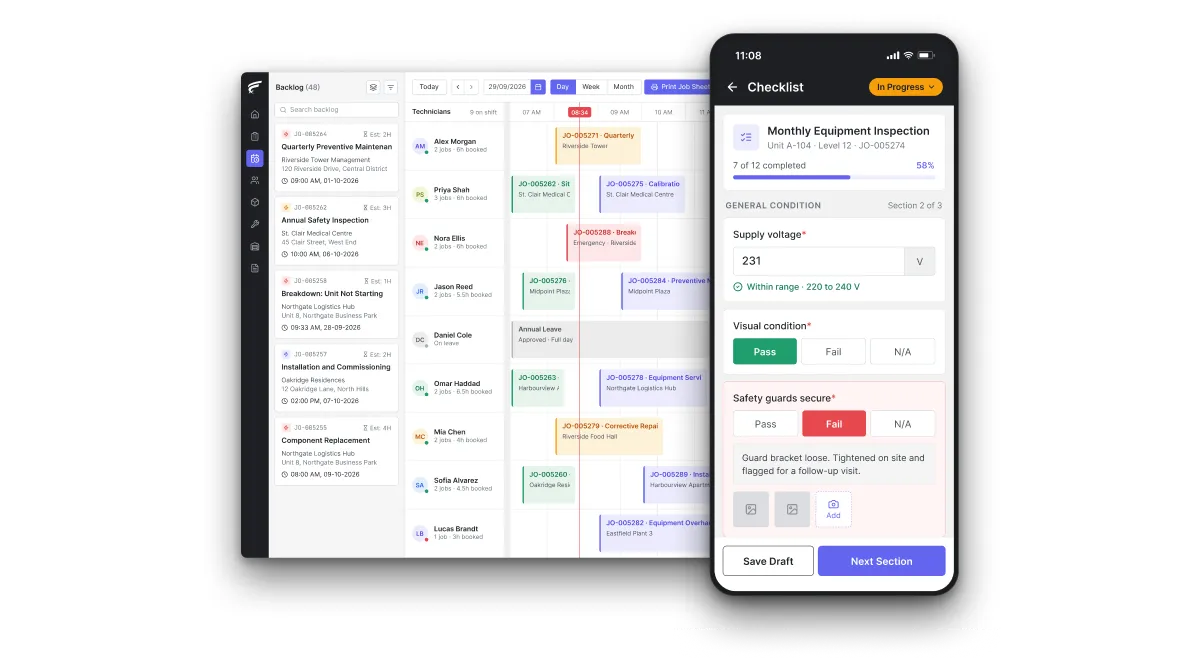
FieldEx scheduling board on desktop with a technician's inspection checklist open on the mobile app, as used by fire protection contractors

FieldEx is a field service and asset management (FSM+CMMS) application for Malaysian fire protection, fire alarm, security and closed-circuit television (CCTV) contractors. Each client's extinguishers, hose reels and sprinklers get their own record, and so do alarm panels, cameras and recorders. Planned preventive maintenance (PPM) and inspections run to schedule, and failed checks open repair jobs. Signed job sheets go back to the client and the fire safety manager.

What FieldEx does for fire, alarm and CCTV contractors

A Malaysian fire and security contractor answers to three people at once. They are the client, the client's fire safety manager, and the Bomba officer who inspects before the fire certificate is renewed. FieldEx gives all three the same answer from one place, the installation's own record. Book a demo to see it with your own clients, or read our Field Service Management Software Guide.

Client premises and every installation

  • One site per client premises, with its address, map pin, person in charge and service zone. Every installation, job and PPM plan sits under it.
  • One asset per extinguisher, hose reel, hydrant, sprinkler control valve and fire pump, in Asset Management.
  • One asset per alarm panel, intruder alarm, CCTV camera, network video recorder (NVR) and access controller.
  • Each asset holds its serial number, specs and warranty. Technicians take photos on the job.
  • Panels with their zones and devices beneath them, and recorders with their cameras, each keeping its own history.
  • Printable QR or barcode stickers for each unit, and a log of every edit with the user and time.

Extinguisher, alarm and sprinkler cycles

  • Recurring inspections for each equipment type, from daily rounds to yearly checks, each tied to the checklist for that equipment.
  • Certifications can be tracked on supported schedules, with reminders before the due date., such as the yearly Perakuan Bomba. Each notes the issuing authority and keeps the document on file.
  • Certification types can have reminders before the due date. Inspection records include a completion date, result, remarks and linked checklist., through Compliance Documentation.
  • A dashboard of overdue extinguisher, alarm and sprinkler work, what falls due in the next 7 days and what was finished in the last 7 days. You can view it by equipment type, team or zone.

PPM for each maintenance contract

  • Asset PPM and site PPM plans that raise the monthly, quarterly and yearly jobs on their own. Each step of the cycle has its own checklist and technician.
  • A fixed calendar or a cycle counted from the last finished visit, with missed PPM moved forward after a set overdue period.
  • A single plan rolled out to many premises, adding newly installed equipment that fits its rules, in Preventive Maintenance Planning.
  • Maintenance contracts with start and end dates, joined to the equipment and PPM plans they pay for.

Checklists, defects and follow-ups

  • Checklists use single-select questions. Technicians can attach photos to the job.
  • Questions drafted with AI from a short description or a PDF or PNG of your existing checklist or procedure.
  • A "fail" answer opening the repair job and its tasks at once, and scheduling a recheck if you want one.
  • Inspections record their completion date, result, remarks and linked checklist.

Breakdowns, complaints and response targets

  • A QR code at each premises that opens a fault form without a login, with photos or video.
  • A branded Customer Portal where clients log requests and pick a visit date.
  • Each fault landing in the backlog as a time-stamped job, ready for dispatch.
  • Jobs given out by skill, availability and shift, in Scheduling and Dispatch. Leave, zone and live location count too, with drag-and-drop for the odd ones.
  • Response and repair targets per client, counted in working hours, with a warning before a target is missed and an alert once it is.

Technicians, van stock and the app

  • The FieldEx Mobile App on each technician's phone. It shows each unit's past jobs, its checklist, a job form with number fields for pressure readings, and the parts in the technician's van stock.
  • A sticker scan that opens the unit and its inspection, with watermarked photos, markings on the photo and the client's signature.
  • Jobs and tasks can be downloaded and worked offline, with check-in, check-out and travel synced later.

Your own refill workshop, test kit and vans

  • Refill machines, hydrostatic test pumps, detector testers and meters kept as company assets, each with its serial number and location.
  • Calibration and certificate dates for each instrument, with reminders before they lapse and the certificate on file.
  • Service vans on their own maintenance plans by date or odometer reading, with each van's history on its record.

Job sheets and client reporting

  • A job sheet PDF for each visit, emailed with a log of when it went out.
  • The job sheet lists the equipment, fault, fix, parts and prices. It also shows time in and time out, photos and the client's sign-off.
  • Clients and fire safety managers seeing their equipment, last-serviced dates and coming PPM in the portal.
  • Reports on inspections, defects, equipment and premises, in Reporting and Analytics. You can download them as CSV, Excel or PDF, or email them on a timetable.

How early must a Perakuan Bomba renewal be filed, and under which rules?

At least 30 days before the certificate expires, on the form in the Third Schedule. Section 28 of the Fire Services Act 1988 (Act 341) says every designated premises needs a fire certificate, renewable every year. Regulation 4 of the Fire Services (Fire Certificate) Regulations 2001 sets the timing. The owner applies for renewal at least 30 days before expiry, on the form in the Third Schedule. A late renewal isn't accepted, so the owner must apply for a new certificate.

What FieldEx does about it

  • Each client's certificate date on file: the Perakuan Bomba can be kept as a yearly certification on the main fire panel asset. It records the expiry and the issuing authority.
  • Reminders that beat the 30-day cut-off: they go out ahead of expiry, timed so your pre-renewal service is done before the 30-day line.
  • Every premises on one list: the dashboard lists certificate due dates across all clients, filtered by zone and sorted by due date.
  • The service behind the renewal: the visit that prepares the building for inspection runs as its own job with a checklist for each installation.

What does JBPM need to see before it issues or renews a fire certificate?

An inspection that finds every fire safety installation in good condition, plus three documents. Section 29(4) of the Fire Services Act 1988 sets the condition: an inspection that finds adequate fire-fighting equipment or fire safety installation. Bomba's customer charter then issues the certificate within 5 days of the fee being paid. Under PU(A) 290/2020, the application must also include three documents. They are a certificate of establishment of a fire safety organization, a copy of the Fire and Emergency Response Plan, and a copy of a Fire Safety Report.

What FieldEx does about it

  • Installations checked before Bomba arrives: a pre-inspection job can carry tasks for every system on site, from the alarm panel to the hose reels. Each task has its own result.
  • Defects closed in time: any failed item opens its repair job straight away, so it can be fixed and rechecked before the inspection date.
  • Reports for the fire safety report: service records, photos and job sheets for each installation can be downloaded for the client's own fire safety report.
  • Records the client can download: the client sees each unit's last-serviced date in the customer portal, and job reports list every visit by site and period.

Who sits on a fire safety organization, and how does that change the contractor's work?

One fire safety manager and at least three fire safety officers, and the fire safety manager becomes your main contact for records. Section 27A of the Fire Services Act 1988 places a duty on the owner, occupier or manager of designated premises. They must set up a fire safety organization (FSO). Regulation 6B of PU(A) 290/2020 sets out who is in it. The owner, occupier or manager appoints them.

What FieldEx does about it

  • The fire safety manager as a site contact: the FSO's manager and officers can be kept as contacts on the premises record. They sit separately from the main client contact.
  • Records they can open themselves: through the customer portal, the client's team sees installations, last-serviced dates, upcoming asset maintenance and job sheets.
  • Notified when work is done: completion emails and job sheet PDFs can go to the fire safety manager as well as the account owner.
  • Remedial work tracked: any fault found on the visit becomes a scheduled repair job on the same panel.

Who is allowed to service fire extinguishers in Malaysia, and to what standard?

A competent person registered with JBPM in the fixed or portable installation category, working to MS 1539 Part 4. The Fire Services (Competent Person and Fire Safety Contractor) Regulations 2026, in force since 3 February 2026, set the bar. The person has served at least 5 years as a fire officer, or has at least 1 year of supervised experience and has attended the category's course. The eFEIS FAQ names MS 1539 Part 4 for extinguisher maintenance. JBPM's pages don't publish a service interval. As an international comparison, the UK's BAFE summary of BS 5306-3 sets a yearly basic service.

What FieldEx does about it

  • Extinguisher jobs to competent persons only: APA servicing jobs can require their matching skill, so they reach only the technicians who hold it.
  • Your registration on the calendar: your company's eFEIS registration can be tracked with its renewal schedule, due date and automatic reminders.
  • Each unit with its own service date: every APA is an asset with its type, size, location and serial number, and its own yearly cycle.
  • Shutdown visits planned ahead: the shutdown job can be scheduled in advance with its tasks for every device on the list.

How long can an extinguisher cylinder be used, and what does its eFEIS sticker record?

A red cylinder lasts 10 years from its month of manufacture, and a unit already inspected by JBPM carries an H13 receipt or an eFEIS barcode or QR code sticker. The eFEIS FAQ sets both. Every extinguisher on the premises must be registered in eFEIS, with its serial number and exact location. A unit whose registered serial number doesn't match the cylinder fails the inspection.

What FieldEx does about it

  • The sticker number on the unit: each extinguisher's eFEIS barcode can be recorded on its asset alongside your own label.
  • A 10-year end date per cylinder: the manufacture date sits on the asset, so each cylinder's 10-year end date can be worked out from its record.
  • Replacements planned, not discovered: asset reports can list cylinders by manufacture date and client, so replacements can be quoted ahead.
  • Units out and back: extinguishers taken back to the workshop move between stock locations. You always know which are on site and which are with you.

Which Malaysian standards and by-laws cover extinguishers and fire alarm systems?

MS 1539 for extinguishers and the MS 1745 series for fire alarms, with UBBL by-laws on top. For portable extinguishers, the eFEIS FAQ lists the rules JBPM applies:

  • By-law 227 of the Uniform Building By-Laws 1984 (UBBL).
  • PU(A) 463/2021 on Bomba special duty fees.
  • MS 1539 Parts 1 to 4 and 6, with Part 4 covering maintenance.

For alarms, Standards Malaysia's 2025 list of mandatory standards includes the MS 1745 series on fire detection and fire alarm systems. One example is Part 4:2004 on power supply equipment, made mandatory by Bomba through UBBL by-laws 237 and 241.

What FieldEx does about it

  • Checklists built from the standard: the service checklist for each equipment type can follow the clauses you work to, with reference photos for each item.
  • Faster checklist setup: questions can be drafted with AI from a PDF or PNG of your existing checklist or procedure, then edited.
  • One checklist per equipment type: extinguishers, alarm panels and power supply units each open their own checklist when scanned.
  • Faults passed to the contractor: a failed monthly test can raise a job in your backlog straight away.

Must a fire alarm in designated premises be linked to the nearest Bomba station?

Yes. Paragraph 3 of the Fire Services (Designated Premises) Order 1998 says all designated premises must be connected to the nearest fire station, electrically or by telephone. That way an alarm is transmitted immediately and automatically. Jabatan Kerja Raya (JKR) sets the same link in its addressable fire alarm specification, Section 3.6 (2016). The main fire alarm panel must link to the nearest JBPM station through the Central Monitoring System (CMS).

What FieldEx does about it

  • The CMS link as part of the panel: the transmission unit can sit as a component under the main panel, with its own checks.
  • Link checks on every visit: the panel checklist can include a question on the CMS signal, and a fail opens the repair job at once.
  • Faults timed to the minute: the job records when the fault was reported, when the technician checked in and when it was cleared.
  • Repairs from failed doors: a failed closer or damaged seal creates its repair job with the photo attached.

How often should a fire alarm system be inspected in Malaysian buildings?

A visual check every month, and a full service every 6 months. A Malaysian public-sector example gives the monthly check. The Sabah State Health Department published a fire safety guideline for health facilities (first edition, August 2016). It asks for a visual check of the fire alarm system every month. Every result, maintenance and repair goes into a monthly report. BS 5839-1:2025, the UK code of practice, keeps a six-monthly service. The Institution of Engineering and Technology (IET) notes that visits can now fall between 5 and 7 months.

What FieldEx does about it

  • Monthly checks on a site plan: the monthly visual check of each alarm system runs as a site PPM plan with its own checklist.
  • A monthly report without retyping: every result, repair and remark from the month can be pulled into a report by premises and exported.
  • Six-monthly servicing alongside: the full service is a separate visit in the same cycle, with a different checklist and technician if needed.

Who is responsible for fire-fighting equipment in a strata building with a JMB or MC?

The joint management body (JMB), and later the management corporation (MC), so they are your client for common-property equipment. Section 21(1)(a) of the Strata Management Act 2013 requires the JMB to properly maintain and manage the building and common property. The JMB keeps it in good and serviceable repair. When an MC takes over, the Strata Management (Maintenance and Management) Regulations 2015 (third schedule) require it to keep installations and equipment in good and serviceable repair. It must also renew or upgrade them where necessary. By-law 18(4) of the same regulations bars any parcel owner from removing or tampering with fire-fighting installations and equipment.

What FieldEx does about it

  • Common-property equipment under the development: hose reels, hydrants, alarm panels and pumps on common property sit under the development's site, each with its own PPM.
  • The committee kept informed: the JMB or MC sees equipment, coming PPM and job sheets in the customer portal.
  • Tampering reported and fixed: residents can report damaged or missing equipment through the site QR code, and each report becomes a job.
  • Investigation steps in order: an investigation job can hold ordered tasks, from the review of the log to the detector change, each with an owner.

What does a JKR CCTV specification expect from the maintenance contractor?

Service and maintenance of the whole installation during the Defects Liability Period, started as soon as the contractor is told. JKR's electrical branch specification for CCTV systems, L-S39 (2021), covers the Defects Liability Period. During that period, the contractor is responsible for service and maintenance of the complete installation. A skilled person does all the work. Clause 6.3 says work starts as soon as the contractor is told. The superintending officer (S.O.), the S.O.'s representative or the occupant can tell the contractor. The work must be finished within a reasonable time, except in emergencies.

What FieldEx does about it

  • Every call time-stamped: a report from the occupant or the S.O., by portal, QR form or phone, becomes a job with its creation time.
  • Targets per customer: response and repair targets can be set for each customer in working hours, with alerts before they are missed.
  • Cameras and recorders on PPM: each camera, NVR and switch runs on its own PPM plan during the defects period and after it.
  • Skilled-person jobs: CCTV jobs can require the matching skill, so they go only to qualified technicians.

How long should CCTV footage be kept under the PDPA?

As long as the client's purpose for recording needs, because the Personal Data Protection Act 2010 (PDPA) sets no fixed number. A Malaysian Bar proposal paper, on a guide to CCTV management under the PDPA, makes this point. The Act prescribes no minimum or maximum storage period for recorded images. But the retention period should reflect why the organization is recording. In its code of practice for communications, the Personal Data Protection Commissioner states the same retention principle. Personal data is held only as long as necessary for its purpose.

What FieldEx does about it

  • Retention checked on each visit: the recorder visit's custom job form can hold the days of footage kept, as a number field.
  • Settings changes on record: any change to the recording or retention setting is noted on the job with the client's sign-off.
  • Access to records limited: permissions can restrict who sees each client's sites and jobs, so CCTV details stay with the right team.
  • Handover when a contract moves: when a system changes hands, you can export its device lists and visit histories by client site.

How often must a fire contractor's own service vans and test kit be checked?

Commercial vans go for a routine inspection every 6 months, and test kit follows its maker's calibration interval. PUSPAKOM's inspection guide says the Road Transport Act 1987 requires every commercial vehicle to undergo a routine inspection every 6 months.

What FieldEx does about it

  • Vans on two cycles: each van's servicing runs on a plan by date or odometer reading, and its six-monthly PUSPAKOM inspection runs as a recurring certification.
  • Test kit with due dates: each pump, gauge and detector tester has its own record and calibration date, with reminders and the certificate on file.
  • Workshop machines on PPM: refill machines and compressors in your workshop run on their own maintenance plans.
  • Vans on plans: each service van is serviced by date or odometer reading.
Customer story

Chubb is an integrated security provider in Malaysia with 18 branches around the country. It covers alarm monitoring, surveillance systems, safes and access control for businesses and homes. Before FieldEx, technician updates came in only when the day ended and photos went through WhatsApp. Its story describes three changes:

  • A live dashboard of active, pending and finished jobs.
  • Photos that must be uploaded in the app before a job can close.
  • Alerts that help the team avoid service-level agreement (SLA) penalties.
  • Jobs that can't be marked complete until every standard operating procedure (SOP) step is done.
Read the Chubb Story

What Malaysian fire and security firms ask before switching to FieldEx

Which fire inspection software suits a Malaysian fire protection contractor?

One that tracks every APA, hose reel, alarm panel and camera for each client and runs monthly and yearly checks. It should remind you before each Perakuan Bomba expiry and send signed job sheets. FieldEx does this in one system, as the sections above describe. See our guide to CMMS Software.

Can FieldEx remind us before a client's fire certificate expires?

Yes, as the Perakuan Bomba section shows. The dashboard also lists every client's certificate by due date, so pre-renewal visits can be planned a quarter ahead.

Can we record extinguisher servicing unit by unit?

Yes. Each APA is an asset with its own sticker, location and service history. The technician scans it and completes its checklist, and FieldEx saves the result against that unit.

Can FieldEx flag extinguisher cylinders near the end of their life?

Yes, as the cylinder life section shows. An asset report by manufacture date can be shared with the client as a replacement quote.

Can the client's fire safety manager see our service records?

Yes, through the branded customer portal. When Bomba or an insurer asks for proof of servicing, the client's fire safety manager can download each job sheet there without waiting on you.

Can alarm, sprinkler and CCTV maintenance sit under one contract?

Yes. One maintenance contract can link every installation it covers, with each system on its own PPM plan and checklist.

Can we time our response to a fire alarm fault?

Yes. Service-level agreements count response and repair time in working hours, with a warning before the target is missed and an alert when it is.

Can technicians use the app in their own language?

Yes. The FieldEx mobile app runs in English, Bahasa Malaysia and Chinese. Jobs and tasks can be downloaded and worked offline, with check-in, check-out and travel synced later.

Can JMB residents report damaged hose reels or extinguishers?

Yes. The QR code for each development opens a fault form without a login, with photos, and every report becomes a job in your backlog.

How quickly can a fire and security contractor start on FieldEx?

There's no setup fee. Once we know your requirements and your data is ready, FieldEx can be implemented in as little as a week with standard features for small businesses. Larger setups and custom work take longer. Client premises and equipment can be uploaded. FieldEx helps with setup, and training is included. Onboarding is in person in Malaysia as well as online. See Setup and Training.

Keep every client's fire, alarm and CCTV equipment on one record

Book a Demo