Oil and gas service contractor software for PETRONAS-licensed contractors in Malaysia

Track each client vessel's CF, PSV tests and calibrations on schedule. Keep the records DOSH, Suruhanjaya Tenaga and your PETRONAS clients expect.

Book a demo
Updated 16 Oct 2026
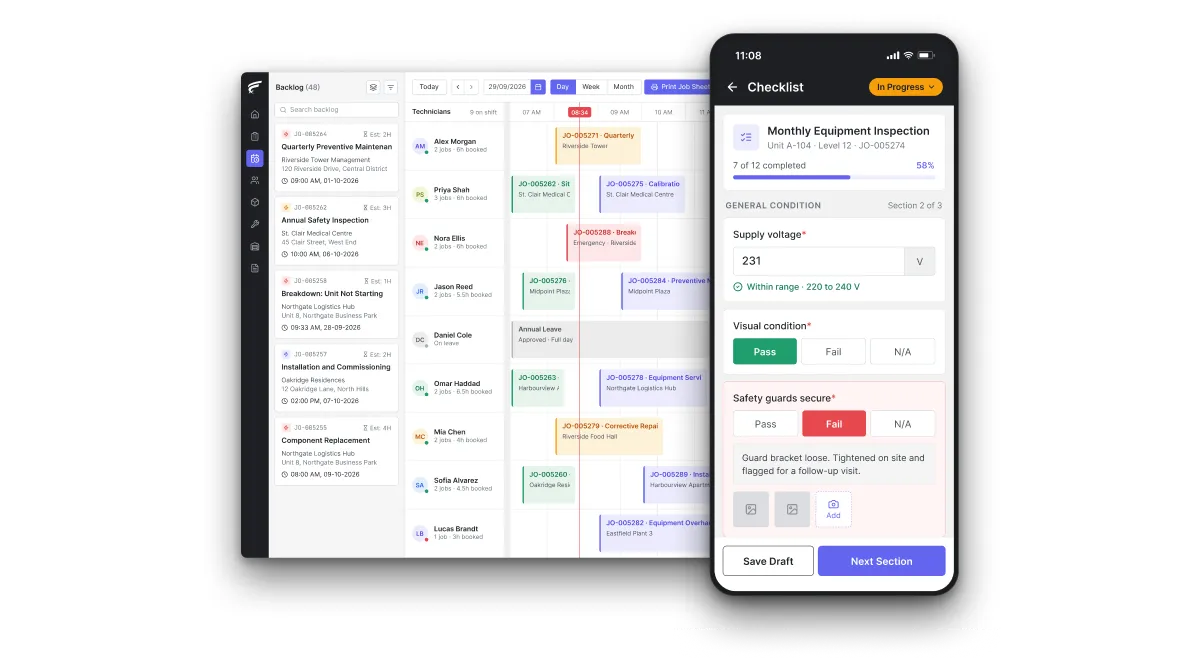
FieldEx scheduling board on desktop with a technician's inspection checklist open on the mobile app, as used by oil and gas service contractors

FieldEx is a field service and asset management (FSM+CMMS) application for PETRONAS-licensed contractors. It serves contractors who maintain, inspect, test, calibrate and rent equipment to Malaysian operators. It holds one record per client vessel, boiler, valve, pump and instrument. FieldEx runs DOSH certificate of fitness and special scheme dates, PSV tests and running-hour servicing on schedule. It logs every inspection with who did it, when and what was found.

What FieldEx does for Malaysian oil and gas service contractors

Malaysian oil and gas maintenance sits under several rule books at once. DOSH covers pressure vessels, boilers, pipelines and Control of Industrial Major Accident Hazards (CIMAH) sites. Suruhanjaya Tenaga covers gas installations, and PETRONAS covers the contractors who do the work. FieldEx keeps each item's dates, tests and reports on its own record. Your engineers and your client's plant engineer see the same history. Book a demo to see it with one of your clients' plant registers.

A register for every vessel, boiler and valve

  • One record per pressure vessel, steam boiler, PSV and pipeline valve.
  • One record per pump, compressor and genset.
  • Tag and serial numbers, specs and photos on each record, with drawings and datasheets.
  • Items placed under their unit or skid as components, such as a separator and its PSVs, each with its own history, in Asset Management.
  • Sites for each client plant, platform, terminal or pipeline section.
  • Map pins, service zones and contacts for each site.
  • QR or barcode stickers printed for each item, and a log of every edit with the user and the time.

CF, special scheme and Suruhanjaya Tenaga dates

  • Recurring certifications such as a 60-month CF under a special scheme or a two-year gas installation test. A 15-month CF cycle runs as a maintenance plan set in months.
  • Each PETRONAS or DOSH record marked due, overdue or done, with reminders sent by email, in the app or both.
  • The inspector, the date, the result and remarks on each record, through Compliance Documentation.
  • The CF, test certificate or examination report attached to the record.
  • A dashboard of what is overdue, due within 7 days or completed over the past 7 days, by site or equipment type.
  • Dashboard filters for equipment type, group or service zone.

PSV, valve and thickness tests

  • Test checklists, plus custom job forms with number fields for set, pop and reseat pressure and wall thickness.
  • A failed test that opens the repair job at once and schedules a retest.
  • Test cycles shortened for a single valve or vessel when its results call for it.
  • Reference photos, and checklist questions generated with AI from a PDF or PNG of your existing checklist or procedure.

PM by running hours, distance or date

  • PM plans for pumps, compressors, gensets and vehicles that trigger on running hours, kilometers or a date, whichever comes first, in Preventive Maintenance.
  • Separate checklists and technicians for the routine service and the major overhaul in the same plan.
  • PM that was missed rescheduled automatically after a set overdue period.
  • Each plan showing its equipment with the last and next service dates.

Instrument calibration for clients

  • Gauges, transmitters, gas detectors and analyzers on record, each with its own calibration cycle and reminders.
  • As-found and as-left values entered on custom job forms, set up with you during onboarding, recorded against the job.
  • Calibration certificates attached to each instrument and included with the client's job sheet.

Rental units and lifting gear

  • Rental units, lifting gear and offshore containers on record, each marked on hire, in the yard or under repair.
  • Jobs for each delivery and each return, with a condition checklist, photos and the client's sign-off.
  • Certificates and examination dates kept on each unit, with reminders before they fall due.
  • Transfers between bases with approvals and a consignment note PDF.
  • Thorough examinations and certificates on each unit, so their due dates travel with it.

Your own vans, detectors and test benches

  • Company vans and trucks on maintenance plans by date or odometer reading, with road tax and insurance renewals as recurring certifications.
  • Gas detectors, harnesses, rescue sets and torque tools as company assets, each with its serial number and location.
  • Calibration and examination due dates for each item, with reminders and the certificate kept on the record.
  • Workshop PSV test benches and reference gauges on their own calibration cycles.

Crew certificates

  • BOSIET, AGTES, AESP and permit-to-work training held as skills, each with an expiry date and reminders.
  • Offshore and confined-space jobs given only to crew holding current certificates.
  • Clients see their equipment, its status and downloadable job reports in the branded customer portal.

Crews offshore and at remote plants

  • The FieldEx Mobile App in English, Bahasa Malaysia and Chinese.
  • The item's past jobs, its checklist and number fields on the phone, plus watermarked photos and the sign-off.
  • Jobs and tasks can be downloaded and worked offline, with check-in, check-out and travel synced later.
  • Steps in a fixed order, so isolation and gas testing are ticked off before the work itself.
  • Jobs matched to people by skill, shift, leave and service zone, so a boiler job reaches a qualified steam boiler engineer.

Spares between shore base and site

  • Spares and tools held in each shore base, warehouse and technician's own stock, with transfers and barcode scanning.
  • Requisitions and transfers with one or more approval levels and a consignment note PDF for goods on the move.
  • Reorder and low-stock alerts per location, and every part used logged against the job and the equipment.

Job sheets and plant reports

  • A job sheet PDF for each completed job, emailed with a log of when it was sent.
  • The equipment, the finding and the fix, parts and time on site on each job sheet, plus photos and signatures.
  • Maintenance contracts with start and end dates, linked to the equipment and PM plans they cover.
  • Reports on jobs, equipment reliability and maintenance cost, exported or sent by email on a timetable, plus a dashboard of overdue certifications.

FieldEx also runs this kind of work for Telecom Infrastructure, Manufacturing Plant Maintenance, Heavy Machinery, Calibration & Test-Equipment Services, Biomedical Equipment, Equipment Rental & Leasing and Fleet Asset Management.

How often must a pressure vessel get its DOSH certificate of fitness inspection?

Every 15 months, unless the vessel is on a special scheme. DOSH's Certificate of Fitness Regulations 2024, P.U.(A) 99/2024, make a certificate of fitness (CF) valid for 15 months from the inspection date. Owners book the periodical inspection before it expires. Each pressure vessel must be available for internal inspection, unless it was designed not to need one. For plants on a special scheme, DOSH's Petroleum Safety Division conducts its own inspections and audits before renewing the certificate.

The interval changes each time a thickness survey changes the remaining life.

What FieldEx does about it

  • A 15-month CF per vessel: each vessel's CF inspection runs on a maintenance plan every 15 months, and the CF is kept on the vessel's record.
  • Preparation raised ahead: a preparation job for draining, cleaning and opening the vessel can be raised before the inspection date, with its own checklist.
  • The certificate kept: the new CF is attached to the completed record, with the inspection date and remarks.
  • Plant-wide due list: the dashboard and calendar show every vessel's CF that is overdue or coming due, by site or unit.

What is the DOSH special scheme of inspection, and how long can a certificate last under it?

It is DOSH's risk-based inspection (RBI) route, and it lets a CF last up to 60 months, with risk data collected at least every 12 months. DOSH's Special Scheme of Inspection Regulations 2025, P.U.(A) 25/2025, set those limits. A class A scheme is valid for 120 months and a class B scheme for 180 months from approval. DOSH's SSI RBI Guideline (second revision, November 2022) also has users collect risk data every 12 months, or under a monitoring program agreed with DOSH.

What FieldEx does about it

  • Two clocks per vessel: the 60-month CF and the yearly risk data collection run as separate recurring certifications on the same vessel.
  • The scheme's own dates: the scheme's 120-month or 180-month validity can run as a time-based site maintenance plan, which raises the renewal job ahead of the date.
  • Data collected on site: the yearly collection runs as an inspection, and thickness and other readings go in number fields on a custom job form.
  • Reports for the scheme: completed inspection jobs by vessel, site or date range are exported from reports for the RBI engineer.

What data must a plant collect before applying for risk-based inspection with DOSH?

At least three thickness measurements taken in operation, 12 months or more apart, with the application made 6 months before the CF expires. The Special Scheme of Inspection Regulations 2025 set that rule for steam boilers and pressure vessels. DOSH's SSI RBI Guideline adds that for existing time-based plant, the risk data comes from the last three regular inspections.

In practice, that means at least 2 years of thickness history and three inspection reports on file.

What FieldEx does about it

  • Thickness readings that build a history: wall thickness readings can be entered on custom job forms set up during onboarding and recorded against the job.
  • Three inspections on file: each inspection records its completion date, who did it, the result and remarks.
  • A six-month reminder: the CF due date shows on the vessel's record and the dashboard, so the SSI application can start 6 months ahead.
  • Measurement rounds spaced correctly: thickness rounds run yearly, counted from the last completed round.

Who must be in charge of a steam boiler, by heating surface?

The grade depends on the boiler's heating surface, single or combined, from a grade 2 operator up to a grade 1 engineer. The Twelfth Schedule of the 2024 CF regulations sets the bands:

  • Steam boiler operator grade 2: 100 m² or less.
  • Operator grade 1 on each shift: over 100 m², up to 200 m².
  • Operator grade 1, plus a grade 1 or 2 engineer: over 200 m², up to 500 m². The engineer can be visiting.
  • Steam boiler engineer grade 1 or 2: over 500 m², up to 2,000 m².
  • Engineer grade 1: over 2,000 m².

What FieldEx does about it

  • Grades as skills: steam boiler operator and engineer grades can be set as skills. Assignment rules send boiler jobs only to people with the required grade.
  • Shifts covered: shift schedules and leave are checked when jobs are assigned, so each boiler shift task goes to someone qualified and on duty.
  • Heating surface on record: each boiler's heating surface is kept in its specifications, so the required grade is clear.
  • Internal inspection prepared: the boiler's CF inspection gets a preparation job with its own checklist before the DOSH date.

How long does a PETRONAS license last, and when is it renewed?

A PETRONAS license and registration lasts 3 years, and the renewal can be submitted from 4 months before it expires. PETRONAS sets that in its License and Registration General Guidelines (v15.0, effective April 2026). The certificates behind the license must stay valid for the whole period, and vendors submit renewed certificates as they are renewed. Any change to the information declared is updated within 14 days.

What FieldEx does about it

  • Equipment certificates kept current: every CF, calibration and test certificate on your equipment runs as a recurring certification with reminders. Renewals are not missed mid-license.
  • Renewed certificates ready to submit: each renewed certificate is attached to its record, ready to send to PETRONAS.
  • License dates: FieldEx tracks a company license, such as the PETRONAS license, with its own renewal schedule, due dates and automatic reminders. The renewal window isn't missed.
  • Reports of what is expiring: the dashboard lists certifications overdue or coming due in a chosen time range, so the 14-day update can be planned.

How often must gas installations be tested and certified under Suruhanjaya Tenaga rules?

Every 2 years for non-domestic gas installations and every 3 years for domestic ones. Suruhanjaya Tenaga's Gas Supply Guidelines set those cycles, and the licensee draws up a comprehensive maintenance program for each installation. Regulation 21 of the Gas Supply Regulations 1997, on Suruhanjaya Tenaga's Competent Person Page, requires a competent person employed by the gas contractor to supervise the work. That registration is valid for 12 months and is renewed at least 2 months before it expires.

What FieldEx does about it

  • Two-year and three-year cycles: each non-domestic installation's two-year test runs as a recurring certification, and a three-year cycle runs as a maintenance plan set in years.
  • The maintenance program as a PM plan: routine maintenance between certificates runs on a site or asset PM plan with its own checklists.
  • Competent person on each job: gas jobs go only to people with the gas competent person skill. Each certification records the person who signed off.
  • Certificates for the client: the gas test certificate is attached to the job, and the client sees the job and its status in the customer portal.

What inspection and maintenance details must a CIMAH report cover?

It must describe the inspection, testing and maintenance programs for barriers and emergency facilities, including how routine maintenance is scheduled and ranked. That is DOSH's Guidance on the Report on Industrial Activity under the CIMAH Regulations 1996 (second edition, 2023). The report is reviewed and resubmitted every 3 years from the date of first submission. The CIMAH Regulations 1996 also require it to describe how the means of safe operation are tested, inspected and maintained.

What FieldEx does about it

  • Programs you can describe: every PM plan shows its equipment, frequency, checklist and last and next dates, ready to summarize in the report.
  • Critical items ranked: you can classify equipment into categories and subcategories, such as safety-critical barriers, and report on them separately.
  • A three-year review date: the CIMAH report's review runs as a time-based site maintenance plan every 3 years, which raises the review job ahead of the date.
  • Evidence behind the report: completed jobs can be exported from reports for any period, and test reports stay attached to each record.

What are the confined space entry permit rules for tank and vessel entry?

Each entry permit lasts for the task or 8 hours, whichever is shorter, with one extension of up to 4 hours. DOSH's Confined Space Code of Practice (2010) sets that limit. It also bars hot work when the explosimeter reads over 1% of the lower explosive limit (LEL). DOSH's page on the Authorised Gas Tester and Entry Supervisor (AGTES) describes the approval. The AGTES checks every procedure, test and item of equipment in the permit before approving it, and closes the permit when entry ends.

The 12 months start on the day of the inspection that found the fault.

What FieldEx does about it

  • Gas readings as numbers: oxygen and LEL readings are entered as exact values on the entry job, against the vessel being entered.
  • Permit steps in order: gas test, isolation and AGTES verification can be tasks that must be done before the entry task starts.
  • Permit on the job: the signed entry permit is photographed and attached to the job, with check-in and check-out times.
  • After the repair, arrange a separate check that the valve shuts off.

What maintenance and inspection rules apply to petroleum pipelines?

The operator keeps a written maintenance schedule, and the Approving Authority sets the type and interval of inspection. That is the rule in the Petroleum Pipelines Regulations 1985, P.U.(A) 85/1985, made under the Petroleum (Safety Measures) Act. The authority decides after considering what the owner or operator puts forward, and defects are made good within the grace period the Inspector sets. DOSH's Petroleum Safety Division inspects onshore pipeline integrity and audits offshore pipeline integrity management.

What FieldEx does about it

  • The written schedule as PM plans: patrols, valve checks and cathodic protection readings run as site PM plans along each pipeline section. The schedule prints from the plan.
  • Intervals set by the authority: inspection frequencies can be set to whatever interval the Approving Authority decides, per section.
  • Grace periods tracked: each defect becomes a repair job with a target date inside the Inspector's grace period. An alert can go out while it is still open.
  • Locations recorded: each section, valve pit and test point has a map pin, so findings are tied to a place.

How often should pressure safety valves be tested on oil and gas plants?

There is no single Malaysian interval: each plant's safety case and inspection scheme sets it. DOSH's CIMAH Guidance (second edition, 2023) gives one example measure, testing pressure safety valves (PSVs) every 3 months. The international code API 510 (11th edition, October 2022) sets relief devices on a 5-year cycle in typical process service and 10 years in clean, noncorrosive service. The interval is re-evaluated when a device is found heavily fouled or stuck shut.

What FieldEx does about it

  • Any interval per PSV: three-monthly, yearly or five-yearly tests are set per valve as recurring certifications or inspections.
  • Bench results recorded: the checklist records the as-found condition, and set pressure, pop and reseat values go in number fields on a custom job form.
  • Shortened after a bad result: create a repair job when a test finds a fault. Set the valve's maintenance plan to the interval required for that valve.
  • Tags and photos: technicians take photos on the job from the mobile app. Photos attach to the job.

What records should an oil and gas maintenance contractor keep for each inspection?

Record who did the inspection, when, on which equipment, what was done and the result. Attach the formal report where the law asks for one. There is no Malaysian list for every inspection. The US process safety standard OSHA 29 CFR 1910.119 names those five items for process equipment. In Malaysia, the 2024 CF regulations require the competent person who carries out a comprehensive examination to give a report with the particulars in the Fourteenth Schedule.

What FieldEx does about it

  • Five fields on every inspection: completion date, the person who performed it, the equipment's tag or serial number, the checklist used and the result.
  • Formal reports attached: comprehensive examination reports and third-party certificates are uploaded to the record.
  • Photos with a watermark: photos taken with the app's camera are watermarked automatically and can be annotated to point out the defect.
  • Client copies: job sheet PDFs are emailed to the client, with a log of when each was sent.

What HSE training does PETRONAS expect from a contractor's crew?

Each crew member needs the HSE trainings the contract's scope calls for, agreed with the PETRONAS Contract Owner and kept valid. PETRONAS's HSE Training Guideline for Contractor lists the trainings generally needed and says not every one is compulsory. Contractors document certificates of competency and show them as evidence when asked. The trainings named include:

  • Basic Offshore Safety Induction and Emergency Training (BOSIET), for offshore personnel.
  • Authorised Gas Testers and Entry Supervisor (AGTES), for gas testing and confined space supervision.
  • Authorised Entrant and Standby Person (AESP), for confined space work.
  • Permit to Work (PTW) training, for work that needs a permit.

What FieldEx does about it

  • Every certificate on the person: BOSIET, AGTES, AESP and PTW training are skills with expiry dates on each crew member.
  • Reminders before they lapse: reminders go out before a certificate expires, so renewals are booked in time.
  • Jobs only for certified crew: offshore and confined-space jobs go only to people holding the required current skill.
  • Who holds what, at a glance: the skills on each technician show the client which crew members are certified.

How often should a crew's gas detectors and confined space equipment be checked?

Inspect each item before every use, and have a qualified person examine entry and rescue equipment at least once a month. DOSH's Confined Space Code of Practice (2010) sets both rules and keeps a report of every examination available for inspection. It also asks for gas detectors calibrated to the manufacturer's recommendation. For portable detectors, the US OSHA Bulletin on Direct-Reading Monitors gives international advice: a bump test before each day's use, and a full calibration if it fails.

What FieldEx does about it

  • Your detectors and rescue sets as assets: each gas detector, tripod, harness and breathing set your crews carry has its own record, with serial number and history.
  • A monthly examination that runs itself: the monthly examination runs as a recurring inspection on each item, linked to its checklist, and shows on the dashboard when it falls due.
  • Calibration on the maker's cycle: each detector's calibration is a recurring certification on the manufacturer's interval, with the certificate kept on the record.
  • Out of use when it fails: a failed check raises a repair job, and the item's status can show it as out of service until it passes.
Customer story

AMRTUR is an oilfield services contractor in Southeast Asia working on offshore OCTG. It uses FieldEx across fleets, heavy machinery and multi-site logistics. Equipment is now serviced after 300 hours of use or 6 months, whichever comes first. Drivers fill trip and safety forms on their phones, tied to the client site. Every postponed maintenance date is logged with who changed it and why.

Read the AMRTUR Story

FieldEx questions from Malaysian oil and gas service contractors

Which software suits a Malaysian oil and gas service contractor?

One that keeps DOSH CF dates, PSV tests and running-hour PM on each item, sends crews out with their jobs on the phone and gives clients the job sheets. FieldEx does this in one system. See our guide to Field Service Management Software.

Can FieldEx track a 60-month CF under a special scheme of inspection?

Yes, as the special scheme section shows. The scheme's own 120-month or 180-month validity can run as a time-based site maintenance plan that raises the renewal job ahead of the date.

Can boiler jobs go only to the right grade of engineer?

Yes. Assignment also checks shifts and leave, so a boiler shift task never goes to a qualified engineer who is off duty.

Can offshore crews use the app without signal?

Yes. Jobs and tasks can be downloaded and worked offline, with check-in, check-out and travel synced later.

Can we keep thickness readings for each vessel?

Yes. Each reading stays on the vessel's history, and completed inspection jobs export from reports for any vessel, site or date range.

Can clients see their own equipment and job sheets?

Yes. The branded customer portal shows each client its own equipment, last-serviced dates, upcoming maintenance and job sheets. Job sheets can also be sent automatically to the client or anyone else you choose.

Can spares be moved from the shore base with approvals?

Yes. Requisitions and transfers can need one or more approvals, with a consignment note PDF for the items in transit.

Can FieldEx remind us before a Suruhanjaya Tenaga gas certificate expires?

Yes. Reminders go out by email, in the app or both. The competent person's own yearly registration can be tracked the same way, so the person signing off stays registered.

Can a pipeline section have its own PM plan?

Yes. Each section can be a site with its own PM plan, assets and map location, and one plan can cover many sections.

Can FieldEx link to the ERP our plant already runs?

FieldEx can connect to any open system through REST APIs and has connectors for QuickBooks and Xero. Existing plant registers can be uploaded.

Can we keep BOSIET and AGTES expiry dates for every crew member?

Yes, as the PETRONAS training section shows. Each technician's skills list also lets you show a client which crew members are certified before mobilization.

How soon can an oil and gas service contractor start using FieldEx?

There's no setup fee. Once we know your requirements and your data is ready, FieldEx can be implemented in as little as a week with standard features for small businesses. Larger setups and custom work take longer. Plant registers can be uploaded. FieldEx helps with setup, and training is included. Onboarding is in person in Malaysia as well as online. See Setup and Training.

How long does it take to set up FieldEx for an oil and gas service contractor?

There's no setup fee. Once we know your requirements and your data is ready, FieldEx can be implemented in as little as a week with standard features for small businesses. Larger setups and custom work take longer. Equipment registers can be uploaded. FieldEx helps with setup, and training is included. See Setup and Training.

Keep every client vessel's CF, every PSV test and every crew certificate on one record

Book a Demo