EV charger service for Malaysian charge point operators and EVCS contractors

Keep every charging bay, charger, isolation switch and fire blanket on record, and track each Suruhanjaya Tenaga and Bomba requirement and malfunction.

Book a demo
Updated 16 Oct 2026
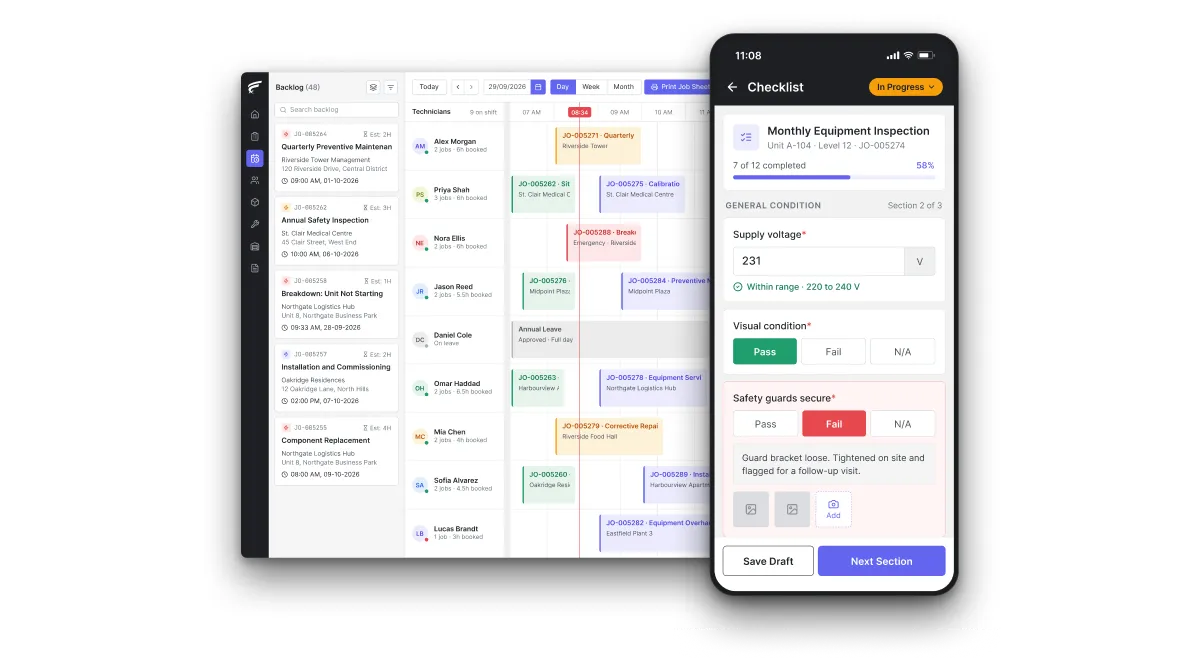
FieldEx scheduling board on desktop with a technician's inspection checklist open on the mobile app, as used by EV charger service teams

FieldEx is a field service and asset management (FSM+CMMS) application for Malaysian charge point operators (CPOs) and electric vehicle charging system (EVCS) contractors. It keeps every charging site and charger on record. FieldEx schedules competent person visits and planned preventive maintenance (PPM) and turns malfunction reports into tracked repair jobs. It keeps the Form G and H, test results and photos.

What FieldEx does for Malaysian CPOs and EVCS contractors

Running EV chargers in Malaysia means answering to three groups:

FieldEx keeps the competent person's visits, the PPM, the faults and the certificates on each charger's own record. Book a demo to see it with your own sites.

Every charging bay and charger

  • One site per mall, R&R, office tower, condominium or depot.
  • Each site holds its address, map pin, host contacts and service zone.
  • One asset per charger, isolation switch, fire blanket and sprinkler zone, in Asset Management.
  • Each asset holds make, rating, serial number, warranty and manuals.
  • Components under each DC charger, such as its power cabinet, dispensers and cables, each with a separate history.
  • A status on every charger, such as in use, malfunction or under repair, with a log of each change.

PPM and competent person visits

  • Monthly competent person visits as a site PPM plan, and yearly charger servicing as asset PPM, both raised automatically, in Preventive Maintenance.
  • Five-yearly installation testing as a recurring certification with reminders, and six-monthly RCD tests as recurring inspections.
  • Missed PPM rescheduled after a set overdue period, on a fixed calendar or counted from the last completed visit.
  • Form G, Form H and inspection reports attached to the completed record, through Compliance Documentation.
  • One plan across every charger of a model, picking up new chargers that match its criteria, in Preventive Maintenance.

Malfunction reports and repairs

  • A QR sticker on each charger that opens a fault form without logging in, with photos or video.
  • Requests from hosts and fleet owners through a branded portal, in the Customer Portal.
  • Each report lands as a time-stamped job in the backlog, in Work Order Management. Targets are set per host, with a warning before a target is missed.
  • A notification when a new fault repeats a recent job on the same charger, so recurring failures get a root-cause visit.

Technicians at the bay

  • Jobs offered to competent persons matched on skills, zone and availability first, then nearest and least busy.
  • A drag-and-drop scheduler for exceptions, in Scheduling and Dispatch.
  • The FieldEx Mobile App in English, Bahasa Malaysia and Chinese.
  • On each job, the app shows the charger's history and its checklist, and photos taken on the job are watermarked automatically.
  • Custom job forms with number fields for insulation and RCD results.
  • Isolation and permit steps as ordered tasks that must be done before work starts.
  • Jobs and tasks can be downloaded and worked offline, with check-in, check-out and travel synced later.

Cables, connectors and van stock

  • Charging cables, connectors, filters, contactors and boards in each store and each technician's van stock.
  • Reorder and low-stock alerts per store, with transfers and scanning, in Spare Parts Inventory.
  • Warranty periods on each part, and every part used logged on the job and the charger.
  • Check-in and check-out times on each task, and ordered safety steps that must be completed before the next task can start.
  • Jobs and tasks can be downloaded and worked offline, with check-in, check-out and travel synced later.

Job sheets, contracts and reports

  • A job sheet PDF for every visit, sent automatically to the host or anyone else.
  • The job sheet holds the charger, fault, fix and parts. It also shows time on site, photos and the host's sign-off.
  • Maintenance contracts with start and end dates, linked to the chargers and PPM plans they cover.
  • Reports on faults, repair times, PPM done and maintenance cost per site, in Reporting and Analytics.
  • Reports can be exported or emailed on a timetable.

Your own testers, vans and workshop

  • Insulation, earth loop and RCD testers on record as company assets, each with its serial number and holder.
  • Calibration due dates for each tester as recurring certifications, with reminders and the certificate on the record.
  • Service vans on maintenance plans by date or odometer reading, and workshop equipment on its own plan.
  • Bench equipment used to repair boards and cables on its own maintenance plan.

Evidence for hosts, funders and auditors

  • A completion PDF for every job, sent automatically to the host or anyone else, with a record of when it was sent.
  • The PDF holds the equipment, the fault and its resolution, and the parts used. It also shows check-in and check-out times, timestamped photos and the customer's signature.
  • A customer portal where hosts and fleet customers see their chargers, upcoming asset maintenance, job status and downloadable reports.
  • Reports on jobs, faults, repair times, maintenance cost and asset reliability.
  • Reports can be exported or emailed on a schedule, in Reporting and Analytics.

FieldEx also runs this kind of work for Solar & Microgrid O&M and Battery Storage.

Who can carry out maintenance on EV chargers in Malaysia?

A competent person registered with Suruhanjaya Tenaga (ST) must do the electrical work. ST's Guidelines on EVCS (GP/ST/No.54/2025) require all EVCS wiring work to be done by the relevant competent person under the Electricity Regulations. Sabah's ECoS EVCS guide is more specific about maintenance. Only a registered competent person working with an Electrical Service Contractor or Electrical Contractor may do it. A Form H test certificate is issued whenever testing work is done.

What FieldEx does about it

  • Competent persons matched to jobs: EVCS maintenance and testing require their matching skill, so jobs are offered only to registered competent persons.
  • Contractor teams in their own groups: each Electrical Service Contractor's team can be its own group, seeing only the jobs given to it.
  • Forms G and H on file: the certificates are attached to the charger's installation record, with the competent person's name.
  • Who signed, and when: every inspection records who carried it out and on what date.

Does an EV charging operator in Malaysia need a license from Suruhanjaya Tenaga?

Yes. ST's Guidelines on EVCS say anyone carrying out an activity under subsection 9(1) of the Electricity Supply Act 1990 in relation to an EVCS needs a license. In Sabah, the Energy Commission of Sabah's EVCS guide (P(E)/ECOS/008/2024) requires a license under Section 8 of the Sabah enactment.

What FieldEx does about it

  • The license on the site: the license is attached to the site. Its renewal runs as a recurring certification on the site's main charger asset.
  • Peninsular and Sabah sites apart: sites carry their service zone and classification, so reports can be run for ST or ECoS separately.
  • Renewal reminders: they go out ahead of each license's expiry, by email, in the app or both.
  • Filters on the right cycle: filter replacement can follow the calendar or the charger's session count recorded as a meter reading, whichever comes first. Fixed calendar dates apply to time-based plans.

How often must an EVCS installation be visited and tested by a competent person?

Inspect each charger as its manufacturer's manual recommends, on top of the site's competent-person visits. ST's Guidelines on EVCS base regular inspection on the manufacturer's recommended manual. Under the Electricity Regulations 1994, an installation up to 600 V supplied through switchgear of 100 A or more needs at least one competent-person visit a month. Every non-domestic installation is checked and tested by a competent person at least once every 5 years.

What FieldEx does about it

  • Monthly visits as PPM: each charging site's competent person visit runs as a monthly site PPM plan with its own checklist.
  • Five-yearly testing on the calendar: the five-yearly inspection and test is a recurring certification with its report attached.
  • Readings on each visit: custom job forms capture insulation resistance, earth and RCD results against each charger.
  • Repair times you can report: SLA timing and job durations are reported per charger, site or period.

What should an EVCS maintenance schedule in Malaysia include?

Plan three things: inspection and testing, routine maintenance, and replacement of parts near the end of their life. Sabah's ECoS EVCS guide lists those three schedules:

  • Inspection and testing schedules that meet the electricity regulations.
  • Maintenance schedules.
  • Replacement schedules for components approaching the end of their operating life.

Its maintenance procedures add a risk-based schedule and a record of the work actually done. In Peninsular Malaysia, ST's Guidelines on EVCS base regular inspection on the manufacturer's recommended manual.

What FieldEx does about it

  • Inspections, PPM and replacements in one place: each charger carries its testing, servicing and component replacement schedules as separate plans or recurring records.
  • Risk sets the frequency: high-use DC chargers can carry a shorter cycle than low-use AC wallboxes, through separate plans for each group.
  • End-of-life parts planned: asset age and maintenance cost reports help plan when cables, contactors and boards are due for replacement.
  • The record of what was done: every completed job, with its checklist answers and photos, is the maintenance record the guide asks for.

What maintenance records must be kept for EV chargers in Malaysia?

Keep every design and operating record of the installation, plus every inspection, test and maintenance record. Both the ST EVCS guide and the ECoS EVCS guide require this. The records must be periodically updated and accessible to relevant and authorized persons.

What FieldEx does about it

  • Everything on the charger: design drawings, Form G and H, test reports, PPM and repairs stay on the charger and site records.
  • Access for the right people: access profiles let each team, contractor or host see only the records they should.
  • Exports when ST or ECoS asks: you can filter records by site, charger or period and export them as CSV, Excel or PDF.
  • The right technician, fast: jobs are matched on skills, zone and availability first, then nearest and least busy. A supervisor is alerted if nobody matches.

What Bomba fire safety requirements apply to EV charging bays in basements?

DC charging bays above 22 kW on basement levels 1 to 3 need an automatic sprinkler system, a water mist system, a deluge system or a continuously operating water monitor. PLANMalaysia's GPP EVCB (amended July 2024) sets this for all building types, including multi-storey housing. DC bays at ground level and above need at least heat or multi-sensor fire detection where the building has no sprinklers.

What FieldEx does about it

  • Fire systems as assets at the site: the sprinkler or water mist zone serving the charging bays sits under the site. It has its own inspection schedule.
  • Fire checks and charger checks together: the monthly visit's checklist can cover both the chargers and the bay's fire protection.
  • Defects raised straight away: a failed fire safety answer opens a repair job and can flag the bay's chargers as out of use.

How many fire blankets are needed, and where must the isolation switch be, at a charging bay?

One vehicle fire blanket covers 1 to 10 bays, and 2 cover 11 to 20 bays. After that, add 1 for every further 1 to 10 bays. Those figures are in PLANMalaysia's GPP EVCB (amended July 2024). It also requires an automatic and a manual main isolation switch for each bay, at least 3 meters and no more than 15 meters from the charging point.

What FieldEx does about it

  • Blankets and switches on record: each fire blanket and isolation switch is an asset at the site, with its location and inspection due date.
  • A site check that counts them: the site checklist confirms the blankets and the switch distance on every visit.
  • Missing items replaced: a failed answer raises a job to replace a blanket or fix a switch, with parts from van stock.
  • Certificates that don't lapse: training certificates are tracked as records with their own renewal schedule, due dates and automatic reminders.

Must charge point operators in Malaysia report charger malfunctions?

In Sabah, the guidance expects it. The ECoS EVCS guide says charger status should be reported from time to time for efficient management. It doesn't say to whom. Status here means states such as in use or malfunction. ST's 2025 Guidelines on EVCS for Peninsular Malaysia don't set this reporting duty. Many operators track charger status anyway, so faults reach a technician quickly.

What FieldEx does about it

  • Status kept per charger: each charger's status shows whether it is in use, faulty or under repair, with a log of every change.
  • Malfunctions as jobs: each malfunction is a job with its report time, attendance and repair recorded.
  • Status reports on a timetable: reports by site, charger and status can be emailed to management or the host each week or month.

What must be reported to Suruhanjaya Tenaga after an EV charger fire or accident?

Report it to the Commission by the quickest means available, then follow up in writing. Section 33 of the Electricity Supply Act 1990 applies this to installation accidents and fires. It covers any that cause loss of life, hurt or serious damage to property. Sabah's ECoS EVCS guide sets the same duty under section 51 of the Sabah enactment.

What FieldEx does about it

  • The incident as a job: an incident job records the time, the charger, the site, photos and what was found.
  • Alerts to management at once: a workflow sends an email and in-app alert to the right managers as soon as an incident job is created.
  • Evidence for the written report: photos, inspection answers and the charger's maintenance history are on hand for the written report to ST or ECoS.

How often should EV charger filters, cables and RCDs be checked?

Check air filters and cables every year and test RCDs every 6 months. These intervals come from manufacturers and international guidance. ABB's Terra DC Wallbox manual says air filters must be inspected every 12 months and replaced if required, more often in dusty sites or with heavy use. The UK's IET says clients should be told about six-monthly RCD testing, using the test button if fitted.

What FieldEx does about it

  • Filters by date or sessions: filter checks follow the calendar or the session count entered as a meter reading, whichever comes first. Fixed calendar dates apply to time-based plans.
  • Six-monthly RCD inspections: each charger's RCD test is a recurring inspection with its own checklist.
  • Cable checks with photos: cracked connectors or exposed wires are photographed on the job, and the replacement is logged against the charger.

What PPE and permit to work are needed for EV charger maintenance in Malaysia?

Technicians need the right personal protective equipment (PPE), and every job needs isolation, lock-out and a permit to work (PTW). ST's Guidelines on EVCS require a competent person doing electrical work to use appropriate PPE. Sabah's ECoS EVCS guide gives examples such as safety helmets with face shields and anti-flash glasses. Its maintenance procedures cover isolation and lock-out, and PTW and approval processes.

What FieldEx does about it

  • PTW and isolation before work: each maintenance job opens with the permit and isolation as ordered tasks, and work can't start until both are done.
  • Required steps before closing: the de-isolation and handback task must be completed before the job can be closed.
  • Photos of the isolation: the technician attaches a photo of the lock-out, watermarked automatically, to the task.
  • Damaged kit out of use: a failed check can set the tester's status to out of service and raise a repair job.

How often should EVCS test instruments be checked and calibrated?

Inspect each tester and its leads before every use, and calibrate it at a SAMM-accredited laboratory on the manufacturer's cycle. Malaysia's SAMM scheme, run by Standards Malaysia, accredits calibration laboratories. The pre-use check comes from international practice. The US rule 29 CFR 1910.334(c) requires a visual check of test instruments, leads and probes before use. Any damaged item is removed from service until it is repaired and tested safe.

What FieldEx does about it

  • Every tester on record: each insulation, earth loop and RCD tester has its own asset record, with serial number and holder.
  • Pre-use checks on the job: the tester inspection can be a required first task on every competent person visit.
  • Calibration on its own cycle: each tester's calibration runs as a recurring certification, with reminders and the lab certificate on file.
  • Damaged kit out of use: a failed check can set the tester's status to out of service and raise a repair job.
Customer story

Chubb is an integrated security provider with 18 branches across Malaysia. It uses FieldEx for security system installation and field maintenance. Its story reports 50% more tasks completed each day and a 20% rise in first-time fix rates. Its story says technicians upload mandatory photos in the app, and automated alerts help avoid SLA penalties. It's a different industry, but the same pattern: fast repairs on equipment spread across many customer sites.

Read the Chubb Story

Questions Malaysian CPOs and EVCS contractors ask about FieldEx

Which EV charger service software suits Malaysian CPOs?

Choose software that covers the ST and Bomba work described above on each charger's own record. FieldEx does this in one system, with field service and maintenance management together. See our guide to CMMS Software.

Can FieldEx schedule monthly competent person visits for every charging site?

Yes. One site PPM plan can cover all your sites, raising each visit job automatically with its checklist and due date.

Can drivers report a broken charger from the bay?

Yes. Each QR sticker is tied to its charger, so the driver's report lands as a job on the right asset, with no login needed.

Can FieldEx link with our charging management platform?

Yes. Through the FieldEx API, outside systems such as charging management platforms can create jobs and exchange data with FieldEx. FieldEx can connect to any open system through REST APIs and has connectors for QuickBooks and Xero.

Can mall and condo hosts see the work on their chargers?

Yes. Through the branded customer portal, each host sees its chargers, last-serviced dates and upcoming asset maintenance. Hosts also see job status and job sheets.

Can we check Bomba items such as fire blankets on the same visit?

Yes. The monthly visit can carry one checklist for the chargers and the bay's fire items together.

Can technicians follow PTW and lock-out steps in the app?

Yes. Each step is an ordered task in the app, and the technician can attach a photo of the lock-out to it.

Can we track cables and connectors in each van?

Yes. Each technician's van stock and each store shows its quantities, and parts can be scanned on the phone.

Does the app work in basement car parks?

Yes. Jobs and tasks can be downloaded and worked offline, with check-in, check-out and travel synced later.

How soon can our charging sites be live on FieldEx?

There's no setup fee. Once we know your requirements and your data is ready, FieldEx can be implemented in as little as a week with standard features for small businesses. Larger setups and custom work take longer. Sites and chargers can be uploaded. FieldEx helps with setup, and training is included. Onboarding is in person in Malaysia as well as online. See Setup and Training.

Put every charging site's PPM, certificates and faults on one record

Book a Demo

See your chiller and AHU PPM cycle running in FieldEx

Book a Demo

See your chiller and AHU PPM cycle running in FieldEx

Book a Demo