Cell tower maintenance software for towers, rooftops and fiber sites

Keep every structure, battery string and generator on its own record. Send the right crew to each fault and keep the evidence carriers ask for.

Book a demo
Updated 19 Oct 2026
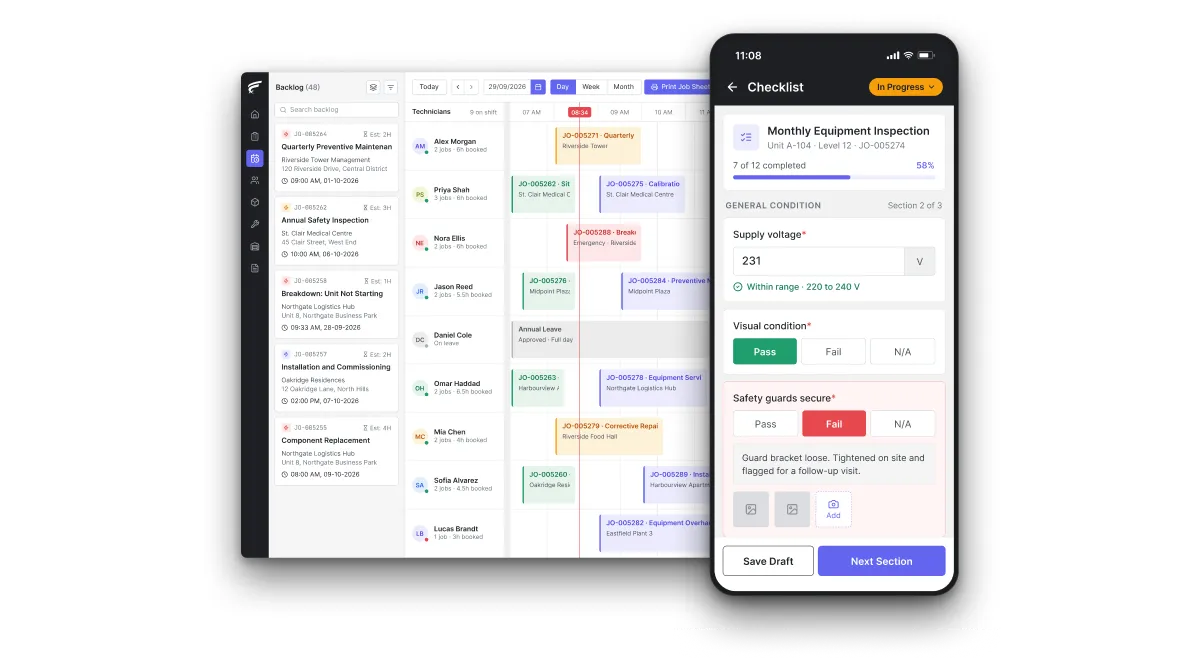
FieldEx scheduling board on desktop with a technician's inspection checklist open on the mobile app, as used by telecom tower crews

FieldEx is a field service and asset management (FSM+CMMS) application for tower companies and telecom maintenance contractors. It keeps each site's tower, antennas, power plant and shelter on record. FieldEx runs structure inspections, lighting checks and battery and generator maintenance on schedule. It turns faults into tracked jobs with restoration targets and keeps the photos, readings and reports from every visit.

What FieldEx does for tower and telecom site teams

A telecom portfolio is hundreds of remote sites. Each has a structure that needs periodic assessment and power equipment that keeps the radios alive when the grid drops. A carrier is waiting for the next fault to be cleared. FieldEx puts the planned work, the faults and the evidence on the same site and asset records. A crew arriving at a site sees what was done there last and what is due. Book a demo to see it on your own site list.

FieldEx keeps all of it on the site's own records. The audit, the PPM visit and the fault repair for each tower sit together. Book a demo to see it with your own sites.

Sites, structures and power plant on record

  • A site record for every tower, rooftop and fiber cabinet location.
  • Each site holds its address, map pin, access contacts and service zone, plus the customers and projects it belongs to.
  • An asset record for each structure, antenna and shelter.
  • An asset record for each rectifier, battery string, generator and air conditioner.
  • Each asset holds serial numbers, specifications, photos, warranty details and attached drawings.
  • Parent and component levels, so a power system and its rectifier shelf and battery strings each keep their own history, in Asset Management.
  • Access letters, site plans and landlord contacts attached to the site, and a change history on each asset of who edited what and when.

Preventive maintenance by site and by asset

  • Site maintenance plans for whole-site visits and asset plans for individual generators, battery strings and air conditioners, each creating its jobs automatically.
  • Triggers on the calendar, on generator running hours, or on whichever comes first.
  • Different checklists and technicians for the monthly, quarterly and annual points in the cycle, with missed visits rescheduled after a set overdue period.
  • One plan across hundreds of sites, picking up new assets that match its criteria, in Preventive Maintenance.

Structure audits, lighting checks and certificates

  • Recurring inspections and certifications can be scheduled by asset type. Due, overdue and completed status appears on each record., with the inspecting body recorded.
  • Due, overdue and completed status appears on each record. Certification reminders can be sent before due dates..
  • The date, the person who did it, the result and remarks on each inspection, with the engineer's report attached to the certification record, through Compliance Documentation.
  • A dashboard of overdue structure audits and lighting checks, those due in the next 7 days and those completed in the last 7 days.

Faults and restoration targets

  • Faults logged by the office, by the customer through a branded portal, or automatically from inspection answers.
  • Each fault at a tower or site becomes a job ready to assign, in Work Order Management.
  • Service-level agreements with several stages, such as respond, restore and close, each with its own at-risk and violation alerts against business hours.
  • SLA targets can apply to all customers or to a specific customer, with valid-from and valid-to dates and, optionally, an asset. Timed steps can have at-risk and violation alerts.
  • A notification when a new fault repeats a recent job on the same asset, so repeat failures are spotted early.

Crews on the road and on the tower

  • Automatic assignment by skill, availability, shift and leave.
  • Assignment also follows service zone and live location, in Scheduling and Dispatch.
  • A drag-and-drop scheduler for exceptions.
  • Each job on the FieldEx Mobile App with the site's history, the right checklist, number fields for voltages and readings, and watermarked photos.
  • Check-in and check-out at the site, and travel logged with distance and duration on a map.
  • Jobs and tasks can be downloaded and worked offline, with check-in, check-out and travel synced later.
  • Jobs and tasks can be downloaded and worked offline, with check-in, check-out and travel synced later.

Spares in warehouses and vans

  • Rectifier units, batteries, lamps, filters and cables held in each warehouse and in each technician's own stock.
  • Transfers and barcode scanning for every stock location.
  • Reorder and low-stock alerts per stock location, with approvals on transfers where needed, in Spare Parts Inventory.
  • Parts used recorded on the job and the asset, with a movement history of every transfer.

Your own climbing gear, test sets and vans

  • Harnesses, lanyards, fall arrest blocks and rescue kits on record as company assets, each with its serial number.
  • Battery testers, power meters and earth testers with calibration due dates and reminders, and the certificate on file.
  • Service vans on maintenance plans by date or odometer reading, with their van stock alongside.
  • Generators and tools at the depot on their own maintenance plans.

Records for tower owners and carriers

  • A completion PDF for every job, emailed with a record of when it was sent.
  • The PDF holds the site equipment, the fault and its resolution, and the parts used. It also shows check-in and check-out times and the customer's signature, and photos stay attached to the job.
  • A customer portal where the carrier or tower owner sees its sites' equipment, upcoming asset maintenance, job status and downloadable reports.
  • Reports on jobs, inspections, sites and asset reliability, in Reporting and Analytics.
  • Last site visits tracked, with reports exported or emailed on a schedule.

FieldEx also runs this kind of work for Oil & Gas, Manufacturing Plant Maintenance, Heavy Machinery, Calibration & Test-Equipment Services, Biomedical Equipment, Equipment Rental & Leasing and Fleet Asset Management.

How often should a cell tower structure be inspected?

Inspect a guyed mast every 3 years and a self-supporting tower every 5 years, or sooner at high-risk sites. Those are the recommended intervals in ANSI/TIA-222, the Telecommunications Industry Association's structural standard for towers. TIA released Revision I in October 2023. Shorter intervals may be needed for Risk Category III or IV structures and towers in coastal or corrosive environments. Sites with frequent vandalism may need them too. Owners and their engineers may lengthen or shorten them to suit each site.

What FieldEx does about it

  • An interval per structure type: guyed masts and self-supporting towers each carry their condition assessment as a recurring certification. It can run every 5 years for self-supporting towers. Guyed masts and coastal or high-risk sites can run every 2 years or sooner.
  • Site-by-site exceptions: a site that needs a shorter cycle gets its own schedule without changing the rest of the portfolio.
  • The engineer's report on file: the completed assessment records the date, the inspecting firm, the result and remarks, with the report attached.
  • Portfolio due dates in one view: the dashboard and reports show which structures are overdue or due soon, filtered by asset type or service zone.

What belongs on a tower site preventive maintenance checklist?

A tower site checklist covers the structure, the lighting controls and the power equipment at the base, plus an extra check after severe storms. TIA-222 also calls for a condition assessment after severe wind or ice storms or other extreme conditions. That comes on top of the routine interval. The US Occupational Safety and Health Administration (OSHA) and Federal Communications Commission (FCC) Communication Tower Best Practices guide says tower owners should keep towers properly maintained. It says they should carry out structural inspections regularly.

What FieldEx does about it

  • One checklist per visit type: the monthly site visit, the quarterly lighting control inspection and the post-storm assessment each have their own checklist. Each is grouped into sections for structure, lighting, power and shelter.
  • Storm checks on demand: after a storm, the office creates assessment jobs for the affected sites straight away, ahead of their scheduled dates.
  • Failed items become work: a failed answer, such as a damaged member or a loose earthing connection, raises a corrective job with its tasks. It can also book a follow-up inspection.
  • Checklists built from your own documents: AI can generate inspection questions from a description, or from a PDF or PNG of your existing checklist or procedure. You then edit them.

How often do tower obstruction lights have to be checked?

Watch a lit tower's lights every 24 hours, and inspect its light controls and alarms at least every 3 months. Under the FCC's rule 47 CFR 17.47, the owner of a lit, registered structure observes the lights at least once every 24 hours. That can be done visually or by watching a properly maintained automatic indicator. An automatic alarm system that detects and reports any light failure can replace the daily watch. All automatic or mechanical control devices, indicators and alarm systems are inspected at intervals of no more than 3 months.

What FieldEx does about it

  • A quarterly inspection per lit tower: each tower's lighting control inspection runs as a recurring inspection on a quarterly frequency, linked to its own checklist.
  • Each light system as an asset: the controller, flashers and beacons sit as components under the tower. Their faults and replacements stay apart from the structure's own history.
  • Due dates in one view: the dashboard lists lighting inspections that are overdue or due in the next 7 days, so no lit tower drifts past 3 months.

What must a tower owner do when an obstruction light goes out?

Report it to the Federal Aviation Administration (FAA) at once if a top steady-burning or flashing obstruction light isn't corrected within 30 minutes. Under 47 CFR 17.48, if the lights can't be repaired within the Notice to Airmen (NOTAM) period, the owner asks the FAA for an extension. The owner also reports a return-to-service date. 47 CFR 17.49 requires the owner record to show the nature of each failure and the date, time and nature of the repairs. The record is kept for 2 years and provided to the FCC on request.

What FieldEx does about it

  • A light outage as a timed job: a lighting failure logged as a job starts a service-level agreement. Its stages cover the 30-minute check, the repair and the return to service, each with at-risk and violation alerts.
  • Alerts to the right people: at-risk and violation alerts go to the users or groups you choose, the job owner or their manager.
  • The repair record kept with the tower: the failure, the work done, the parts replaced and the check-in and check-out times stay on the tower's record. They also appear on its completion PDF.
  • Two years and beyond: job history stays on the asset and can be reported or exported whenever the FCC asks for it.

How often should telecom backup batteries be inspected and tested?

Inspect valve-regulated lead-acid (VRLA) batteries monthly, add ohmic checks quarterly and capacity-test critical batteries every 2 years. The US Air Force pamphlet AFPAM 32-1186, based on IEEE 1188, sets the monthly inspection. It includes the battery area's ambient temperature, ideally 21°C to 27°C (70°F to 80°F). Quarterly checks add ohmic values and cell temperatures. India's Telecommunication Engineering Centre (TEC) VRLA monitoring guidelines ask for a physical inspection preferably monthly and at least every 2 months. Any cell whose voltage drifts more than 5% from the others needs further scrutiny.

What FieldEx does about it

  • Battery strings as assets: each string sits under its site's power system with its make, install date and warranty. Its age and history are always visible.
  • Custom job forms capture ambient temperature, float voltage, ohmic values and cell temperatures. Each reading is recorded against the job.
  • Monthly, quarterly and two-yearly work on one plan: the monthly inspection, the quarterly ohmic check and the capacity test each run at their own point in the cycle. Each has its own checklist.
  • Weak cells become jobs: a failed answer on the checklist, such as a cell out of tolerance, raises the replacement job. It can also schedule a recheck.

How often should a cell site standby generator be exercised?

Exercise a standby generator at least once a month for at least 30 minutes, and test its transfer switch monthly. NFPA 110 is the standard for emergency and standby power. Generator sets in service are exercised at least monthly for a minimum of 30 minutes. The monthly transfer switch test operates the switch electrically from the primary position to the alternate position and back again.

What FieldEx does about it

  • Calendar and running hours together: the generator's plan triggers on the calendar for the monthly exercise. It triggers on running-hour meter readings for its service, whichever comes first.
  • Run time and transfer test recorded: number fields capture the run time, load and fuel level. The checklist records the transfer switch test in both directions.
  • Meter history on the generator: every running-hour reading builds a history on the asset, so the next service date follows actual use.
  • Parts and fuel filters from van stock: filters and belts used on the job come out of the technician's own stock. FieldEx logs them against the generator.

What safety checks should a crew do before climbing a tower?

Start each work day with a tailgate meeting and equipment inspections, and don't rely on a safety climb until a competent person has inspected it. The OSHA and FCC best practices guide says contractors should begin every work day with a tailgate meeting. Daily equipment inspections follow immediately. All employees should certify their commitment to 100 percent tie-off at least once each year. A safety climb system should not be relied on as fall protection until a competent person has inspected it.

Service providers send MCMC audited quality of service reports every 6 months, plus a full report within 7 business days of any major disruption. MCMC's Kualiti Perkhidmatan page describes the six-monthly audited reports. The wired broadband guidelines set the deadline for major disruptions. It applies to any single disruption affecting 500 or more customers for 3 hours or longer.

What FieldEx does about it

  • The safety steps first: a climbing job opens with the tailgate meeting and the equipment inspection as ordered tasks. Nobody can start the climb task until both are complete.
  • The safety climb as an asset: each tower's safety climb system carries its own inspection record, with the competent person and the result recorded.
  • Climbing jobs to qualified climbers: climbing work requires its matching skill, so it is assigned only to technicians who hold it.
  • Evidence on the job: the completed checklist and photos of the equipment inspection are kept on the job record. Each technician's yearly tie-off certification is tracked with its due date and automatic reminders.

How should RF exposure be managed for technicians on antenna sites?

Check which antennas are live and coordinate with the operator before anyone works near them. The FCC's RF safety FAQ warns about maintenance workers who climb structures for painting, repairs or lamp replacement. They can be exposed to high levels of RF energy on an active tower or near a radiating antenna. In the UK, Ofcom's EMF license condition applies to licensees authorized to transmit above 10 W EIRP (6.1 W ERP). They must comply with the general public limits and keep records showing their compliance.

What FieldEx does about it

  • Exposure checks as a step: the job procedure includes the RF exposure check and the operator coordination as tasks. Both must be completed before work at height begins.
  • Site-specific instructions: the site's RF survey, signage plan and exposure zone drawings are attached to the site, and the technician sees them on the phone.
  • Who was on site, and when: check-in and check-out times on each task show who worked near the antennas and for how long.

How quickly must a wireless network outage be reported?

In the US, notify the FCC within 120 minutes of discovering a reportable outage, then file an initial report within 72 hours and a final report within 30 days. 47 CFR 4.9 sets those deadlines for wireless service providers. The rule covers any facilities they own, operate, lease or otherwise use.

What FieldEx does about it

  • Times recorded as they happen: each fault job holds its creation time, the technician's check-in and check-out, and the time it was closed.
  • Stages that match the clock: a service-level agreement with stages for attendance, restoration and close-out alerts the operations team before each target is missed.
  • Root cause on the record: the fault, the work done and the resolution are captured on the job and shown on its completion PDF. They are ready for the carrier's final report.

What records should a tower maintenance contractor keep for each site visit?

Keep each technician's training and certifications, inspection records for work equipment and, on lit towers, a log of every light failure and repair. The OSHA and FCC best practices guide says contractors should keep complete records of all employee training and certifications. They should make them available to carriers and tower owners as needed. The UK Health and Safety Executive's (HSE) brief guide to working at height requires a record of any inspection of work equipment, such as guard rails and working platforms. Under 47 CFR 17.49, the lighting record is kept for 2 years.

What FieldEx does about it

  • Every visit on the site record: jobs, inspections, readings, photos and parts used stay on the site and asset. A change history on the asset shows who edited what.
  • Equipment inspections recorded: work-at-height equipment can be kept as assets with their own recurring inspections and results. Inspection reports can be attached to a recurring certification.
  • Completion PDFs per visit: each job produces a PDF with the work performed, check-in and check-out times and the customer's sign-off.
  • Qualified people on record: each technician holds the skills that job types require, so climbing, power and fiber work reach the right people. Training and certification records are tracked with due dates and reminders, so they can be shown to carriers when asked.

How often should climbing harnesses and lanyards be inspected?

Check fall protection before its first use on every shift, and give harnesses and lanyards a detailed, recorded inspection at least every 6 months. OSHA's rule 29 CFR 1910.140(c)(18) requires inspection before initial use during each workshift for mildew, wear, damage and other deterioration. Defective components are removed from service. HSE's INDG367 leaflet recommends a detailed inspection at least every 6 months. It suggests every 3 months for frequently used lanyards on steel masts and towers with edges and protrusions. Detailed inspections should be recorded.

What FieldEx does about it

  • Each harness as an asset: every harness, lanyard and fall arrest block has its own record, with serial number and the technician or van it's issued to.
  • Detailed inspections on a cycle: each item's detailed inspection runs as a recurring certification, every 6 months or every 3 months, with reminders before it falls due.
  • The shift check as a task: the climbing job opens with the pre-use check, and the climb task can't start until it's done.
  • Results on the record: the inspector, result and remarks stay on each item, with photos attached to the job.

How often should a telco site genset be test-run?

Run each genset at least once a month for at least 30 minutes, following the international NFPA 110 standard. NFPA 110 also has the system's storage batteries, including electrolyte levels or battery voltage, inspected weekly.

What FieldEx does about it

  • Running hours as the trigger: each genset's PPM follows the calendar for the monthly run and running hours for servicing, whichever comes first.
  • Run results recorded: number fields log run time, fuel level and starting battery voltage against the genset.
  • Weekly battery checks: where the site needs them, weekly battery inspections run as a recurring inspection with a short checklist.

How often should riggers' harnesses and lanyards be inspected?

Check harnesses and lanyards before every climb, and give them a detailed, recorded inspection at intervals set by how hard they're used. DOSH's work at height guidance says equipment is maintained and inspected regularly. Inspection intervals depend on the environment, such as adverse weather or accidental damage, and on usage. The UK Health and Safety Executive's INDG367 leaflet is an international reference. It recommends a detailed inspection of fall arrest lanyards at least every 6 months, and every 3 months on steel masts and towers.

What FieldEx does about it

  • Each harness as an asset: every harness, lanyard and fall arrest block sits on record with its serial number and the rigger or van it's issued to.
  • Detailed inspections on a cycle: each item's detailed inspection runs as a recurring certification, every 6 months or every 3 months, with reminders before it's due.
  • Results on file: the inspector's result and remarks stay on the record, with photos attached to the job.
  • Test sets calibrated too: earth testers and battery testers carry calibration due dates, with the certificate attached.
Customer story

AlanDick runs telecom infrastructure operations in Brunei on FieldEx. Up to 26 team members are deployed daily to onshore and offshore sites, handling more than 70 jobs a month. Its story describes scheduling and dispatch by skill, availability and proximity, reminders for inspections and certifications, and a customer portal for service updates.

Read the AlanDick Telecom Customer Story

Questions tower companies and telecom contractors ask about FieldEx

What is the best software for cell tower maintenance?

It has to hold every site and its power plant and run each inspection on its own cycle. FieldEx covers this in one system, as the sections above describe. Compare approaches in our guide to Field Service Management Software.

Can FieldEx manage maintenance across hundreds of remote sites?

Yes, as the maintenance section describes. Reports by service zone then show which sites in each region are overdue.

Can we track rectifiers, batteries and generators at each site?

Yes, each as its own asset under the site. When a unit is swapped, the replacement gets its own record and the old one keeps its history.

Can FieldEx create fault jobs from our network monitoring alarms?

Jobs can be created automatically from other systems as well as from checklists, the customer portal and QR-code requests. FieldEx can connect to any open system through REST APIs and has connectors for QuickBooks and Xero.

Can different carriers have different restoration targets?

Yes, as the faults section shows. A target can also be scoped to one site asset, such as a hub site's power system.

Can our tower owner clients see the work done on their sites?

Yes, through the customer portal described above. Each client sees its own equipment with last-serviced dates.

Can technicians record battery voltages and generator hours on site?

Yes, as the battery and generator sections show. Readings stay on the asset, so a slow drift across visits stands out.

Can crews work at sites with no mobile coverage?

Yes. Jobs and tasks can be downloaded and worked offline, with check-in, check-out and travel synced later.

Can we manage spares held in vans and regional warehouses?

Yes. Transfers can need approval, so a part leaving a regional warehouse is signed off before it reaches a van.

How quickly can FieldEx be set up for a tower portfolio?

There's no setup fee. Once we know your requirements and your data is ready, FieldEx can be implemented in as little as a week with standard features for small businesses. Larger setups and custom work take longer. Sites and assets can be uploaded. FieldEx helps with setup, and training is included. See Setup and Training.

Put every tower, power system and fault on one maintenance record

Book a Demo