Healthcare CMMS for medical device inventory, inspection, PM and repair

A healthcare CMMS that gives every infusion pump, monitor and ventilator its own record, with each inspection, PM and safety test run on schedule.

Book a demo
Updated 16 Oct 2026
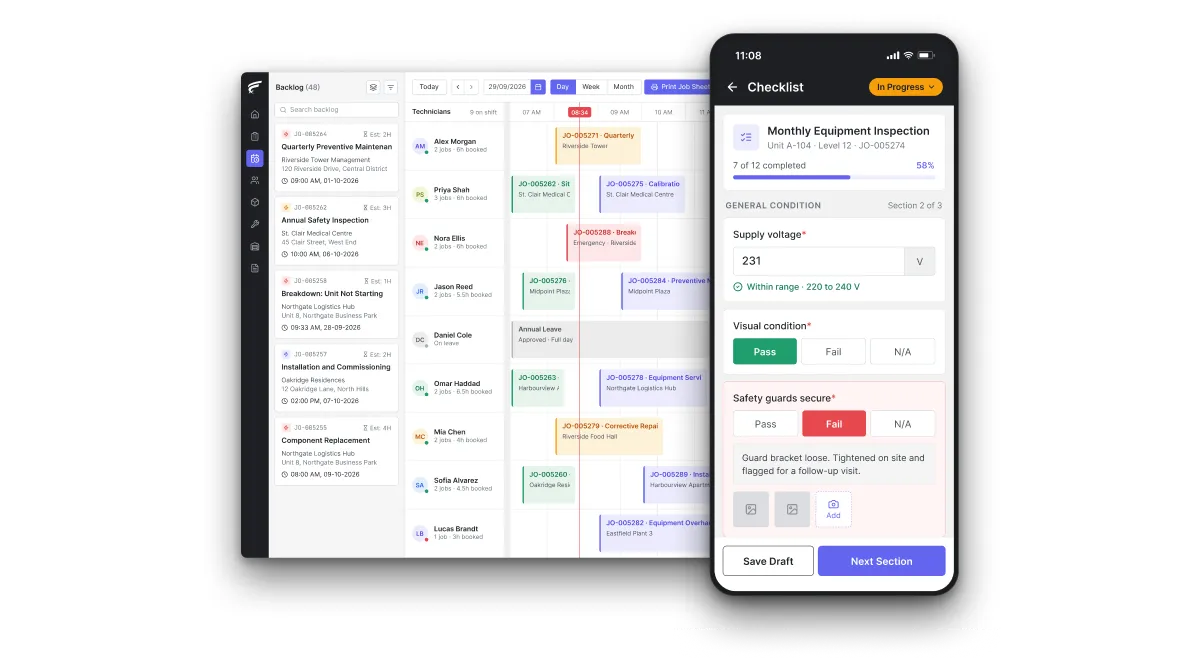
FieldEx scheduling board on desktop with a technician's inspection checklist open on the mobile app, as used by biomedical engineering teams

FieldEx is a field service and asset management (FSM+CMMS) application for hospital clinical engineering departments and medical equipment service companies. It keeps every device on record with its model, serial number and location. FieldEx runs inspection and preventive maintenance to the manufacturer's intervals and sends repairs to qualified technicians. Each device's test results, repairs and certificates stay together on its record.

What FieldEx does for clinical engineering teams

Healthcare technology management comes down to three things a surveyor will check. These are a complete inventory, every scheduled activity done on time, and a record that proves it. FieldEx runs all three on the device's own record. The acceptance check, every PM, each electrical safety test and every repair after a fault sit in one history. Anyone in the department can open it. Book a demo to see it with your own equipment list.

Every medical device on its own record

  • An asset record for every infusion pump, patient monitor, ventilator, defibrillator and ultrasound scanner.
  • Manufacturer, model and serial number on each record, with photos and warranty details.
  • Acquisition and depreciation information on each record.
  • Each device linked to its hospital site, with its location recorded.
  • Devices classified by type, category and subcategory.
  • Lifecycle statuses you define, such as in service, awaiting repair or retired.
  • Parent and component levels in Asset Management. An anesthesia workstation and its ventilator, or a central monitoring station and its bedside monitors, keep their own histories.
  • QR or barcode labels for every device, and a change history showing who edited each record and when.

Inspection and PM to the right interval

  • Preventive maintenance plans that create each visit automatically, by calendar or by meter readings such as operating hours or cycles, or whichever comes first.
  • Different checklists and technicians for different points in the cycle, such as a six-monthly performance check and a yearly full service.
  • Fixed calendar schedules or schedules that count from the last completed visit, with missed PM rescheduled after a set overdue period. Fixed calendar dates apply to time-based plans.
  • One plan for every device of a model, picking up new devices that match its criteria as they are added, in Preventive Maintenance.

Safety tests, calibration and certificates

  • Recurring inspections per device type, on the schedule each one needs, each linked to its own checklist.
  • Recurring certifications, such as calibration, on set frequencies. Each records the certifying body and sends reminders by email, in-app notification or both.
  • Certification records include the completion date, person, result, remarks and certifying body. A certificate or report can be uploaded when the certification is marked complete. Inspection records include the completion date, person, result, remarks and linked checklist.
  • A dashboard of overdue inspections and certifications, those due in the next 7 days and those completed in the last 7 days.

Fault reports from wards and clients

  • A QR code for each hospital or building that opens a fault-report form without logging in. The form takes the location, a description, contact details and photos or video.
  • A branded customer portal where client hospitals raise service requests, follow job status and download job reports, in the Customer Portal.
  • An alert by email or in-app notification when a new job repeats a recent job on the same device.
  • Service-level agreements with several stages, measured against business hours, with at-risk and violation alerts per client or device.

Biomedical technicians on the wards

  • Automatic assignment in Scheduling and Dispatch by skill and availability. It also checks shift, leave, service zone and live location.
  • A drag-and-drop scheduler for exceptions.
  • Each job on the FieldEx Mobile App. Technicians scan the device's label, see its history and answer the checklist. They enter test readings as numbers and add watermarked photos and a signature.
  • Jobs and tasks can be downloaded and worked offline, with check-in, check-out and travel synced later.

Spare parts and own stock

  • Spare parts held in each store and in each technician's own stock, with transfers, barcode scanning and approvals where needed.
  • Reorder and low-stock alerts per stock location, with a movement history of every transfer and part used, in Spare Parts Inventory.
  • Parts recorded on the job and the device, with manufacturer details and warranty periods kept on each part.

Your own analyzers, simulators and vans

  • Electrical safety analyzers, patient simulators, defibrillator analyzers and workshop tools on record as company assets, each with its serial number and location.
  • Calibration due dates for each instrument as recurring certifications, with reminders and the certificate kept on the record.
  • Service vans on maintenance plans by date or odometer reading, with each van's history on its own record.

Service contracts, reports and audit records

  • Service contracts with start and end dates, linked to the devices and maintenance plans they cover.
  • Completion PDFs in Work Order Management. Each shows the equipment, fault, resolution and parts used. It also records check-in and check-out times, attachments and a signature.
  • Each PDF emailed, with a record of when it was sent.
  • Reports on device reliability, maintenance cost, utilization and age, in Reporting and Analytics.
  • Inspection and certification due dates show on the CMMS dashboard.
  • CSV, Excel or PDF exports, or reports emailed on a schedule.

Must hospitals follow the manufacturer's maintenance schedule for every device?

Not always, but a hospital that leaves the manufacturer's schedule needs a documented program for doing so. The Centers for Medicare & Medicaid Services (CMS) covers this in its hospital guidance CMS QSO-25-24, released 5 September 2025. Hospitals that maintain equipment to the manufacturer's recommendations keep documentation of those recommendations and of the maintenance done. Hospitals that use alternate activities or schedules should develop, implement and maintain a documented alternate equipment management (AEM) program. The World Health Organization (WHO) starts from the same place in its Medical equipment maintenance program overview (2011). The manufacturer's maintenance manual sets the frequency of inspection and preventive maintenance (IPM).

What FieldEx does about it

  • The manual on the device: the manufacturer's service manual and maintenance schedule are attached to the device record. The source of each interval is on file.
  • A plan per route: devices kept to the manufacturer's schedule and devices on an AEM program run on separate maintenance plans. Each plan has its own interval and checklist.
  • Checklists built from your procedure: AI can generate inspection questions from a description, or from a PDF or PNG of your existing checklist or procedure. Your team then checks and edits them.
  • Every activity logged: each completed PM stays on the device record with its date, technician, checklist answers and readings.

Which devices have to stay off an AEM program?

Imaging equipment, therapeutic radiologic equipment and medical lasers stay on the manufacturer's schedule. The CMS guidance QSO-25-24 says diagnostic imaging and therapeutic radiologic equipment is not eligible for AEM. Nor are medical lasers, for which the US Food and Drug Administration (FDA) requires manufacturers to provide a schedule of maintenance. The same CMS guidance asks hospitals to identify critical equipment in their AEM program. That is equipment whose failure risks serious injury or death to a patient or staff person.

What FieldEx does about it

  • Risk and route on every device: device type, category and subcategory mark each device as high-risk, life-support, imaging or laser. The AEM-excluded devices are then easy to filter.
  • Fixed plans for excluded devices: imaging and laser equipment run on plans set to the manufacturer's intervals. These plans are kept apart from the plans used for AEM devices.
  • High-risk work first: high-risk and life-support devices can carry their own service-level agreement. A fault on a ventilator then raises an at-risk alert sooner than one on a lower-risk device.
  • Lists for the survey: reports filter the inventory by category or type and export it as CSV, Excel or PDF.

What does a medical equipment inventory need to contain?

Every device, owned or leased, with its identity and a record of its maintenance activities. The CMS guidance QSO-25-24 expects all equipment, whether leased or owned, to be listed in an inventory that includes a record of maintenance activities. That applies whether the device follows the manufacturer's recommendations or an AEM program. The WHO maintenance program overview lists the identifying data each device record should hold: a brief description, manufacturer, model, serial number and location.

What FieldEx does about it

  • Identity fields on every record: each device holds its description, manufacturer, model and serial number. It also holds its location, photos and warranty details. Categories tell owned and leased devices apart.
  • Activities and frequencies alongside: each device shows the maintenance plans and inspection schedules it belongs to, with last and next due dates.
  • Maintenance history in the same place: every job, inspection, certification and part used is listed under the device.
  • Rented devices tracked: devices on a rental contract show their contract, and whether each is on rent or returned.

What checks are needed before new medical equipment goes into use?

Performance and safety checks, done before the device's first use. The CMS guidance QSO-25-24 says all equipment should be inspected and tested for performance and safety before initial use and after major repairs or upgrades. The UK Medicines and Healthcare products Regulatory Agency (MHRA) adds an earlier step in its 2021 guidance Managing Medical Devices. Check that the specification of newly delivered devices matches the purchase order or tender specification.

What FieldEx does about it

  • Acceptance as a job: each new device gets an acceptance job with an ordered procedure. It can run a delivery check against the order, an electrical safety test and a functional check. An acceptance-test form captures baseline readings at handover. FieldEx stores them against the device and the job.
  • No release until it passes: designated tasks must be completed before the job can be closed. A device cannot be signed off with a step missing.
  • Readings kept as a baseline: the first test values are entered as numbers on the job, so later tests have a reference.
  • The schedule starts at once: FieldEx adds a device to any existing plan whose criteria it matches. Its first PM is already on the calendar.

Which standard covers in-service electrical safety testing of medical electrical equipment?

IEC 62353 does. IEC 62353:2014, published by the International Electrotechnical Commission (IEC), covers medical electrical equipment in use. It covers testing before putting into service and during maintenance, inspection and servicing. It also covers testing after repair and on recurrent tests. The MHRA explains in Managing Medical Devices why the product standard is not used for this. The tests in BS EN 60601-1 are designed for type testing and may damage the device under test, so not all of them suit maintenance testing.

  • An incident tied to device failure: within 30 days.
  • An incident that led to death or serious deterioration in health: within 10 days.
  • A serious threat to public health: within 48 hours of discovery.

MDA's mandatory problem reporting page adds that an investigation report is due within 30 days after the initial report.

What FieldEx does about it

  • A safety test on its own cycle: the recurrent electrical safety test runs as a recurring inspection per device type. It has its own frequency and checklist.
  • Measured values recorded: number fields on the job capture readings such as earth resistance and leakage currents against the device tested.
  • Test after repair built in: a repair job can include the post-repair safety test as a required task. The job cannot close until the test is done.
  • The analyzer report attached: the printout or file from the safety analyzer is attached to the completed record.

What maintenance records should be kept for each medical device?

A record of every maintenance task, kept in one system wherever possible. The MHRA's Managing Medical Devices says good record keeping is essential for the safe management of medical devices. It adds that the records should be kept within one system wherever possible. The WHO maintenance program overview describes what those records are. Work order records document every maintenance task performed on the device, and together they give its full technical and financial history.

What FieldEx does about it

  • One system for every record: inspections, PM, repairs and certifications sit on the device record, along with parts and attachments. A change history shows who edited what.
  • Technical and financial history: each job keeps the work done, parts with quantities and prices, and time on site. Reports add up maintenance cost per device.
  • A job report for every visit: each completed job produces a PDF with the equipment, fault, resolution, parts and signature.
  • Records for the client: service companies give client hospitals the device list with last-serviced dates and downloadable job reports through the customer portal.

How should medical equipment be labeled after inspection or PM?

Give each device a unique identification number, and label it after every IPM with the date and the procedure performed. The WHO maintenance program overview calls a unique identification number on each piece of medical equipment good practice. After IPM, it says, a label showing the date the work was done and the procedure performed should be applied to the equipment.

What FieldEx does about it

  • A unique label per device: QR or barcode labels are generated from each device's record, in several formats, sizes and page layouts.
  • Scan to open: scanning the label on the mobile app opens the device's record, its history and its checklist.
  • Date and procedure on record: the completed job holds the date, the procedure and the technician, matching the service sticker applied on the ward.

Who is qualified to decide maintenance strategies for medical equipment?

A qualified clinical or biomedical technician or engineer, and contractors must use qualified staff too. The CMS guidance QSO-25-24 says qualified personnel make AEM decisions, and a clinical or biomedical technician or engineer would be considered qualified. CMS also asks whether the hospital can demonstrate how it assures that contractors use qualified personnel. The WHO maintenance program overview leaves room for local judgment. The clinical engineering department manager may prefer to change what equipment is inspected, how often maintenance is done and which parts are replaced.

What FieldEx does about it

  • Skills on every job: jobs require the skill they need, such as defibrillator or imaging service, and only technicians or contractors holding it are assigned. Skills can be named after any qualification or manufacturer training, and carry an expiry date.
  • Plan changes controlled: permission profiles decide who can create or edit maintenance plans.
  • Contractors on the same record: contractor groups receive jobs through the same assignment rules, and their work lands on the same device history.
  • Records ready for audit: you can filter inspection, job and certification data by period, technician or device type for a random audit.

How fast must a hospital report a medical device adverse incident?

A US hospital reports a device-related death within 10 work days, to the FDA and the manufacturer. The FDA's medical device reporting rule, 21 CFR 803.30, counts the 10 work days from the day the facility becomes aware of the information. A serious injury goes to the manufacturer within the same 10 work days, or to the FDA if the manufacturer isn't known. In the UK, the MHRA's Managing Medical Devices asks healthcare organizations to appoint Medical Device Safety Officers (MDSOs). Part of the MDSO role is to report adverse incidents to the MHRA and other official agencies.

What FieldEx does about it

  • The device out of use: the device's status changes to quarantined or out of service, so it shows as unavailable across the inventory.
  • The incident on file: the incident is logged as a job on the device with notes, photos and attachments. FieldEx can notify the safety officer automatically when the job is created.
  • The reporting deadline in view: a service-level agreement with stages can count down to the report deadline. FieldEx warns before it is missed.
  • History to hand: the device record shows every inspection, repair and part since it was accepted, ready to attach to the report.

How often should biomedical test equipment be calibrated?

At appropriate intervals, usually those its manufacturer sets, with the analyzer kept in good repair in between. The WHO maintenance program overview says tools and test equipment must themselves be appropriately maintained. They should be kept in good physical condition, calibrated at appropriate intervals and repaired as required. WHO puts the typical working life of test equipment at about seven years. The MHRA's Managing Medical Devices says the maintenance and repair service provider should have all the testing, measuring and repair equipment it needs. It should keep that equipment adequately maintained and calibrated, as required.

What FieldEx does about it

  • Your analyzers as assets: each electrical safety analyzer, patient simulator and defibrillator analyzer can have its own record, with serial number, location and history.
  • Calibration that doesn't lapse: each instrument's calibration runs as a recurring certification on its own cycle. It shows as due or overdue, sends reminders and keeps the certificate on file.
  • Repairs on the instrument's record: a faulty analyzer gets a repair job on its own record, so its service history sits beside its calibration history.
  • Vans on their own plans: each service van runs on a maintenance plan by date or odometer reading, with its service history on its record.

How often must test equipment for medical device servicing be calibrated?

At the specific intervals your procedures set, with a record of every calibration. MDA's Good Distribution Practice for Medical Devices (GDPMD) says equipment used for testing and maintaining medical devices must be calibrated or verified at specific intervals. The calibration and maintenance of that test equipment must conform to the applicable standards. The establishment must also keep testing and commissioning, installation, calibration and maintenance service records. GDPMD ties maintenance procedures to MS 2058, the Malaysian Standard code of practice for good engineering maintenance of active medical devices.

What FieldEx does about it

  • Analyzers on the register: each safety analyzer, patient simulator and defibrillator analyzer your unit owns has its own record, with serial number and location.
  • Calibration on its own cycle: each instrument's calibration runs as a recurring certification. It shows as due or overdue, sends reminders and keeps the certificate on file.
  • Records the Authority can ask for: calibration and repair history for every instrument can be reported and exported for any period.
  • Vans on their own plans: service vans run on maintenance plans by date or odometer reading, with road tax and insurance renewals as recurring certifications.
Customer story

EC Solutions maintains and replaces technical equipment across multiple airport sites in Latin America on FieldEx. It's a different industry, but the same need: a traceable record of every part swap on every unit. In its story, a QR scan on the equipment opens a replacement job. One mobile form records several part replacements. Equipment records and linked parent and child assets update automatically. Digital sign-offs carry the reason for replacement, giving a time-stamped record of every swap for audits.

Read EC Solutions' FieldEx Story

Questions clinical engineering managers ask about FieldEx

What is the best CMMS for a hospital clinical engineering department?

One that holds the whole device inventory and keeps every inspection, PM, safety test and repair on the device's own record, as described above. FieldEx adds field service management on the same records, so outside service companies and in-house teams work from one history. Compare approaches in our guide to the Best CMMS Software.

Can FieldEx hold our whole medical equipment inventory, owned and leased?

Yes. Owned and leased devices sit in the same inventory, as the inventory section above describes. Extra identifier fields on each device can be renamed to your own terms, such as UDI or Device Class.

Can FieldEx schedule PM by operating hours as well as by date?

Yes. Devices can carry meter readings such as operating hours or cycles. A plan can trigger on the calendar, on the meter or on whichever comes first.

Can we record electrical safety test readings on each device?

Yes, as the safety-testing section above describes. Each reading is recorded against the job, so the device's history shows every value since its acceptance test.

Can FieldEx remind us before a calibration certificate expires?

Yes. Calibration can run as a recurring certification on the device type, with its own set frequency and due and overdue status. Reminders go by email, in-app notification or both.

Can ward staff report a faulty device without a FieldEx login?

Yes. A QR code for the hospital or building opens a fault-report form with photos or video. The report arrives as a job in the backlog, ready to assign.

Can a medical equipment service company give each client hospital its own view?

Yes. Each client gets a branded customer portal showing its devices with last-serviced dates and upcoming asset maintenance. The portal also shows job status and downloadable job reports. You can limit access so each team sees only its own records.

Can technicians work in theatres and imaging suites without a signal?

Yes. Jobs and tasks can be downloaded and worked offline, with check-in, check-out and travel synced later.

Can FieldEx show which devices keep failing?

Yes. FieldEx reports mean time between failures (MTBF), mean time to repair (MTTR) and downtime for every device as standard. Reports also show repair frequency, maintenance cost and age per device or model, and a repeat job on the same device is flagged automatically.

How long does it take to get our department running on FieldEx?

There's no setup fee. Once we know your requirements and your data is ready, FieldEx can be implemented in as little as a week with standard features for small businesses. Larger setups and custom work take longer. Devices can be uploaded. FieldEx helps with setup, and training is included. See Setup and Training.

Put every device's PM, safety tests and repairs on one record

Book a Demo