Retail maintenance software for store estates and the contractors maintaining them

Plan fire alarm tests, emergency lighting and refrigeration leak checks across every branch, and track every repair a store reports.

Book a demo
Updated 19 Oct 2026
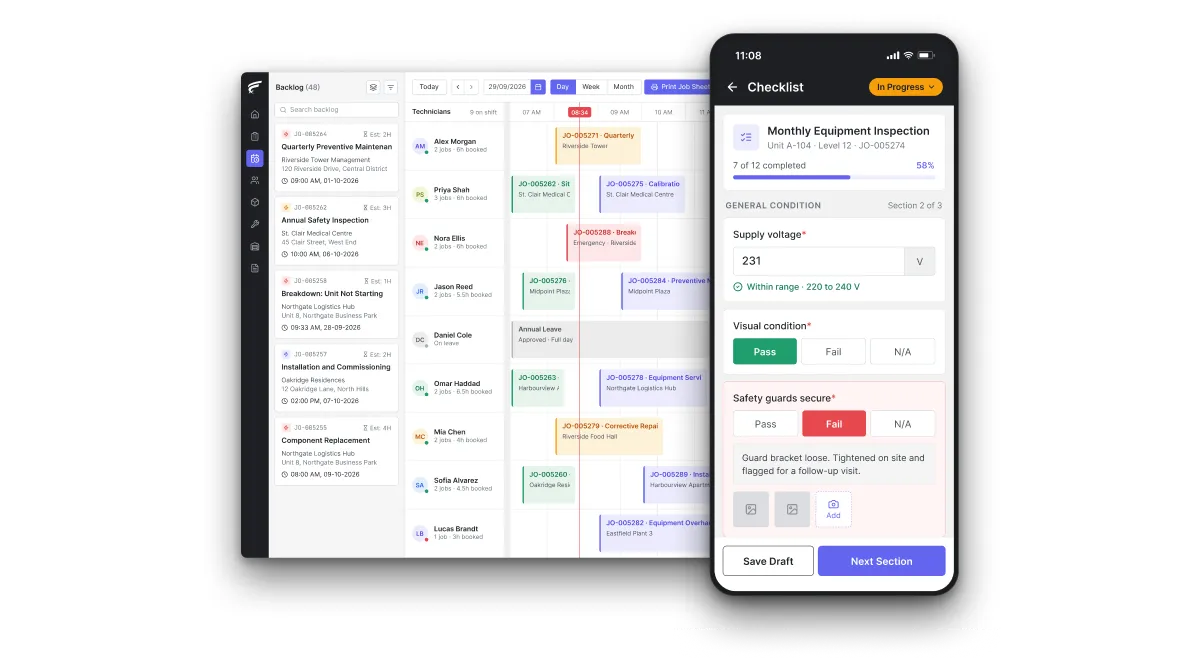
FieldEx scheduling board on desktop with a technician's inspection checklist open on the mobile app, as used by retail maintenance teams

FieldEx is a field service and asset management (FSM+CMMS) application. Store chains and the contractors who service them use it as retail maintenance software. It keeps every store and its equipment on record and runs fire, safety and refrigeration checks on cycle. FieldEx turns store repair reports into jobs with response targets, and it handles one-off refit work.

What FieldEx does for store maintenance teams and retail contractors

A store that can't open its doors, keep its chillers cold or pass a fire check loses sales by the hour. A chain feels it across hundreds of branches at once. FieldEx runs the planned checks and the reactive repairs across every branch, whether your own team or a contractor does the work. Book a demo with a handful of stores.

Every store and what's in it

  • Each store as a site, with its address, map position and contacts.
  • Refrigerated cases, freezers, air conditioning and lighting as assets at each store, in Asset Management.
  • Automatic doors, shutters, lifts and alarm panels as assets too.
  • Store numbers, regions and formats kept in renamed identifier fields.
  • Every repair, inspection and part used on the asset's own history.

Planned checks across the estate

  • Weekly, monthly and annual checks on each store's site plan, raised automatically for whoever covers that store.
  • Equipment services triggered by date, running hours, or whichever comes first, in Preventive Maintenance.
  • One plan applied to every store of a format, picking up new stores as they open.
  • Overdue checks rescheduled automatically after the period you set.

Repairs reported by stores

  • Store staff report faults through a QR code at the store, with no login, and the report arrives as a job for that store.
  • Store managers with portal access raise requests with photos, follow progress and see completed reports.
  • Service-level agreement (SLA) clocks by priority, with at-risk and breach alerts, in Scheduling and Dispatch.
  • Emails and alerts to the people you choose at each step, from the report to the fix.

Contractors across regions

  • Contractors work in their own accounts, limited to the jobs and stores that involve them.
  • Roles and a regional hierarchy control what each contractor and manager can see.
  • Jobs assigned by skill, availability, shift and leave.
  • Jobs matched to service zone and live location.
  • Technician skills named after certificates, such as refrigeration or electrical qualifications, with expiry dates.

Store refits and one-off jobs

  • New-store and refit work raised as one-off jobs, each with its own checklist and photos.
  • Snagging items raised as follow-up jobs from the handover checklist.
  • New equipment added to the store's asset list as it's fitted.
  • Technician skills named after certificates, such as a wireman or chargeman certificate, with expiry dates.
  • The app is available in English, Bahasa Malaysia, Chinese, German or Spanish, chosen by each technician.

Engineers on the FieldEx mobile app

  • The day's stores, each asset's history and a map of the store on the phone, on the FieldEx Mobile App.
  • Jobs and tasks downloaded and worked offline, with check-in, check-out and travel synced later.
  • Watermarked photos, the store manager's signature and parts used from the van.

Parts and stock

  • Spare parts held per warehouse and per van, with transfers and approvals between them, in Spare Parts Inventory.
  • Low-stock alerts and movement history for refrigeration parts, lamps, door sensors and filters.

The chain's own equipment and vehicles

  • Forklifts, pallet trucks, test meters and service vans kept as assets, each with its serial number and location.
  • Inspection and calibration due dates for the chain's equipment as recurring certifications, with reminders and the certificate on file.
  • Maintenance plans for vans by date or odometer reading, and for forklifts by running hours.

Reports by store, region and contractor

  • Completion PDFs with the work done, parts, times on site, photos and signature.
  • MTBF, MTTR and downtime per asset, and repeat jobs flagged on the same asset.
  • Jobs, checks and SLA results by store, region or contractor, in Reporting and Analytics.

FieldEx also runs this kind of work for Hotel & Hospitality, Food & Beverage Equipment, Pest Control and Agriculture & Estate.

What fire safety checks does a shop need each week, month and year?

Test the fire alarm every week, test emergency lighting every month and have both serviced by a competent person. The UK government's fire safety guide for offices and shops sets out this routine. The weekly alarm test uses a different call point each time, and the control panel is checked every 24 hours. A competent person services the alarm every 6 months. Emergency lighting also gets an annual full discharge test. Extinguishers get a brief monthly check and annual maintenance. The guide recommends a log book of all maintenance and testing.

What FieldEx does about it

  • Each check on its own cycle: daily, weekly, monthly, six-monthly and annual checks sit on each store's plan and raise jobs on time.
  • Call points in rotation: the weekly test checklist can record which call point was used, so each one gets tested in turn.
  • Contractor services alongside store checks: the six-monthly fire alarm service runs as a contractor job, while store staff complete the weekly test.
  • The log book, kept for you: every test, false alarm and repair stays on the store's record, with dates and who did it.

How often should a store's emergency lights and fire extinguishers be tested?

Test battery emergency lights for 30 seconds every month and for 90 minutes every year, and inspect extinguishers monthly. NFPA 101, the Life Safety Code, sets the lighting tests, as the NFPA Journal explains. Self-testing units still need a visual check every 30 days. In the United States, OSHA's rule 29 CFR 1910.157 asks employers to inspect portable extinguishers visually every month. Each one gets maintenance at least once a year, and the date is recorded.

What FieldEx does about it

  • Monthly and annual tests on one plan: the 30-second and 90-minute tests run as separate recurring checks for each store.
  • A record per extinguisher: each extinguisher can be an asset at the store, with its monthly checks and annual service on its history.
  • Failed lights raise repairs: a failed answer on the test checklist raises the repair job for the electrician.
  • Records ready for the inspector: completion reports carry the date, photos and who did the test.

How often do automatic store doors need inspecting?

Give automatic doors a quick safety check every day and a full inspection every year. The American Association of Automatic Door Manufacturers (AAADM) recommends both. The premises owner does the daily check, following steps printed on a label from AAADM or a certified inspector. An AAADM-certified inspector does the annual inspection. The standards behind it include ANSI A156.10 for power-operated pedestrian doors, A156.19 for low-energy doors and A156.27 for revolving doors.

What FieldEx does about it

  • A daily door check for store staff: the opening checklist can include the door safety check, completed on a phone each morning.
  • Annual inspection by the certified contractor: each door is an asset with its own annual inspection, raised for your door contractor.
  • Faults raised from the check: a door that fails the daily check raises the repair job with an SLA clock.
  • Every door's history: sensor changes, adjustments and inspections sit on the door's own record.

How often must store refrigeration be checked for refrigerant leaks?

Leak check any system holding 5 tonnes of carbon dioxide equivalent or more at least once a year, and larger systems more often. The EU's F-gas rules, Regulation (EU) 2024/573, set three bands. Systems under 50 tonnes are checked every 12 months, and 50 to under 500 tonnes every 6 months. Systems of 500 tonnes or more are checked every 3 months. A leakage detection system doubles each interval. Operators keep equipment records for at least 5 years. Great Britain's F gas guidance uses the same 12-month and 6-month intervals.

What FieldEx does about it

  • Each system on the right cycle: every pack or condensing unit is an asset with its own leak check plan, yearly or six-monthly.
  • Leak checks by qualified engineers: skills named after F gas qualifications, with expiry dates, keep checks with qualified engineers.
  • Refrigerant added recorded: custom job forms, set up with you during onboarding, can include number fields for refrigerant added, recorded against the job.
  • Leaks followed up: a leak found raises the repair job and the follow-up check.
  • Every outlet at a glance: the dashboard shows which scales are overdue or due in the next 7 days, across the whole chain.

How often should a shop's electrical installation be tested?

Have a shop's electrical installation inspected and tested at the interval its last report recommends, with routine checks in between. The IET's inspection and testing FAQ says the designer recommends the first interval, and the inspector recommends each one after. Guidance Note 3 gives recommended initial frequencies, which are not legal requirements. The result is an Electrical Installation Condition Report (EICR). Each defect carries a code: C1 for danger present, C2 for potentially dangerous, C3 for improvement recommended and FI for further investigation. Any C1 or C2 code makes the report unsatisfactory, and FI items need investigation without delay.

What FieldEx does about it

  • Yearly checks and five-yearly tests: the yearly routine check runs as a recurring inspection, and the five-yearly test as a recurring certification.
  • Next date from the report: if the electrician sets a shorter interval, change that store's due date and its reminders follow.
  • Reports attached to the store: the EICR attaches to the job, with photos and remedial items.
  • Remedial work tracked: each item the report flags becomes its own repair job.

What should a store check to keep escape routes and stockrooms safe?

Keep every exit route clear at all times, and keep surplus stock and packaging in a stockroom away from the public. In the United States, OSHA's rule 29 CFR 1910.37 says each exit route must be free and unobstructed. No materials or equipment may be placed in it, even for a short time. The UK government's guide for offices and shops adds that excess stock belongs in a dedicated store room, never where the public has access. Packaging waste from deliveries must be kept away from ignition sources.

What FieldEx does about it

  • Opening and closing checks: escape routes, fire exits and stockroom storage can be items on the store's daily checklist.
  • Failed items need action: a blocked exit raises a job for the store manager or facilities team.
  • Photos as proof: watermarked photos show the exit or stockroom as it was found and as it was cleared.
  • Patterns by store: repeated failures at the same store show up in the store's reports.
  • Records that last: every leak check, top-up and repair stays on the system's history. The record is ready whenever an auditor, insurer or new contractor asks for it.

How often must a store's own forklifts and pallet trucks be examined?

Examine each forklift before it goes into service, at least once a day, and take an unsafe truck out of use. In the United States, OSHA's powered industrial truck rule, 29 CFR 1910.178, sets this. Where trucks run round the clock, they are examined after each shift. Defects must be reported and corrected at once, and only authorized personnel make repairs. The same rule asks for each operator's performance to be evaluated at least once every 3 years.

What FieldEx does about it

  • Each truck as an asset: forklifts, powered pallet trucks and reach trucks carry a serial number, the store or warehouse they work in, and their own history.
  • A pre-shift check on the phone: the daily examination runs as a short checklist, raised each day for the store team.
  • Unsafe trucks off the floor: a failed answer raises the repair job, and the truck's status can be set to out of service until it is fixed.
  • Servicing by hours: each truck's servicing can run on running hours, by date, or whichever comes first.
  • Operator evaluations tracked: a skill named after the forklift qualification, with an expiry date, shows when each operator's next evaluation is due.

How should a chain handle repair requests from hundreds of stores?

Give every store one way to report a fault, and give head office one place to follow it. In FieldEx, each request becomes a job carrying the store, the asset and a photo. It also has a priority and an owner. The response clock starts when the store reports the fault, and the job goes to your own engineer or the contractor covering that region.

What FieldEx does about it

  • One way in for every store: QR codes and the portal turn every report into a job, with no phone calls needed.
  • The right contractor by region: service zones send each store's jobs to the contractor or engineer who covers it.
  • Response targets that are measured: SLA results by store, region and contractor show who meets them.
  • Stores kept informed: store managers follow each job's progress in the portal instead of calling for updates.

How do you manage maintenance after a store refit?

In FieldEx, a refit runs as a set of one-off jobs: the handover check, each snag, and the first service of each new asset. New equipment goes onto the store's record on the day with its warranty dates, so the first breakdown arrives with a record behind it.

What FieldEx does about it

  • Handover as a checklist: the refit handover runs as a one-off job with its own checklist and photos.
  • Snags as follow-up jobs: each failed handover item raises its own job, assigned to the right contractor.
  • New assets on day one: new chillers, lighting and doors are added to the store with their warranty dates.
  • Plans from the first day: each new asset picks up its maintenance plan as soon as it's added.
Customer story

Magnum, a Malaysian leisure and entertainment company, runs its jobs, inventory and reports on FieldEx. It manages jobs, inventory and SLA deadlines from one dashboard. Magnum reports a 25% increase in operational efficiency, with the field team it needs reduced from 55 to 41 people. Its outlets share the same pattern as a retail chain: many sites, scheduled checks and repairs tracked from head office.

Read the Magnum Story

Questions retail maintenance teams ask about FieldEx

What does retail maintenance software do?

It plans the checks every store needs, from fire alarms to refrigeration, and takes repair requests from stores. It sends them to engineers or contractors with response targets, and keeps the records. FieldEx does all of that in one system. Compare approaches in our guide to CMMS Software.

Can store staff report faults without a login?

Yes. A QR code at the store opens a short form that needs no login, and the report arrives as a job for that store. Managers with portal access can also follow progress.

Can contractors see only their own stores and jobs?

Yes. Contractors get their own accounts, with roles and a hierarchy that limit them to the jobs that involve them.

Can FieldEx run different SLAs for different stores or priorities?

Yes. SLAs can be set for all customers or per customer and asset, with several stages and alerts before a breach.

Can the same plan apply to every store of one format?

Yes. A plan applied to a store format picks up new stores as they're added, and raises their checks on the same cycle.

Can each refrigerated case have its own history?

Yes. Each case, pack or condensing unit is an asset at the store. Its leak checks sit beside its repairs, parts and plans on one record, and repeat jobs on it are flagged.

Can FieldEx handle store refits?

Yes, as one-off jobs. Handover checklists raise snag jobs, and new equipment is added to the store with its warranty dates.

Can we compare maintenance across regions?

Yes. Jobs, checks, SLA results and costs can be reported and exported by store, region or contractor.

Can engineers work in stores with poor signal?

Yes. Jobs and tasks can be downloaded and worked offline, with check-in, check-out and travel synced later.

How quickly can a retail chain start using FieldEx?

There's no setup fee. Once we know your requirements and your data is ready, FieldEx can be implemented in as little as a week with standard features for small businesses. Larger setups and custom work take longer. Stores, assets and past jobs can be uploaded. FieldEx helps with setup, and training is included. See Setup and Training.

Bring a few of your stores and their repair log to the demo

Book a Demo