Solar asset management software for PV plants, rooftops and microgrids

Keep each inverter, string and battery bank on its own record. Run cleaning, inspection and thermography cycles across every site.

Book a demo
Updated 16 Oct 2026
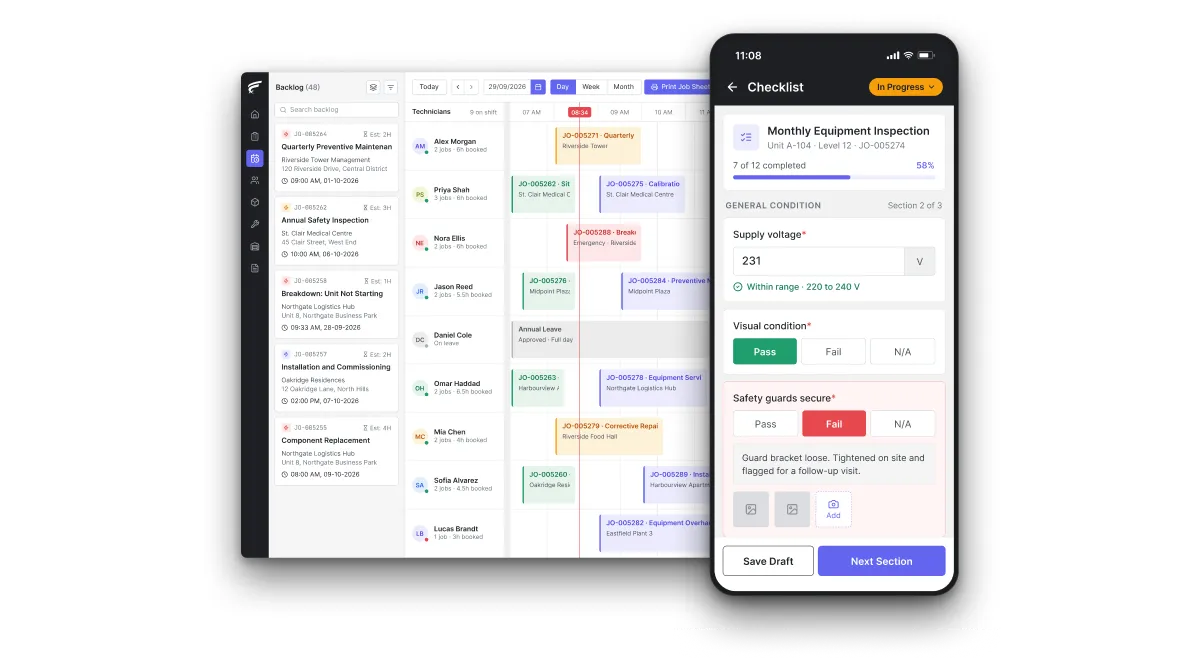
FieldEx scheduling board on desktop with a technician's inspection checklist open on the mobile app, as used by solar O&M teams

FieldEx is a field service and asset management (FSM+CMMS) application for solar and microgrid operations and maintenance (O&M) providers. It keeps each site's inverters, combiner boxes, strings and trackers on record, along with batteries and generators. FieldEx runs preventive maintenance, cleaning and inspections on schedule. It turns inverter trips and faults into tracked jobs and keeps the readings, photos and reports from every visit.

What FieldEx does for solar and microgrid O&M teams

Solar O&M is a long, quiet contract punctuated by faults. It means years of scheduled cleaning, inspections and torque checks across dozens or hundreds of sites. Then an inverter trip costs generation every hour it stays down. FieldEx keeps both kinds of work on the same site and asset records. The technician who answers a fault sees every earlier visit to that inverter. The owner sees the evidence that each scheduled task was done. Compare approaches in our guide to CMMS Software, or book a demo.

Plants, rooftops and microgrid sites on record

  • A site record for every ground-mount plant, commercial rooftop and microgrid.
  • Each site holds its address, map pin, owner contacts and service zone, and the projects it belongs to.
  • An asset record for each inverter, combiner box, string and tracker row.
  • Asset records for transformers, battery banks and generators too.
  • Serial numbers, specifications, photos and warranty details on each record, with datasheets attached.
  • Parent and component levels, so an inverter station keeps its inverters, and each inverter its own fault and repair history, in Asset Management.
  • Single-line diagrams, layout drawings and handover documents attached to the site, and a change history on each asset of who edited what and when.

Preventive maintenance and cleaning cycles

  • Site plans for whole-plant work, such as panel washing and vegetation cutting, and asset plans for individual inverters, trackers and generators. Each plan creates its jobs automatically.
  • Cleaning and maintenance intervals by day, week, month or year, including quarterly and every 3 years.
  • Plans on a fixed calendar or counted from the last completed visit. Fixed calendar dates apply to time-based plans.
  • Generator and hybrid plant service triggered on running hours, on the calendar, or on whichever comes first.
  • One plan applied across a whole portfolio, picking up new assets that match its criteria, in Preventive Maintenance Planning.

Inspections, thermography and test records

  • Recurring inspections per asset type, each on the schedule it needs and linked to its own checklist.
  • One example is the annual combiner box thermography and torque check.
  • Array and microgrid inspections and tests show as due, overdue or completed. Certifications also send reminders by email, in-app notification or both.
  • The date, the technician, the result and remarks on each record, in Compliance Documentation.
  • Thermal images, test sheets and reports are attached to the job.
  • A dashboard of overdue array and microgrid inspections, those due in the next 7 days and those completed in the last 7 days.

Faults, inverter trips and response times

  • Faults from the control room, from the asset owner's branded portal, or from a failed checklist answer.
  • Each fault becomes a job ready to assign, in Work Order Management.
  • Service-level agreements with stages such as respond, make safe and restore, each with at-risk and violation alerts against business hours.
  • Different response targets per owner or per asset, within the dates each SLA assignment is valid.
  • A notification when a new fault repeats a recent job on the same inverter, so recurring trips get a root-cause visit.

Technicians on roofs and in the field

  • Automatic assignment in Scheduling and Dispatch, with a drag-and-drop scheduler for exceptions.
  • Jobs matched on skills, zone and availability first, then nearest and least busy, with shifts and leave taken into account.
  • Each job on the FieldEx Mobile App with the asset's history and the right checklist.
  • Custom job forms with number fields for voltages, currents and torque values, and watermarked photos on the job.
  • Ordered tasks with safety steps that must be finished before the next task can start.
  • Jobs and tasks can be downloaded and worked offline, with check-in, check-out and travel synced later.

Spares and warranty parts

  • Inverter boards, fuses, connectors, tracker motors and replacement panels in each warehouse and each technician's own stock.
  • Stock transfers and barcode scanning.
  • Reorder and low-stock alerts per stock location, in Spare Parts Inventory.
  • Warranty periods and manufacturer details on each part, and every part used recorded on the job and the asset.
  • Automatically watermarked photos.
  • Jobs and tasks can be downloaded and worked offline, with check-in, check-out and travel synced later.

Your own test instruments, vans and workshop

  • Insulation testers, I-V curve tracers, thermal cameras and torque wrenches on record as company assets, each with its serial number and location.
  • Calibration due dates for each instrument as recurring certifications, with reminders before they lapse and the certificate on the record.
  • Service vans and washing rigs on maintenance plans by date or odometer reading, each with its own service history.
  • Workshop machinery used to repair boards and trackers on its own maintenance plan.

Records for owners and asset managers

  • A completion PDF for every job, sent automatically to the owner or anyone else, with a record of when it was sent.
  • Each PDF shows the equipment, the fault and resolution, and parts used. It also shows check-in and check-out times, timestamped attachments and the customer's signature.
  • A customer portal where the owner sees its equipment, upcoming asset maintenance, job status and downloadable reports.
  • Reports in Reporting and Analytics on asset reliability, maintenance cost and age.
  • Reports on jobs and sites, exported or emailed on a schedule.

Job sheets and reports for owners

  • A job sheet PDF for every finished visit, with the equipment, fault, fix and parts. It goes automatically to the owner or anyone else.
  • Time on site, photos and the owner's sign-off on the same sheet.
  • A portal where the owner sees its equipment, upcoming asset maintenance, job status and downloadable job sheets.
  • Reports on PPM done, faults, asset reliability and maintenance cost per site, in Reporting and Analytics.
  • Reports exported or emailed on a timetable.

FieldEx also runs this kind of work for Battery Storage, EV Chargers, Power Utilities, Water Works, Sewerage and Waste Water, Wind Infrastructure and Generators & Standby Power.

How often should a solar PV system be serviced?

Commercial PV systems need an inspection at least once a year, while domestic systems can go 5 to 10 years between deep inspections. Solar Energy UK's O&M guidelines set frequencies by system category. A competent person inspects the inverter's internal components for discoloration, corrosion, wear and damage. That runs every year on school, hospital and commercial systems, and every 5 to 10 years on domestic ones. Inverter production is checked weekly, or daily where remote monitoring is in place. The international standard IEC 62446-2:2020 sets preventive, corrective and performance maintenance requirements for grid-connected PV systems.

What FieldEx does about it

  • Frequencies by site type: domestic, commercial and public-sector sites each carry their own plan. The inverter inspection runs annually on one and every 5 years on another.
  • Weekly production checks as jobs: where remote monitoring isn't in place, a short weekly check runs as a recurring job with its own checklist.
  • Preventive and corrective on the same record: scheduled visits and fault repairs both sit on the inverter's asset history.
  • Next visit always visible: each plan shows the last and next maintenance date for every site and inverter it covers.

What tasks belong on a solar plant maintenance checklist?

A solar plant checklist covers combiner box scans and torque, string tests, inverter checks and, on rooftops, the roof itself. NREL's PV O&M best practices guide (3rd edition) gives a model annual scope. Technicians scan all combiner and re-combiner boxes with infrared, tighten connections to the manufacturer's torque specification and report broken terminal blocks. They also test string open-circuit voltage and DC operating current, and trace I-V curves on a share of strings. For rooftops, Solar Energy UK adds checks from ground level for roof damage, gutters, moss and birds' nests.

What FieldEx does about it

  • One checklist per task family: combiner box scans, string tests, roof checks and inverter inspections each have their own checklist, grouped into sections.
  • Measurements, not ticks: a custom job form records each string's open-circuit voltage and operating current as numbers, and the I-V curve file is attached to the job.
  • Broken parts become work: a failed answer, such as a broken terminal block, raises the corrective job with its tasks. It can also open a follow-up checklist.
  • Your own scope, digitized: AI can generate checklist questions from a description or a PDF or PNG of your existing checklist or procedure. You can then edit them.

Do solar panels really need cleaning, and how often?

Yes, most sites need cleaning, and once a year is a common starting point that local soiling then adjusts. Solar Energy UK says the frequency depends on many factors, including the manufacturer's requirements and local soiling. NREL's model scope of work washes all panels with water, with no chemicals, once a year or as a soiling study recommends. IEC 62446-2 treats panel cleaning and vegetation upkeep as performance maintenance, done to get the most from the plant rather than to keep it safe.

What FieldEx does about it

  • A cleaning plan per site: each plant or rooftop carries its own washing schedule, on a fixed calendar or counted from the last clean.
  • Change the cycle, not the records: when a soiling study moves a site from yearly to twice-yearly cleaning, the plan changes and the history stays.
  • Before and after photos: watermarked photos on the job show the panels before and after cleaning.
  • Vegetation on its own schedule: grass cutting and vegetation control run as a separate site plan with their own crew.

How quickly should a solar O&M provider respond to a fault?

Respond within the time written into the O&M contract. NREL's O&M guide says that is typically 10 days or less for corrective work that isn't safety-related. Its example performance guarantee assumes 98% availability in the first year and 99% in the second and later years. EPRI's preliminary fleet data, presented at Sandia's PV Performance Modeling workshop, found that sites with stuck trackers had median availability of about 90% to 95%.

What FieldEx does about it

  • Contract response times as SLAs: SLAs can apply to all customers or be scoped by customer, validity dates, an optional asset, or job conditions, using timed steps with at-risk and violation alerts. Safety faults get a tighter target.
  • Alerts before the clock runs out: at-risk and violation alerts go to the users or groups you choose, the job owner or their manager.
  • Response performance on record: SLA timing, completion and violations show on each job and in reports, ready for the owner's monthly review.
  • The right technician first: jobs are matched on skills, zone and availability first, then nearest and least busy, so the response clock isn't lost to driving.

How often should infrared thermography be done on PV electrical equipment?

Scan PV electrical equipment with infrared at least once a year, and every 6 months where its condition is poor. NFPA 70B is the US standard for electrical equipment maintenance, now in its 2026 edition. In its 2023 edition, NFPA 70B requires inspection of all qualifying electrical equipment at least every 12 months. Equipment rated in Physical Condition 3 needs thermographic inspection at least every 6 months. NREL's model O&M scope includes infrared scans of all combiner and re-combiner boxes once a year.

What FieldEx does about it

  • Thermography as a recurring inspection: combiner boxes, inverters and transformers carry an annual or six-monthly thermography inspection, linked to its checklist.
  • The team can record condition grades in checklists, update asset status and raise follow-up jobs automatically.
  • Images on the record: thermal images are attached to the job and the asset, with the result and remarks.
  • Hot spots raise work: a failed answer on the checklist raises the corrective job straight away.

What maintenance records should a solar O&M provider keep?

Keep preventive, corrective and inspection records for every asset, and the system's manuals and documents for its whole life. NREL's O&M guide asks providers to keep corrective maintenance logs and preventive maintenance and inspection records. Those records prove that the maintenance needed to keep warranties in effect has been done. Solar Energy UK says all relevant documentation and manuals should be provided and kept for the life of the system.

What FieldEx does about it

  • Every visit on the asset: jobs, inspections, readings, photos and parts used stay on the asset. Each inverter, string and battery bank also keeps a change history.
  • Documents for the life of the plant: manuals, datasheets, warranty certificates and handover packs are attached to the site and its assets.
  • Proof for warranty claims: completion PDFs and inspection records show what was done, when and by whom.
  • Exports on request: maintenance data can be reported by site, asset type or period and exported as CSV, Excel or PDF.

How often should torque be checked on PV mounting and electrical connections?

Check combiner box connections every year, and a sample of panel clamp fixings every year on larger systems. Solar Energy UK recommends checking the torque setting of a sample of clamp fixings, as per the manufacturer's design. The check runs every 5 to 10 years on domestic systems and annually on larger categories. NREL's model scope tightens combiner box connections to the manufacturer's torque specification once a year.

What FieldEx does about it

  • Torque values entered as numbers: a custom job form records the torque applied at each sample point or combiner box.
  • Annual and multi-year cycles together: the yearly combiner box torque check and the five-to-ten-year clamp check run as separate points on the same plan.
  • The specification on hand: the manufacturer's torque table is attached to the asset and visible to the technician on the phone.

What safety checks apply to technicians working on rooftop solar?

Plan every rooftop job to avoid or prevent falls, and keep each roof's lifeline on an annual inspection with a pull test every 4 years. The UK Health and Safety Executive's brief guide to working at height (INDG401) sets the order. Avoid work at height where it is reasonably practicable, and otherwise prevent falls. Solar Energy UK says a horizontal lifeline fall protection system should be pull-tested every 4 years and inspected annually.

What FieldEx does about it

  • Safety tasks first: a rooftop job opens with the access and isolation checks as ordered tasks. The work task can't start until they are complete.
  • Lifelines as assets: each roof's lifeline carries an annual inspection and a recurring pull-test certification, with the report attached to the certification.
  • Roof work to qualified technicians: work at height requires its matching skill, so it is assigned only to technicians who hold it.
  • Offline on the island: jobs and tasks can be downloaded and worked offline, with check-in, check-out and travel synced later.

How should battery banks in a solar microgrid be maintained and replaced?

Record each battery's voltage at every visit, and plan replacements in phases as the bank ages. NREL's O&M guide says battery maintenance costs increase as a battery plant ages. Owners need a strategy for when and how to replace batteries in phases, with a reserve set aside for it. Voltage differences between batteries over time show when maintenance is needed, and NREL stresses that good record keeping is needed to track those trends.

What FieldEx does about it

  • Each bank with its age and warranty: battery banks sit under the microgrid's power system with their install date, warranty and replacement history.
  • Voltages recorded every visit: a custom job form captures each battery's voltage as a number, building the trend NREL asks for. Battery readings, including state of health, can be captured on digital forms too.
  • Replacement planned from data: maintenance cost and age reports per asset help plan phased replacement.
  • Generators on the same plan: hybrid generators run on running-hour and calendar triggers alongside the batteries.

How often should a solar O&M provider calibrate its own test instruments and site sensors?

Calibrate each instrument to its manufacturer's interval, and track every due date in one program. NREL's PV O&M guide lists an internal equipment calibration and tracking program among the qualifications to look for in a service provider. Its model scope checks the calibration expiry of site sensors and meters once a year. The same guide notes that most pyranometers must be recalibrated every 2 years.

What FieldEx does about it

  • Your instruments on record: each insulation tester, I-V curve tracer, thermal camera and torque wrench has its own asset record, with serial number and location.
  • Calibration on its own cycle: each instrument's calibration runs as a recurring certification. Each one then shows as due or overdue, with reminders, and its certificate stays on file.
  • Site sensors too: pyranometers and other plant sensors can sit on the site's asset list, each with a two-yearly calibration certification.
  • Vans on their own plans: the vans that reach your arrays follow maintenance plans by date or odometer reading, each holding its own service history.

What anti-islanding settings must a solar inverter meet under NEM?

Under NEM, a smart inverter on low voltage (LV) disconnects within 2 seconds and reconnects after 2 minutes. On medium voltage (MV), it disconnects within 2 seconds and reconnects after 5 minutes. Those settings are in Suruhanjaya Tenaga's NEM guidelines. The NOVA guidelines cover a TNB supply failure. During one, there must be no reverse power or back-feed to the grid from any internal source, including solar PV, batteries or generators.

What FieldEx does about it

  • Settings checked on every inspection: the inverter checklist includes the disconnect and reconnect settings, with a failed answer raising a job.
  • Trip tests recorded: a custom job form logs the disconnect and reconnect times measured during testing.
  • Back-feed checks for hybrid sites: sites with batteries or gensets carry an extra check on the same checklist.

What warranty and handover rules apply to LSS interconnection assets?

All assets transferred to the distribution licensee carry a 3-year warranty. The full Initial Operation Date (IOD) document set is due at least 60 days before the proposed IOD. Both rules are in the LSS guidelines. The IOD document set follows the guidelines' IOD checklist.

What FieldEx does about it

  • Warranty end dates on each asset: transferred assets carry their 3-year warranty, so defects inside the period are visible.
  • The IOD pack as tasks: each document on the IOD checklist becomes a task with an owner and a date, tracked to the 60-day deadline.
  • Handover documents kept: the submitted pack is attached to the site record.

How often should a PV contractor's insulation testers and other instruments be calibrated?

Calibrate each tester at its manufacturer's interval, at a laboratory accredited by Standards Malaysia. Under the Laboratory Accreditation Scheme of Malaysia (SAMM), Standards Malaysia accredits calibration laboratories so that their certificates are accepted internationally through the ILAC and APAC arrangements. International guidance from NREL adds that an O&M provider should run its own calibration tracking program. It notes that most pyranometers must be recalibrated every 2 years.

What FieldEx does about it

  • Your testers on record: each insulation tester, clamp meter, thermal camera and torque wrench has its own asset record, with serial number and location.
  • Calibration that doesn't lapse: each tester's calibration runs as a recurring certification, shown as due or overdue, with reminders and the lab certificate kept on file.
  • Vans on their own plans: each company van's servicing runs on a maintenance plan by date or odometer reading, with its history on its record.
Customer story

AMRTUR, a Southeast Asian oilfield services contractor, runs maintenance for its offshore and onshore equipment on FieldEx. Its story describes maintenance triggered at 300 hours of use or 6 months, whichever comes first. It also covers component-level tracking over a five-year service plan and QR-code requests routed to the right team. It's a different industry, but the same pattern: hour-or-calendar maintenance on equipment spread across remote sites.

Read the AMRTUR Story

Agri Sumber Prestari (ASP) runs maintenance across 92 agricultural estates in Malaysia on FieldEx. ASP is an agricultural manpower and training company under SD Guthrie Agri Bio. Its story describes preventive maintenance scheduling, automated jobs and inspections, and live inventory with low-stock alerts. Regional planning was cut from a full day to half a day. It's a different industry, but the same pattern: planned maintenance spread across many rural sites.

Read the Agri Sumber Prestari Story

Questions solar O&M providers ask about FieldEx

What is the best solar asset management software for O&M contractors?

Pick software that holds every site's equipment and runs both the planned cycles and the fault response described above. FieldEx does this in one system, with field service and maintenance management on the same asset records. Compare approaches in our guide to CMMS Software.

Can FieldEx run different maintenance cycles for rooftop and utility-scale sites?

Yes. Each site type carries its own plans and intervals, and one plan can cover many sites while picking up new assets that match its criteria.

Can technicians record string voltages, currents and torque values?

Yes. Custom job forms, set up during onboarding, add number fields for these readings. Technicians type each exact reading at the array, and FieldEx records it against the job.

Can FieldEx create jobs from our monitoring platform's alarms?

Yes. Through the FieldEx API, outside systems such as monitoring platforms can create jobs and exchange data with FieldEx. FieldEx can connect to any open system through REST APIs and has connectors for QuickBooks and Xero.

Can we track response times written into each O&M contract?

Yes. Each owner's targets run as the service-level agreement described in the response section, within the contract's validity dates. Reports then show each owner's record of met and missed targets.

Can asset owners see the maintenance we have done?

Yes. The branded customer portal shows their equipment with last-serviced dates, upcoming asset maintenance, job status and downloadable job reports.

Can FieldEx track spare inverters and parts across sites?

Yes. Each warehouse and each technician's own stock is tracked, with transfers between them and barcode scanning on the phone.

Can crews work at remote plants without a signal?

Yes. Jobs and tasks can be downloaded and worked offline, with check-in, check-out and travel synced later.

Can FieldEx keep warranty evidence for each inverter and panel batch?

Yes. Warranty details sit on each asset and part, alongside the visit history described above. A claim can be backed with the completion PDFs for the period in question.

How quickly can FieldEx be running across our solar portfolio?

There's no setup fee. Once we know your requirements and your data is ready, FieldEx can be implemented in as little as a week with standard features for small businesses. Larger setups and custom work take longer. Sites and assets can be uploaded. FieldEx helps with setup, and training is included. See Setup and Training.

See your solar sites' cleaning, inspections and faults on one record

Book a Demo