Building services software for M&E maintenance contractors

Run every client's planned maintenance, breakdown calls and statutory tests from one record of their plant, so each contract shows what was done.

Book a demo
Updated 16 Oct 2026
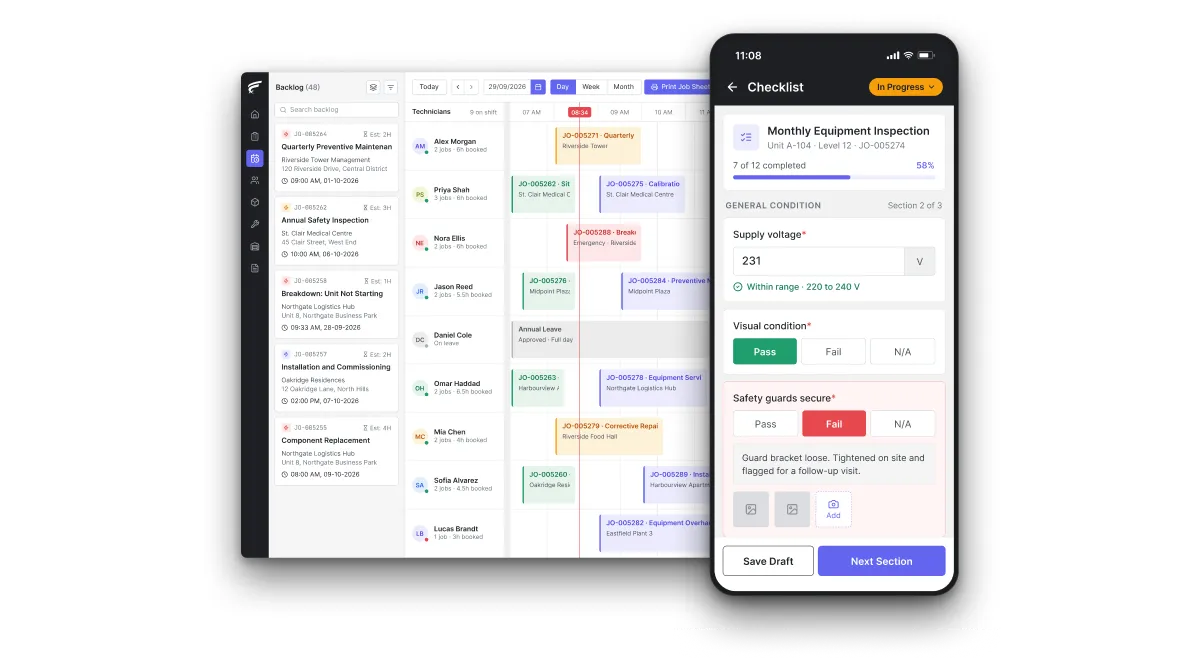
FieldEx scheduling board on desktop with a technician's inspection checklist open on the mobile app, as used by building services engineers

FieldEx is a field service and asset management (FSM+CMMS) application for mechanical and electrical (M&E) maintenance contractors. It holds each client building's plant on its own record. FieldEx runs planned preventive maintenance (PPM) and statutory tests on schedule and dispatches breakdown calls against response times. Engineers capture readings on site, and FieldEx sends the signed service report.

What FieldEx does for M&E maintenance contractors

A building services contract is a promise made for each asset. The boilers get serviced, the generator gets run and the emergency lights get tested. The call gets answered within the agreed time. FieldEx keeps that promise visible. Every client, building and item of plant has its own record. Every visit comes from a plan or a call, and every result lands back on the asset it belongs to. FieldEx works as Field Service Management Software and maintenance software at once. Book a demo to see your own contracts in it.

Client buildings and their plant

  • A customer record for each client, with its buildings as sites.
  • Each site holds the address, map location, contacts, service zone and reference details.
  • An asset record for every boiler, chiller, pump set and air handling unit.
  • Asset records for distribution boards, generators and emergency lighting circuits too.
  • Make, model, serial number and warranty details are recorded on each asset. Technicians take photos on the job from the mobile app. Operation and maintenance manuals can be attached.
  • Parent and component levels, so a plant room, its pump set and each motor keep their own history, in Asset Management.
  • QR or barcode labels on plant, so an engineer scans the item to open its record, its checklist or a new job.

PPM built from your task schedules

  • Asset maintenance plans and site maintenance plans that raise each visit automatically.
  • A different job template and engineer for the monthly, quarterly and annual points in the cycle.
  • Presets such as every two weeks, quarterly and every 3 years.
  • Intervals by day, week, month or year, on a fixed calendar or counted from the last completed visit. Fixed calendar dates apply to time-based plans.
  • Triggers on running hours or other meter readings, on the calendar, or on whichever comes first, in Preventive Maintenance.
  • One plan applied across many client buildings, picking up new plant that matches its criteria and rescheduling missed visits after a set overdue period.

Statutory tests and certificates

  • Recurring certifications and inspections per asset type on set frequencies, with the certifying body recorded.
  • Each statutory test shows as due, overdue or completed, with reminders by email, in-app notification or both.
  • The completion date, the engineer, the result, remarks and the certificate or test report attached, through Compliance Documentation.
  • A dashboard of overdue items, items due in the next 7 days and items completed in the last 7 days. Users can filter it by asset type or service zone.

Breakdown calls and response times

  • Calls from the helpdesk, the client's branded portal, or a QR code on site that needs no login. Each call arrives as a job in the backlog.
  • Service-level agreements on business hours, with several stages such as attend and fix, at-risk and violation alerts, and terms set per client or per asset.
  • An in-app or email notice when a new job repeats a recent job on the same asset. The team sees repeat failures before the engineer leaves.
  • Corrective jobs raised straight from a failed checklist answer, linked to the PPM visit that found the fault.

Engineers on the tools

  • Automatic assignment in Scheduling and Dispatch, with a drag-and-drop scheduler for the exceptions.
  • Assignment that weighs skill, availability, shift and leave, plus service zone and live location.
  • The FieldEx Mobile App with the asset's history, the visit checklist, number fields for test readings, watermarked photos and the client's signature.
  • Check-in and check-out times on each task.
  • Jobs and tasks can be downloaded and worked offline, with check-in, check-out and travel synced later.
  • Each technician's van stock and each store tracked, with transfers, reorder alerts and parts booked to the job, in Spare Parts Inventory.

Parts and van stock

  • Spare parts in each store and in each engineer's van stock, with transfers, barcode scanning and approvals where needed.
  • Reorder and low-stock alerts per stock location, and a movement history of every part used, in Spare Parts Inventory.
  • Parts recorded on the job and the asset, with quantities, prices and warranty periods.

Your own access equipment, instruments and vans

  • Your own scissor lifts, access towers, gas analyzers and test meters kept as company assets, each with its serial number and current holder.
  • Thorough examinations and calibrations as recurring certifications, with reminders before each falls due and the certificate on the record.
  • Company vans and workshop machinery on maintenance plans by date or odometer reading.
  • Monthly reports in Reporting and Analytics of PPM done against PPM scheduled, SLA performance, breakdowns per asset and maintenance cost per client.
  • Reports exported or emailed on a timetable.

Contracts, service reports and client reporting

  • Maintenance contracts with start and end dates, linked to the plant and maintenance plans they cover.
  • A service report PDF for each visit, emailed with a record of when it was sent.
  • Each report shows the equipment, the fault and resolution, and parts and prices. It also holds time on site, photos and the client's signature.
  • Reports in Reporting and Analytics on PPM completed against scheduled, response times, asset reliability and maintenance cost per client. Reports can be exported or emailed on a schedule.

FieldEx also runs this kind of work for Electrical Contractors, Property, Strata & Building Management, Facilities, Building Management and Cleaning, HVAC, Fire, Security and CCTV and Elevator & Escalator.

What goes into a planned maintenance schedule for a client's building services?

A recognized task library matched to a complete asset register. SFG20's FAQs describe the Building Engineering Services Association (BESA) specification. It holds over 2,000 task schedules with legislative references, color-coded by criticality. Red is statutory and legal, pink is business-critical, amber is optimal and green is discretionary. The UK Government Property Function's Facilities Management Standard 001 asks for a complete asset register, detailed to the building's criticality. Asset condition and maintenance status are reviewed regularly.

What FieldEx does about it

  • Plans per asset and per building: asset plans cover each boiler, pump or air handling unit. Site plans cover building-wide rounds. Each plan raises its visits automatically with the right job template.
  • Criticality kept visible: statutory tasks can run as certifications and inspections with their own due dates. They show on the dashboard apart from optimal and discretionary work.
  • The register the schedule depends on: plant is classified by type, category and subcategory, with its status recorded on each asset.
  • One cycle, several visit types: a single plan can hold a different checklist and engineer for the monthly, quarterly and annual visits.

How often should emergency lighting be tested, and what has to be logged?

A short functional test every month and a full rated-duration test every year, with all results recorded. The BS 5266-1 pocket guide published by fire systems maker Advanced and hosted by the Institute of Healthcare Engineering and Estate Management (IHEEM) sets this routine. The monthly test is typically 10 minutes per luminaire. The annual duration test can be phased through the year. Daily testing is only needed where the building has a central battery system.

What FieldEx does about it

  • Monthly and annual cycles together: the monthly functional test and the annual duration test run as separate recurring inspections, each with its own checklist.
  • Circuits or fittings as assets: each emergency lighting circuit or luminaire can carry its own record and QR label. Engineers log each failure against the right fitting.
  • Failures become repairs: a failed answer on the checklist raises the corrective job and can book a follow-up test.
  • Results the client can see: clients see their completed jobs in the customer portal and can download each job's summary.

What weekly and six-monthly fire alarm checks belong in a maintenance contract?

Weekly call point tests, and a competent person's inspection and service at least every 6 months. The IET's Wiring Matters guidance sets out a regime under BS 5839-1. It runs from weekly call point tests and monthly power supply checks to six-monthly checks of logbooks, detectors, false alarm records and batteries. Annual checks cover at least radio signaling and cause-and-effect operation. The Fire Industry Association adds that if visits are more than 6 months apart, the system should be considered no longer compliant with BS 5839.

What FieldEx does about it

  • Weekly, six-monthly and annual on one panel: each frequency runs as its own recurring inspection on the fire alarm asset. Each visit has its own IET-style checklist.
  • Battery and signal readings recorded: number fields on the job capture battery voltages and other test values.
  • Checklists built from your documents: AI can generate inspection questions from a description or a PDF or PNG of your existing checklist or procedure. You can then edit them.
  • Defects closed out: record the failed result on the inspection. Track repair work in a separate job.

Which water temperature readings do legionella checks require each month?

Below 20°C at cold sentinel taps after 2 minutes, and at least 50°C hot within 1 minute. The UK Health and Safety Executive's (HSE) guidance on water systems asks for monthly checks with the findings recorded. For open systems such as cooling towers, evaporative condensers and spa pools, HSE's testing and monitoring guidance asks for routine testing at least quarterly.

What FieldEx does about it

  • Temperatures entered as values: forms on the job add number fields, so the engineer records the exact reading at each sentinel outlet.
  • Monthly and quarterly rounds: the monthly temperature round and the quarterly cooling tower testing run as separate recurring inspections.
  • Out-of-range readings acted on: a failed answer raises the corrective job and books the follow-up check.
  • Technicians record readings on the job form or as meter readings on the asset. A certificate or report can be attached to a completed certification.

How often does a standby generator need exercising under load, and when is the longer test due?

Monthly for at least 30 minutes, with a longer test at least once every 36 months. NFPA 110 section 8.4.2 sets the monthly run. Generator sets are exercised at least monthly for 30 minutes, at no less than 30% of nameplate rating or with a load that keeps the manufacturer's minimum exhaust gas temperature. Under section 8.4.9, Level 1 systems are tested at least once every 36 months for their assigned class, up to 4 hours. Batteries are inspected weekly, and records of every test, exercise and repair are kept for the authority having jurisdiction.

What FieldEx does about it

  • Calendar and running hours on one plan: the generator's plan can trigger on the calendar, on running-hour meter readings, or whichever comes first.
  • Weekly, monthly and 36-month visits: each runs as its own visit type in the cycle, with its own checklist and engineer.
  • Load, run time and battery values: number fields on the job record load percentage, run time and battery voltage.
  • The log, on the generator: every exercise, test, service and repair stays on the generator's asset record, ready to show an inspector.

What does NFPA 70B 2023 change for electrical maintenance programs?

An interval for each item set by its condition, criticality and environment, plus records of the work. EC&M's review of the 2023 edition explains the shift. Earlier editions of NFPA 70B said what electrical maintenance practice "should" be. The 2023 edition says what it "shall" be. Chapter 9 sets maintenance intervals from an equipment condition assessment based on at least the equipment's physical condition, its criticality and its operating environment. The program must include a plan of inspections, servicing and suitable tests, and documentation and records retention for maintenance, equipment and personnel.

What FieldEx does about it

  • Condition recorded at every visit: the checklist can set the asset's status, so each board carries its latest condition.
  • Intervals that follow condition: a plan can count from the last completed visit, and its frequency can be changed when a board's condition changes.
  • Criticality by classification: boards and switchgear can be classed by type, category and subcategory, so critical equipment can sit on its own plan.
  • Documentation kept together: test results, photos and reports stay on each asset, with a change history of who edited what.

Can a PPM regime replace periodic inspection of a fixed electrical installation?

Yes, if the regime is effectively managed and its records prove it. Regulation 4 of the Electricity at Work Regulations requires all systems to be maintained to prevent danger, so far as is reasonably practicable. The IET's Wiring Matters guidance points to regulation 652.2 of BS 7671. It lets an effectively managed program of preventive maintenance stand in place of separate periodic inspections. The records show each visit's date, the tasks completed, the operative responsible and any follow-up work.

What FieldEx does about it

  • A planned regime, on record: each distribution board and installation runs on a maintenance plan with its tasks and frequency.
  • Every visit fully recorded: each job keeps the date, the tasks done, the engineer and check-in and check-out times.
  • Follow-up work tracked: defects found raise corrective jobs linked to the visit, so open remedial work stays visible.
  • Reports for the duty holder: completed and outstanding electrical PPM can be reported by building and exported as CSV, Excel or PDF.

When do boilers, calorifiers and air receivers need a written scheme of examination?

Before the equipment is first used. HSE's pressure systems guidance on the Pressure Systems Safety Regulations 2000 is clear on order. Before any qualifying pressure equipment is used, new or otherwise, a written scheme of examination must be in place. An examination must also be carried out. The competent person carries out examinations to the scheme and reviews whether the scheme is still suitable. The competent person also produces a written report for each examination and notifies the user or owner of any repairs required.

What FieldEx does about it

  • The examination as a certification: each vessel carries its examination as a recurring certification on the interval in its scheme, with the examining body recorded.
  • Report and scheme attached: the written scheme sits on the asset, and each examination report is attached to its completed record.
  • Repairs raised from the report: required repairs become corrective jobs on the vessel, with their own tasks.
  • Reminders ahead of the date: sent by email, in-app notification or both.

Which air conditioning systems need a TM44 inspection, and how often?

Every 5 years at most, for systems over 12kW. The UK government's air conditioning inspection guide covers every system with an effective rated output of more than 12kW. An energy assessor must inspect each one regularly, with inspections no more than 5 years apart. That includes systems made of individual units under 12kW whose combined effective rated output is more than 12kW. The inspection report is lodged on the Energy Performance of Buildings Register, which generates its reference number.

What FieldEx does about it

  • Every unit counted: each indoor and outdoor unit is an asset under its building, with its rated output in the specification.
  • A five-year certification: the inspection runs as a recurring certification on the building's main system, with the assessor recorded.
  • The report and reference on file: the lodged report is attached to the completed certification.

What should an engineer record on each PPM or breakdown visit to prove the work was done?

The date, the tasks done, the engineer responsible and any follow-up work needed. The IET's Wiring Matters guidance lists that minimum for a site visit record. How long it is kept depends on the record. HSE's legionella records guidance asks for monitoring records to be kept for at least 5 years. HSE's gas safety record page says gas safety check records are kept for at least 2 years. The rule is in regulation 36 of the Gas Safety (Installation and Use) Regulations.

What FieldEx does about it

  • Who and when, automatically: check-in and check-out times, the engineer and the job's activity history are recorded without extra effort.
  • What was done and found: checklist answers, test readings, watermarked photos and notes sit on the job, against the asset.
  • What happens next: follow-up jobs and inspections are created from the visit and linked to it.
  • Signed proof for the client: the service report PDF carries the work done, parts used, time on site and the client's signature.

How do building maintenance contracts set response and rectification times for breakdowns?

As two clocks, written into a schedule: the time to attend and the time to put it right. The Crown Commercial Service's framework specification for Facilities Management and Workplace Services covers reactive maintenance and helpdesk services alongside PPM services. Its Annex E sets service delivery response times in a table of response and rectification times for on-site work.

What FieldEx does about it

  • Two clocks per call: service-level agreements (SLAs) hold several stages, such as response and rectification, each with its own at-risk and violation thresholds.
  • Contract hours respected: timers run against business hours that can differ by day, and pause or stop on job conditions.
  • Per client or per asset: terms can apply to all clients or to selected ones, scoped to a specific asset where the contract says so.
  • Reported, not argued: SLA timing and violations show on each job and in reports for the monthly client review.

How often must an M&E contractor's own access platforms and lifting gear be examined?

Every 6 months for equipment that lifts people and for lifting accessories, and every 12 months for other lifting equipment. HSE's guidance on thorough examinations sets these intervals under the Lifting Operations and Lifting Equipment Regulations 1998 (LOLER). They apply unless a competent person's examination scheme sets different ones. A mobile elevating work platform used to reach ceiling voids and plant decks falls in the 6-month group.

What FieldEx does about it

  • Each platform and hoist on record: scissor lifts, access platforms, chain blocks and slings are company assets, each with its serial number.
  • Examinations that don't lapse: each item's thorough examination runs as a recurring certification at 6 or 12 months, with reminders and the report attached.
  • Kit booked to jobs: the platform taken to a client site can be recorded on the job, so its examination status is known before use.
  • Instruments and vans too: gas analyzers and test meters carry calibration certifications, and vans follow service plans by date or odometer reading.
Customer story

A large American facility services company with a regional presence in Singapore manages more than 100 technicians and contractors across trades on FieldEx. Its story describes mechanical and electrical maintenance scheduled by equipment type and location alongside cleaning rosters. The work is tracked floor by floor across multi-storey buildings. Technicians check in, complete inspection forms on the mobile app and produce a finished PDF report the moment a job is done. It's the same pattern as an M&E contract: planned and reactive work on each building's equipment, with a report for every visit.

Read the Facility Services Case Study

Chubb runs its field maintenance on FieldEx. It is an integrated security provider with 18 branches across Malaysia. Its more than 300 professionals deliver alarm monitoring, surveillance, safes and access control. Its story describes jobs assigned automatically by skill, availability and location. SLA reminders help avoid penalties, and jobs cannot be closed until every standard operating procedure (SOP) step is done. Chubb recorded a 50% increase in daily completed tasks and a 20% boost in first-time fix rates. It's a different trade, but the same work: scheduled maintenance across many client sites, against SLAs and step-by-step procedures.

Read the Chubb Story

Questions M&E maintenance contractors ask about FieldEx

What is the best software for a building services maintenance contractor?

One that covers the plant records, PPM, statutory tests and response times described above. FieldEx also lets field service and maintenance management share the same asset records, so a breakdown and its PPM history sit together. See how it compares in our guide to CMMS Software.

Can we load our SFG20 or in-house task schedules into FieldEx?

Yes. Each schedule's tasks become job templates and checklists on maintenance plans, with the frequency, visit type and skill set per task. FieldEx helps with setup, and training is included.

Can one plan cover the same plant type across many client buildings?

Yes. A plan can cover many sites and pick up new assets that match its criteria. Each building keeps its own last and next visit dates.

Can engineers record test readings rather than just ticking a box?

Yes. Number fields on the job capture values such as temperatures, pressures, currents and battery voltages. Meter readings on each asset build a history that can trigger running-hour maintenance.

Can we measure response and fix times separately for each client?

Yes, as the response and rectification section shows. Each client's SLA results can also be reported month by month.

Will we know when a breakdown is a repeat failure?

Yes. When a new job is raised on an asset that had a recent job, FieldEx notifies users by email or in the app. The engineer and supervisor see it before attending.

Can clients log breakdowns and see their service history?

Yes. Clients raise requests through a branded portal or a site QR code. The portal shows their equipment with last-serviced dates, upcoming asset maintenance, job status and downloadable service reports.

Can we see which statutory tests are overdue across all our contracts?

Yes. The dashboard’s Compliances tab shows certification and inspection due dates, including overdue items. Certification and inspection data is not yet available in Reports.

Can engineers carry their own van stock and book parts to the job?

Yes. Each engineer has their own stock location, and parts used are recorded on the job and the asset. Reorder alerts go out when stock falls below its threshold.

Can engineers work in plant rooms with no signal?

Yes. Jobs and tasks can be downloaded and worked offline, with check-in, check-out and travel synced later.

How soon can our maintenance contracts be running on FieldEx?

There's no setup fee. Once we know your requirements and your data is ready, FieldEx can be implemented in as little as a week with standard features for small businesses. Larger setups and custom work take longer. Clients, buildings and plant can be uploaded. FieldEx helps with setup, and training is included. See Setup and Training.

Run every client's PPM, call-outs and test records from one system

Book a Demo