Oil and gas contractor software for inspection, valves, rotating equipment and rentals

Keep every client's pressure vessels, relief valves, pumps and instruments on their inspection intervals. Hand clients the test records their auditors ask for.

Book a demo
Updated 16 Oct 2026
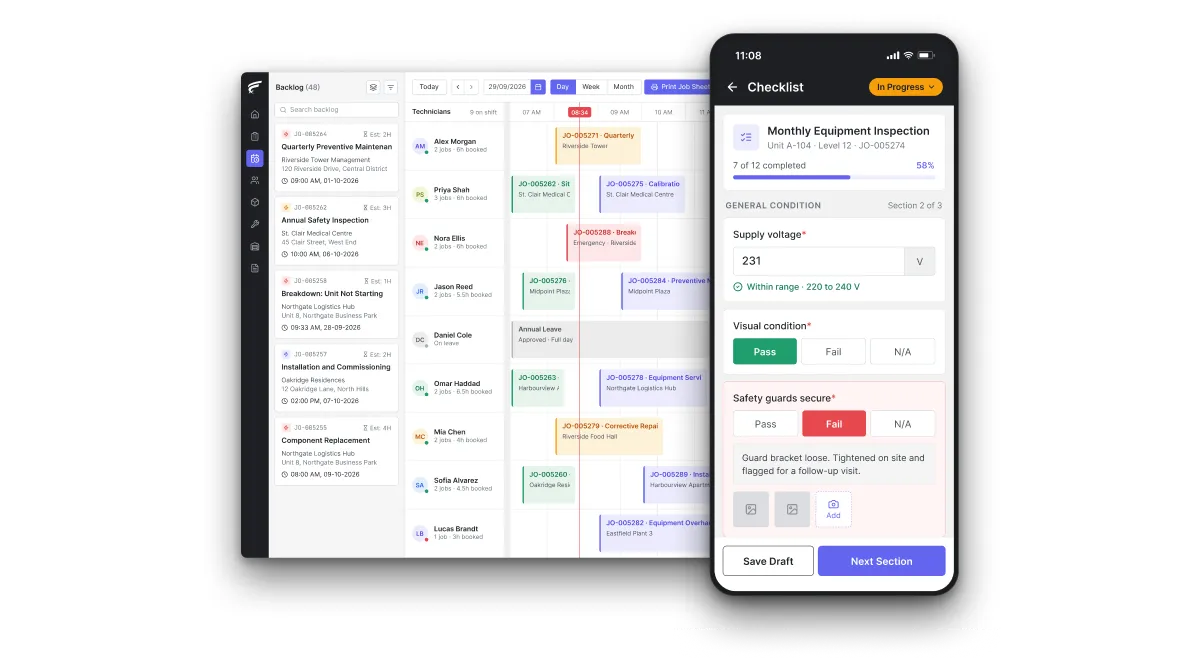
FieldEx scheduling board on desktop with a technician's inspection checklist open on the mobile app, as used by oil and gas service contractors

FieldEx is a field service and asset management (FSM+CMMS) application for oil and gas service contractors. It is built for companies that maintain, inspect, test, calibrate and rent equipment to operators. Each client's vessels, valves, pumps, instruments and rental units have their own records. FieldEx runs inspections and tests on code-based intervals. It records who did each test, when and with what result.

What FieldEx does for oil and gas service contractors

Oil and gas maintenance runs on intervals. There are years between internal inspections, months between valve strokes and hours between compressor services. Miss one and the gap shows up in an audit, or worse. FieldEx puts each interval on the client equipment it belongs to. The result of every test stays on the same record, ready to hand over. Book a demo to see it with one of your clients' equipment registers.

Your clients' wellsite, platform and plant equipment on record

  • Asset records for pressure vessels, separators, relief valves and mainline valves.
  • Asset records for pumps, compressors, wellheads and generators.
  • Each record holds the tag number, serial number, specifications and photos, with datasheets and drawings attached.
  • Parent and component levels in Asset Management. A compressor package and its driver, cooler and relief valves each keep their own history.
  • Equipment grouped by client, site, field or platform, with a service zone and map location for each site.
  • QR or barcode labels on each item, and a change history showing who edited what and when.
  • QR or barcode stickers printed for each item, and a log of every edit with the user and the time.

Inspection intervals that follow the code

  • Recurring inspections and certifications per equipment type on set frequencies in months or years, with the inspecting body recorded. Longer cycles run as maintenance plans set in years.
  • Each plant or pipeline check is marked due, overdue or completed on the CMMS dashboard.
  • The date, the inspector, the result and remarks on each record, through Compliance Documentation.
  • Certificates can be attached to certification records.
  • A dashboard listing overdue inspections, inspections due within 7 days and those closed in the past 7 days.
  • Dashboard filters for equipment type, group or service zone.

Relief valves, safety valves and shutdown tests

  • Each relief valve, safety valve and shutdown valve as its own asset, with its set pressure and service recorded in its specifications.
  • Test checklists, job-form number fields for set pressures and leak rates, and photos of the bench test.
  • Record the test result, then create a separate repair job for the valve.
  • Test frequencies changed per valve when its service or its history calls for a shorter interval.

Usage-based servicing for rotating equipment and fleets

  • Maintenance plans for pumps, compressors, generators and vehicles that trigger on running hours, mileage or the calendar, whichever comes first, in Preventive Maintenance.
  • Meter readings entered from the field, building a history on each machine that drives the next service.
  • Different checklists and technicians for different service levels in the same plan.
  • Missed maintenance rescheduled automatically after a set overdue period, with every plan showing last and next service dates.

Instruments and calibration

  • Pressure gauges, transmitters, gas detectors and analyzers as assets, each with its calibration as a recurring inspection.
  • As-found and as-left readings entered on custom job forms, set up with you during onboarding, recorded against the job.
  • Calibration certificates attached to each instrument's record, with the next due date.

Rental equipment out and back

  • Rental units, lifting gear and offshore containers as assets.
  • Statuses named your way, such as on hire, in the yard or under repair.
  • Delivery and return jobs with condition checklists, photos and the client's signature.
  • Transfers between bases with approvals and a consignment note PDF.
  • Thorough examinations and certificates on each unit, so their due dates travel with it.

Your own vans, gas detectors and workshop

  • Service vans and trucks on maintenance plans by date or odometer reading, each with its own service history.
  • Your crews' portable gas detectors, torque tools and pressure test pumps as company assets, each with its serial number and location.
  • Calibration due dates for each instrument, with reminders before they lapse and the certificate kept on the record.
  • Reference gauges, valve test benches and workshop machines on their own maintenance and calibration cycles.

Crew certificates and client access

  • Offshore survival, competency and confined-space certificates held as skills, each with an expiry date and reminders.
  • Jobs assigned only to technicians whose certificates are current.
  • Clients see their equipment, its status and downloadable job reports in the branded customer portal.

Work packs for remote and offshore crews

  • Each job on the FieldEx Mobile App with the equipment's history, the right checklist, number fields for readings, watermarked photos and a signature.
  • Tasks in a set order, with steps such as isolation that must be completed before the next task starts.
  • Jobs and tasks can be downloaded and worked offline, with check-in, check-out and travel synced later.
  • Assignment by skill, availability, shift, leave and service zone, so certified technicians get the jobs that need them.
  • Jobs matched to people by skill, shift, leave and service zone, so a boiler job reaches a qualified steam boiler engineer.

Spares across bases and sites

  • Spare parts and equipment held in each shore base, warehouse, site store and technician's own stock, with transfers between them.
  • Transfer and requisition approvals at one or more levels, with a consignment note PDF for items on the move.
  • Reorder and low-stock alerts per stock location, and a record of every part used on each job and each item of equipment.

Records an auditor can follow

  • Every inspection, test, repair and part used on the equipment's record, with attachments and a change history.
  • Completion PDFs emailed to the client, with a record of when each was sent.
  • Each PDF holds the equipment, the fault and resolution, parts and check-in and check-out times, plus attachments and signatures.
  • Reports on jobs, overdue work, asset reliability and maintenance cost, in Reporting and Analytics. Reports export as CSV, Excel or PDF, or go out by email on a schedule.

FieldEx also runs this kind of work for Telecom Infrastructure, Manufacturing Plant Maintenance, Heavy Machinery, Calibration & Test-Equipment Services, Biomedical Equipment, Equipment Rental & Leasing and Fleet Asset Management.

How often does a pressure vessel need an internal inspection under API 510?

Under API 510, the internal or on-stream interval is half the vessel's remaining life or 10 years, whichever is less. API 510, the American Petroleum Institute's Pressure Vessel Inspection Code (11th edition, October 2022), applies that limit unless a risk-based inspection (RBI) assessment justifies otherwise. Where the remaining life is under 4 years, the interval may be the full remaining life, up to 2 years. Each aboveground vessel also gets an external visual inspection every 5 years, or at the internal interval if that is shorter.

The interval changes each time a thickness survey changes the remaining life.

What FieldEx does about it

  • Internal and external on separate cycles: each vessel carries its internal or on-stream inspection and its external visual inspection as separate recurring certifications.
  • Intervals set in years or months: two-year and five-year intervals run as certifications, and a 10-year interval runs as a maintenance plan set in years. Each can be shortened when a new remaining-life figure comes in.
  • The survey on the vessel: technicians enter thickness readings as number fields on the inspection job. The full survey report is attached to the record.
  • Planning ahead: reminders by email, in-app notification or both go out before each due date, and the dashboard lists what is overdue.

When can risk-based inspection extend pressure vessel inspection intervals?

Only under a documented RBI assessment that is updated after each inspection. API 510 lets the RBI assessment set the interval in place of the half-life and 10-year limits, and requires the assessment to be updated after each vessel inspection. The UK Health and Safety Executive (HSE) describes the same approach in its COMAH Guidance on Inspection and NDT. RBI ranks high-risk items for frequent non-destructive testing (NDT), and low-risk items for infrequent testing or none.

What FieldEx does about it

  • Different intervals for different risk ranks: high-risk and low-risk vessels can sit on different inspection frequencies, set per vessel or per equipment type.
  • The assessment on file: the RBI assessment and each update are attached to the vessel's record.
  • An update after every inspection: completing a vessel inspection can book the RBI update as a follow-up job, so the assessment never falls behind the last result.
  • Changes traceable: every change to a vessel's record is logged with the user and the time.

How often do pressure systems need examining in the UK?

At the intervals in the written scheme of examination. Regulation 9 of the UK Pressure Systems Safety Regulations 2000 requires a competent person to examine the parts in the scheme within the intervals the scheme specifies. HSE's guidance on the regulations adds that a written scheme must be in place, and an examination carried out, before qualifying pressure equipment is first used.

The regulations leave the number of months to the scheme, so the scheme and the dates belong on the same record.

What FieldEx does about it

  • The scheme's intervals per item: each vessel, receiver or pipework section in the scheme carries its examination as a recurring certification. It runs at the interval the scheme sets.
  • The scheme attached: the written scheme of examination is attached to the system's record, alongside each examination report.
  • No use before the first examination: a new item's status can show it as awaiting examination until the first certification is completed.
  • Competent person recorded: each examination records the competent person who carried it out and the result.

What must a pressure system examination report include, and when is it due?

The written report is due within 28 days of the examination, and it sets the date of the next one. Under regulation 9 of the Pressure Systems Safety Regulations 2000, the competent person sends the report to the user or owner within those 28 days. It states the date after which the system may not be operated without a further examination, within the scheme's limits. HSE's guidance adds that the competent person also tells the user or owner of any repairs required.

  • Steam boiler operator grade 2: 100 m² or less.
  • Operator grade 1 on each shift: over 100 m², up to 200 m².
  • Operator grade 1, plus a grade 1 or 2 engineer: over 200 m², up to 500 m². The engineer can be visiting.
  • Steam boiler engineer grade 1 or 2: over 500 m², up to 2,000 m².
  • Engineer grade 1: over 2,000 m².

What FieldEx does about it

  • The next date from the report: the certification runs at the interval the report and the scheme set, and reminders go out before each due date.
  • Report received within 28 days: a follow-up task on the examination job tracks the arrival of the written report. The report is attached when it comes in.
  • Repairs into the backlog: each repair the competent person requires becomes a job on the same system, so it can be tracked to completion.
  • Who was told: a completion notification can go to a chosen group when the certification is closed.

How often should pressure relief valves be inspected and tested?

Every 5 years in typical process service and every 10 years in clean service, under API 510. API 510 (11th edition, October 2022) gives the 10-year cycle to clean, nonfouling and noncorrosive services. A device found heavily fouled or stuck shut, or one that fails its as-received pop test, has its interval re-evaluated. US gas pipelines follow the Pipeline and Hazardous Materials Safety Administration (PHMSA) rule 49 CFR 192.739. Each pressure relief device is inspected and tested once each calendar year, at intervals not exceeding 15 months.

What FieldEx does about it

  • Each valve on its own cycle: five-year and annual tests run as recurring certifications on each valve, set by service. A ten-year test runs as a maintenance plan set in years.
  • As-found condition recorded: the test checklist records the as-found condition. The set pressure and the pop and reseat readings go in number fields on a custom job form.
  • Fouled or stuck shortens the cycle: a fouled or stuck result raises the repair job and can book a follow-up test. The valve's frequency can then be shortened on its record.
  • A 15-month ceiling with annual reminders: pipeline relief devices run on an annual cycle with reminders ahead of each date, well inside the 15-month limit.

How often do offshore subsurface safety valves have to be tested?

Every six months on the US outer continental shelf. The Bureau of Safety and Environmental Enforcement (BSEE) sets the rule in 30 CFR 250.880. Surface-controlled subsurface safety valves (SSSVs) are tested semi-annually, with no more than 6 calendar months between tests. Each valve is also tested when it is installed or reinstalled. A valve that doesn't operate properly is removed and repaired, or replaced. The same applies if it leaks more than 400 cubic centimeters of liquid or 15 standard cubic feet of gas per minute.

What FieldEx does about it

  • Six-monthly tests per well: each SSSV runs a six-monthly recurring inspection, with an extra test raised on installation or reinstallation.
  • Leak rates against the limit: the leak rate is a number field on the job form. A fail answer raises the remove-and-repair job.
  • Wells grouped by platform: wells are grouped under their platform or field site, so the dashboard shows which platform has tests due.
  • Weather delays visible: overdue tests stay on the overdue list until completed, and missed jobs can be rescheduled automatically after a set period.

How often should pipeline and mainline valves be inspected and operated?

Once each calendar year for gas transmission valves, and twice each calendar year for hazardous liquid mainline valves. Under PHMSA's 49 CFR 192.745, each gas transmission valve that might be needed in an emergency is inspected and partially operated at intervals not exceeding 15 months. Under 49 CFR 195.420, each mainline valve on a hazardous liquid pipeline is inspected at intervals not exceeding 7½ months, to check that it functions properly. The rule accepts a minimum 25 percent valve closure for that inspection, unless operating information calls for more.

What FieldEx does about it

  • Annual and twice-yearly valve rounds: gas valves run on an annual cycle and liquids mainline valves on a six-monthly one. Each runs as its own recurring inspection.
  • Closure recorded: the percentage of closure achieved goes in a number field on a custom job form, and the checklist records the valve's condition.
  • Valves by route section: each valve sits under its site or route section with a map location, so a technician can work along the line.
  • One round, many valves: a site maintenance plan can raise one job for a whole section of line, with a task per valve.

What has to happen when a pipeline valve is found inoperable?

It needs prompt remedial action. On a gas transmission line, PHMSA's 49 CFR 192.745 requires prompt remedial action for any valve found inoperable. Rupture-mitigation valves found inoperable are repaired or replaced as soon as practicable, and no later than 12 months after the finding. Under 49 CFR 195.420, each valve needed for the safe operation of a hazardous liquid pipeline is kept in good working order at all times.

The 12 months start on the day of the inspection that found the fault.

What FieldEx does about it

  • Record the failed inspection, then create a repair job for the valve and add the required tasks.
  • A deadline you can see: the repair job is scheduled inside the deadline that applies to the valve. Workflow alerts by email or in-app notification can remind a supervisor while it stays open.
  • Out of service until repaired: the inspection can set the valve's status, so planners see which valves are inoperable.
  • The fix verified: completing the repair can book a follow-up inspection to confirm the valve shuts off.

What inspection and test records does OSHA process safety management require?

A dated record of each inspection and test, saying who did it, on which equipment, what was done and the result. OSHA's process safety management standard, 29 CFR 1910.119, names five items. They are the date, the person who performed it and the equipment's serial number or other identifier. The record also describes the inspection or test and gives its results. Frequencies follow manufacturers' recommendations and good engineering practice, and increase where operating experience shows a need.

What FieldEx does about it

  • The five fields on every record: each inspection holds the completion date and the person who did it. It also holds the equipment's tag or serial number, the checklist that describes the test, and the result.
  • Frequencies you can tighten: inspection frequencies are set per equipment type or per item, and can be shortened when experience shows they should be.
  • Results that trigger work: a failed answer creates the corrective job and its tasks, linked to the same equipment.
  • Exported for the audit: filter completed inspection jobs on date range, equipment type or site in reports, then export them as CSV, Excel or PDF.

How often must lifting equipment and lifting accessories be thoroughly examined?

Every 6 months for lifting accessories and for equipment that lifts people, and every 12 months for other lifting equipment, unless an examination scheme sets other intervals. Those are the UK HSE's intervals under the Lifting Operations and Lifting Equipment Regulations 1998 (LOLER), in Thorough Examinations of Lifting Equipment. A further examination follows damage, failure or other exceptional circumstances, and the report gives the next due date. HSE's LOLER Overview adds that defects are reported to the user, to anyone the equipment was hired from and to the enforcing authority.

What FieldEx does about it

  • Each unit on its own cycle: every crane, hoist, sling and spreader is an asset. Its 6- or 12-month thorough examination runs as a recurring certification.
  • Reports with the next due date: the examination report attaches to the unit, and reminders go out before the next date.
  • Out of service until fixed: a defect raises the repair job and can change the unit's status, so it isn't sent out again.
  • Condition at delivery and return: delivery and return checklists record the unit's condition, and photos and the client's signature are attached to the job.

How does a permit-to-work system control maintenance and hot work?

Through a permit that a responsible person issues after assessing the work, and that the people doing it sign before they start. HSE's guidance on permit-to-work systems says safety is checked at each stage, and the system includes a hand-over of the plant when the work is complete. OSHA's 29 CFR 1910.119 adds that hot work on or near a covered process needs a hot work permit. The permit documents the fire prevention and protection measures in place.

What FieldEx does about it

  • The permit attached to the job: the signed permit is photographed or uploaded to the maintenance job it covers.
  • Precautions as ordered tasks: isolation, gas testing and fire watch can be tasks that must be completed before the work task starts. Technicians enter readings as numbers.
  • Signed off on the phone: a signature is captured in the mobile completion flow, and the job's PDF shows it with check-in and check-out times.
  • Hand-over before closing: a hand-over task can be required before the job can be closed.

How often should pressure gauges, transmitters and gas detectors be calibrated?

Each instrument gets its own interval, set by risk and then adjusted by its calibration results. The international guideline ILAC-G24 / OIML D 10 (2022) sets the first interval from a risk assessment. It weighs the measurement uncertainty needed, the manufacturer's recommendation, the risk of drift, how much the instrument is used and its environment. An instrument found well within its permitted error can move to a longer interval, and one found outside it moves to a shorter one. Intervals can also be set in hours of use.

  • Basic Offshore Safety Induction and Emergency Training (BOSIET), for offshore personnel.
  • Authorised Gas Testers and Entry Supervisor (AGTES), for gas testing and confined space supervision.
  • Authorised Entrant and Standby Person (AESP), for confined space work.
  • Permit to Work (PTW) training, for work that needs a permit.

What FieldEx does about it

  • One cycle per instrument: each gauge, transmitter or detector carries its own calibration frequency, changed when its results call for it.
  • As-found and as-left recorded: custom job forms can include number fields for both readings, recorded against the job.
  • Certificates on the instrument: each calibration certificate attaches to the instrument's record and the client's job report.
  • Your standards calibrated too: reference standards and test equipment are assets with their own calibration cycles and reminders.

How often should a crew's portable gas detectors be bump tested and calibrated?

Bump test each portable gas detector before each day's use, and fully calibrate any detector that fails. OSHA's bulletin Calibrating and Testing Direct-Reading Monitors (SHIB 11-26-2024) quotes that advice from the International Safety Equipment Association (ISEA). An instrument that then fails its full calibration is removed from service. OSHA adds that employers should keep calibration records for the life of each instrument. The history shows which units need repeated repairs and when sensors are drifting.

What FieldEx does about it

  • Each detector as a company asset: every gas detector your crews carry has its own record, with its serial number, location and history.
  • Calibration that doesn't lapse: each detector's full calibration runs as a recurring certification, with reminders before it falls due and the certificate on the record.
  • A record for the instrument's life: every calibration, repair and sensor replacement stays on the detector's record, so units with repeated faults stand out.
  • Out of service when it fails: a failed answer on the detector's calibration checklist can raise a repair job and set its status to out of service until it passes.
Customer story

AMRTUR is a Southeast Asian oilfield services contractor specializing in offshore OCTG (oil country tubular goods). It runs its fleets, heavy machinery and multi-site logistics on FieldEx. Its story describes maintenance jobs created automatically at 300 hours of use or 6 months, whichever comes first. QR request forms route pickups and deliveries to the right team. Equipment transfers come with a signed PDF, and components are tracked over a 5-year service plan.

Read the AMRTUR Story

Questions oil and gas service contractors ask about FieldEx

What is the best oil and gas maintenance software for a service contractor?

One that handles both sides of the work. It needs the inspection intervals and asset history of a maintenance system. It also needs the dispatch, mobile checklists and customer reports of field service software. FieldEx does both in one system. Compare approaches in our guide to CMMS Software.

Can FieldEx track inspection intervals measured in years?

Yes. The vessel and valve sections above run 2-year and 5-year certifications, and longer cycles run as maintenance plans set in years. Each long-cycle date also shows on the calendar beside the monthly work, so planners see a turnaround coming.

Can maintenance be triggered by running hours and the calendar together?

Yes, whichever is reached first, as in the AMRTUR story's 300-hour or 6-month rule. Meter readings entered on each job feed the next service date.

Can we track every relief valve separately?

Yes. Each valve is its own asset with its own test cycle, as described above. It can also sit as a component under the vessel or line it protects, so the vessel's record shows every valve on it.

Can offshore crews work without a connection?

Yes. Jobs and tasks can be downloaded and worked offline, with check-in, check-out and travel synced later.

Can clients see the inspection status of their equipment?

Yes. The branded customer portal shows each client its own equipment, last-serviced dates, upcoming maintenance and job reports. Completion reports can also be sent automatically to the client or anyone else you choose.

Can we move equipment between bases with an approval trail?

Yes. Transfers and requisitions can need one or more approvals, and a consignment note PDF can go with the items.

Can a technician see the full history of a vessel or valve on site?

Yes. Scanning the item's QR label opens its record, past jobs and attached reports on the phone. The app also flags when a new job repeats a recent one on the same equipment.

Can FieldEx send overdue inspection alerts to a supervisor?

Yes. Beyond the due-date reminders, workflow alerts can go to a chosen supervisor or group by email or in-app notification. They fire when a record meets the conditions you set, such as an overdue status.

Can FieldEx work alongside our ERP?

FieldEx can connect to any open system through REST APIs and has connectors for QuickBooks and Xero. Existing equipment registers can be uploaded.

Can each rental unit carry its own thorough examination date?

Yes, as the lifting section shows. The examination date travels with the unit between bases and clients, so the next hire starts from a current record.

Can we track crews' offshore survival and competency certificates?

Yes. Each certificate is a skill with an expiry date and reminders. Assignment then skips any technician whose certificate has lapsed, so an offshore job never goes to someone who can't board.

How long does it take to set up FieldEx for an oil and gas service contractor?

There's no setup fee. Once we know your requirements and your data is ready, FieldEx can be implemented in as little as a week with standard features for small businesses. Larger setups and custom work take longer. Equipment registers can be uploaded. FieldEx helps with setup, and training is included. See Setup and Training.

See your clients' vessels, valves, rental units and crews in one system

Book a Demo