Fire inspection software for extinguisher, alarm, sprinkler and CCTV contractors

Put every extinguisher, detector, sprinkler valve and camera on its client's record. Run each test cycle on time and turn failed checks into repairs.

Book a demo
Updated 16 Oct 2026
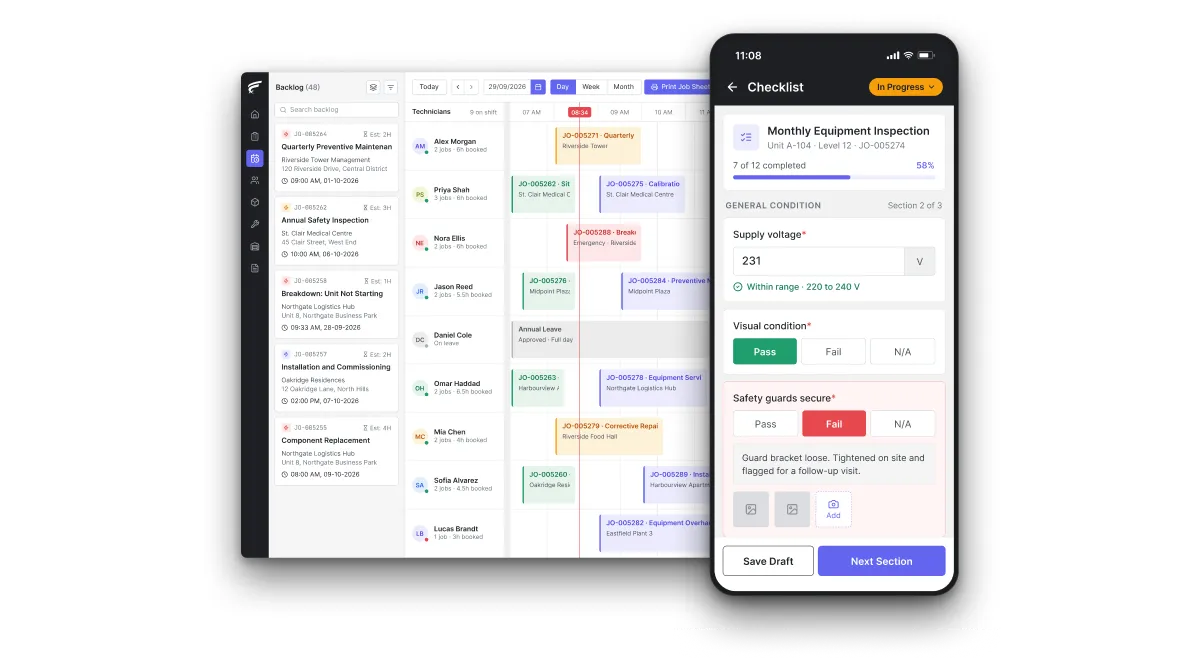
FieldEx scheduling board on desktop with a technician's inspection checklist open on the mobile app, as used by fire protection contractors

FieldEx is a field service and asset management (FSM+CMMS) application for fire protection, fire alarm, security and closed-circuit television (CCTV) contractors. Each client site's extinguishers, panels, sprinkler valves, cameras and recorders have their own records. FieldEx schedules the monthly, quarterly, six-monthly, annual and multi-year inspections. It raises repair jobs from failed checks and sends the client a signed service report.

What FieldEx does for fire and security contractors

A fire and security contractor sells one thing in the end: proof. Every device at every client site was checked when it should have been, and whatever failed was put right. FieldEx keeps that proof on the device itself, from the first inspection to the last repair, across every contract you hold. Book a demo to see it with your own client sites, or compare approaches in our guide to Field Service Management Software.

Every device at every client site

  • A site record for each protected client premises, with its address, map pin, contacts and service zone. Each site holds the devices, jobs and maintenance plans that belong to it.
  • An asset record for each fire panel, detector loop, sprinkler valve set, fire pump and extinguisher, in Asset Management. Intruder alarm panels, cameras, recorders and access controllers get one too.
  • Each record holds serial numbers, specifications, photos, warranty details and attached drawings.
  • Parent and component levels, so a fire alarm panel keeps its loops and devices under it, and a recorder keeps the cameras it serves.
  • QR or barcode labels printed for each device, and a change history showing who edited what and when.
  • Printable QR or barcode stickers for each unit, and a log of every edit with the user and time.

Test cycles that run on their own

  • Recurring inspections for each device type, each linked to its own checklist. Some run daily, weekly or every two weeks. Others run monthly, quarterly, every 6 months or annually.
  • Certifications can track scheduled tests, with reminders before the due date and the certificate attached to the asset record., such as a 5-year extended service. A 6-year teardown can run on a maintenance plan with its own repeat frequency. Each one records the certifying body and has the certificate attached.
  • Due, overdue and completed status on every record, with certification reminders by email, in-app notification or both, through Compliance Documentation.
  • A dashboard of inspections that are overdue, due in the next 7 days or completed in the last 7 days. It filters by device type, group or service zone.

Planned maintenance across every contract

  • Asset and site maintenance plans that create each fire, security and CCTV visit automatically. The quarterly visit and the annual service in the same cycle can each have a different checklist and technician.
  • Fixed calendar schedules, or schedules counted from the last completed visit, with missed visits rescheduled after a set overdue period.
  • One plan applied across many client sites, picking up newly installed devices that match its criteria, in Preventive Maintenance.
  • Maintenance contracts with start and end dates, linked to the devices and plans they cover.

Checklists that find defects and act on them

  • Inspection checklists matched to the device being checked, with questions grouped into sections and reference photos where a picture says it better.
  • Questions generated with AI from a description or a PDF or PNG of your existing checklist or procedure.
  • A failed answer creating the repair job and its tasks straight away, and booking a follow-up inspection where needed.
  • Inspection records include a completion date, result, remarks, and linked checklist.

Callouts, faults and response times

  • A QR code for each client site that opens a fault-report form without logging in, with photos or video.
  • A branded Customer Portal for service requests and appointment dates.
  • Every report arriving as a job in the backlog, time-stamped and ready to assign.
  • Automatic assignment by skill, availability and shift, in Scheduling and Dispatch. Assignment also weighs leave, service zone and live location, and a drag-and-drop scheduler handles the exceptions.
  • Service-level agreements on business hours, with several stages and at-risk and violation alerts per client or device.

Device inspections on the technician's phone

  • Each visit on the FieldEx Mobile App, with the device's history and its checklist. Number fields hold readings such as pressures, and the app shows the parts in the technician's own stock.
  • Scan a device's label to open its record and start its inspection, with watermarked photos, annotations and the client's signature.
  • Jobs and tasks can be downloaded and worked offline, with check-in, check-out and travel synced later.

Your own test kit, workshop and vans

  • Hydrostatic test rigs, detector testers, sound level meters and multimeters kept as company assets, with serial numbers and locations.
  • Calibration due dates for each instrument as recurring certifications, with reminders and the calibration certificate filed on the record.
  • Refill and workshop machines on their own maintenance plans, and service vans serviced by date or odometer reading.

Service reports and client records

  • A completion PDF for every visit, emailed to the client with a record of when it was sent.
  • The PDF lists the devices, faults and resolutions, and the parts with quantities and prices. It also shows check-in and check-out times, photos and the client's signature.
  • Clients seeing their registered devices with last-serviced dates, upcoming asset maintenance and job reports in the customer portal.
  • Inspection records are held on asset records. Certification and inspection data isn't in Reports yet. You can export them as CSV, Excel or PDF, or email them on a schedule.

What inspection, service and pressure-test cycle does each type of fire extinguisher follow?

Every extinguisher runs on three clocks at once: a monthly inspection, an annual maintenance check and a multi-year test or service. The US Occupational Safety and Health Administration (OSHA) rule 29 CFR 1910.157 requires the monthly visual inspection and annual maintenance. Its Table L-1 sets a 5-year hydrostatic test for stored-pressure water units. Stored-pressure dry chemical units on a 12-year hydrostatic test are emptied and maintained every 6 years. In the UK, the BAFE summary of BS 5306-3 sets a basic service every 12 months and an extended service every 5 years for water-based units.

What FieldEx does about it

  • Each extinguisher on its own dates: every unit is an asset with its type, location, serial number and manufacture date. Each one has its own monthly, annual and multi-year records.
  • Long cycles tracked: the 5-year extended service and the 5-year hydrostatic test run as certifications, with the test certificate attached. The 6-year maintenance and 12-year test run on maintenance plans with their own repeat frequency.
  • Monthly rounds by scan: the technician scans each unit's label, answers the short monthly checklist and moves on. A photo of the gauge can be attached to the job if needed.
  • A defect raises the replacement: a failed answer, such as a low gauge or a broken seal, creates the corrective job straight away.

What should a fire extinguisher inspection record show, and how long must it be kept?

It shows the month and year of each inspection and who did it, and it is kept for at least 12 months. OSHA 1910.157(e)(3) requires the employer to record the annual maintenance date. The employer keeps that record for one year after the last entry or for the life of the shell, whichever is less. NFPA's guide to NFPA 10 says monthly inspection records can sit on a tag or label on the extinguisher, or on paper or electronic files. They must show the month and year of the inspection and the person who did it. Those records are kept for at least 12 months.

What FieldEx does about it

  • Who, when and what, on every unit: each completed inspection records the date and the result, with remarks. It also names the technician, chosen from your user list.
  • History that stays put: every monthly check, annual service and test stays on the extinguisher's record for as long as the unit is on file.
  • Photos as evidence: watermarked photos of the tag or label are attached to the job with the date and time.
  • Records the client can download: the client sees each unit's last-serviced date in the customer portal, and job reports list every visit by site and period.

How often must a fire alarm be serviced under BS 5839-1:2025?

Every 6 months, with a visit allowed anywhere from 5 to 7 months after the last one. The Institution of Engineering and Technology (IET) covers this in Wiring Matters issue 108 that clause 43.2.1 now gives this tolerance without the system being treated as non-compliant. The Fire Industry Association's guide to BS 5839-1:2025 adds that the date of acceptance is the datum for these periods.

What FieldEx does about it

  • A fixed six-monthly calendar: the alarm service runs as a six-monthly certification on a fixed schedule. Each visit is due from the original start date, not from whenever the last one happened.
  • Reminders inside the window: they go out ahead of each due date, so the visit is booked within the five-to-seven-month window.
  • The service sheet on the panel: the checklist results, readings and the engineer's remarks stay on the panel's record. The panel's loops and devices sit under it as components.
  • Remedial work tracked: any fault found on the visit becomes a scheduled repair job on the same panel.

How long can a fire alarm initiating device go between tests under NFPA 72?

Never more than 18 months, even when it can only be reached during a shutdown. NFPA 72, the National Fire Alarm and Signaling Code, covers in its testing frequencies (Table 10.4.3) devices that can't be reached safely. They may be tested during scheduled shutdowns if the authority having jurisdiction approves. The interval can't exceed 18 months. For smoke detector functional testing, different detectors are tested each year, the owner keeps records of which were tested, and every detector is tested within 5 years.

What FieldEx does about it

  • Each device under its panel: detectors, call points and interface units can be recorded as components of the panel, each with its own test history.
  • An 18-month ceiling as a set cycle: hard-to-reach devices carry their own recurring certification every 18 months, with the shutdown visit booked before it falls due.
  • Which detectors were tested, on record: FieldEx logs each completed test against the device tested. You can then report the five-year coverage by panel and year.
  • Shutdown visits planned ahead: the shutdown job can be scheduled in advance with its tasks for every device on the list.

What goes on an NFPA 25 sprinkler inspection, testing and maintenance checklist?

Monthly gauge checks, quarterly alarm checks, annual valve tests and a few long-interval tests. NFPA's article on NFPA 25 lays out the rhythm for a wet or dry system. Gauges and the dry pipe valve exterior are inspected monthly. Alarm valve exteriors, fire department connections, valve supervisory devices and waterflow alarms are checked every quarter. Each year brings the main drain test and the dry valve trip test. The dry valve full flow test comes every 3 years, and the gauges are tested every 5 years.

What FieldEx does about it

  • One plan, five frequencies: a single maintenance plan for the riser can carry all five checks, each with its own checklist. They are the monthly gauge check, the quarterly alarm test, the annual trip test, the 3-year full flow test and the 5-year gauge test.
  • Readings as numbers: static and residual pressures from the main drain test go into number fields on the job. Each reading sits against the riser it belongs to.
  • Valves and riser as components: the valve set, gauges, fire department connection and flow switch each have their own record under the system.
  • The log the standard expects: every visit, reading and result stays on the system record. You can export it for the client or the authority having jurisdiction.

Which emergency lighting tests can the building's own staff carry out?

The monthly functional test, once the competent person who hands over the system has trained them. BAFE's emergency lighting guidance on BS 5266-1 sets a functional check at least every month and a full rated duration test of each luminaire at least annually. The competent person handing over the system should train the responsible person on the monthly tests and the test facilities. All testing and repair information goes in a logbook.

  • By-law 227 of the Uniform Building By-Laws 1984 (UBBL).
  • PU(A) 463/2021 on Bomba special duty fees.
  • MS 1539 Parts 1 to 4 and 6, with Part 4 covering maintenance.

For alarms, Standards Malaysia's 2025 list of mandatory standards includes the MS 1745 series on fire detection and fire alarm systems. One example is Part 4:2004 on power supply equipment, made mandatory by Bomba through UBBL by-laws 237 and 241.

What FieldEx does about it

  • Client staff on the same checklist: the monthly test can run as a recurring inspection with its own checklist, assigned to the client's users.
  • Monthly and annual on one calendar: the client's monthly tests and your annual full-duration test sit side by side on the dashboard calendar.
  • Durations recorded: the full-duration test time is entered as a number field, so the record shows the time, not just a tick.
  • Faults passed to the contractor: a failed monthly test can raise a job in your backlog straight away.

How often must fire doors be inspected?

At least once a year under the US standard, and more often in some residential buildings. NFPA's fire door FAQ says NFPA 80 requires fire doors to be inspected and tested after installation and at least annually after that, against 13 items. England adds its own cycle for blocks above 11 meters. The Home Office fact sheet on regulation 10 of the Fire Safety (England) Regulations 2022 sets two cycles. Communal fire doors are checked every quarter, and flat entrance doors every year on a best-endeavor basis.

What FieldEx does about it

  • Each door as an asset: every communal and flat entrance door can have its own record and QR label, grouped under the block and floor.
  • Annual and quarterly rounds: each door group runs on its own inspection cycle, with a checklist for closers, seals, gaps and labels.
  • No-access visits recorded: a door the technician couldn't reach is saved with a remark, and a follow-up inspection is booked for it.
  • Repairs from failed doors: a failed closer or damaged seal creates its repair job with the photo attached.

How often should fire protection equipment be serviced under AS 1851?

At least every 6 months for portable extinguishers, with other routines set system by system. Standards Australia describes AS 1851-2012 as setting the requirements for inspection, testing, preventive maintenance and survey of fire protection systems and equipment. For portable extinguishers, the Australian Maritime Safety Authority's guidance notice AMSA 707 (February 2017) states that AS 1851-2012 requires inspections every 6 months.

What FieldEx does about it

  • Six-monthly extinguisher routines: each extinguisher's six-monthly inspection runs as a recurring record with its own checklist, due date and overdue status.
  • Monthly, six-monthly and yearly on one plan: different routines in the same cycle can use different checklists and technicians.
  • Results by device: each routine's pass or fail result is stored on the device, ready for the client's records.

How many false alarms trigger an investigation under BS 5839-1:2025?

More than four false alarms per 100 detectors over the previous 12 months. The FIA's guide calls for a preliminary investigation at that rate. An in-depth investigation is recommended for systems with more than 40 automatic detectors when the average rate exceeds five per 100 detectors a year. The IET's summary of clause 29.6 adds that the user should be told to investigate every false alarm and act where appropriate.

What FieldEx does about it

  • Every false alarm as a job: each call-out is a job on the panel's record with its date, cause and resolution. The 12-month count comes from the system's own history.
  • Repeat-call warnings: when a new job repeats a recent job for the same panel, the team gets an email or in-app warning.
  • The rate at each service: reports group false-alarm jobs by panel and period, so the engineer can check the rate before the six-monthly visit.
  • Investigation steps in order: an investigation job can hold ordered tasks, from the review of the log to the detector change, each with an owner.

What should a CCTV maintenance visit and annual review cover?

A visit checks that each camera and recorder still works, and a yearly review checks that the system is still needed. The UK Home Office's Surveillance Camera Code of Practice (amended November 2021) covers the review. Paragraph 10.1 says the operator should review the continued use of a camera system at least once a year. The review checks that the system remains necessary, proportionate and effective.

What FieldEx does about it

  • Cameras under their recorder: each camera is a component of its recorder or system, with its location, model, serial number and photos.
  • A checklist per camera: the maintenance checklist covers image quality, field of view and housing. It also covers infrared, recording and retention, and a reference photo shows the correct view.
  • The annual review on the calendar: the client's yearly review can run as its own recurring inspection, with the outcome and remarks recorded.
  • Faulty cameras fixed: a failed answer raises the repair job for that camera, with parts drawn from the technician's own stock.

What maintenance rules apply to police-monitored intruder alarms and CCTV?

The maintenance company must be certified by an accredited body, and the system must be maintained to a recognized standard. The National Police Chiefs' Council's Requirements for Response to Security Systems (August 2022) set three rules. A United Kingdom Accreditation Service (UKAS) accredited body certifies the installation, maintenance and monitoring companies. The system follows a recognized public-domain standard or code of practice for its manufacture, installation, maintenance and operation. If a maintenance company loses police recognition, its customers have 90 days to make other arrangements.

What FieldEx does about it

  • Maintenance visits on contract: each monitored system's routine maintenance visits run on a plan linked to its contract, with start and end dates.
  • The record behind the certification: every visit, fault and repair is kept on the system's record, ready for your certification body's audit.
  • Response times measured: service-level agreements time each fault from report to attendance and fix, with at-risk and violation alerts.
  • Handover when a contract moves: when a system changes hands, you can export its device lists and visit histories by client site.

How often must a fire contractor's own hydrostatic test equipment be calibrated?

At least once every 12 months, with an accuracy check on each day it is used, under the US cylinder requalification rule. The Department of Transportation's 49 CFR 180.205 requires pressure test equipment to be calibrated with a calibrated cylinder of known water capacity. The pressure gauge must be accurate within 1 percent of the test pressure.

What FieldEx does about it

  • Test rigs as company assets: each hydrostatic test rig, gauge and detector tester has its own record, with serial number and workshop or van location.
  • Yearly calibration on a cycle: each calibration runs as a recurring certification with reminders, and the certificate stays on the instrument's record.
  • Workshop machines maintained: refill machines and compressors run on their own maintenance plans, with their service history kept.
  • Vans on plans: each service van is serviced by date or odometer reading.
Customer story

Chubb is an integrated security provider with more than 300 people across 18 branches. It runs alarm monitoring, surveillance, safes and access control service on FieldEx. Its story describes four things:

  • Jobs auto-assigned by skill, availability and location.
  • Photos taken on the job in the mobile app, with the time and place watermarked.
  • Service-level reminders that help it avoid penalties.
  • Jobs that can't be marked complete until every standard operating procedure (SOP) step is done.
Read the Chubb Story

Questions fire and security contractors ask about FieldEx

What is the best fire inspection software for a fire protection contractor?

One that covers the device records, test cycles and repairs described above, and sends the client a signed report. In FieldEx, field service and maintenance management share the same device records, so a callout and a planned test sit on one history. See our guide to CMMS Software.

Can FieldEx handle extinguishers, alarms, sprinklers and CCTV on the same contract?

Yes. Each system is a set of assets under the client's site, each with its own inspection cycle, checklist and history. One maintenance contract can cover all of them.

Can technicians inspect each extinguisher by scanning a label?

Yes. FieldEx prints QR or barcode labels for each unit. The technician scans the label, opens the unit's checklist and records the result on the phone.

Can FieldEx track 5-year and 6-year extinguisher services and hydrostatic tests?

Yes, as the extinguisher cycle section shows. The dashboard calendar also shows each long-cycle date as it comes up, so the work can be quoted ahead.

Can a failed inspection item create the repair job automatically?

Yes. Beyond the repair job itself, FieldEx can book a follow-up inspection to confirm the fix.

Can we keep fire alarm services within the BS 5839-1 tolerance window?

Yes, as the BS 5839-1 section shows. The dashboard also lists services due in the next 7 days across every client.

Can clients see their devices and service reports?

Yes. The branded customer portal shows each client their registered devices with last-serviced dates, upcoming asset maintenance, job status and downloadable job reports.

Can we measure response times on maintenance contracts?

Yes. Service-level agreements run on business hours with several stages, such as attend and fix, and send at-risk and violation alerts to the people you choose.

Can technicians work in basements and risers without a signal?

Yes. Jobs and tasks can be downloaded and worked offline, with check-in, check-out and travel synced later.

How long does it take to get FieldEx running for a fire and security contractor?

There's no setup fee. Once we know your requirements and your data is ready, FieldEx can be implemented in as little as a week with standard features for small businesses. Larger setups and custom work take longer. Client sites and devices can be uploaded. FieldEx helps with setup, and training is included. See Setup and Training.

Put every device, test cycle and repair for your fire and security contracts in one system

Book a Demo