Farm equipment maintenance software for estates, mills and machinery fleets

Service every machine on its engine hours or calendar date. Drivers' daily checks become repair jobs, and each machine's history stays in one place.

Book a demo
Updated 16 Oct 2026
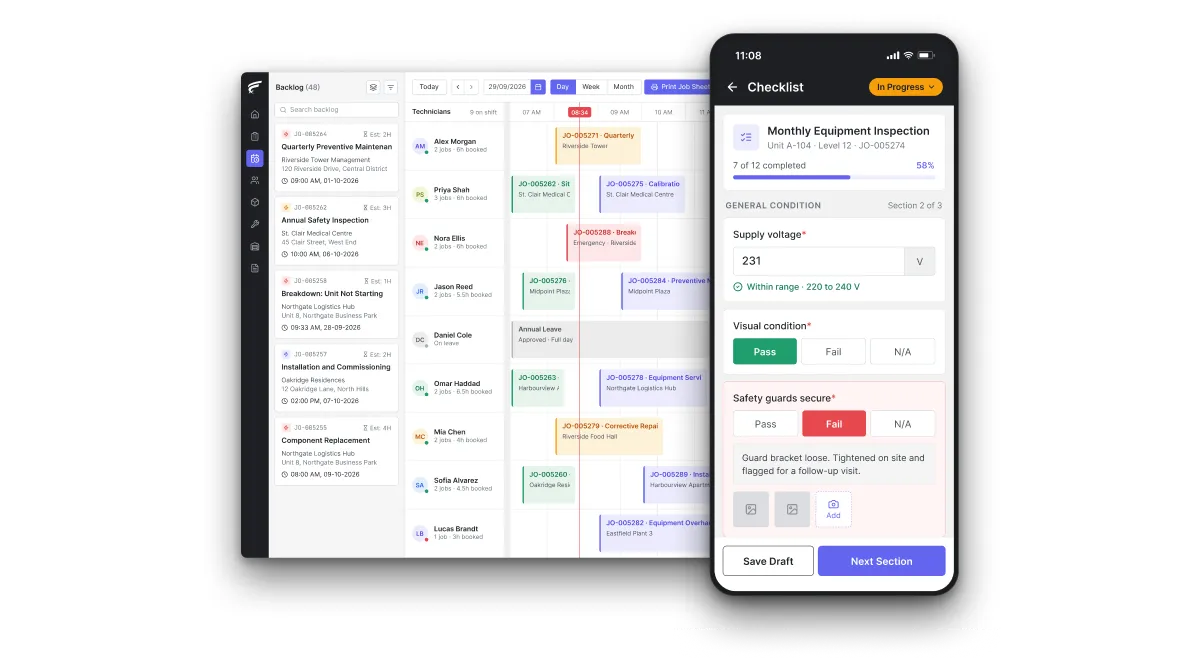
FieldEx scheduling board on desktop with a technician's inspection checklist open on the mobile app, as used by estate and mill maintenance teams

FieldEx is a field service and asset management (FSM+CMMS) application for plantation estates, farms and processing mills. Every tractor, loader and lorry has its own record. So does every pump, generator and mill boiler. FieldEx schedules servicing by engine hours or by date and runs pre-start checks and statutory examinations. It sends workshop and field crews to breakdowns and tracks the spare parts each repair uses.

What FieldEx does for estate and farm maintenance teams

An estate's machines are spread over many blocks, divisions and mills. They work hard in the season, and the workshop rarely sees them all at once. FieldEx puts every machine on one record and plans its servicing from its hour meter or the calendar. The driver's check, the mechanic's repair and the part fitted all land on the same history, wherever the machine is. See how it fits alongside other Multi-site Operations. You can also compare approaches in our guide to the Best CMMS Software, or book a demo with your own estates and fleet.

FieldEx keeps the work behind each of those on the machine's own record. The PPM, the breakdown and the certificate for each boiler or lorry sit in one place. Book a demo to see it with your own estates and mills.

Every estate, mill and machine on record

  • A site record for each estate, division, mill or workshop. It holds the address, map pin, contacts and service zone.
  • The machines, jobs and maintenance plans that belong to each site, listed on its record.
  • Asset records for tractors, trailers, telehandlers and lorries.
  • Asset records for irrigation pumps, generators, boilers and presses.
  • Serial numbers, specifications, photos, warranty details and attached manuals on each asset record.
  • Parent and component levels in Asset Management. A tractor and its loader each keep their own history, and so do a boiler and its feed pumps.
  • Machines grouped by asset type, with a default meter unit per type, such as engine hours for tractors and distance for lorries.

Servicing on engine hours or the calendar

  • Maintenance plans that create service jobs automatically. A job is raised when the hour meter, the calendar or whichever comes first says the machine is due.
  • Each machine's own meter interval, or one interval applied across the whole plan.
  • A default meter-based frequency for new machines of a type.
  • Separate plans for the 50-hour, 250-hour and 500-hour services, each with its own job template and mechanic.
  • One plan applied across many estates in Preventive Maintenance. The plan picks up new machines that match its criteria.

Statutory examinations and certificates

  • Recurring certifications and inspections can be tracked per asset type on standard frequencies, with the examining body recorded.
  • FieldEx sends reminders before certification due dates by email, in-app notification or both.
  • The date, the person who did it, the result and remarks on each record in Compliance Documentation. The examination report is attached.
  • A dashboard of examinations that are overdue, due in the next 7 days or completed in the last 7 days. Managers can filter it by asset type or service zone.

Daily checks, defects and breakdowns

  • Pre-start and after-use checklists linked to each machine, opened by scanning its QR or barcode label.
  • A failed answer on a checklist that raises the repair job and its tasks, and can book a follow-up check.
  • A QR code for each estate or mill that opens a fault-report form without logging in. The report carries a description and photos or video, and arrives as a job in the backlog.
  • An alert in Work Order Management when a new job repeats a recent job on the same machine. A recurring fault is spotted early.
  • A drag-and-drop scheduler in Scheduling and Dispatch.

Workshop and field crews

  • Automatic assignment by skill, availability, shift and leave, plus service zone and live location.
  • A breakdown in a far block goes to the nearest mechanic who can fix it.
  • A drag-and-drop scheduler with an unassigned backlog, in Scheduling and Dispatch. The mechanic gets a notification each time a job is assigned or reassigned to them.
  • Ordered tasks and procedures inside each job, with tasks that must be finished before the job can close.
  • Travel to each job logged with its distance and duration, viewable on a map.

On the phone, out in the blocks

  • Each job on the FieldEx Mobile App with the machine's history and the right checklist.
  • Number fields for readings such as hydraulic pressure or hour-meter values.
  • Jobs and tasks can be downloaded and worked offline, with check-in, check-out and travel synced later.
  • Watermarked photos and video of the damage and the repair, and the supervisor's signature on completion.

Spare parts in the workshop and on the service truck

  • Spare parts in each store and in each mechanic's own stock.
  • Transfers, barcode scanning and approvals where needed.
  • Reorder and low-stock alerts for each stock location, in Spare Parts Inventory. Filters, belts and hoses are on the shelf before the service is due.
  • Parts used recorded on the job and on the machine, with a movement history of every transfer and part fitted.

Your own workshop, service trucks and tools

  • Workshop lifts, compressors, welding sets and pressure washers on record as assets with their own maintenance plans.
  • Service trucks on plans by date or odometer reading, with each mechanic's own stock alongside.
  • Pressure gauges, torque wrenches and other test tools with calibration due dates and reminders.
  • Lifting slings, chains and jacks with their examination dates, reminders and reports on file.
  • Access limited by estate or region. Each team sees its own machines, and managers see the whole group.

Machine histories and reports

  • Every service, check, examination, repair and part kept on the machine's record.
  • A change history showing who edited what and when.
  • Completion PDFs with the machine, the fault and resolution, and parts with quantities and prices.
  • Each PDF also shows time on site and the signature, and photos stay attached to the job. It is emailed, with a record of when it was sent.
  • Reports on machine reliability, maintenance cost, utilization and age, in Reporting and Analytics.
  • Reports exported as CSV, Excel or PDF, or emailed on a schedule.

What is a typical tractor maintenance schedule by engine hours?

Follow the hours in the tractor's operator's manual: typically daily checks, an oil and filter change every 100 hours and a larger service at 500. Penn State Extension's machinery guide says the manual that comes with a new tractor gives the hours between maintenance intervals. John Deere's 4100 operator's manual shows the usual shape:

  • Every 10 hours or daily: check the engine oil, coolant and air filter indicator, and grease the fittings.
  • Every 100 hours: change the engine oil and filter.
  • Every 500 hours: replace the fuel filter and change the transmission oil.

What FieldEx does about it

  • Hours and dates on one plan: each tractor's plan can trigger on hour-meter readings, on the calendar, or on whichever comes first. That matches manuals that list tasks by hours or yearly.
  • Each interval with its own job: the 10-hour, 100-hour and 500-hour services can each run as their own plan with their own job template. The oil change and the fuel filter service arrive as different jobs.
  • Readings from the cab: drivers or mechanics enter the hour meter on the phone. Each reading builds the tractor's history and moves the next service forward or back.
  • A default for each model: set a default meter unit and service frequency on the asset type. A new tractor then joins its schedule the day it is added.

What pre-start checks should tractor drivers do every day?

Check fluids, brakes, steering and safety systems at the start of every work day, before the tractor leaves the yard. Penn State Extension's guide to pre-operational checks says to begin every work day with a check of the coolant, engine oil and hydraulic oil levels. The UK Health and Safety Executive's (HSE) Using tractors safely (INDG185) adds that drivers should check the brakes and steering operate correctly.

Heating surface (single or combined)Person in charge
100 m² or lessOperator grade 2
Over 100 to 200 m²Operator grade 1, on each shift
Over 200 to 500 m²Operator grade 1, plus engineer grade 1 or 2 (can be visiting)
Over 500 to 2,000 m²Engineer grade 1 or 2
Over 2,000 m²Engineer grade 1

What FieldEx does about it

  • A checklist on the tractor itself: each tractor carries a QR label. The driver scans it, and the pre-start checklist for that model opens on the phone.
  • Single-tap answers: the driver answers fluid levels, brakes, steering and safety systems pass or fail in grouped sections. Reference photos sit on the question where they help.
  • A failed check becomes a job: a fail on brakes or steering raises the repair work order and its tasks straight away. The workshop can then assign it.
  • The machine marked out of use: the checklist can update the tractor's status. A supervisor can see it should not go out until it is repaired.

What should be done after each use of a tractor?

Clean it and check it for loose, missing or damaged parts after each use. John Deere's 4100 manual lists cleaning away debris and checking for loose, missing or damaged parts. Its manual for the 1435 to 1565 range adds cleaning the air intake screen and the radiator and oil cooler fins.

What FieldEx does about it

  • An end-of-shift checklist: a short after-use checklist on the tractor's record covers cleaning, the intake screen and cooler fins. It also covers loose or damaged parts.
  • Photos with the report: the driver photographs a damaged part on the phone. The watermarked photo stays on the job and the tractor's history.
  • Defects to the workshop the same day: a fail answer raises a repair job in the backlog. The workshop supervisor assigns it to a mechanic.
  • Repeat faults flagged: if a new job repeats a recent job on the same tractor, FieldEx alerts the user by email or in the app.

How should tractor and trailer brakes be maintained and checked?

Inspect and adjust tractor and trailer brakes as a pair, at the frequency the manufacturer sets. HSE's INDG185 says braking systems for tractor-trailer combinations must be properly maintained and adjusted. Operators should follow the manufacturer's recommendations on how often and how thoroughly to inspect. Brakes that aren't self-balancing need more frequent checks. Deere's manual for the 1435 to 1565 range also asks for a brake and neutral lock linkage check after the first 10 hours.

What FieldEx does about it

  • Tractors and trailers on record: each trailer is its own asset with its own brake checks and history, alongside the tractors that pull it.
  • The break-in check raised: the 10-hour brake check can be raised as its own job on the new machine, with its brake checklist.
  • Brake checks at the manufacturer's frequency: recurring inspections for each asset type can run daily, weekly or monthly. They can also run quarterly, six-monthly or annually, each linked to its brake checklist.
  • Adjustments recorded: the mechanic records what was adjusted, the parts fitted and photos on the job. The job stays on both machines' records.

What should be checked on hydraulic systems during farm machinery maintenance?

Check the oil level, hoses and leaks, release the pressure before work and prop any raised equipment. HSE's Working safely with agricultural machinery (INDG241) warns that hydraulic oil is under high pressure. Never feel for leaks with your hands, and release the pressure before working on the system. Under hydraulically raised equipment such as a trailer body, use props and never rely on the hydraulics alone. Penn State Extension includes the hydraulic oil level in the daily pre-operational check.

What FieldEx does about it

  • Hydraulic checks in the service checklist: hose condition, leaks, oil level and props in place are questions on the service checklist. The mechanic answers them before the job closes.
  • Pressure released first: a procedure can set "release pressure" and "props fitted" as tasks. Each must be completed before the next task can start.
  • Readings as numbers: forms on the job record hydraulic pressures and oil levels as exact values, against the machine.
  • Oil changes on hours: oil changes run on the machine's hour meter, and the oil and filters are drawn from stock on the job.

How should PTO shaft guards be checked and maintained?

Check the power take-off (PTO) shaft guard is fitted and intact before use, and clean and lubricate it regularly. HSE's guidance on PTO shafts says guards should be properly used and maintained, and cleaned and lubricated regularly. The shaft should have a non-rotating guard made to a recognized standard. The US Occupational Safety and Health Administration (OSHA) sets rule 29 CFR 1928.57. It requires guards, shields and access doors to be in place whenever farm field equipment is operating.

What FieldEx does about it

  • The guard on the daily check: the pre-start checklist for every PTO-driven implement asks if the guard is fitted, intact and undamaged.
  • Photo evidence: the driver or mechanic attaches a photo of the guard to the check. A supervisor can see its condition without going out to the block.
  • Damaged guard, machine stopped: a fail answer raises a repair job. It can also set the implement's status so it is not sent out until the guard is replaced.
  • Guards as parts: replacement guards and shields are stocked spare parts. Each has reorder alerts and a record of where it was fitted.

What must happen before servicing or unblocking farm machinery?

Stop the engine, disconnect the power and wait for all movement to stop before any servicing or unblocking. HSE's INDG241 calls this Safe Stop procedure the most important safety measure before any maintenance or adjustment, including clearing a blockage. OSHA's 29 CFR 1928.57 sets the same order before servicing, adjusting, cleaning or unclogging equipment. For farmstead equipment, OSHA requires electrical power to be locked out before maintenance or service.

What FieldEx does about it

  • Safe Stop as the first tasks: a job template for servicing or unblocking a machine starts with an ordered procedure. Typical steps are engine off, key removed, movement stopped and power locked out.
  • No skipping ahead: a procedure can require each task to be complete before the next one starts and before the job closes.
  • Lockout recorded: the mechanic checks in to each task on the phone. The job history shows when isolation was confirmed and who confirmed it.
  • The right checklist for each machine: each machine type has its own isolation questions. A combine, a feed mixer and a conveyor each get the steps that fit them.

Do telehandlers and loaders on farms need thorough examination?

Yes, when they lift loads: a competent person thoroughly examines them at least every 12 months. HSE's guidance on LOLER in agriculture covers telehandlers, fork-lift trucks, mobile elevating work platforms (MEWPs) and fore-loaders. Regulation 9 of LOLER 1998 sets the maximum intervals. Most lifting equipment is examined at least every 12 months. Equipment used to lift people, and lifting accessories, need it at least every 6 months.

  • electrical fittings, fixtures, plant and equipment
  • wiring, insulation and switches
  • power cords, plugs and earth wires
  • guarding and welding equipment.

What FieldEx does about it

  • Examinations per machine: each telehandler, loader and MEWP carries its thorough examination as a recurring certification on a 6-month or 12-month cycle. The examining body is recorded.
  • Attachments with their own dates: a fore-loader, bucket or pallet fork can be its own asset. Its examination follows the attachment, not the tractor.
  • Reminders before the deadline: FieldEx sends them by email, in-app notification or both. The timing lets you book the examiner before the date passes.
  • The report on file: the examination report is attached to the completed certification. Any defect it lists becomes a repair job.

How often should boilers at processing mills be examined?

Run the manufacturer's routine tests and record them, and examine the boiler under a written scheme of examination. HSE's INDG436 on industrial steam and hot water boilers says the manufacturer's recommended routine tests are the minimum, with results recorded. It adds that a steam boiler's scheme should include an out-of-service examination, with the boiler cold, off-line and open. An in-service examination follows. HSE's INDG261 explains that the Pressure Systems Safety Regulations 2000 require a written scheme for most pressure systems.

What FieldEx does about it

  • Routine tests on a plan: the manufacturer's routine tests run as recurring inspections at the frequency it sets. Each has its own checklist, and readings go in number fields on a custom job form.
  • The written scheme as certifications: the out-of-service and in-service examinations each run as a certification at the frequency set in the scheme. The competent person is recorded.
  • Reminders ahead of the shutdown: reminders go out in advance, so the mill can plan its downtime and line up the inspector.
  • Every result on the boiler: test readings, examination reports and repairs stay on the boiler's record. Its feed pumps and safety valves are components.

How do you set up maintenance for second-hand farm machinery?

Replace all filters and fluids first, then follow the manual's intervals from that reset. Penn State Extension's machinery guide says to ask when the oil was last changed and whether the hour meter works. It recommends replacing all filters and fluids so you know it has been done, then following the suggested intervals. New machines start differently. John Deere's 4100 manual lists an engine oil and filter change after the first 50 hours as part of break-in.

What FieldEx does about it

  • A record from day one: add the used machine with its serial number, photos and purchase details. Attach any service paperwork from the seller.
  • The starting reading: enter the current hour-meter reading as the first meter entry. The plan counts the next intervals from there.
  • A full service first: raise the first filters-and-fluids service as a job straight away, ahead of the plan's normal timing.
  • Schedules that float from that service: the plan can recalculate from the date the last service was completed. The cycle starts from the reset, not the purchase date.

What records should a farm keep of machinery checks?

Record each check, what it found and what was fixed, and keep it at least until the next inspection. HSE's INDG185 points farms to the Farm Vehicle Health Check, a checklist that can also record that checks were made. HSE's guidance on inspecting work equipment under the Provision and Use of Work Equipment Regulations (PUWER) says to record each inspection result. Keep it at least until the next inspection. Computer records are fine if held securely and made available to any enforcing authority on request.

What FieldEx does about it

  • Each check stored as a record: every completed checklist keeps the answers, the date, the person and the jobs it raised on the machine's history. Photos are attached to the job.
  • Secure, with a change history: access is set by permission profile, and each machine's record shows who edited what and when.
  • Ready for an inspector: managers can report checks, inspections and repairs by machine, estate or period. Reports export as CSV, Excel or PDF on request.
  • Kept beyond the next inspection: each new check adds to the machine's history instead of replacing the last one. Earlier results are still there when someone asks for them.

How often must farm workers be instructed in safe operation and servicing of machinery?

In the US, instruct workers when they're first assigned and at least once a year after that. OSHA's 29 CFR 1928.57 requires employers to instruct every employee in the safe operation and servicing of covered farm equipment. Instruction happens at initial assignment and at least annually. HSE's INDG241 adds that operators should carry out any pre-use checks the operator's manual specifies.

What FieldEx does about it

  • Skills on each person: technicians and drivers hold the skills they are trained for. Assignment rules send each machine's jobs only to people with the matching skill. Skills carry an expiry date, so refresher training falls due on time.
  • The manual's checks in the app: each machine's pre-use checklist follows its operator's manual. The driver sees the right checks for that model every time.
  • Reference photos on each question: checklist questions can carry a reference photo. It shows a new driver exactly what a good guard or a correct oil level looks like.
  • Who did each check: every completed check records the person by name. Supervisors can see who checked each machine and when.

How often should workshop vehicle lifts and lifting slings be examined?

Thoroughly examine workshop vehicle lifts at least every 12 months, and slings, chains and other lifting accessories at least every 6 months. HSE's guidance on thorough examination of lifting equipment gives those intervals where no examination scheme applies. Equipment used to lift people is examined every 6 months too. The competent person's report includes the examination date and the date the next one is due. Records are kept of all thorough examinations and inspections.

What FieldEx does about it

  • Each lift and sling on record: workshop lifts, slings and chains are assets with their own serial numbers and examination history.
  • Examinations on the right cycle: each one carries its thorough examination as a recurring certification, six-monthly or yearly, with the examining body recorded.
  • The next due date set for you: reminders go out before each examination falls due, by email, in-app notification or both.
  • Reports and defects together: the examiner's report is attached to the record, and any defect it lists becomes a repair job.
Customer story

Agri Sumber Prestari (ASP) is an agricultural manpower and training company under SD Guthrie Agri Bio. It has 92 agricultural estates up and running on FieldEx. Its story describes automated preventive maintenance scheduled on usage or time, and work orders and inspection checklists generated automatically. ASP tracks job progress and stock levels live, with low-inventory alerts. Planning time fell by 50%: "What used to take an entire day to plan for the whole region now takes half a day."

Read the Agri Sumber Prestari Story

Questions estate and farm managers ask about FieldEx

What is the best farm equipment maintenance software for estates with many sites?

Look for software that keeps every machine on its own record and services it by engine hours or date. FieldEx covers this in one system, as the sections above describe. Compare approaches in our guide to the Best Field Service Management Software.

Can FieldEx schedule tractor servicing by engine hours?

Yes, as the tractor section shows. Each tractor can use its own interval or one set across the plan.

Can drivers record pre-start checks on their phones?

Yes, as the pre-start section shows. Staff without accounts can still report a fault through the estate's QR code, without logging in.

Does the mobile app work out in the fields without a signal?

Yes. Jobs and tasks can be downloaded and worked offline, with check-in, check-out and travel synced later.

Can FieldEx track thorough examinations for telehandlers and loaders?

Yes, as the lifting section shows. The dashboard lists which examinations fall due in the next 7 days.

Can we manage machines across several estates and a mill in one system?

Yes. Access can be limited so each estate team sees only its own records, while head office sees them all.

Can FieldEx send breakdowns to the nearest mechanic?

Yes. Live location picks the nearest available mechanic with the right skill, and the mechanic is notified when the job is assigned.

Can we track spare parts in the workshop and on service trucks?

Yes. Low-stock alerts per location mean filters and belts are reordered before a service falls due.

Can FieldEx show which machines cost the most to keep running?

Yes. Reports can be grouped by estate, asset type or period, then exported or emailed on a schedule.

What does it take to get FieldEx running across our estates?

There's no setup fee. Once we know your requirements and your data is ready, FieldEx can be implemented in as little as a week with standard features for small businesses. Larger setups and custom work take longer. Estates and machines can be uploaded. FieldEx helps with setup, and training is included. See Setup and Training.

Put every tractor, pump and mill boiler on one maintenance record

Book a Demo