Facilities management software for statutory compliance, planned maintenance, repairs and cleaning

Facilities management software that keeps every building's assets, statutory inspections, planned maintenance, cleaning rounds and tenant repairs on one record, with the proof an insurer, auditor or regulator asks for.

Book a demo
Updated 15 Oct 2026
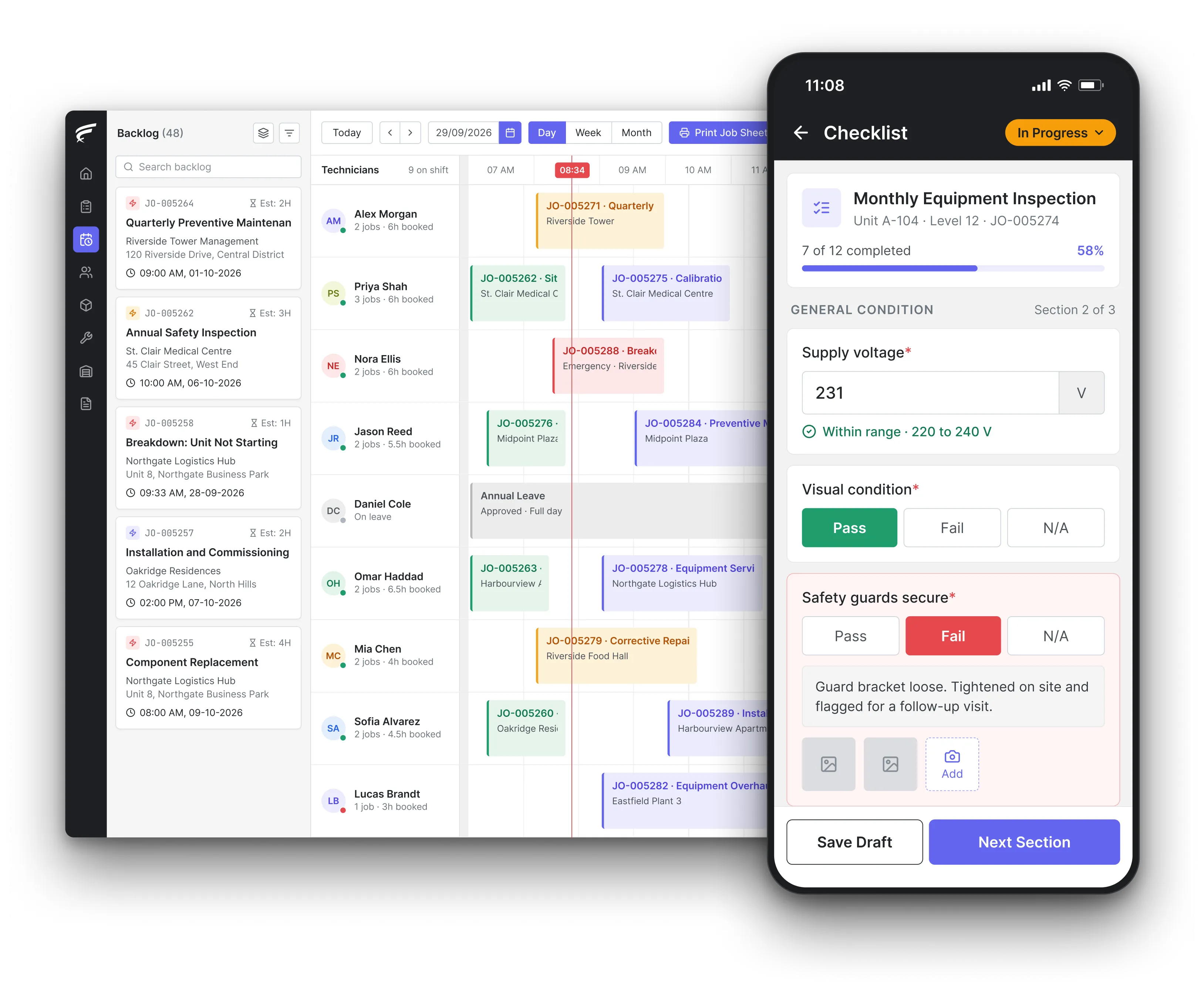
FieldEx scheduling board on desktop with a technician's inspection checklist open on the mobile app, as used by facilities management teams

FieldEx is field service management and maintenance management (CMMS) in one system for building owners, managing agents and facilities management contractors. It keeps each building's lifts, fire systems, water systems, plant and electrical installations on their own records, runs planned preventive maintenance, cleaning rounds and statutory inspections on schedule, turns tenant fault reports into jobs, and keeps the certificates on file.

What FieldEx does for facilities and building management teams

Hard facilities management is a calendar of legal inspections, a cycle of planned maintenance and a steady flow of tenant repairs, all on the same buildings. FieldEx runs all three on the building's own asset records, so the inspection that found a defect, the repair that fixed it and the certificate that proves it sit together. Book a demo to see it on your own portfolio.

Buildings and assets on record

  • A site record for every building, with its address, map location, contacts, service zone and the assets, jobs and maintenance plans that belong to it.
  • An asset record for every lift, fire panel, pump, boiler, generator, air handling unit and distribution board, with specifications, photos, serial numbers, warranty details and attached drawings and manuals.
  • Parent and component levels, so a lift and its controller, or a pump set and its motors, each keep their own history, in asset management.
  • QR or barcode labels on each asset, and a change history showing who edited what and when.

Planned maintenance across the portfolio

  • Asset maintenance plans and site maintenance plans that create the visits automatically, with different checklists and technicians for different points in the cycle.
  • Triggers on the calendar, on meter readings such as running hours, or on whichever comes first.
  • Fixed calendar schedules, or schedules that recalculate from the last completed visit, with missed visits rescheduled after a set overdue period. Fixed calendar dates apply to time-based plans.
  • One plan applied across many buildings, picking up new assets that match its criteria, in preventive maintenance.

Statutory inspections and certificates

  • Recurring certifications and inspections per asset type on standard or custom frequencies, with the certifying authority recorded.
  • Due, overdue and completed status, with reminders by email, in-app notification or both.
  • The date, the person who did it, the result and remarks on each record, with the certificate or report attached, through compliance documentation.
  • A dashboard of overdue certifications and inspections, those due in the next 7 days and those completed in the last 7 days, with a calendar of maintenance and compliance work.

Tenant fault reports and repairs

  • A QR code for every building that opens a fault-report form without logging in, with the location, a description, contact details and photos or video.
  • A branded customer portal where clients and tenants submit service requests, request appointment dates and follow job status, in the customer portal.
  • Every report arriving as a job in the backlog, ready to assign.
  • Service-level agreements on business hours, with several stages and at-risk and violation alerts per customer or asset.

Technicians and contractors in the field

  • Automatic assignment by skill, availability, shift, leave, service zone and live location, and a drag-and-drop scheduler for exceptions, in scheduling and dispatch.
  • Each job on the FieldEx mobile app with the asset's history, the right checklist, number fields for readings, watermarked photos and the customer's signature.
  • Jobs downloaded to the phone, worked without a signal in plant rooms and basements, and uploaded when the connection returns.
  • Spare parts in each store and each technician's van stock, with transfers, reorder alerts and a history of every part used, in spare parts inventory.

Parts and stores

  • Spare parts in each store and in each technician's own stock, with transfers, barcode scanning and approvals where needed.
  • Reorder and low-stock alerts per stock location, and a movement history of every transfer and part used, in spare parts inventory.
  • Parts used recorded on the job and the asset, with warranty periods kept on each part.

Cleaning contracts and rounds

  • Daily janitorial rounds and frequent checks, such as hourly washroom rounds, run as recurring jobs on each site's schedule.
  • Washroom, floor and kitchen checklists completed on the phone, with photos and a signature on the job.
  • Periodic deep cleans, such as carpets, facades, water tanks and kitchen extract ducts, on their own cycles for each building.
  • Cleaning contractors given their buildings and rounds, with every finished job recorded against the site.

Contracts, reports and records

  • Service contracts with start and end dates, linked to the assets and maintenance plans they cover.
  • Completion PDFs with the equipment, fault and resolution, parts with quantities and prices, check-in and check-out times, attachments and the customer's signature, emailed with a record of when each was sent.
  • Reports on asset reliability, maintenance cost, utilization and age, and on jobs, inspections and sites, exported or emailed on a schedule, in reporting and analytics.

What should a building PPM schedule include for statutory and mandatory tasks?

A building's planned preventive maintenance (PPM) schedule starts with the work the law requires and builds out from there. SFG20, the building maintenance standard developed by the Building Engineering Services Association (BESA), defines each schedule by its task details, frequency, timing, priority and skill level, and sorts tasks into four priorities: statutory, mandatory, optimal and discretionary. The legal baseline is broad. Regulation 5 of the UK Workplace (Health, Safety and Welfare) Regulations 1992 requires the workplace and its equipment, devices and systems to be kept in efficient working order and good repair, under a suitable system of maintenance where appropriate.

In practice, a PPM schedule lists every asset, the task and its frequency, who is qualified to do it, and which tasks are statutory, so those are never the ones that slip.

What FieldEx does about it

  • Plans for assets and for whole buildings: asset plans cover individual equipment such as pumps and boilers, and site plans cover building-wide work such as fire door rounds, each creating its visits automatically with the right job template.
  • Statutory work kept separate: statutory inspections run as recurring certifications and inspections with their own due dates and reminders, so they show on the dashboard apart from routine maintenance.
  • The right skill on each task: assignment rules match each job's required skill to qualified technicians, then check availability, shift, leave and service zone.
  • Schedules that follow the specification: intervals run by day, week, month or year, including preset intervals such as quarterly or every 3 years, on a fixed calendar or from the last completed visit.

How often does a passenger lift need a thorough examination?

In the UK, the Lifting Operations and Lifting Equipment Regulations (LOLER) require a thorough examination at least every 6 months for equipment that lifts people, and every 12 months for other lifting equipment, unless an examination scheme drawn up by a competent person sets different intervals. The UK Health and Safety Executive (HSE) leaflet INDG339 applies this to lifts: any lift used at any time to carry people is examined at least every 6 months, a goods-only lift every 12 months. If the examination finds a serious and significant defect, the lift is taken out of service immediately until the fault is dealt with.

City rules can be stricter. In New York City, the Department of Buildings requires elevators to be inspected and tested twice a year. Defects found on a periodic inspection or a Category 1 or Category 5 test must be corrected within 90 days, and an Affirmation of Correction filed within 14 days of the correction.

What FieldEx does about it

  • The examination as a certification: each lift's thorough examination runs as a recurring certification on a six-month or 12-month cycle, with the examining body recorded and the report attached.
  • Reminders before the due date: sent by email, in-app notification or both, so the examination is booked before the deadline, not after it.
  • Defects become jobs: a defect found on the lift's checklist raises a corrective work order and can schedule a follow-up inspection, so the 90-day correction is tracked from the first day.
  • The lift's own history: every service visit, examination, repair and part replaced stays on the lift's record, with its controller and doors as components.

What fire safety checks should a commercial building do each week, month and year?

UK government guidance on fire safety risk assessment for offices and shops sets a clear rhythm.

  • Weekly: test the fire detection and warning system and manual call points, following the manufacturer's or installer's instructions, and run fire pumps and standby diesel engines for 30 minutes.
  • Monthly: check emergency lighting, and check that fire doors close correctly and their frames and seals are intact.
  • Six-monthly: a competent person tests and maintains the fire alarm system.

Regular checks, servicing and maintenance are required whatever the size of the premises, and defects should be put right as quickly as possible. Residential blocks have extra duties: under the Fire Safety (England) Regulations 2022, since 23 January 2023, multi-occupied residential buildings with storeys above 11 metres must check all fire doors in common parts every quarter, including self-closers, and flat entrance doors every year on a best-endeavours basis.

What FieldEx does about it

  • Every check at its own frequency: set weekly alarm tests, monthly emergency lighting checks, quarterly fire door checks and six-monthly alarm servicing as recurring inspections, each linked to its own checklist.
  • Fire doors as assets: each fire door can be its own asset with a QR label, so the inspector scans the door, answers its checklist and records any failed seal or closer against it.
  • Failures raise the repair: a failed answer creates the corrective work order and its tasks straight away, and can book a follow-up inspection.
  • One calendar for the building: the dashboard calendar shows overdue, open and completed fire safety work alongside the building's other maintenance.

How often do fire extinguishers need to be inspected and serviced?

The US Occupational Safety and Health Administration's (OSHA) rule 29 CFR 1910.157 requires portable fire extinguishers to be visually inspected every month and to have an annual maintenance check. Longer cycles sit on top: stored-pressure dry chemical extinguishers that need a 12-year hydrostatic test are emptied and maintained every 6 years, and carbon dioxide (CO2) extinguishers are hydrostatically tested every 5 years. A UK landlord compliance guide from Places for London asks for an annual inspection by a certified person, with a tag on each extinguisher showing the month and year of maintenance, the inspector's name and their company.

Across a portfolio that is hundreds of units, each on three or four clocks at once.

What FieldEx does about it

  • Each extinguisher on record: each unit is an asset with its type, location, serial number and service dates, grouped under its building.
  • Monthly, annual and multi-year cycles together: the monthly visual check, the annual service and the 5-year or 6-year test each run as their own recurring inspection or certification, with custom repeat frequencies.
  • Scan, check, done: the technician scans the unit's QR label, answers its checklist and records the result on the phone, with a photo of the tag attached to the job if needed.
  • Portfolio view: reports and the dashboard show which units are overdue, filtered by building, asset type or service zone.

What water temperature checks are needed to control legionella?

HSE's guidance on hot and cold water systems sets the routine checks. Cold water at sentinel outlets is checked monthly and should be below 20°C after running for 2 minutes. Hot water should be stored at 60°C or more, and outlets should reach at least 50°C within one minute. Outlets that are used infrequently should be flushed weekly. For open systems such as cooling towers and evaporative condensers, HSE says routine legionella testing should be carried out at least quarterly.

These are readings, not ticks: the record has to show the temperature, the outlet and the date.

What FieldEx does about it

  • Temperatures as numbers: forms attached to the job add number fields for readings such as water temperatures, so the technician enters the exact value at each sentinel outlet, recorded against the job.
  • Monthly, weekly and quarterly rounds: the monthly temperature checks, the weekly flushing of little-used outlets and the quarterly testing each run as their own recurring inspection.
  • Out-of-range results trigger work: a failed answer on the checklist raises the corrective job and books a follow-up check.
  • Lab results attached: sample results and certificates are attached to the completed inspection record.

How often should electrical installations and portable appliances be tested in an office?

There are two separate jobs. For the fixed installation, Places for London's statutory compliance guide asks for an Electrical Installation Condition Report at least every 5 years on its properties. For portable equipment, HSE says the Electricity at Work Regulations don't set a fixed frequency for portable appliance testing: it depends on the type of equipment and where it is used. In HSE's office example, computers and printers are visually inspected every 5 years, while a vacuum cleaner is checked every 6 months.

So the frequency belongs to the asset type, and the building needs both registers kept up to date.

What FieldEx does about it

  • Frequencies by asset type: certifications and inspections are set per asset type, so the five-yearly installation report and the six-monthly check on heavy-use equipment each follow their own cycle.
  • Readings on the job: test values are entered as number fields on the job, against the installation or appliance tested.
  • The report on file: the condition report is attached to the completed certification on the distribution board or building record.
  • Registers you can export: asset and inspection data can be reported by building or asset type and exported as CSV, Excel or PDF.

How often should a building's standby generator be load tested?

For emergency generators, the National Fire Protection Association's NFPA 110 standard is the usual reference. As applied by The Joint Commission (NFPA 110, 2010 edition), diesel emergency generators get a monthly load test at no less than 30% of the nameplate rating for 30 minutes. Cummins' guide to NFPA 110 (2016 edition) adds that starting batteries are inspected weekly, and for lead-acid batteries the electrolyte's specific gravity is tested and recorded monthly. In UK offices, the government's fire safety guidance asks for standby diesel engines to be run for 30 minutes every week.

What FieldEx does about it

  • Running hours and calendar together: the generator's plan can trigger on the calendar, on running-hour meter readings, or whichever comes first.
  • Weekly, monthly and annual checks on one plan: a single plan can produce the weekly battery check, the monthly load test and the annual service, each with its own checklist and technician.
  • Load and battery readings recorded: number fields on the job capture the load percentage, run time and specific gravity readings.
  • History on the generator: every test, service and part replaced is kept on the generator's asset record.

What gas safety checks does a landlord or managing agent need each year?

HSE's guidance for landlords and letting agents requires a gas safety check within 12 months of a new appliance or flue being installed, and every year after that, by a Gas Safe registered engineer. The check can be done up to 2 months before the deadline without losing the original deadline date. The gas safety record must list each appliance and flue checked, be given to existing tenants within 28 days of the check and to new tenants before they move in, and be kept for at least 2 years.

What FieldEx does about it

  • A due date per appliance: each boiler, appliance or flue is an asset with its annual gas safety check as a recurring certification and reminders ahead of the deadline.
  • Gas jobs to registered engineers: gas safety jobs require their matching skill, so they reach registered engineers only.
  • The record attached and sent: the gas safety record is attached to the completed certification, and the job's completion PDF is emailed with a record of when it was sent.

How quickly must a landlord respond to an emergency repair reported by a tenant?

In England, Awaab's Law sets the clock for social landlords from 27 October 2025. Emergency hazards must be investigated and made safe within 24 hours. Significant hazards must be investigated within 10 working days, the tenant gets a written summary within 3 working days of the investigation, and relevant safety work must be done within 5 working days of the investigation. Supplementary preventative work must begin within 5 working days or, where that isn't possible, physically start within 12 weeks. Private and commercial landlords usually work to response times written into their leases and service contracts.

Whatever the source of the deadline, the landlord needs to show when the report came in, when someone attended and when the work was finished.

What FieldEx does about it

  • Reports in, time-stamped: tenants report faults through the portal or the building's QR code, with photos or video, and each report becomes a job with its creation time.
  • Response times in stages: service-level agreements can have several stages, such as attend, make safe and complete, each with its own at-risk and violation thresholds against business hours.
  • Alerts to the right people: at-risk and violation alerts go to the users or groups you choose, the job owner or their manager.
  • Proof of attendance: check-in and check-out times, photos and the work done are recorded on the job and shown on its completion PDF.

Is there a legal duty to maintain ventilation and extraction systems?

Yes. The same regulation 5 of the Workplace (Health, Safety and Welfare) Regulations 1992 that covers the workplace in general names mechanical ventilation systems: they must be kept in efficient working order and good repair, with a suitable system of maintenance where appropriate. Local exhaust ventilation (LEV), such as extraction in kitchens and workshops, needs a thorough examination and test at least every 14 months, with critical defects fixed immediately, and HSE says the record of each examination and test must be kept for at least 5 years.

What FieldEx does about it

  • A 14-month cycle: LEV examinations run as recurring certifications with a custom frequency, the examining body recorded and the test report attached.
  • Defects fixed now: a critical defect recorded on the checklist raises the corrective job immediately.
  • Air handling plant on PPM: air handling units and extract fans run on their own maintenance plans, by date or running hours.

What building information and records must owners keep and share with contractors?

For higher-risk buildings in England (at least 18 metres or 7 storeys, with at least 2 residential units), the Building Safety Regulator requires duty holders to keep a digital record of building information, known as the golden thread. It includes inspection reports and maintenance records, including those from previous owners where available, and must be kept secure, available when needed and act as the building's single source of truth. Asbestos is a separate duty: HSE says the asbestos management plan must include the asbestos register and site plan, and state how the register is shared with workers or contractors doing maintenance work.

Retention periods vary by record. HSE says legionella records are kept while current and for at least 2 years after, and monitoring records for at least 5 years.

What FieldEx does about it

  • Everything on the building and asset: every job, inspection, certificate, meter reading and attachment stays on the asset and site records, with a change history on each asset of who edited what.
  • Documents where the technician needs them: registers, site plans and drawings are attached to the site or asset, and the technician sees the asset's record on the phone before starting work.
  • Records for the client: through the customer portal, the building owner sees registered equipment with last-serviced dates and upcoming asset maintenance, and downloads completed job reports.
  • Reports when asked: inspection and job data can be reported by building, asset type or period and exported on demand.

How often should kitchen extract ductwork be cleaned?

No UK statute names a frequency. The Regulatory Reform (Fire Safety) Order 2005 requires the responsible person to manage fire risk, and TR19 Grease, the Building Engineering Services Association's specification for cleaning grease extract systems, is the benchmark fire risk assessors and insurers measure a system against. It sets starting intervals by how many hours a day the kitchen cooks.

Kitchen use (TR19 Grease)Cooking hours a dayClean at least every
Heavy12 to 163 months
Moderate6 to 126 months
Light2 to 612 months

Source: KICS, Commercial Kitchen TR19 Cleaning FAQs; Craven Cooling, Commercial Kitchen Extraction Regulations Explained (2026).

The calendar is only the start. TR19 Grease works to measured grease: when the mean deposit inside the duct reaches 200 microns, the system needs cleaning whatever the date. Cooking method, grease output and the results of cleanliness tests can all shorten the interval, which makes each kitchen's record of past readings the thing that sets its next clean.

What FieldEx does about it

  • A cycle per kitchen: each extract system is an asset with its own cleaning frequency, set to 3, 6 or 12 months from the kitchen's hours.
  • Deposit readings on the job: custom job forms can include number fields for grease depth before and after the clean, recorded against the job.
  • Proof for the insurer: the cleaning certificate and before-and-after photos attach to the asset and the client's job report.
  • Intervals that follow the readings: when readings show grease building up faster, the frequency on that system is shortened.

How often must workplace toilets and washrooms be cleaned?

The Workplace (Health, Safety and Welfare) Regulations 1992 say toilets and washing facilities, and the rooms containing them, must be kept in a clean and orderly condition (regulations 20 and 21). HSE's Approved Code of Practice L24 doesn't set a fixed number of cleans. It says the frequency and thoroughness of cleaning should be adequate to keep them clean, and that responsibility for cleaning should be clearly established, particularly where facilities are shared by more than one workplace.

For the workplace as a whole, regulation 9 requires it to be kept sufficiently clean. L24 explains that means cleaning regularly so dirt and refuse don't build up, removing spillages as soon as possible, and choosing a method that doesn't create a health or safety risk. HSE's cleaning guidance adds that floors left wet after cleaning are a common cause of slips.

  1. Agree the round frequency for each washroom with the client, from hourly in busy sites to daily in quiet ones.
  2. FieldEx raises each round as a job for a named cleaner or contractor.
  3. The cleaner completes the washroom checklist on the phone.
  4. Anything broken or out of stock becomes a repair or restocking job.
Who (The Star, 13 May 2024)Practice reported
DBKL, 64 PPR housing projectsTanks cleaned and inspected every six months
Kuala Lumpur condominium JMB memberChecking ideally every 12 months
Selangor state housing committeeJMB or MC appoints a certified contractor; tanks sterilised before use

What FieldEx does about it

  • Frequent rounds on a schedule: washroom checks run as recurring jobs, hourly, several times a day or daily, per site.
  • Clear responsibility: every round is assigned to a named cleaner or contractor, so shared facilities have an owner.
  • Checklists with proof: surfaces, supplies, floors and wet-floor signs are ticked off with photos and a time on each job.
  • Faults straight to repair: a tenant scanning the building's QR code to report a blocked toilet or spill creates a job in the backlog.

How often should kitchen exhaust hoods and ducts in malls and hotels be cleaned?

No Malaysian rule setting a cleaning interval for commercial kitchen exhaust was found, so food court, hotel and restaurant operators often follow the UK specification TR19 Grease (international). It ties the interval to how long the kitchen cooks each day, and treats a measured grease layer of 200 microns inside the duct as the point at which cleaning is due, even before the scheduled date.

Daily cooking (TR19 Grease, UK)Typical premisesInterval
Over 12 hoursHotels, 24-hour food courtsQuarterly
6 to 12 hoursMost restaurantsTwice a year
Under 6 hoursOffice pantries, cafésYearly

Source: Craven Cooling, Commercial Kitchen Extraction Regulations Explained (2026); KICS, TR19 cleaning FAQs.

Heavy frying, wok cooking and long horizontal duct runs collect grease faster, so a contractor's own readings from earlier cleans are the best guide to the next date.

What FieldEx does about it

  • Each hood and duct with its own interval: quarterly, twice-yearly or yearly cleaning set per kitchen and tenant.
  • Readings kept per clean: grease thickness can be entered in number fields on the custom job form, so the history shows how fast each duct fouls.
  • Report for the tenant and the mall: photos and the job report go to the client in the portal after every clean.
Customer story

Royal Facilities Management runs facilities maintenance across commercial and residential properties in Oman on FieldEx. Its story describes QR codes at each site for work requests and equipment-malfunction reports, automatic maintenance reminders and work orders, and mobile checklists for maintenance visits.

Read the Royal Facilities Management story

DKSM, a Malaysian mechanical, electrical and plumbing (MEP) and fire safety contractor, runs compliance scheduling and inventory tracking for 300+ client sites on FieldEx. Its story describes maintenance reminders and work orders created for each account's schedule, with parts logged on team leads' phones.

Read the DKSM story

Questions facilities managers ask about FieldEx

What is the best facilities management software for building maintenance?

For hard facilities management, the software has to hold the building's assets, run planned maintenance and statutory inspections, take tenant fault reports and keep the certificates. FieldEx does all of these in one system, with field service and maintenance management sharing the same asset records. Compare approaches in our guide to CMMS software.

Is FieldEx a CAFM system?

FieldEx covers the maintenance side of computer-aided facilities management (CAFM): building and asset records, planned maintenance, statutory inspections, fault reporting, contractors and technicians in the field, and reports.

Can FieldEx track statutory inspections and certificates for every building?

Yes. Certifications and inspections run on recurring schedules per asset type, show as due, overdue or completed, send reminders and keep the result, the person who did it and the certificate attached.

Can tenants report faults without an account?

Yes. A QR code for each building opens a fault-report form without logging in, with photos or video, and the report arrives as a job in the backlog.

Can FieldEx manage planned maintenance across many buildings?

Yes. One plan can cover many sites and pick up new assets that match its criteria, and each plan shows the last and next maintenance dates for every building and asset it covers.

Can we set response times for different clients and buildings?

Yes. Service-level agreements can apply to all customers or to selected ones, scoped to a specific asset where needed, with business hours that differ by day.

Can our building owners see their maintenance records?

Yes. The branded customer portal shows their equipment with last-serviced dates, upcoming asset maintenance, job status and downloadable job reports.

Can technicians record meter readings and temperatures on site?

Yes. Number fields on the job capture readings such as water temperatures and pressures, and meter readings on each asset build a history that can trigger maintenance by running hours.

Can FieldEx manage spare parts across several buildings?

Yes. Each store and technician holds its own stock, with transfers, reorder and low-stock alerts per location and a history of every part used on each job.

Can technicians work in basements and plant rooms without a signal?

Yes. Technicians download their jobs to the mobile app, work without a signal and upload the completed work when the connection returns.

Can FieldEx run hourly washroom checks for a cleaning contract?

Yes. Washroom rounds run as recurring jobs as often as the contract needs, hourly or several times a day, each with its checklist, photos and the cleaner who did it.

Can kitchen extract cleaning be scheduled by how busy the kitchen is?

Yes. Each extract system carries its own cleaning frequency, such as 3, 6 or 12 months, with the certificate and grease readings kept on its record.

What does it take to get FieldEx running across our buildings?

Once we know your requirements and your data is ready, FieldEx can be implemented in as little as a week with standard features for small businesses. Larger setups and custom work take longer. Setup, data upload and training are included in the subscription, with no setup fee. Buildings, asset registers, checklists and report templates can be uploaded. FieldEx helps with setup, and training is included. See FieldEx implementation.

See your buildings' inspections, PPM, cleaning and repairs in one system

Book a demo