Manufacturing maintenance software that moves your plant from breakdowns to planned work

Put presses, conveyors, CNC machines and boilers on maintenance plans. Let operators report breakdowns from the machine, and see backlog and cost per asset.

Book a demo
Updated 16 Oct 2026
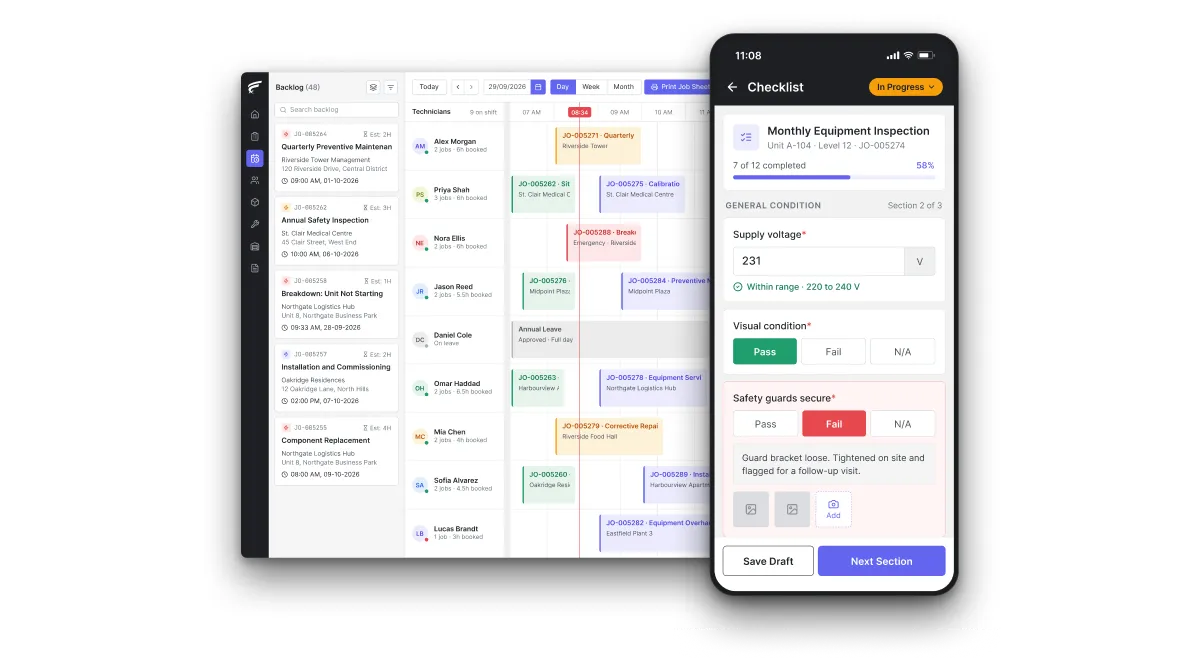
FieldEx scheduling board on desktop with a technician's inspection checklist open on the mobile app, as used by plant maintenance teams

FieldEx is a field service and asset management (FSM+CMMS) application for factory and plant maintenance teams. It schedules preventive maintenance by run hours, cycles or date, and turns operator breakdown reports into assigned work. FieldEx runs press, crane and pressure-plant inspections and tracks spares in the maintenance store. It reports backlog, reliability and cost for every machine.

What FieldEx does for factory maintenance teams

A factory maintenance team is judged on two things. The first is how little unplanned downtime the lines have. The second is whether the statutory checks on presses, cranes and boilers were done on time. FieldEx runs both on the same machine records. The planned service, the breakdown and the inspection that found the worn clutch all sit in one history. Book a demo to see it on your own lines.

Production lines, machines and utilities on record

  • An asset record for every press, injection moulder, CNC machine, conveyor and robot cell. Compressors, boilers, chillers and overhead cranes get one too.
  • Each record holds the serial number, specifications, photos, warranty and attached manuals.
  • Line, machine and component levels, so a gearbox, a motor or a clutch keeps its own repair history under the machine, in Asset Management.
  • Machines grouped by plant, building or line and classified by type and category. Each has a status such as running, under maintenance or out of service.
  • QR or barcode labels on each machine, and a change history of who edited what and when.

Planned maintenance by run hours, cycles or date

  • Maintenance plans that trigger on running hours, cycle counts or the calendar, or whichever threshold comes first, in Preventive Maintenance.
  • Different checklists and technicians for daily, weekly, monthly and annual tasks on the same machine.
  • Fixed calendar schedules for shutdown windows, or schedules counted from the last completed service. Fixed calendar dates apply to time-based plans.
  • Missed maintenance rescheduled after a set overdue period, and each plan showing every machine's last and next service.

Breakdowns reported from the shop floor

  • A QR label on each machine that opens a breakdown request without logging in, with a description, contact details and photos or video.
  • Every request arriving as a job in the backlog, assigned by skill, shift, leave and availability to the right maintenance technician.
  • An alert when a new job repeats a recent job on the same machine, so repeat failures are seen early.
  • Response and repair targets measured in the plant's working hours, with at-risk and violation alerts.

Statutory checks on presses, cranes and pressure plant

  • Recurring inspections and certifications per machine type on set frequencies, with the examining body recorded.
  • Each press, crane or boiler check marked due, overdue or completed, with certification reminders by email, in-app notification or both.
  • The date, the person, the result and remarks on each record, with the thorough examination report attached.
  • Checklists that raise the repair from a failed answer, update the machine's status and meter reading, and book a follow-up inspection.

Maintenance technicians on the shop floor

  • Each job on the FieldEx Mobile App, with the machine's history, its checklist and watermarked photos. Number fields hold readings such as temperatures, pressures and amps.
  • Ordered procedures, with isolation steps that must be completed before the next task starts and designated tasks required before the job can close.
  • Check-in and check-out on each task, so time spent on each machine is recorded.
  • Jobs and tasks can be downloaded and worked offline, with check-in, check-out and travel synced later.

Spares in the maintenance store

  • Spare parts in each store, zone and technician's own stock, with transfers, barcode scanning and approvals where needed.
  • Reorder and low-stock alerts per stock location, and part availability by store or technician, in Spare Parts Inventory.
  • Parts used recorded on each job and machine, with unit prices, manufacturer details and warranty periods.

The maintenance team's own tools, test kit and vehicles

  • Power tools, extension leads and lifting gear as company assets, each with a QR label and its own inspection cycle.
  • Multimeters, insulation testers and torque wrenches with calibration due dates and certificates on the record.
  • Workshop machines and service vehicles on maintenance plans by date, running hours or odometer.

Downtime, backlog and cost reports

  • Reports on asset reliability, maintenance cost and utilization, and on asset age and lifecycle, in Reporting and Analytics.
  • Job reports grouped by job type, machine, line or period. Counts, sums and averages compare planned work against breakdowns.
  • A dashboard of work that is overdue, due in the next 7 days or completed in the last 7 days. It filters by machine type or group.
  • Reports exported as CSV, Excel or PDF, or emailed to plant management on a schedule.

FieldEx also runs this kind of work for Oil & Gas and Telecom Infrastructure.

How should a plant record equipment downtime?

Log every stoppage against the machine, and keep planned and unplanned downtime apart. The Pacific Northwest National Laboratory (PNNL) Applying Key Performance Indicators (December 2020) compares unplanned failures and shutdowns with planned ones. Its target is below 25% and falling, with planned downtime under 10% of uptime. Availability, meaning uptime over expected operating time, should be above 90%. PNNL's Reliability Centered Maintenance guide (May 2022) adds that all time and cost tied to operation, downtime and equipment purchases should be tracked.

What FieldEx does about it

  • Planned and unplanned kept apart: planned maintenance jobs come from plans, and breakdowns come from requests. Each job shows which plan generated it, so the two can be counted separately.
  • Machine status on record: checklists and technicians can set a machine to out of service and back. The dashboard shows the status breakdown across the plant. FieldEx reports downtime, MTBF and MTTR for every machine.
  • Time on every job: check-in and check-out on each task record how long the machine was being worked on.
  • Costs in one place: each job records parts with prices and the technician's check-in and check-out times. Maintenance cost reports roll them up per machine or line.

How often does a power press need to be inspected, and what records are kept?

At least weekly in the US, and every 6 or 12 months for a UK thorough examination. OSHA's 29 CFR 1910.217 requires each mechanical power press to be inspected and tested weekly, covering the clutch and brake, the antirepeat feature and the single-stroke mechanism. The employer keeps a certification record of each inspection, maintenance and repair, with the date, the signature and the press's identifier. UK HSE's HSG236 (second edition, 2003) sets the thorough examination of a press and its guards at 6 months. Where the tools are fenced only by fixed fencing, it is 12 months.

Heating surfaceIn charge
100 m² or lessOperator grade 2
Over 100 to 200 m²Operator grade 1, each shift
Over 200 to 500 m²Operator grade 1, plus engineer grade 1 or 2 (may visit)
Over 500 to 2,000 m²Engineer grade 1 or 2
Over 2,000 m²Engineer grade 1

What FieldEx does about it

  • Daily, weekly and six-monthly on one press: each check runs as its own recurring inspection or certification. That covers the appointed person's daily check, the weekly clutch and brake test and the six-monthly thorough examination.
  • The OSHA record fields: each inspection holds the date, the person who did it and the press's identifier. The technician signs the job on the phone.
  • Long-interval tasks planned: two-yearly tasks such as flywheel removal sit in the same plan as the monthly service, with their own checklist.
  • Faults stop the press on record: a failed clutch or brake answer raises the repair and sets the press's status to out of service.

How often should overhead cranes and hoists in a factory be inspected?

Daily to monthly for frequent inspections and every 1 to 12 months for periodic ones, under US OSHA's 29 CFR 1910.179. Hooks and hoist chains get a daily visual check and a monthly inspection. The monthly one has a certification record of the date, the inspector's signature and an identifier. In the UK, regulation 9 of LOLER 1998 requires a thorough examination of lifting equipment at least every 12 months, unless an examination scheme sets other intervals. Lifting accessories and equipment used to lift people are examined every 6 months.

What FieldEx does about it

  • Every hoist and sling on record: each crane, hoist, chain block, sling and spreader beam is its own asset with a QR label.
  • Daily, monthly and yearly cycles: visual checks and monthly hook and chain inspections run as recurring inspections. The 12-month or 6-month thorough examination runs as a certification.
  • Signed monthly records: the monthly inspection records the date and the person, and the job is signed on the phone.
  • Record the sling inspection's result, completion date and performer on its asset record.

How often should industrial steam boilers and air receivers be tested and examined?

Routine boiler tests at least as often as the manufacturer says, plus a two-stage examination under a written scheme. UK HSE's INDG436 (October 2011) asks for more frequent tests where water quality is poor, with each result recorded with the operator, date and any corrective action. The scheme covers an out-of-service examination, cold and opened up, and an in-service examination at operating pressure. HSE's Pressure Systems Guidance covers steam at any pressure and compressed air above 0.5 bar. A written scheme and an examination must be in place before first use.

What FieldEx does about it

  • Daily and weekly boiler checks can run as recurring inspections. Each inspection records its completion date, performer, result and remarks.
  • Two-stage examinations: the out-of-service and in-service examinations are separate tasks on the examination job, in order.
  • Receivers on their own scheme: each air receiver is an asset with its written scheme attached and its examination as a recurring certification.
  • Servicing kept separate: compressor and boiler servicing runs on running hours or calendar dates in its own maintenance plan.

How do you decide how often to inspect production machines?

By risk assessment, the conditions of use and the manufacturer's recommendations. UK HSE's Equipment and Machinery FAQs (updated 7 May 2026) describe typical tiers. Quick checks come before use, and weekly checks cover items such as guarding and the function of safety devices. More extensive examinations follow every few months or longer. HSE's HSG236 adds that the safety-critical parts of a press and its control system need more frequent maintenance than the rest.

What FieldEx does about it

  • Tiers on one machine: pre-use, weekly and periodic checks on the same machine each have their own checklist and frequency.
  • Safety-critical components on tighter cycles: guards, interlocks and light curtains can be components with their own, more frequent inspection.
  • Checklists from your procedure: inspection questions can be generated with AI from a PDF or PNG of your existing checklist or procedure, then edited.
  • Frequencies that follow the conditions: a machine in a hot, dusty or high-duty area can run on a shorter interval than the same model elsewhere.

What maintenance records should a factory keep for its machinery?

Maintenance records for high-risk equipment at least, and any log you keep has to be up to date. UK HSE's Equipment and Machinery FAQs say no law requires a maintenance log, but HSE recommends records for high-risk equipment. Where a log exists, the law requires it to be kept current. HSE's PUWER Brief Guide (INDG291) adds that inspection records are kept at least until the next inspection.

What FieldEx does about it

  • A log that keeps itself: every planned job, breakdown, inspection and part used is recorded on the machine as the work is done.
  • High-risk machines flagged: you can classify machines by category and report on high-risk equipment on its own.
  • Signed entries: each job carries the technician's check-in and check-out times and a signature captured on the phone.
  • The log on demand: a machine's maintenance history can be exported as CSV, Excel or PDF.

What lockout steps are required before maintenance on production machines?

A documented energy control procedure, used whenever unexpected start-up or release of energy could injure someone. OSHA's lockout/tagout standard, 29 CFR 1910.147, requires employers to develop, document and use those procedures for service and maintenance work. Each procedure is inspected at least once a year, and the employer certifies that the inspection was done. UK HSE's Equipment and Machinery FAQs add that only people competent to do the work should carry out maintenance.

What FieldEx does about it

  • Isolation before the work: a job can be built as an ordered procedure. Isolation and a try-start test are tasks that must be completed before the maintenance task starts.
  • No closing without the steps: designated tasks, such as removing locks and handing the machine back, must be completed before the job can close.
  • Competent people only: assignment rules send each job to technicians with the matching skill, such as electrical or hydraulic.
  • The annual procedure inspection: each machine's energy control procedure gets a yearly recurring inspection, with the inspector and the date recorded.

What does NFPA 70B ask a plant to set up for electrical maintenance?

An electrical maintenance program (EMP), with intervals, test methods and records for each piece of equipment. NFPA's NFPA 70B Product Page says the standard covers EMP development, maintenance intervals, testing methods and documentation practices. The National Fire Protection Association's NFPA 70B Blog says the 2023 edition took effect on 16 January 2023. It turned 70B from a recommended practice into a standard, giving more enforceability to what must be done.

What FieldEx does about it

  • Electrical assets on plans: switchboards, motor control centers, transformers and drives each carry their own maintenance plan and history.
  • Test values recorded: insulation resistance, thermography temperatures and other readings are entered as numbers on the job.
  • Condition visible: the asset's status and its last and next maintenance dates are shown on its record and the plan.
  • Reports for the safety program: you can report completed electrical maintenance by asset type, location and period.

Which maintenance KPIs should a manufacturing plant record?

Backlog, rework and schedule compliance, alongside availability and downtime. PNNL's Guide to Applying KPIs sets backlog, meaning work orders in backlog status over total work orders, below 5% and falling. Rework should stay below 3%, and more than 95% of work orders should have a defined schedule. Schedule compliance compares the scheduled work orders completed in a period, normally one week, with all those scheduled. PNNL suggests reviewing the KPIs at least once a year.

What FieldEx does about it

  • Backlog on screen: unassigned jobs sit in the scheduler backlog, and open jobs are listed with their status on the dashboard.
  • Schedule compliance by week: job reports grouped by week show scheduled jobs against those completed.
  • Rework spotted: the repeat-job alert flags a new job on a machine that had a recent one. Returning faults are seen as soon as they are raised.
  • KPIs on a schedule: saved reports with counts, sums and averages are emailed weekly or monthly to the people who review them.

How often should the maintenance team's own power tools be inspected and tested?

In heavy industry, a user check daily, a formal visual inspection weekly and a combined inspection and test every 6 to 12 months. Those are UK HSE's suggested starting intervals in Work Using Electrically Powered Equipment. A competent person with suitable equipment does the formal checks, often enough that tools don't become unsafe between them. HSE's PAT FAQs add that no law requires a yearly test, so employers set intervals by risk.

What FieldEx does about it

  • Every tool on the register: drills, grinders, extension leads and test instruments are company assets with QR labels.
  • Weekly and yearly cycles: the weekly visual inspection and the 6- or 12-month inspection and test run as recurring inspections with due dates and overdue status.
  • Fails out of use: a failed check sets the tool to out of service and raises its repair.
  • Calibration on the test kit: multimeters and insulation testers carry their calibration as a recurring certification, with the certificate attached.

How should a Malaysian plant record planned maintenance and downtime?

Log every breakdown and every planned job separately, then compare the split each month. International guidance from PNNL's Applying Key Performance Indicators (December 2020) gives benchmarks. It sets availability above 90%, with unplanned failures and shutdowns below 25% of planned ones. PNNL's Maintenance Approaches benchmarks (July 2021) give target ranges of 20-30% reactive, 25-35% preventive and 30-40% predictive work.

What FieldEx does about it

  • PM and breakdowns counted separately: each job has a type and shows whether a PM plan generated it, so reports split planned from reactive work.
  • Monthly trend reports: saved reports group jobs by type and month, and are emailed to management on a timetable.
  • Breakdown time logged: check-in and check-out times show how long each breakdown job took. FieldEx reports total downtime, MTBF and MTTR for every machine.
  • Status across the plant: the dashboard shows how many machines are running, under PM or in breakdown.

How often should the maintenance team's own power tools and extension leads be checked?

Before each use by the user, with a formal inspection and test at intervals set by risk. International practice from UK HSE, in Work Using Electrically Powered Equipment, suggests starting points for light industrial work. Tools get a formal visual inspection before first use and then every 6 months, and a combined inspection and test every 6 months to 1 year. The person testing should be trained and competent to do it.

What FieldEx does about it

  • Tools on the register: each grinder, drill, extension lead and chain block is an asset with its own QR sticker.
  • Six-monthly checks on time: the visual inspection and the inspection and test run as recurring inspections, with due dates and overdue status on the dashboard.
  • Failed tools held back: a failed answer sets the tool to out of service and opens its repair job.
  • Meters calibrated: test meters and torque wrenches carry their calibration as a recurring certification, with the certificate kept on the record.
Customer story

Agri Sumber Prestari (ASP) is an agricultural manpower and training company under SD Guthrie Agri Bio, with 92 estates running on FieldEx. It moved its machine maintenance off logbooks and paper checklists. Estates are not factories, but the work is the same: planned service, inspections and spares for every machine. Its story describes work orders, inspection checklists and SOPs generated automatically, and preventive maintenance triggered by usage or time. It also describes live dashboards of job progress and stock levels, with low-inventory alerts.

Read the Agri Sumber Prestari Story

Magnum moved its operations off paper forms and inventory sheets onto FieldEx. It works in leisure and entertainment, not manufacturing, but its maintenance started from the same place: paper forms and stock sheets. Its story describes four changes:

  • Work orders, inventory logs and reports generated automatically.
  • Reports sent out on the schedule the team sets.
  • Live tracking of team activity, stock levels and job progress.
  • SLA alerts as deadlines approach.
Read the Magnum Customer Story

Questions plant maintenance managers ask about FieldEx

What is the best manufacturing maintenance software for a plant maintenance team?

One that runs planned maintenance, takes breakdown requests from the floor, keeps statutory inspections and spares, and reports downtime and cost per machine. FieldEx does all of these in one system. See our Guide to Choosing Maintenance Software.

Can maintenance be scheduled by cycle count as well as hours?

Yes. Meter units include hours, cycles and distance, and a plan can trigger on the meter, the calendar or whichever comes first.

Can operators report a breakdown without a login?

Yes, from the machine's QR label, as described above. Operators can add photos or video, so the technician knows what to bring.

Can FieldEx separate planned work from breakdowns in reports?

Yes, by period, line or machine. Reports can be sent automatically to plant management or anyone else you choose.

Can we track parts for each machine?

Yes. Parts used are recorded on each job and the machine, with prices, and store stock has reorder and low-stock alerts.

Can technicians record readings such as temperatures and vibration?

Yes. Meter readings build a history on the machine, so a rising bearing temperature shows up over several visits.

Can we plan maintenance around shutdown weeks?

Yes. Fixed calendar schedules can be anchored to a weekday, a date or an ordinal weekday. Jobs can be created a set number of days ahead.

Can the maintenance manager see who is working on what?

Yes. The scheduler shows each technician's jobs by day or week, and managers see task status, check-ins and locations for their team.

Does FieldEx keep a history of every change to a machine's record?

Yes. Each asset has a change history showing who edited which field and when.

How quickly can a plant get FieldEx running?

There's no setup fee. Once we know your requirements and your data is ready, FieldEx can be implemented in as little as a week with standard features for small businesses. Larger setups and custom work take longer. Machines and parts can be uploaded. FieldEx helps with setup, and training is included. See Setup and Training.

See your plant's planned work, breakdowns and inspections in one system

Book a Demo