Heavy equipment maintenance software for hour-meter service, inspections and site repairs

Service every excavator, crane, loader and forklift on its hours or its calendar date, and keep each machine's inspections and repairs on one history.

Book a demo
Updated 16 Oct 2026
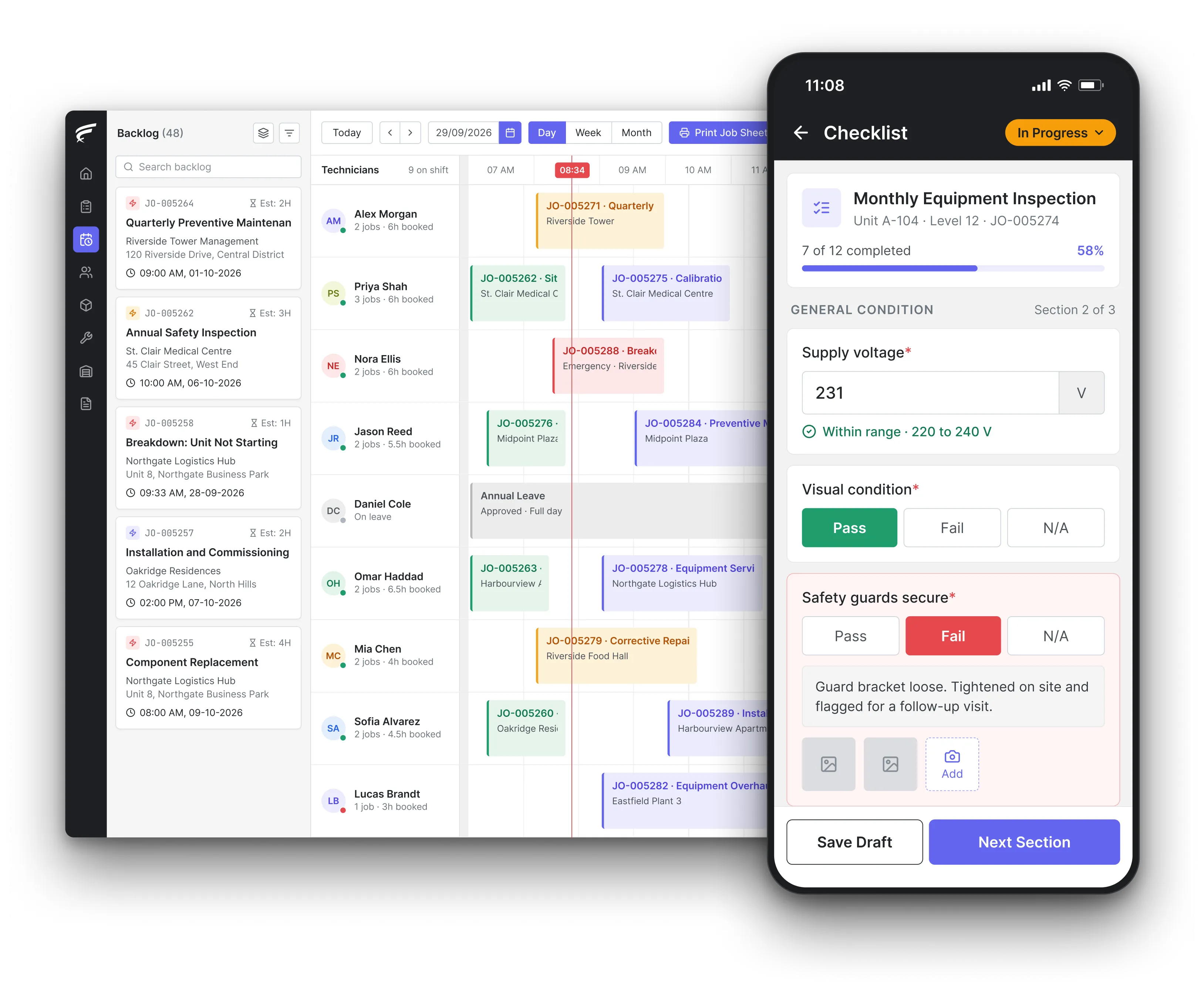
FieldEx scheduling board on desktop with a technician's inspection checklist open on the mobile app, as used by heavy equipment service teams

FieldEx is a field service and asset management (FSM+CMMS) application for equipment dealers, service providers and fleet owners. It works as heavy equipment maintenance software that schedules service by hour meter or calendar, whichever comes first. Every machine and component keeps its own history. FieldEx runs crane and lifting inspections with the reports attached. It sends technicians to breakdowns on customer sites with the parts they need.

What FieldEx does for heavy equipment service teams

Heavy equipment work runs on three clocks at once. One is the hour meter, one is the inspection calendar, and one is the customer with a machine down on site. FieldEx keeps all three on the machine's own record. The 500-hour service, the annual crane inspection and the hydraulic hose replaced last Tuesday sit in one history. Book a demo to see it with your own fleet.

Every machine and its components on record

  • An asset record for every excavator, crane and wheel loader, and for every forklift, compressor and generator.
  • Each record holds the serial number, specifications and photos. It also holds warranty details, location and acquisition or depreciation information.
  • Parent and component levels in Asset Management. An engine, a hydraulic pump, a slew ring or an attachment keeps its own history under the machine.
  • Machines linked to the customer and site they work on, with lifecycle statuses such as in service, under repair or out of service.
  • A QR or barcode label on each machine, with a change history showing who edited what and when.
  • A printed QR or barcode sticker on each unit, plus a log of every edit with the user and the time.

Service by hour meter, calendar or both

  • Maintenance plans that trigger on running hours, on the calendar, or on whichever threshold is reached first.
  • Each machine's own meter interval, or one custom interval applied across a whole plan.
  • A default meter unit and service frequency for each equipment type.
  • Different checklists and technicians for different points in the cycle, such as a 250-hour, 500-hour and 2,000-hour service.
  • New machines that match the plan's criteria added to it automatically, in Preventive Maintenance.

Crane, lifting and pressure inspections

  • Recurring inspections and certifications per equipment type on set frequencies, with the certifying body recorded.
  • Each crane or machine certificate marked due, overdue or completed, with reminders by email, in-app notification or both.
  • The date, the inspector, the result and remarks on each record, with the examination report or certificate attached, through Compliance Documentation.
  • Inspection checklists that raise repair jobs from failed answers, update the machine's status and meter reading, and open a follow-up checklist.

Breakdowns on customer sites

  • A QR label on each machine that opens a breakdown request without logging in, with the location, a description, contact details and photos or video.
  • A branded customer portal where customers raise service requests, request a date and see their machines with last-serviced dates, in the Customer Portal.
  • Automatic assignment by skill, availability, shift and leave, as well as service zone and live location.
  • A drag-and-drop scheduler for the exceptions, in Scheduling and Dispatch.
  • Response and repair targets per customer or per machine, measured in business hours, with at-risk and violation alerts.

Technicians at the machine

  • Each job on the FieldEx Mobile App with the machine's history, its checklist, number fields for readings, watermarked photos and the customer's signature.
  • An alert when a new job repeats a recent job on the same machine, so a returning fault is seen before the technician leaves.
  • Travel to the site recorded as a task journey with distance and duration, plus check-in and check-out on the job.
  • Jobs and tasks can be downloaded and worked offline, with check-in, check-out and travel synced later.
  • Jobs and tasks can be downloaded and worked offline, with check-in, check-out and travel synced later.

Parts for the job

  • Spare parts in each warehouse and in each technician's van stock, with transfers, barcode scanning and approvals where needed.
  • Reorder and low-stock alerts per stock location, and part availability by warehouse, zone or technician, in Spare Parts Inventory.
  • Parts used recorded on the job and the machine, with manufacturer details and warranty periods on each part.

Your own service trucks, lifts and workshop tools

  • Field service trucks serviced on their own plans, by date or by the odometer, with every repair on the truck's record.
  • Workshop vehicle lifts, presses, hose crimpers and overhead cranes kept as company assets, each on its own inspection cycle.
  • Torque tools, pressure gauges and diagnostic kits with calibration due dates, reminders and the certificate attached.

Service reports, history and fleet figures

  • A completion PDF for each machine job, emailed to the customer, with the time it was sent kept on record.
  • The PDF holds the equipment, fault and resolution, and parts with quantities and prices. It also shows check-in and check-out times, mileage, attachments and the customer's signature.
  • Service contracts with start and end dates, linked to the machines and maintenance plans they cover.
  • Reports on asset reliability, maintenance cost, utilization and age. Other reports cover jobs and technicians.
  • Fleet reports export or go out by email on a schedule, in Reporting and Analytics.

How often does a crane need to be inspected?

In US construction, a crane is inspected before each shift, every month and at least once a year. OSHA's crane rule, 29 CFR 1926.1412, has a competent person carry out the shift and monthly inspections, and a qualified person the annual comprehensive one. Where the manufacturer's schedule is more frequent or more thorough, it must be followed. Safe Work Australia's Guide to Inspecting and Maintaining Cranes says regular inspections follow the manufacturer's or a competent person's instructions. Where that is not reasonably practicable, they happen annually.

What FieldEx does about it

  • Three cycles on one crane: the shift, monthly and annual inspections each run as their own recurring inspection. Each has its own checklist and due date.
  • Frequencies set by equipment type: each inspection runs on its own set frequency, so mobile, crawler and tower cranes each follow the cycle that applies to them.
  • The right person on each one: the operator completes the shift check on the phone. The qualified inspector who completes the annual inspection is recorded on it.
  • What is due this week: the dashboard shows overdue inspections, those due in the next 7 days and those completed in the last 7 days. You can filter it by equipment type or service zone.

What records does an OSHA crane inspection need, and how long are they kept?

The monthly record names the items checked, the results, the inspector and the date, and is kept for at least 3 months. Those are the rules in OSHA's 29 CFR 1926.1412. The annual comprehensive inspection is documented too and kept for at least 12 months. Where lockout procedures apply, OSHA's 29 CFR 1910.147 adds a certification of each periodic procedure inspection. It names the machine, the date, the employees included and the inspector.

What FieldEx does about it

  • The four OSHA fields on every record: each inspection holds the checklist answers, the result, the person who did it and the completion date. The inspector is picked from your user list.
  • Signed on site: the technician captures a signature in the mobile completion flow, and the job's PDF shows it with the check-in and check-out times.
  • Kept on the crane: inspection records stay on the crane's asset record, with a change history of who edited what and when. That makes the 3-month and 12-month minimums easy to exceed.
  • Ready when asked: the dashboard filters inspections by time range, equipment type or service zone, so the records are quick to find.

When is a 10-year major inspection due on a mobile crane?

At the end of the crane's design life, or every 10 years where the manufacturer's or a competent person's instructions can't be followed. Safe Work Australia's Guide to Inspecting and Maintaining Cranes requires a major inspection for registered mobile and tower cranes. The 10-year interval counts from the date the crane was first commissioned or registered, whichever came first. The inspection covers the structure as well as the mechanical components, and a competent person carries it out or supervises it.

What FieldEx does about it

  • Long cycles as certifications: the major inspection is kept as a certification on the crane, alongside the crane's annual and monthly inspections.
  • Dates that survive a change of owner: acquisition information, attachments and the full inspection history stay on the crane's record. The date of the last major inspection stays on file.
  • Component history: the boom, slew ring and hoist can be components under the crane, each with its own repairs and parts recorded.
  • Reports by age: asset reports show machine age and lifecycle details, so cranes nearing a major inspection can be listed early.

Should a LOLER thorough examination be every 6 months or every 12 months?

Every 12 months for a crane or other lifting equipment, and every 6 months for lifting accessories and equipment that lifts people. Regulation 9 of LOLER 1998, the UK Lifting Operations and Lifting Equipment Regulations, sets those intervals unless an examination scheme sets others. Equipment exposed to deterioration is also inspected between examinations. LOLER Schedule 1 lists what each report contains, including:

  • the safe working load
  • the latest date for the next thorough examination
  • any defective parts, with a description of the defect

What FieldEx does about it

  • The right cycle per item: man-riding equipment and lifting accessories run on a six-month certification. Other lifting equipment runs on a 12-month one.
  • Accessories as their own assets: slings, chains and shackles can each carry a QR label. Each has its own examination record under the crane or the stores location.
  • Interim inspections in between: inspections between thorough examinations run on their own schedule and checklist, so deterioration checks are not missed.
  • Report attached, next date set: the examination report is attached to the completed certification, and the next due date and reminders follow automatically.

How often should a forklift or mobile machine be checked before use, and what happens when the check finds a defect?

Check a forklift before it goes into service each day, or after each shift where it runs around the clock. Take it out of service if it isn't safe. OSHA's 29 CFR 1910.178 also requires defects to be reported and corrected. In US mines, MSHA's 30 CFR 56.14100 has the operator inspect self-propelled mobile equipment before each shift. Hazardous defects are tagged out of use until corrected, and uncorrected defects are recorded until they are fixed.

What FieldEx does about it

  • A daily check from a scan: the operator scans the machine's QR label, opens its pre-use checklist and answers it on the phone.
  • Failed answers raise the repair: a failed answer creates the repair job and its tasks straight away. The defect is reported and assigned in the same step.
  • Out of service on the record: the checklist can change the machine's status to out of service. The machine stays that way until it is returned to service after the repair.
  • Open defects tracked until closed: every open repair stays open on the machine's history until it is done. Photos of the defect are attached.

What is the recommended service interval by hour meter for heavy equipment?

At the intervals in the machine's operation and maintenance manual, acting on whichever comes first. Caterpillar's Machine Fluids Recommendations (SEBU6250-30, December 2020, since revised as SEBU6250-35) says severe, dusty or wet conditions may need more frequent lubrication and filter changes. Its general oil sampling interval is 250 hours for the engine. The transmission, hydraulics, differential and final drives are sampled every 500 hours. For cranes, OSHA's 29 CFR 1926.1412 requires the manufacturer's inspection schedule wherever it is stricter than OSHA's.

What FieldEx does about it

  • Hours or months, whichever first: a plan can trigger at 500 hours or 3 months. It creates the job at whichever threshold the machine reaches first.
  • Hours from the field: technicians and operators enter hour-meter readings from the machine's record or its checklist. The reading history drives the next service.
  • One plan, several service levels: the 250-hour, 500-hour and 2,000-hour services each get their own checklist and technician within the same plan.
  • Shorter intervals for harsh sites: a custom meter interval can apply to the machines on a dusty quarry or a wet site. The rest of the fleet keeps the standard one.

How often should hydraulic oil be changed and sampled?

Every 2,000 hours for commercial hydraulic oils in Caterpillar machines, or 6,000 hours or more for Cat HYDO Advanced oils backed by oil analysis. Those intervals are in Caterpillar's Machine Fluids Recommendations (SEBU6250-30, December 2020, since revised as SEBU6250-35). Caterpillar's guidance on S·O·S Fluid Analysis describes how to extend an interval safely. Sample at 250 hours, then at 350 hours, and extend by 100 hours while results stay normal. Once the target interval is reached, keep sampling every 100 hours.

What FieldEx does about it

  • Sampling and changes as separate cycles: oil sampling runs every 100 or 250 hours as its own job. The drain runs on its own longer meter interval.
  • Lab results on the machine: fluid analysis reports are attached to the job or the machine's record, next to the readings taken on site.
  • Readings as numbers: forms on the job add number fields, so the technician records exact values such as hours, pressures or temperatures.
  • Change the interval when the results allow: you can edit the plan's meter interval when analysis supports a longer drain. The next service date moves with it.

Do air compressors need a written scheme of examination?

Yes, in most cases. HSE's Pressure Systems: A Brief Guide (INDG261) says the UK Pressure Systems Safety Regulations 2000 require a written scheme of examination for most pressure systems. Only very small systems are exempt. A pressure system must not be operated, or hired out, until it has a written scheme and has been examined. The scheme sets the nature and frequency of examinations, and HSE says it does not replace routine maintenance.

What FieldEx does about it

  • The scheme's dates as certifications: each compressor and air receiver carries its examination as a recurring certification. It runs on a set frequency, such as every 12 or 24 months, with the competent person recorded.
  • Servicing on its own plan: filter, oil and belt servicing runs on running hours or calendar dates in a separate maintenance plan.
  • The scheme on file: the written scheme and each examination report are attached to the compressor's record.
  • Not released until examined: a compressor whose examination is overdue shows as overdue on the dashboard. Its status can be set to out of service until the examination is done.

What should be done before a technician starts maintenance or repair on a machine?

Isolate it from its energy sources first, using a documented lockout procedure. OSHA's lockout/tagout rule, 29 CFR 1910.147, requires energy control procedures to be developed, documented and used. An authorized employee other than those using the procedure inspects it at least annually. OSHA's 29 CFR 1910.178 adds that a forklift needing electrical repairs has its battery disconnected first, and only authorized personnel make the repairs.

What FieldEx does about it

  • Isolation as the first task: the job can be built as an ordered procedure. Isolation, battery disconnection or depressurizing becomes a task that must be completed before the next one starts.
  • Tasks that block closing: designated tasks must be completed before the job can be closed, so a skipped step is visible.
  • Authorized people only: assignment rules send repair jobs to technicians with the matching skill.
  • The annual procedure check: the yearly inspection of each energy control procedure runs as a recurring inspection. It records the inspector, the date and remarks.

What maintenance records should be kept for plant and work equipment?

Keep each inspection record at least until the next inspection, and maintain the equipment regularly. That is the UK HSE's PUWER guide, Providing and Using Work Equipment Safely (INDG291, rev1, 2013). It points to the manufacturer's maintenance instructions as a guide, particularly for safety-critical features. In US mines, MSHA's 30 CFR 56.14100 has safety defects that aren't corrected straight away reported to the mine operator, who records them.

What FieldEx does about it

  • Every job on the machine: each service, inspection, repair and meter reading stays on the machine's record. So does every part used, with photos and attachments.
  • The manufacturer's schedule built in: checklists follow the manufacturer's schedule. AI can generate the questions from a PDF or PNG of your existing checklist or procedure.
  • Warranty details at hand: warranty details on each machine and warranty periods on each part sit next to the repairs that used them.
  • A history you can hand over: the machine's jobs, inspections and parts can be reported and exported for an owner, auditor or buyer.

Does a crane need inspecting after a repair or after sitting idle?

Yes. OSHA's 29 CFR 1926.1412 requires a qualified person to inspect equipment after a repair or adjustment, before it is used again, including functional testing. Equipment idle for 3 months or more is inspected by a qualified person to the monthly inspection before use. Safe Work Australia's crane guide adds that cranes should be inspected and tested routinely even when they aren't operated regularly, and damaged cranes taken out of service.

What FieldEx does about it

  • Post-repair check opened automatically: completing the repair's checklist can open a follow-up checklist for the post-repair inspection.
  • Idle cranes on a calendar plan: a calendar trigger keeps inspections coming even when the hour meter hasn't moved.
  • Find what has been standing: asset lists filter by status, location and type, and reports show each machine's last service date. Idle cranes can then be checked before they go back out.
  • Back in service on record: the inspection can update the crane's status, so passing it puts the crane back in service on its record.

How often should a workshop's vehicle and truck lifts be inspected?

At least once a year, by a qualified lift inspector. The US national standard ANSI/ALI ALOIM, published by the Automotive Lift Institute (ALI), covers lift operation, inspection and maintenance. It sets periodic inspections by a qualified lift inspector at least annually, along with the owner's duties for planned and repair maintenance. ALI's Lift Inspection FAQ adds that a lift should be inspected whenever it is installed. Lifts that pass the annual inspection carry that year's inspection label.

What FieldEx does about it

  • Each lift as a company asset: every two-post, four-post and mobile column lift in your workshop has its own record, with its serial number, location and history.
  • The annual inspection on a cycle: each lift's yearly inspection runs as a recurring certification, with reminders and the inspector's report attached.
  • Planned maintenance between inspections: the manufacturer's lubrication and wear checks run on a maintenance plan for each lift.
  • Out of use after a failed check: a failed answer raises the repair job, and the lift's status can show it as out of service until it is fixed.
Customer story

Sime Industrial is a heavy equipment provider serving construction, mining and energy customers with machinery, servicing and rentals. It runs its field service operations on FieldEx. Its story describes the move off Excel and WhatsApp. Sime Industrial now has real-time job tracking, live technician locations and task progress in one view. Real-time logs back mileage and job claims.

Read the Sime Industrial Story

Questions heavy equipment dealers and fleet owners ask about FieldEx

What is the best heavy equipment maintenance software for a service team in the field?

It needs hour-meter maintenance, inspection records, parts and field jobs in one place. FieldEx combines a maintenance system with field service management. The plan that schedules a 500-hour service also dispatches the technician, books the parts and keeps the report on the machine. Compare approaches in our guide to CMMS Software.

Can FieldEx schedule maintenance by engine hours and by date?

Yes, as the hour-meter section shows. New machines that match a plan's criteria join it automatically, so a delivery to the fleet doesn't need its plan built by hand.

Can we track components such as engines and attachments separately?

Yes. Components sit under their parent machine, and a replaced engine or attachment keeps its own jobs, parts and history.

Can our customers report a breakdown themselves?

Yes, through the machine's QR label or the branded customer portal described above. The request arrives as an unassigned job, ready to dispatch.

Can FieldEx manage crane inspections and certificates?

Yes. Beyond the crane cycles above, each certificate records the certifying body, and completion reports can be sent automatically to the crane's owner or anyone else you choose.

Can technicians see a machine's service history on site?

Yes. Scanning the machine's QR label opens its record and past jobs on the phone, and the app warns when a new job repeats a recent one.

Can FieldEx track parts in technicians' vans?

Yes. Each technician has their own van stock beside the warehouses. Dispatchers can check which warehouse, zone or technician holds a part before sending someone to a breakdown.

Can we set response times for customers on a service contract?

Yes. Service-level agreements can apply to selected customers, scoped to a specific machine where needed, with several stages and at-risk and violation alerts.

Does the mobile app work on remote sites without a signal?

Yes. Jobs and tasks can be downloaded and worked offline, with check-in, check-out and travel synced later.

What does it take to get our fleet running on FieldEx?

There's no setup fee. Once we know your requirements and your data is ready, FieldEx can be implemented in as little as a week with standard features for small businesses. Larger setups and custom work take longer. Machines and parts can be uploaded. FieldEx helps with setup, and training is included. See Setup and Training.

See your fleet's hours, inspections and repairs in one system

Book a Demo