7 best BESS maintenance software in 2026

Looking for the best BESS maintenance software? We break down the top 7 platforms for 2026, comparing features for compliance, asset tracking and more.
The FieldEx Team
March 17, 2026
Header image

Let's be real – managing a battery energy storage system (BESS) isn't a "set it and forget it" gig. The global BESS market is exploding, projected to reach a staggering $99.67 billion by 2033 at a 28.3% CAGR, driven by the aggressive transition to decentralized energy. But with that rapid deployment comes massive operational and financial risk.

With the constant risk of thermal runaway and incredibly strict fire codes, downtime isn't just an inconvenience; it is a safety hazard and a regulatory violation. Furthermore, annual Operations & Maintenance (O&M) costs for a commercial BESS currently range from $15 to $25 per kW per year, consuming a significant portion of a project's lifecycle budget.

Most operators today suffer from a massive "maintenance gap". Your digital monitoring tools might ping you that a battery rack is overheating, but who is actually dispatching the tech, verifying their high-voltage certifications, and tracking the spare coolant pump? The software landscape is heavily dominated by tools that generate data but ultimately fail to drive physical action.

Here we've rounded up the 7 best BESS software platforms on the market, categorized by their core strengths. Whether you need a massive data cruncher, a smart grid trading algorithm, or a dedicated "boots-on-the-ground" execution app, here is exactly what you need to know.

TL;DR: Quick Guide

Software Primary Category Best For Best Paired With
1. FieldEx The Execution Layer Turning digital BESS alerts into compliant, physical field action with built-in safety checks and granular parts tracking. Power Factors, EMS Platforms
2. Power Factors APM & Analytics High-level data analytics, predicting battery degradation, and monitoring portfolio-wide state-of-health. FieldEx
3. IBM Maximo Enterprise Asset Mgmt Massive, global utility companies with huge IT budgets needing infinite asset mapping and deep corporate ERP integrations. SAP, Oracle
4. IFS Enterprise Asset Mgmt Managing traditional industrial supply chains and heavy machinery logistics. Standalone ERP/FSM
5. Fluence IQ Energy Mgmt & Dispatch Maximizing financial ROI through algorithmic grid trading and automated charge/discharge cycles. Energy Market Trading Platforms, Physical CMMS
6. Radian Digital Financial & Portfolio Mgmt Office-based asset managers tracking financial compliance, Power Purchase Agreements (PPAs), NERC regulations, and commercial viability. Financial Accounting Tools, FieldEx
7. Salesforce Field Service Generalist Scheduler Generalist contractors and traditional trades needing powerful shift scheduling and dynamic geographic routing. Salesforce CRM Ecosystem

Why is BESS maintenance crucial in 2026?

Before we dive into the software, we need to address why BESS requires a completely different operational playbook compared to traditional solar or wind assets.

  • Thermal Runaway Risks: Lithium-ion batteries are prone to thermal runaway – uncontrollable fires that are notoriously difficult to extinguish. A deep dive into the EPRI Failure Incident Database reveals that HVAC cooling failures and poor component integration are among the leading root causes of catastrophic battery fires. Maintaining these thermal management systems is a daily necessity.
  • Strict Regulatory Pressure: In 2026, compliance is non-negotiable. Strict codes like NFPA 855 mandate documented Hazard Mitigation Analysis (HMA) and recurring, periodic safety inspections for fire suppression and ventilation systems.
  • The "Battery Passport" Era: Mandates like the European Union's Regulation 2023/1542 are completely changing the compliance game. Starting strictly on February 18, 2027, every industrial battery and electric vehicle (EV) battery with a capacity greater than 2 kWh placed on the EU market is legally required to have a digital battery passport. This isn't just a basic label; it requires a persistent digital record – accessible via a physical QR code – that captures the battery's real-time state of health, carbon footprint, precise material composition (like recycled cobalt, nickel and lithium thresholds), and complete maintenance history from cradle to grave. If your maintenance software cannot track granular asset genealogy down to the individual module's serial number, your BESS operation simply won't be compliant.

Category 1: The Execution Layer (The “boots-on-the-ground")

Best for: Turning digital BESS alerts into compliant, physical field action with built-in safety checks and granular parts tracking.

1. FieldEx | www.fieldex.com

FieldEx is your "boots-on-the-ground" operating system designed specifically for the green infrastructure transition. It bridges the massive gap between digital SCADA alerts and physical field repairs by automating the people, the work, the parts and the compliance.

Why it made the list: It’s the ultimate execution layer. When your energy management system flags a BESS issue, FieldEx takes over to actually get the hardware fixed. It seamlessly consolidates complex compliance protocols, labor dispatching, and granular inventory tracking into one mobile-first workflow.

Top features you'll actually use

  • Automated Checklist Triggers: This is a lifesaver for compliance. If a technician answers "No" to a critical safety question (eg "Is the gas detection sensor functioning?"), FieldEx automatically logs the hazard, instantly creates a new follow-up work order, and assigns it to the appropriate team without any manual dispatcher intervention.
  • NFPA 855 Safety Enforcement: Administrators can build strict, logic-driven procedures where technicians are physically blocked from marking a ticket as complete until sequential safety tasks (like Lockout/Tagout protocols) are finished.
  • Multi-Layer Asset Genealogy: Track individual battery components down to their unique serial numbers using parent-child asset relationships. This gives you an immutable, chronological timeline of every part swapped, perfectly positioning you to meet EU Digital Battery Passport mandates.
  • 3-Tier Inventory & Van Stock Tracking: Tracks expensive, high-voltage spare parts from your main warehouse (Location), to a specific storage room (Zone), right down to the individual technician's vehicle (User Bin). When a tech uses a part on-site, it automatically updates the system via the mobile app, creating a flawless audit trail.
  • Intelligent Round Robin Assignment: Forget manual dispatching. When a BESS alert comes in, FieldEx automatically cycles through a designated group of certified technicians, checks their leave schedules, and assigns the work order to the next available person.
  • Dynamic Preventive Maintenance (PM): Schedule deep-dive maintenance based on elapsed time, meter readings (like charge cycles), or configure hybrid schedules to ensure critical HVAC systems are serviced before thermal issues arise.

Pros & Cons

  • Pros: Features an incredibly robust, offline-first native mobile app built specifically to empower green tech field workers in remote locations.
  • Cons: It is an execution tool, not a data science tool – it relies on integrations to predict battery degradation or yield.

Best paired with: Integrates perfectly with APMs (like Power Factors) or EMS platforms via its REST API or built-in Power BI connector to automatically turn digital telemetry alerts into dispatched truck rolls.

Category 2: APM & Analytics (The "Brains without Hands")

Best for: High-level data analytics, predicting battery degradation and monitoring portfolio-wide state-of-health.
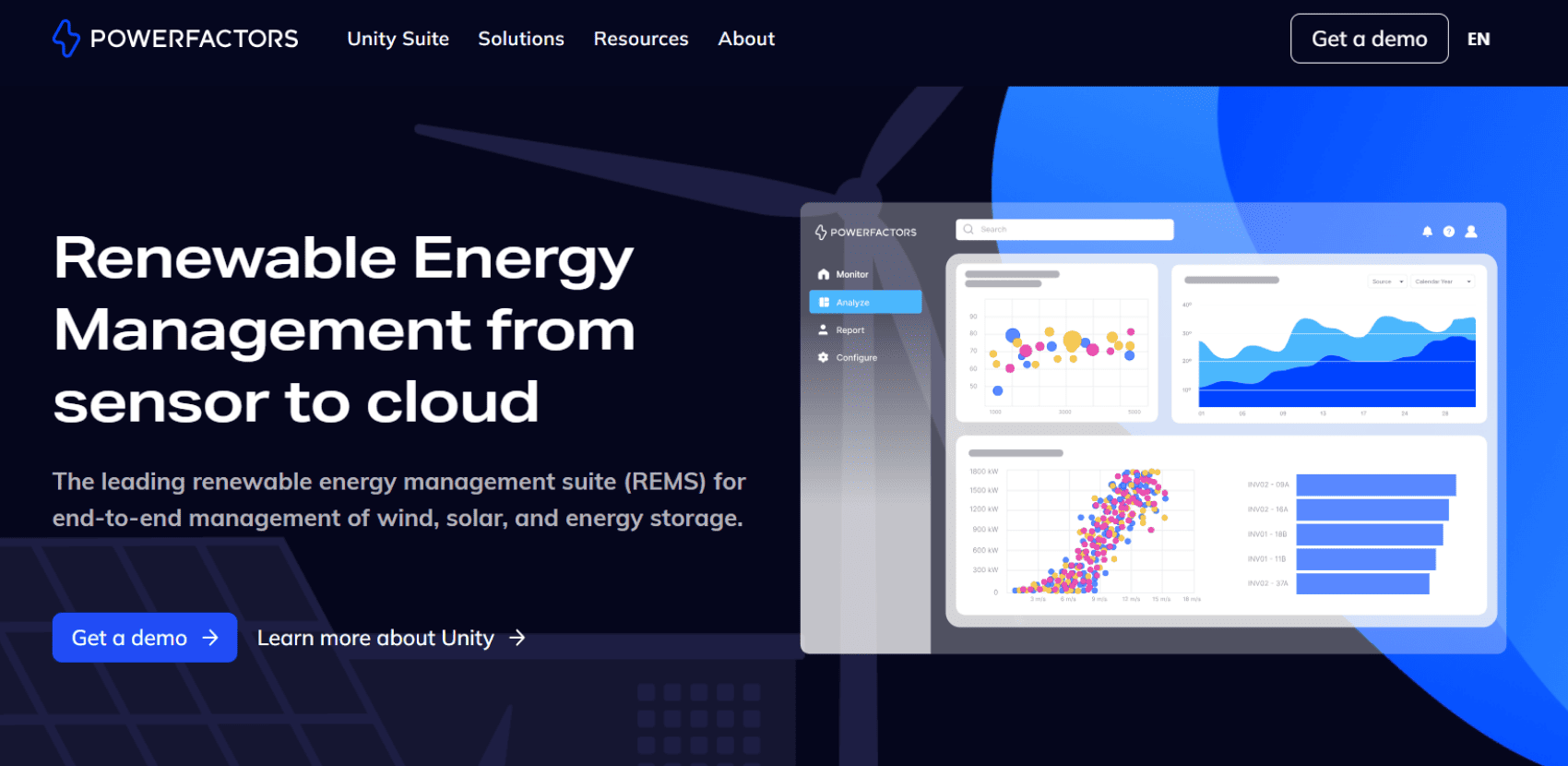
2. Power Factors | www.powerfactors.com

Power Factors is a heavyweight in asset performance management (APM), giving you deep digital visibility into your entire renewable energy portfolio.

Why it made the list: It’s the "brains" of the operation. If you need to monitor the state-of-health or predict the energy yield across multiple battery and solar sites, this is the industry standard.

Top features you'll actually use

  • Real-time SCADA data ingestion and underperformance detection.
  • Predictive yield analytics and state-of-health (SoH) monitoring.

Pros & Cons

  • Pros: Unmatched for high-level data analytics and spotting exactly when and where a battery rack is starting to degrade.
  • Cons: It acts as the "brains without hands". You cannot use it to efficiently dispatch a technician or track your physical spare parts inventory.

Best paired with: A dedicated field execution platform (like FieldEx) to act as the execution layer, closing the loop between detecting an issue digitally and actually resolving it physically.

Category 3: Enterprise Asset Management (The Heavyweights)

Best for: Massive, global utility companies with huge IT budgets needing infinite asset mapping and deep corporate ERP integrations.
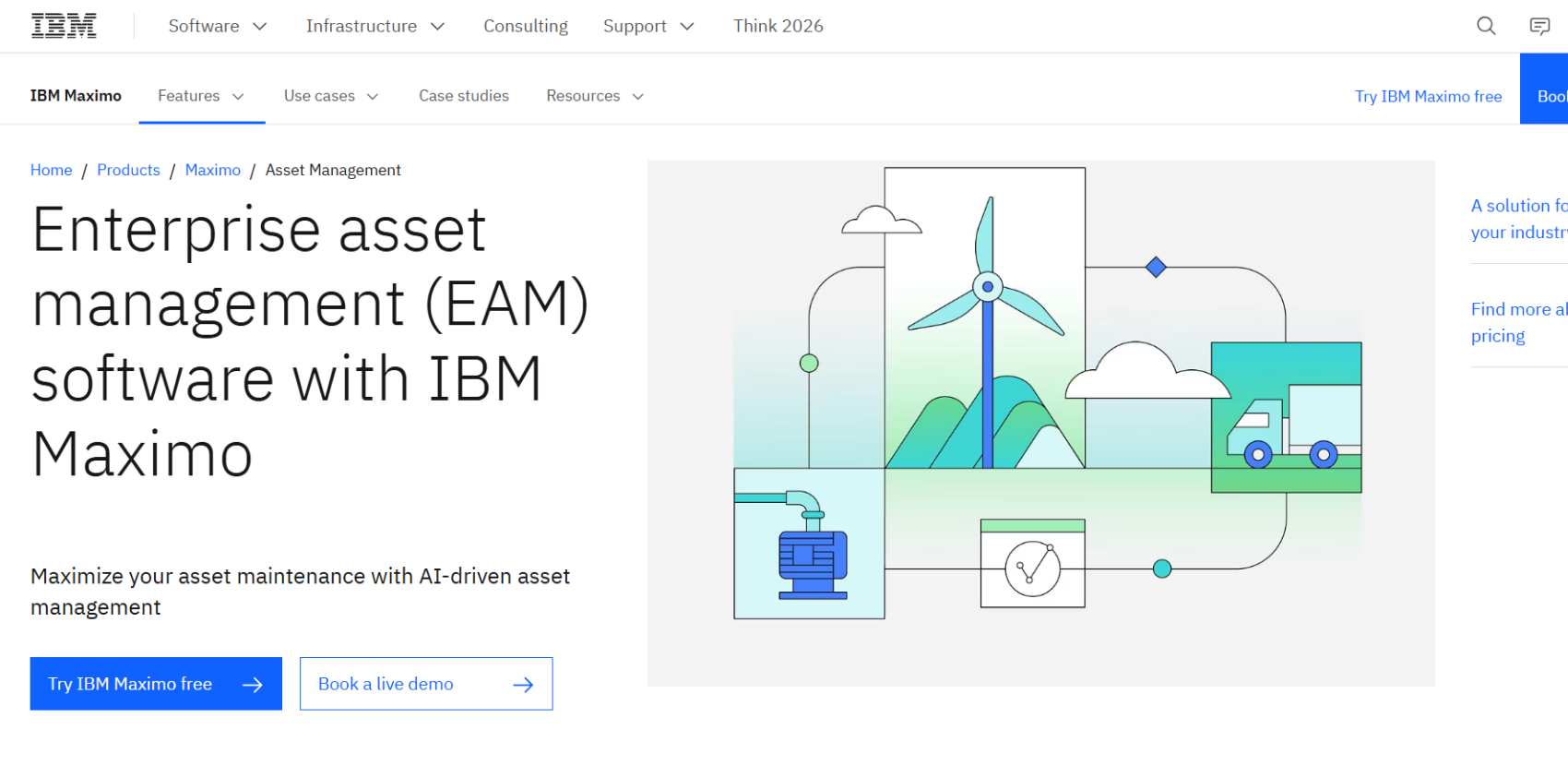
3. IBM Maximo | www.ibm.com

IBM Maximo is a massive, traditional enterprise asset management (EAM) system built primarily for giant legacy utility companies.

Why it made the list: When you’re managing an unbelievably complex, global BESS infrastructure and have the budget of a small nation, Maximo has the raw computing power to handle it.

Top features you'll actually use

  • Endless customization for mapping out incredibly complex, global asset hierarchies.
  • Advanced procurement forecasting and enterprise-level reporting.

Pros & Cons

  • Pros: Incredible scale and customization capabilities for massive corporate entities.
  • Cons: It is notoriously expensive, and technicians often struggle with its clunky mobile interface out in the field.

Best paired with: Heavy-duty enterprise ERP systems like SAP or Oracle.
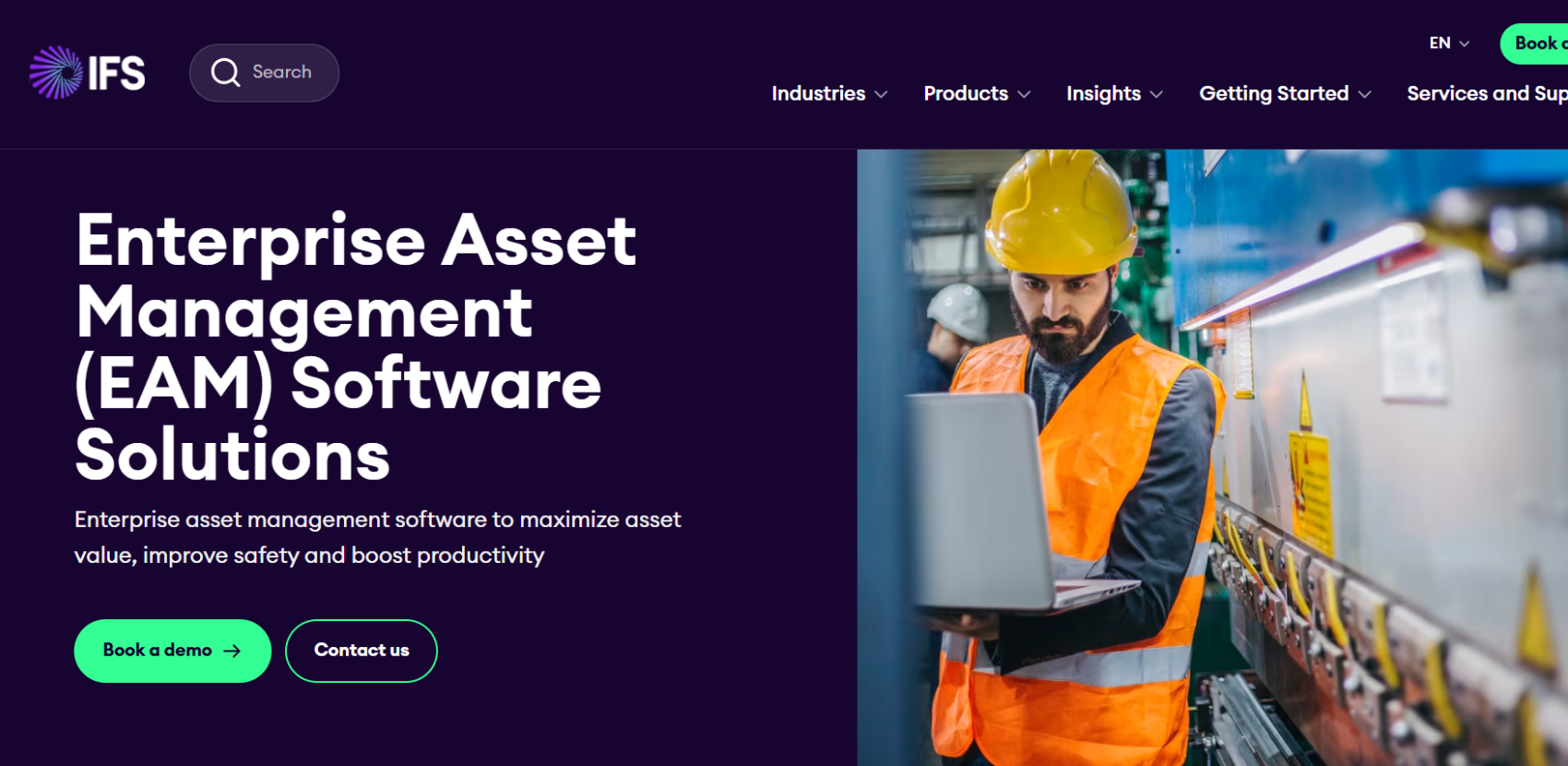
4. IFS | www.ifs.com

IFS is an entrenched giant in the broader industrial service and enterprise resource management space.

Why it made the list: It has a massive track record managing logistics and heavy machinery for traditional industrial and manufacturing companies.

Top features you'll actually use

  • Global spare parts logistics and supply chain tracking.
  • Heavy-duty maintenance scheduling for traditional facilities.

Pros & Cons

  • Pros: An incredibly robust, proven system if you are running a legacy industrial or manufacturing business.
  • Cons: Because it's a generalist horizontal tool, it forces entrants into a capital-intensive race and lacks out-of-the-box green tech workflows, like automated NEVI reporting templates or NFPA 855 safety checks.

Best paired with: Works best as a standalone, all-in-one ERP/FSM for traditional industrial operations.

Category 4: Energy Management & Dispatch (The Algorithms)

Best for: Maximizing financial ROI through algorithmic grid trading and automated charge/discharge cycles.

5. Fluence IQ | fluenceenergy.com

Fluence IQ acts as the digital optimization engine for your battery energy storage systems.

Why it made the list: It's the dispatch algorithm that actually makes your battery profitable by optimizing exactly when to charge and discharge based on grid prices.

Top features you'll actually use

  • Algorithmic bidding for energy markets.
  • Automated charge/discharge cycles based on real-time pricing and grid demand.

Pros & Cons

  • Pros: Absolutely essential for maximizing the financial ROI of your battery's energy capacity.
  • Cons: It is strictly digital operational software. It won't help you swap out a busted HVAC cooling pump or track a technician's safety certifications.

Best paired with: Energy market trading platforms and a physical CMMS to handle the actual hardware maintenance.

Category 5: Financial & Portfolio Management

Best for: Office-based asset managers tracking financial compliance, Power Purchase Agreements (PPAs), NERC regulations, and commercial viability.

6. Radian Generation (Radian Digital) | radiangen.com

Radian Generation is a specialized software provider that recently made a massive strategic move by uniting its three powerful legacy products (LENS, GREEN IT and GAR) into one cohesive, full life-cycle platform called Radian Digital.

Why it made the list: It's the ultimate unified dashboard for the office-based owner, operator, or investor. If you need to keep stakeholders happy, track land payments, and ensure strict commercial and NERC compliance across a massive green infrastructure portfolio, this platform brings it all under one roof.

Top features you'll actually use

  • NERC & Commercial Compliance: A highly reliable, automated digital environment specifically built for managing complex NERC regulatory requirements and auditable deliverables.
  • Land Control & Financials: Streamlines and automates landowner payment calculations, featuring an extensive Accounts Payable (AP) interface and deep ERP synchronization.
  • Full Life-Cycle Tracking: Covers everything from early-stage project development (budgeting and financial modeling) to cross-functional team collaboration and KPI performance tracking.

Pros & Cons

  • Pros: Fantastic for tracking the financial health, stakeholder reporting, and complex regulatory viability (like NERC) of a large renewable portfolio from development through operation.
  • Cons: While it is an incredible tool for the commercial asset manager, it is still largely a "brains without hands" platform. It lacks the granular, mobile-first "wrench-turning" features and offline physical parts tracking that your maintenance crew needs in the field.

Best paired with: Financial accounting tools and a specialized field execution app (like FieldEx) to handle the physical labor and hardware repairs.

Category 6: Generalist Field Schedulers

Best for: Generalist contractors and traditional trades needing powerful shift scheduling and dynamic geographic routing.
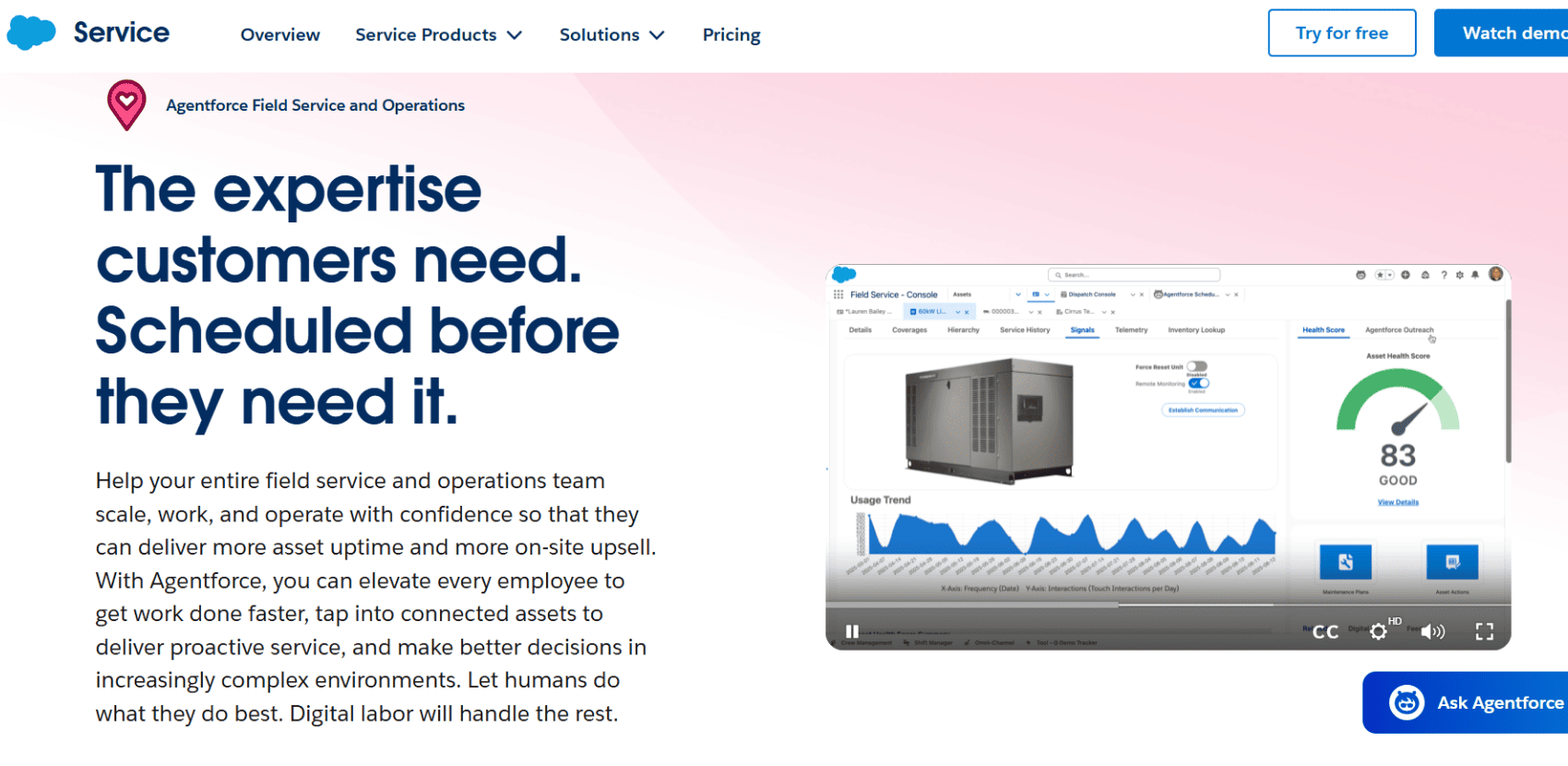
7. Salesforce Field Service | www.salesforce.com

Salesforce Field Service is a behemoth in the general field service and workforce management space.

Why it made the list: If you just need a massive scheduling engine to manage a huge traditional workforce, Salesforce is a dominant force with an incredible ecosystem.

Top features you'll actually use

  • Advanced shift scheduling and dynamic routing.
  • Standard ticketing capabilities and solid customer communication flows.

Pros & Cons

  • Pros: You get the reliability of the massive Salesforce CRM ecosystem and highly refined scheduling tools.
  • Cons: It's built for traditional trades (like HVAC or plumbing) and treats a highly volatile 150kW battery rack the exact same way it treats a generic commercial boiler. You'll need expensive custom coding to hit rigid green-tech compliance rules.

Best paired with: The Salesforce CRM ecosystem for standard customer support tracking.

Operational resilience is non-negotiable

Relying on disconnected spreadsheets, generic ticketing systems or brilliant analytics dashboards that can't actually dispatch a wrench-turning technician is a recipe for costly downtime and failed compliance audits.

True operational resilience requires a tech stack that seamlessly connects the digital and the physical. It is about closing the massive gap between the exact moment a SCADA sensor detects a cooling anomaly and the moment a certified technician signs off on a mandatory safety checklist.

Ultimately, adopting purpose-built technology isn't just an operational upgrade – it's your strongest insurance policy against catastrophic failures and the only way to survive the highly regulated future of decentralized energy.

Frequently asked questions 

1. What is a BESS?

A battery energy storage system (BESS) is a technology developed for storing electrical charge by using specially developed batteries. They are critical for stabilizing the grid by storing excess energy (like solar or wind) and discharging it when demand is high.

2. Why is battery storage an important component in green infrastructure?

Renewable energy sources like solar and wind are intermittent (the sun doesn't always shine, and the wind doesn't always blow). Battery storage bridges this gap, transitioning the grid from a unidirectional flow to a reliable, bidirectional, decentralized energy network.

3. What is BESS maintenance software?

It's specialized software used to manage the physical upkeep, mandatory safety inspections, and parts inventory specifically for BESS.

4. Why is NFPA 855 compliance important for battery storage?

NFPA 855 is the strict fire code governing stationary energy storage systems. Compliance ensures you are actively mitigating extreme risks like thermal runaway by conducting documented Hazard Mitigation Analysis (HMA) and recurring fire system inspections.

5. How does field service management (FSM) differ from an APM?

An APM (Asset Performance Management) acts as the "brains", analyzing telemetry data to tell you what is wrong, while an FSM platform acts as the "hands", dispatching the technician and parts to actually fix it.

6. What is the EU Digital Battery Passport?

It's a regulatory mandate requiring a persistent digital record of an industrial battery's health, carbon footprint and maintenance history from cradle to grave.

7. Can standard FSM tools handle BESS maintenance?

Usually no. Standard generalist tools treat a complex battery like a generic asset and lack the complex parent-child asset tracking and strict high-voltage safety checklists required for modern energy assets.

8. Why is HVAC tracking critical for lithium-ion batteries?

Batteries generate massive heat during charge and discharge cycles. Maintaining the liquid or air cooling systems is often the most frequent and critical maintenance task on a BESS site to prevent catastrophic thermal runaway.

9. How do you integrate SCADA alerts with field service platforms?

Modern platforms like FieldEx use REST APIs to connect directly with SCADA or EMS systems, automatically generating work orders and dispatching technicians when a sensor detects a fault.

10. How do maintenance apps help prevent thermal runaway?

By using automated, mandatory checklist triggers that force technicians to physically verify gas sensors, ventilation and cooling systems on a strict schedule before they can log a job as complete.

About the Author

Dashboard mockup

The FieldEx Team

FieldEx is a B2B field service management software designed to streamline operations, scheduling, and tracking for industries like equipment rental, facilities management, and EV charging, helping businesses improve efficiency and service delivery.

Complex operations simplified with one software.

No paperwork. No spreadsheets. No blindspots. Just one solution that simplifies your field service operations.
Header image