BESS maintenance software for battery racks, inverters and site safety checks

Plan every enclosure inspection, cooling service and fire system test, and keep a full service and warranty history for every container, rack and inverter.

Book a demo
Updated 19 Oct 2026
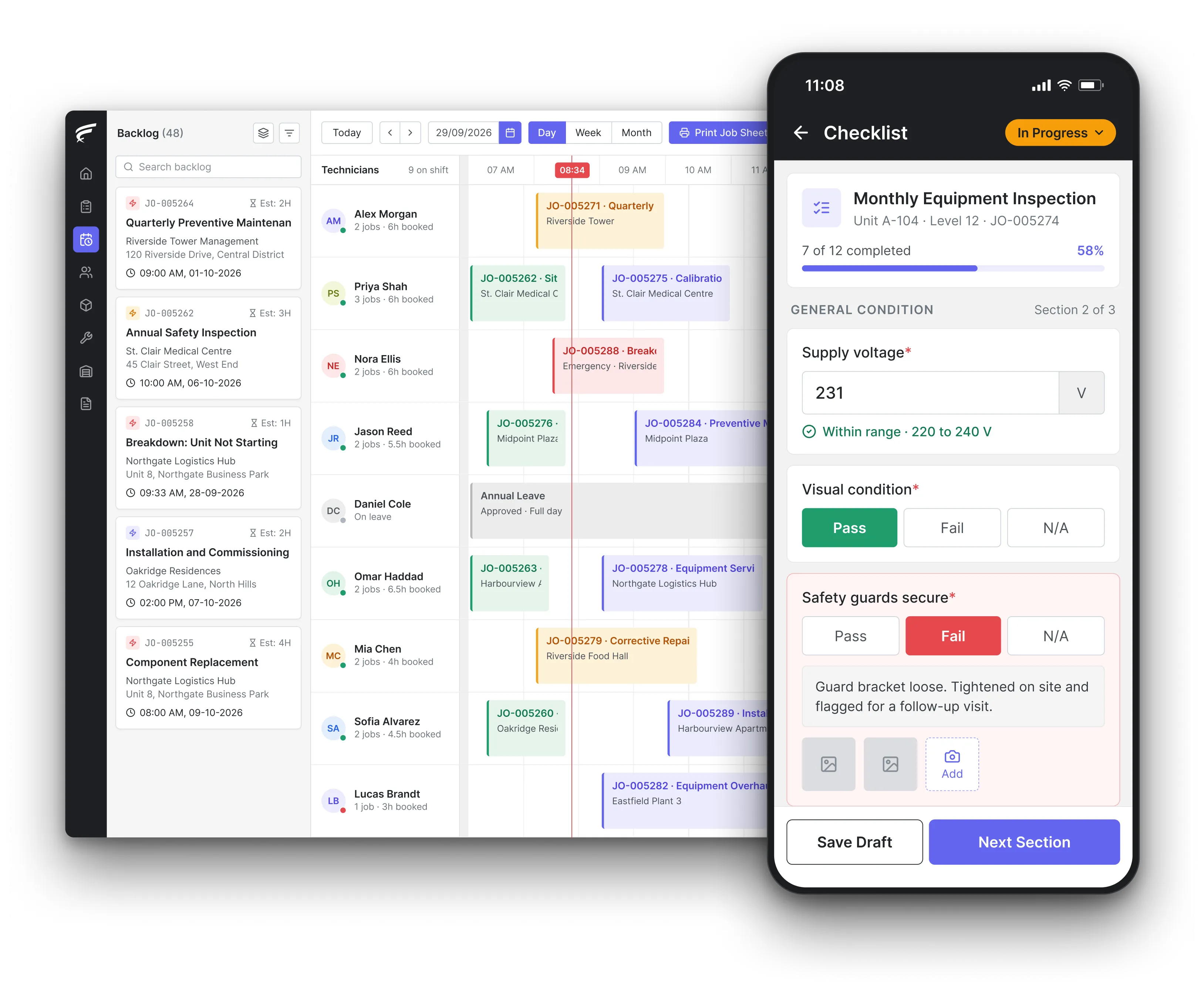
FieldEx scheduling board on desktop with a technician's inspection checklist open on the mobile app, as used by battery storage maintenance teams

FieldEx is a field service and asset management (FSM+CMMS) application for battery energy storage owners and operations and maintenance (O&M) providers. Every container, rack, inverter, cooling unit and fire system has its own record. It runs monthly, annual and multi-year maintenance on schedule and sends qualified technicians to remote sites. Inspection results, warranty details and service reports stay together.

What FieldEx does for battery storage O&M teams

A battery storage site holds a short list of very expensive, very energy-dense assets. The manufacturer, the insurer and the local fire authority all want to see them looked after. The work mixes routine enclosure checks, annual service under a long-term service agreement, fire system testing and fast corrective work when something trips. FieldEx keeps all of it on the asset records of each site. The inspection, the repair and the warranty trail for a rack or inverter sit together. Book a demo to see it set up for your own sites.

Containers, racks and inverters on record

  • A site record for every storage facility, with its address, map pin, service zone and contacts.
  • The assets, jobs and maintenance plans that belong to each site, held on its record.
  • An asset record for every enclosure, battery rack and inverter, and for every transformer, cooling unit and fire suppression panel.
  • Serial numbers, specifications, photos and warranty details on each asset record.
  • Parent and component levels, so a container keeps its racks, cooling unit and fire panel as components, each with its own history, in Asset Management.
  • Manufacturer manuals, single-line drawings and test reports attached to the asset, and a change history showing who edited what and when.
  • Containers as parents, with their racks, HVAC unit and fire panel as components that each carry their own history, in Asset Management.
  • The original equipment manufacturer's (OEM) manual, single-line diagram, UN 38.3 report and commissioning results stored on the asset.
  • A log of every edit to the asset, with the user and time.

Maintenance plans on the calendar and on usage

  • Asset maintenance plans that create the visits automatically, each with its own checklist and technician.
  • Visits such as the quarterly ventilation check, the annual service and the manufacturer's longer-interval overhauls.
  • Triggers on the calendar, on meter readings such as cycles or running hours, or on whichever comes first.
  • Fixed calendar schedules, or schedules that recalculate from the last completed visit, with missed visits rescheduled after a set overdue period. Fixed calendar dates apply to time-based plans.
  • One plan applied across a whole fleet of sites, picking up new containers that match its criteria, in Preventive Maintenance.

Fire system tests and safety inspections

  • Recurring inspections per asset type, on the schedule each one needs, and certifications on set frequencies with the certifying authority recorded.
  • Due, overdue and completed status for every inspection and certification, with reminders on certifications by email, in the app or both.
  • The date, the person who did it, the result and remarks on each record, with the test certificate or service report attached, through Compliance Documentation.
  • A dashboard of overdue inspections, those due in the next 7 days and those completed in the last 7 days.
  • Dashboard filters by asset type or service zone.

Readings, findings and corrective work

  • Custom job forms with number fields for readings such as voltages, currents and temperatures, so the technician records the exact value, not a tick.
  • Temperature readings logged against an asset as meter readings, building a time-stamped history for each enclosure or cooling unit.
  • A failed answer on a checklist that raises the corrective work order and its tasks straight away, and can book a follow-up inspection.
  • An alert when a new job repeats a recent job on the same asset, in Work Order Management. A recurring fault on one rack or inverter is spotted early.

Technicians on remote storage sites

  • Each job on the FieldEx Mobile App with the asset's history, the right checklist, watermarked photos and the site contact's signature.
  • Jobs and tasks can be downloaded and worked offline, with check-in, check-out and travel synced later.
  • QR or barcode labels on each container and rack, scanned on the phone to open the asset and launch its checklist.
  • Task procedures in a set order, with designated tasks such as isolation steps that must be completed before the job can be closed.

Dispatch and response times

  • Automatic assignment that matches jobs on skills, zone and availability first, then nearest and least busy.
  • A drag-and-drop scheduler for exceptions, in Scheduling and Dispatch.
  • Service-level agreements with several stages, such as attend and make safe, each with its own at-risk and violation alerts.
  • Travel to site recorded as a task journey, with distance, duration and check-in and check-out times on the job.

Spare parts, warranties and service agreements

  • Spare parts held in each store and in each technician's own stock.
  • Parts such as cooling fans, pumps, gaskets, fuses and contactors.
  • Transfers and approvals for parts, in Spare Parts Inventory.
  • Warranty periods kept on each part and warranty details on each asset, with every part fitted recorded on the job and the asset.
  • Service agreements with start and end dates, linked to the assets and maintenance plans they cover.
  • Reports by site, asset or period, exported or emailed on a timetable.

Your own gas monitors, test kit and vans

  • Portable gas monitors, insulation testers, thermal cameras and insulated tools on record as company assets, each with its serial number and holder.
  • Calibration and inspection due dates for each instrument as recurring certifications, with reminders and the certificate on the record.
  • Service vans on maintenance plans by date or odometer reading, each with its own service history.
  • Workshop machinery used to repair battery packs and fans on its own maintenance plan.

Reports and records for owners

  • Completion PDFs, sent automatically to the owner or anyone else, with a record of when each was sent.
  • Each PDF holds the equipment, the fault and resolution, the parts used and check-in and check-out times. Photos and the customer's signature are included too.
  • Reports on asset reliability, maintenance cost and age, and on jobs and inspections by site, in Reporting and Analytics.
  • Owner reports exported as CSV, Excel or PDF, or emailed to owners on a schedule.
  • A branded Customer Portal where the asset owner sees registered equipment with last-serviced dates, upcoming asset maintenance and downloadable job reports.

How often does a battery energy storage system need preventive maintenance?

At least once a year, with some checks more often and the rest at the manufacturer's intervals. The US National Renewable Energy Laboratory's O&M best practices guide (3rd edition, December 2018) lists an annual visual survey of the battery bank. It covers cracked or bulging cases and the condition of the enclosure and support structure. It adds a quarterly check of the ventilation or air filtration system and an annual re-torque of the battery connections. Scheduled maintenance otherwise follows the manufacturer's recommendations, as the equipment warranty requires.

What FieldEx does about it

  • Every cycle on one plan: a single asset maintenance plan can produce the quarterly checks, the annual service and the manufacturer's longer-interval overhauls. Each visit has its own checklist and technician.
  • Multi-year intervals: schedules run by day, week, month or year, on a fixed calendar or counted from the last completed visit. Presets cover intervals such as quarterly or every 3 years.
  • Parts ready for the big visits: job templates carry the parts list for each visit. Filters, fans and gaskets for each overhaul are on the job before the technician leaves.
  • Fleet-wide plans: one plan covers every container of the same model across all your sites, and picks up new ones as they are commissioned.

What goes on a BESS maintenance checklist?

A BESS checklist follows the manufacturer and covers the battery, the thermal system, the power electronics and the safety systems. NREL's O&M best practices guide lists the battery items: corrosion, cracked or bulging cases, the enclosure and support structure, ventilation and air filters, and connection torque. It also recommends infrared imaging. Cells with high internal resistance show up hotter than their neighbors, and so do loose or corroded post connections.

What FieldEx does about it

  • Checklists per asset type: each enclosure, cooling unit and inverter gets its own checklist, grouped into sections. The technician picks the one that matches the asset scanned.
  • Built from your procedure: checklist questions can be generated with AI from a description or a PDF or PNG of your existing checklist or procedure. You can then edit them.
  • Reference photos: questions can carry reference photos, so a technician sees what a clean radiator or a good door gasket should look like.
  • Thermal images on file: infrared photos are attached to the job and the asset, with automatic watermarks on photos taken in the app.

What maintenance do lithium-ion battery racks need?

Lithium-ion racks need connection and torque checks, cleaning, infrared surveys and rack-by-rack readings that can be compared from visit to visit. NREL's O&M guide calls differences in voltage over time, or by position in the arrangement, important signs that maintenance or replacement is needed. It adds that infrared imaging can show where problems sit in a battery system. The Electric Power Research Institute (EPRI) analyzed its BESS Failure Incident Database in May 2024. Many failures investigated in South Korea occurred when the state of charge was above 90%.

What FieldEx does about it

  • Each rack as a component: racks sit under their container as component assets, each with its own serial number, warranty and history.
  • Readings you can compare: custom job forms capture voltages and temperatures rack by rack as numbers, recorded against the job for the next visit's comparison.
  • Out-of-range findings become work: a failed checklist answer raises the corrective work order and can book a follow-up inspection on the same rack.
  • Repeat faults flagged: a new job that repeats a recent job on the same rack triggers an alert by email or in-app notification.

How is thermal runaway detected and handled at a battery site?

Gas detection and the battery management system (BMS) detect it, and an on-call technician attends to make the site safe. The UK National Fire Chiefs Council's grid-scale BESS guidance (December 2025) calls for continuous combustible gas monitoring within BESS enclosures. Gas detectors should alarm, shut down the BESS and start full exhaust ventilation. Early fault detection, often through the BMS, should let the affected batteries be disconnected remotely. EPRI's failure incident analysis recommends battery monitoring and analytics that add to the BMS, so potential failures are found early.

What FieldEx does about it

  • Response clocks in stages: service-level agreements can time attend, make safe and repair as separate stages. Each stage has at-risk and violation alerts to the users or groups you choose.
  • The right person first: jobs are matched on skills, zone and availability first, then nearest and least busy.
  • Gas detectors on schedule: gas detection and BMS sensors are assets with their own calibration certifications, reminders and test inspections.
  • The incident on record: the corrective job keeps the times, photos, findings and parts used, on the asset that failed.

How often should BESS fire detection and suppression be tested?

Test them at the intervals set by the applicable National Fire Protection Association (NFPA) standards, the local fire code and the manufacturer. NREL's O&M best practices guide names the safety codes and standards for stationary energy storage, from UL, NFPA, ANSI, CSA and IEC. It also says to follow any additional safety instructions from the manufacturer.

What FieldEx does about it

  • Each system on its own cycle: detection, suppression and ventilation equipment each run as recurring inspections or certifications. They run at the frequency your fire code and manufacturer set.
  • Test results with the certificate: each completed test records the date, who did it, the result and remarks, with the test certificate attached.
  • Failures closed out: a failed test raises the corrective job and books a follow-up inspection, so the defect is fixed and re-tested.
  • Completion notices: a completion notification can be sent when a certification is completed.

Do you have to notify the fire service before commissioning or servicing a BESS?

Only where the local fire authority requires it, so check the rule for each site. In the UK, the National Fire Chiefs Council says fire and rescue services are not statutory consultees on BESS planning, but early discussion with them is encouraged.

What FieldEx does about it

  • Jobs created ahead of time: a maintenance plan can create each annual service job a set number of days before its due date. That leaves time to notify the fire service.
  • A notification step on the job: the notification can be a required task on the service job, completed and time-stamped before the job can close.
  • Fire service contacts on the site: the local fire service sits with the site's additional contacts, so the planner can reach it when booking.
  • Owner access: the branded Customer Portal lets the owner see equipment, last-serviced dates and planned work, and download job reports.

What should a BESS emergency response plan include?

It should cover how the fire service is alerted, a site plan, the emergency coordinator's details, alarms, hazards and shutoff locations. The UK National Fire Chiefs Council lists those contents for the outline battery safety management plan that operators share with the fire and rescue service.

What FieldEx does about it

  • Response times measured: a service-level agreement with an en-route stage and an on-site stage can track a 15-minute and a 4-hour target. Each stage has at-risk and violation alerts.
  • Site documents in one place: emergency plans, site plans and drawings are attached to the site record. The technician sees them on the phone before work starts.
  • Contacts on the site: each site keeps its primary contact and additional contact records, separate from the owner's account.
  • Plan reviews scheduled: the yearly review of the emergency plan runs as a recurring site job, created ahead of its due date.

How much clearance from vegetation does a battery storage site need?

Keep combustible vegetation at least 3 meters from BESS units, and keep a wider fire break where the local fire authority requires one. The UK National Fire Chiefs Council sets the 3-meter figure, and asks for added separation where there is wildfire risk.

What FieldEx does about it

  • Site-wide maintenance plans: vegetation clearance and fire break upkeep run as site maintenance plans, applied to every storage site at once.
  • Seasonal timing: fixed calendar schedules can anchor the work to a date, such as before the fire season.
  • Before and after photos: the grounds crew records the clearance with watermarked photos on the mobile app, attached to the job.
  • Contractors included: grounds contractors can be set up as a user group, so the jobs go to them and the record stays on your site.

How should BESS operators keep maintenance and warranty records?

Keep a record of every inspection and maintenance visit, with who did it, so the warranty holds and trends show over time. NREL's O&M best practices guide says scheduled maintenance is often carried out at the manufacturer's intervals, as the equipment warranties require. It adds that good record keeping is needed to track battery voltage and impedance trends over time.

What FieldEx does about it

  • Warranty on the asset and the part: each asset holds its warranty details and each spare part its warranty period. Every part fitted is recorded against the job and the asset.
  • Who did the work: each job and inspection records the technician, check-in and check-out times and the result. Routing by skill or group sends work only to authorized providers.
  • Logs ready on request: run reports of inspection and maintenance records for a site, asset or period, and export them as CSV, Excel or PDF.
  • Service agreements linked: the long-term service agreement is a contract with start and end dates, linked to the assets and plans it covers.

How often should a technician's portable gas monitor be checked?

Bump test or calibration check each portable gas monitor before every day's use, and keep its calibration records for life. That is the US Occupational Safety and Health Administration's advice in its bulletin on calibrating portable gas monitors. A monitor that fails the bump test gets a full calibration before use. If it fails the full calibration, the employer removes it from service. At battery sites, the NFCC guidance also expects continuous gas monitoring inside every BESS enclosure.

What FieldEx does about it

  • Each monitor as an asset: every portable gas monitor, insulation tester and thermal camera has its own record, with serial number and holder.
  • Daily checks on the job: the bump test can be a required first task on every battery site job.
  • Calibration that doesn't lapse: each monitor's full calibration runs as a recurring certification, with reminders and the certificate kept for the life of the instrument.
  • Failed monitors out of use: a failed answer on the monitor's checklist can set its status to out of service and raise a repair job.
Customer story

TapEffect designs, builds and operates piped water systems for hard-to-reach rural communities in Cambodia. It runs its remote sites from a head office in Phnom Penh on FieldEx. Its story describes central visibility of stock levels at each site and transfers of equipment and machinery between sites. It also describes job tasks and instructions set for each remote site. TapEffect recorded a 25% increase in inventory management efficiency. It's a different industry, but the same pattern: unmanned remote sites run from one office.

Read the TapEffect Story

AMRTUR, a Southeast Asian oilfield services contractor, runs offshore and onshore maintenance on FieldEx. It works across harsh rig environments and strict HSSEQ standards. Its story describes maintenance jobs created automatically once a machine reaches 300 hours of use or 6 months, whichever comes first. It also describes QR request forms routed to the right team, and maintenance tracked for each component of complex equipment. It's a different industry, but the same pattern: hours-or-calendar PPM on component-level assets at remote sites.

Read the AMRTUR Story

Questions battery storage operators ask about FieldEx

What software do BESS O&M providers use to schedule inspections and track maintenance?

They use a maintenance system that covers the planned work, inspections and fault response described above. FieldEx adds field service management on the same records, so dispatch, mobile work and the asset history share one set of data. Compare approaches in our guide to CMMS Software.

Can FieldEx connect to our BMS, monitoring or other systems?

Yes. Through the FieldEx API, outside systems such as BMS or monitoring platforms can create jobs and exchange data with FieldEx. FieldEx can connect to any open system through REST APIs and has connectors for QuickBooks and Xero.

Can we track maintenance at component level inside each container?

Yes. A container can hold racks, a cooling unit, a fire panel and other components as child assets. Each one has its own serial number, warranty, readings and history.

Can maintenance be triggered by cycles or running hours as well as dates?

Yes. Each asset's meter readings build a history, and a plan can trigger on the calendar, on the meter reading, or on whichever comes first.

Can technicians work at remote sites without mobile coverage?

Yes. Jobs and tasks can be downloaded and worked offline, with check-in, check-out and travel synced later.

Can we send only authorized technicians to a manufacturer's equipment?

Yes. Each job's required skill limits it to qualified technicians. Skills can be named after any license or authorization, such as an OEM-certified service technician, and carry an expiry date.

Can FieldEx manage spares across several storage sites?

Yes. Each store and each technician's own stock is tracked, with transfers between sites and low-stock alerts for each location.

Can the asset owner see what maintenance has been done?

Yes. The branded customer portal shows registered equipment with last-serviced dates, upcoming asset maintenance, job status and downloadable job reports.

Can we run planned maintenance and fault response for several asset owners?

Yes. Each owner is a customer with its own sites, assets, contracts and service-level agreements, and the scheduler shows all of their work together.

Can a technician record readings such as voltages and temperatures on site?

Yes. Custom job forms, set up during onboarding, add number fields for these readings, as in the rack section above. Temperatures can also be recorded as meter readings on an asset, building a time-stamped history.

How quickly can our storage sites be running on FieldEx?

There's no setup fee. Once we know your requirements and your data is ready, FieldEx can be implemented in as little as a week with standard features for small businesses. Larger setups and custom work take longer. Sites and assets can be uploaded. FieldEx helps with setup, and training is included. See Setup and Training.

Put every battery site's inspections, service and warranty trail in one system

Book a Demo