

Fire suppression systems detect, control, and extinguish fires automatically using water, clean chemical agents, inert or CO2 gases, foam, dry or wet chemicals, or hybrid water-mist setups. Using The 3-Step Suppression Selection Rule, facility managers choose the right system by matching the agent to the exact fire class and room contents, verifying human occupancy safety and 2027 chemical regulations (such as HFC phasedowns and fluorine-free foam rules), and locking in recurring NFPA inspection schedules. Tracking pressure checks, cylinder weights, and valve inspections in a CMMS replaces scattered paper binders with audit-ready compliance logs.
Fire is a friend when it cooks your dinner, but a nightmare when it hits your server room or warehouse. That’s where fire suppression systems step in. They don’t just sound alarms; they actually fight flames before they spread.
Here’s the catch: there’s more than one kind. From old-school sprinklers to high-tech clean agents and foam blankets, each system works differently and fits specific environments. The right choice for a hospital isn’t the right one for a restaurant kitchen.
In this guide, we’ll break down the major types of fire suppression systems, how they work, where they’re used, and how to choose the right one. Along the way, we’ll keep things simple, skip the jargon, and share real-world examples so you walk away knowing exactly what makes sense for your facility.
At its core, a fire suppression system is a setup designed to detect, control and put out fires. Pretty straightforward, right? But here’s the catch: it’s not the same as your everyday smoke alarm or even your standard sprinkler system. Fire suppression goes a step further; it doesn’t just sound the alarm or slow things down. It actively takes the fight to the fire.
Here’s a simple way to picture it:
Most suppression systems are automatic, which means they kick in on their own when heat, smoke or flame sensors detect trouble. Imagine you’re asleep at 2 am in an office tower (not the best place for a nap, but stick with me). Suddenly, a fire starts in the electrical room. You’re not there to grab an extinguisher, but the suppression system is. It detects the threat and gets to work while you’re none the wiser.
There are a bunch of ways these systems suppress fires, and that’s where things get interesting:
Because different environments have different “personalities". A server room hates water, so you’d never want sprinklers there. A commercial kitchen, on the other hand, needs something that can handle grease fires. One size definitely doesn’t fit all.
Fire suppression isn’t just about saving lives (though that’s the top priority, of course). It’s also about compliance. In the US, standards like the National Fire Protection Association (NFPA) codes require businesses to install and maintain proper systems.
Insurance companies are sticklers about it too; skip compliance, and not only do you put people and property at risk, but you might also end up footing a massive bill after an incident.
So, in short: a fire suppression system is your facility’s last line of defense when fire prevention fails. It’s the difference between a small, manageable incident and a full-scale disaster. And as we’ll see in the next sections, there’s a whole toolbox of options to choose from.
Different environments call for different tactics. Think of it like picking shoes: you wouldn’t wear flip-flops in the snow (okay, maybe that one time, but you’d regret it). Same with suppression systems – use the wrong one, and you’ll have a disaster on your hands.
Let’s go through the most common (and a few emerging) types.
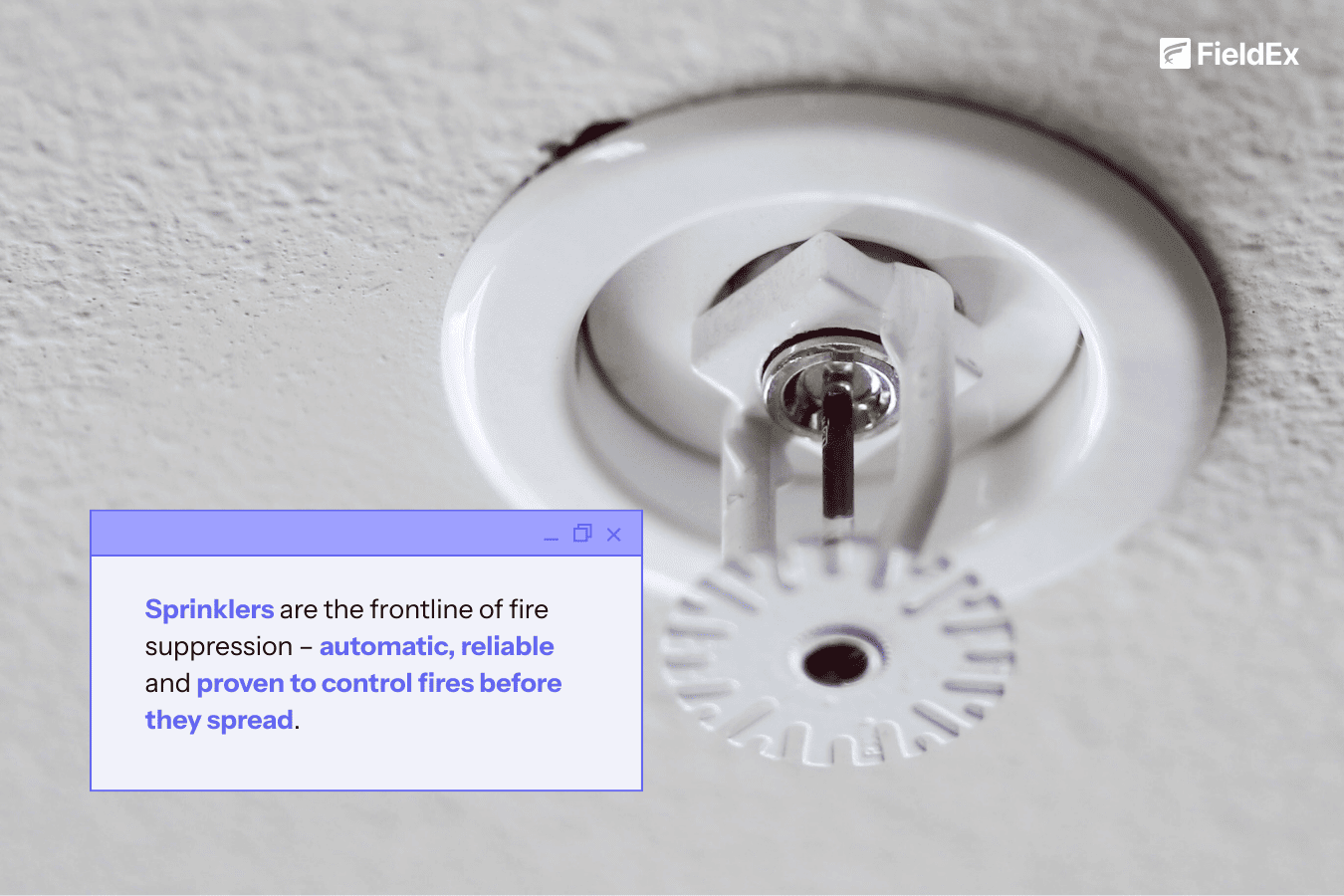
The Classic. Water-based systems are what most people picture when they think of fire safety – sprinklers raining down like in every action movie ever.
Instead of flooding a room with water, clean agent systems discharge stored gases or vaporizing liquids that absorb heat and interrupt the fire's chemical chain reaction without leaving residue.
These are like pulling the oxygen plug on a fire.
If water is like a hose, foam is like a thick blanket that smothers flammable liquid fires and stops vapors from reigniting.
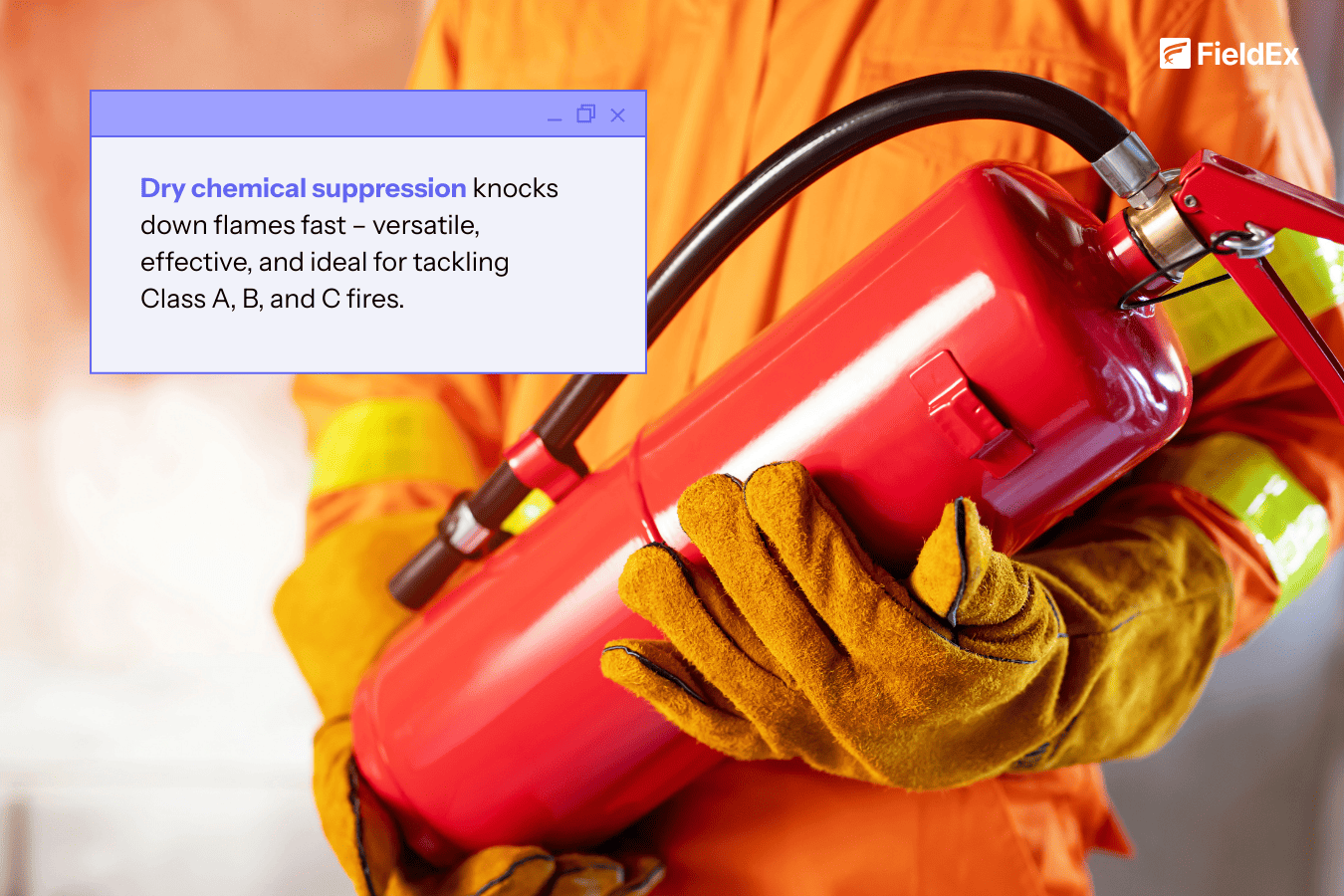
Chemical suppression systems split into two distinct categories depending on whether you are protecting industrial machinery or commercial cooking lines.
Hybrid systems combine ultra-fine water mist with inert gas (typically nitrogen) in a single nozzle, using a fraction of the water required by traditional sprinklers.
The big takeaway? Each fire suppression system has its strengths and weaknesses. The key is matching the system to the environment and the type of fire risk you’re dealing with.
Okay, so now that we’ve paraded all the main fire suppression systems across the stage, here comes the million-dollar question: Which one is right for you?
The short (and slightly annoying) answer is: it depends. The long (and more useful) answer is: it depends on your environment, the types of risks you’re dealing with, your budget, and what regulations apply to your industry. Let’s break it down.
Different spaces have different personalities.
This isn’t just about “what works best”. Fire codes and insurance requirements might already be nudging you in a certain direction. In the US, the National Fire Protection Association (NFPA) has entire books of standards:
Skipping compliance is like skipping the seatbelt – you might get away with it for a while, but when trouble hits, you’ll wish you hadn’t.
Yes, the sticker shock of some systems can make you gulp. But keep in mind: the total cost of ownership includes maintenance, inspections, and downtime if things go wrong. A cheap system that causes massive water damage in the wrong place? Not really cheap in the long run.
Here’s a quick cheat sheet:
Choosing the right system isn’t a one-and-done deal. Suppression systems need regular inspections, testing, and servicing. A half-working system is almost worse than no system at all; it gives you false confidence. That’s where smart tools like CMMS (Computerized Maintenance Management Systems) come in handy. With FieldEx, for example, you can schedule routine inspections, track compliance, and get alerts before anything slips through the cracks.
Bottom line: The right fire suppression system isn’t about picking the fanciest option. It’s about choosing the one that matches your fire risks, keeps you compliant, and fits your budget without leaving you vulnerable.
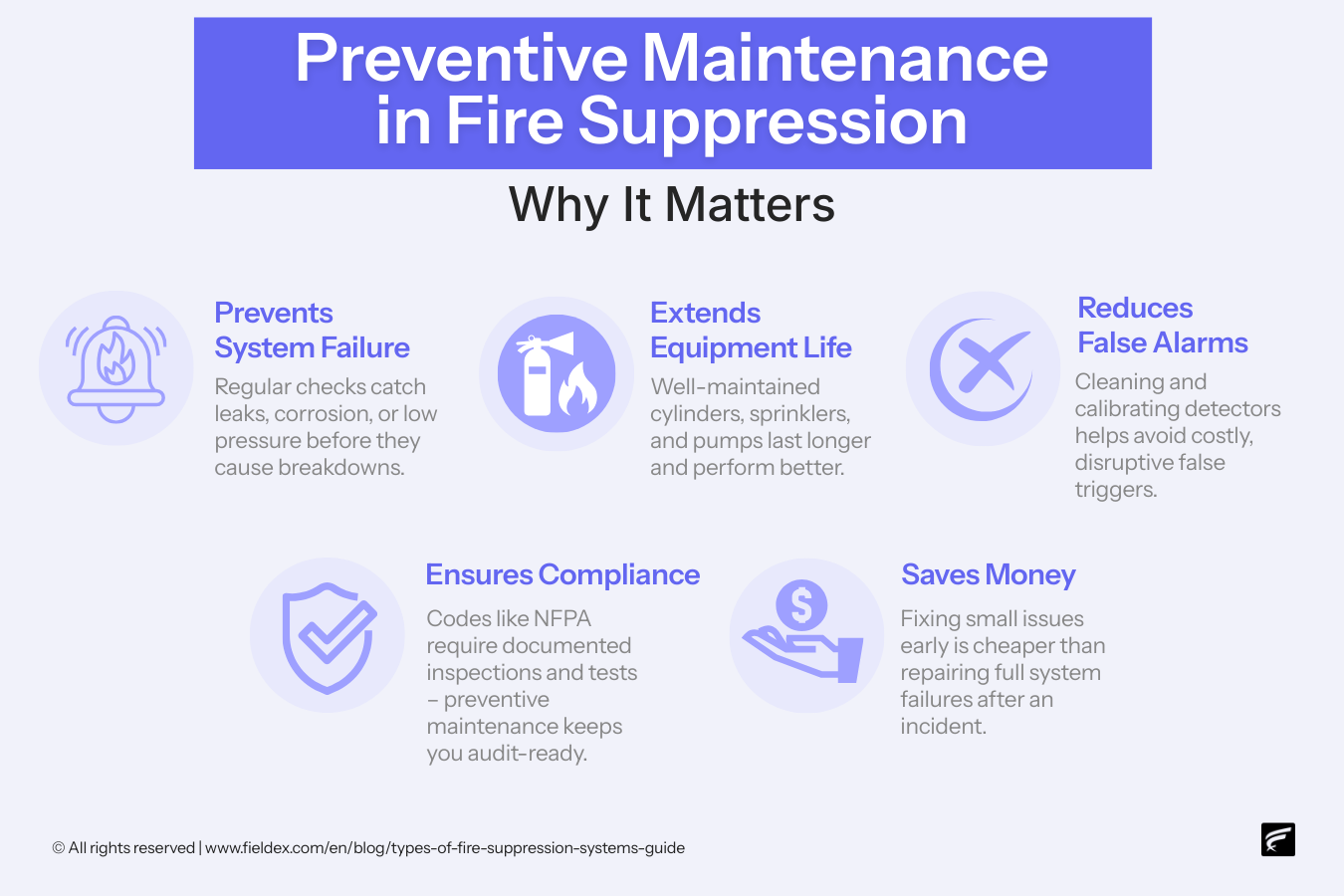
Here’s the thing about fire suppression systems: they’re like treadmills. Buying one is only half the story; if you don’t use it (or in this case, maintain it), it’s basically an expensive coat rack. A neglected system might look fine on the outside, but when it’s showtime and flames are licking up the walls, you need it to actually work.
According to the NFPA (National Fire Protection Association), more than 20% of sprinkler system failures in reported incidents were because the system was shut off or not maintained properly. That’s not just bad luck – it’s preventable neglect.
Regular checks catch issues like:
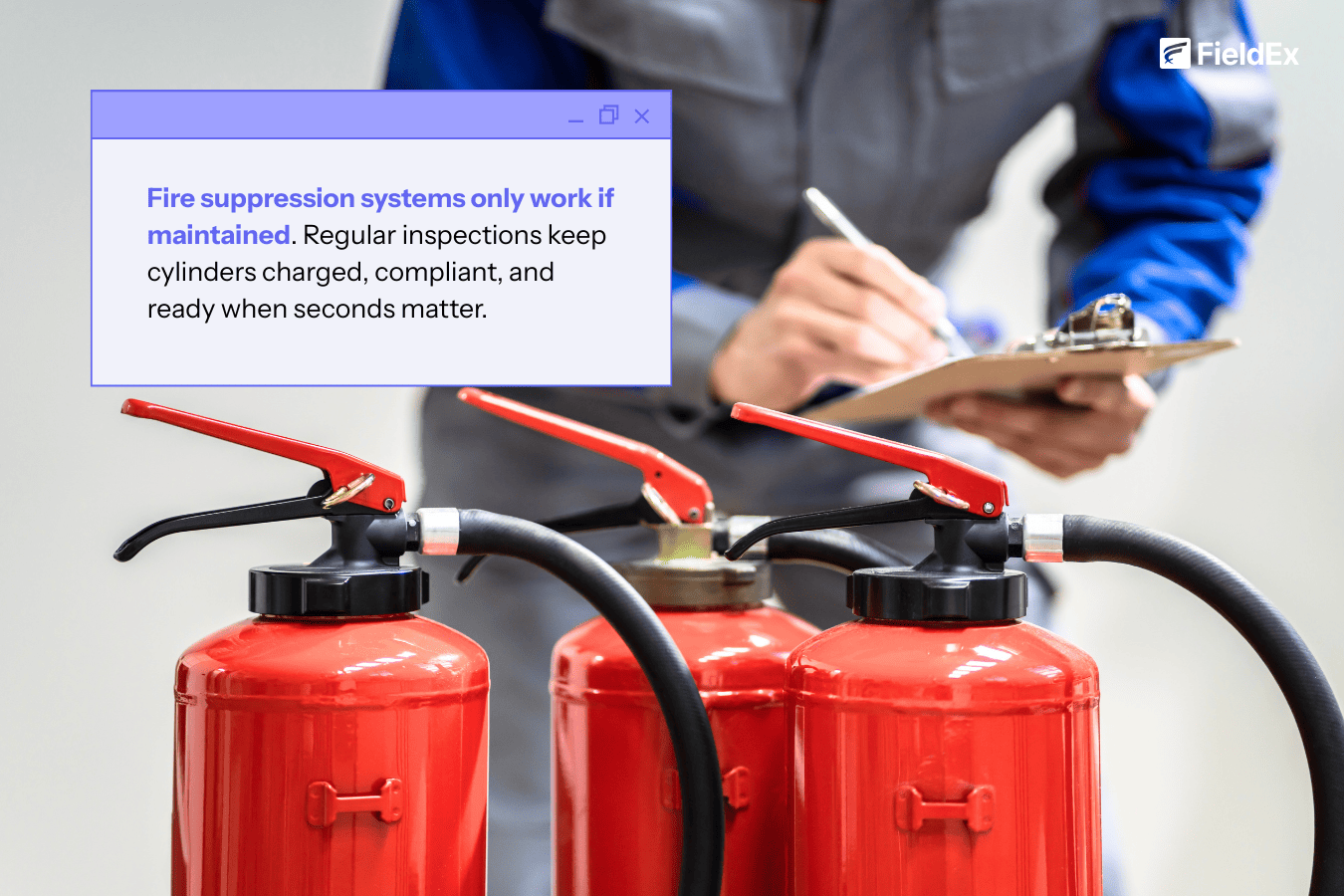
Most countries have fire codes that say, “If you’re running a building, you’ve got to keep your fire suppression systems in fighting shape”. In the US, NFPA standards spell it out clearly:
Local fire marshals or inspectors don’t just take your word for it, either. They want logs, records and proof. Insurance companies are the same way. Without compliance, you risk fines, higher premiums or denied claims after an incident.
Here’s the smarter play: don’t just wait for scheduled inspections … go proactive. Preventive maintenance (that’s just a fancy way of saying “fix stuff before it breaks”) keeps systems reliable and reduces costly emergencies. For example:
It’s like brushing your teeth daily so you don’t need a root canal. Less dramatic, less expensive and much less painful.
Here’s where a CMMS (Computerized Maintenance Management System) like FieldEx makes life easier. Instead of juggling paper checklists, sticky notes, and “Did we do that inspection last month?” conversations, you can:
That way, you’re not just compliant, but also ahead of the curve. And let’s be honest, nothing feels better than handing an inspector a clean, organized record without breaking a sweat.
Bottom line: Installing a fire suppression system is only half the battle. Keeping it maintained and compliant is what turns it from expensive hardware into a life-saving, property-protecting asset.
So, you’ve met the cast of fire suppression systems: water, chemical, gas, foam, dry chemical and hybrids. But where do they actually shine in the real world?
Let’s walk through a few industries and see which systems make the most sense.
Best Fit: Clean agent systems (FM-200, Novec 1230) or hybrid mist + gas.
Why? Servers and water are not friends. One unexpected sprinkler activation, and you’re not just looking at smoke damage; you’re looking at fried motherboards, downtime, and possibly millions in losses.
Clean agents put out fires fast without leaving residue or harming sensitive electronics.
Best Fit: Water sprinklers (wet or dry pipe), foam systems for hazardous storage.
Warehouses usually mean lots of flammable material: cardboard, packaging, plastics. In manufacturing, add machinery, chemicals, and oils into the mix.
Classic water-based systems are the bread-and-butter here, but in areas with flammable liquids, foam systems are the heavy hitters.
Best Fit: Water mist or clean agent systems.
Hospitals are full of sensitive equipment (MRI machines don’t take kindly to water), plus patients who can’t just evacuate at the sound of an alarm.
Water mist systems use very fine droplets that reduce water damage while being safe for people. Clean agents are also a solid option for labs and operating rooms.
Best Fit: Wet chemical systems (Class K for grease), plus sprinklers for the rest of the building.
In restaurants, grease fires are the main villain. They spread fast and laugh at water. That’s why wet chemical suppression systems are installed in hoods and over cooking equipment. In the rest of the retail floor, sprinklers handle the usual risks, eg paper, fabric, electronics.
Best Fit: Foam systems (low- or high-expansion), inert gas for specialized rooms.
Fuel fires are no joke. In oil refineries, chemical plants, or airplane hangars, foam suppression is often the only reliable option. High-expansion foam can blanket massive spaces, cutting oxygen and stopping re-ignition.
Best Fit: Good old sprinkler systems.
Sometimes simple is best. Offices, malls, apartment complexes – sprinklers are the most cost-effective, reliable option. They’ve been around for over a century for a reason: they work.
Takeaway: There’s no such thing as a “single perfect system”. The best choice depends on your industry, environment, and compliance rules. But one thing is universal: whichever system you pick, it needs consistent inspections and preventive care to be reliable when you need it most.
There are some classic mistakes people make when choosing (or maintaining) their systems, and if you can dodge these, you’ll save yourself a lot of money, headaches and potential disaster.
Yes, budgets matter. But fire suppression isn’t the place to cut corners. A warehouse manager might go for the cheapest sprinkler install, only to realize later that water damage could cost ten times more than the “fancier” clean agent option. Think long-term, not just upfront.
Every building has its quirks. A clean agent system in a car repair garage? Overkill. A sprinkler system above a server room? Disaster waiting to happen. Too often, people default to the “usual” option without asking: What’s the real fire risk here?
Even the best system is useless if it’s not maintained. I’ve seen places with pristine-looking sprinklers that haven’t been inspected in years. Spoiler alert: when the fire came, half of them didn’t work. Regular inspections and tests aren’t “extra”; they’re the whole point.
According to NFPA research, shut-off valves and lack of maintenance account for the majority of preventable sprinkler system failures, with shut valves alone responsible for roughly two-thirds of cases where sprinklers failed to operate.
Compliance isn’t just about avoiding fines; it’s about protecting people. Still, many organizations don’t realize that failing an NFPA or OSHA check can also void your insurance coverage. Imagine having a fire, then finding out your insurance claim is denied because your suppression system wasn’t inspected on schedule. Ouch.
Technology moves fast. Ten years ago, hybrids were rare. Now, they’re gaining traction in sensitive industries. If you invest in a system today, think about scalability: Will it still make sense if your facility doubles in size? Will it still meet evolving environmental regulations (like the push toward eco-friendly clean agents)?
Let’s bust a couple of persistent ones:
Bottom line: The biggest mistake isn’t choosing the “wrong” system; it’s not asking the right questions before you choose. Think about your environment, your compliance needs, and your long-term risks. And whatever system you land on, keep it maintained like your business depends on it … because it kind of does.
Fire suppression systems are moving rapidly toward lower-emission agents, connected sensors, and automated compliance tracking. Here are five shifts shaping facility fire protection in 2027:
Environmental rules are reshaping chemical suppression. Under the US AIM Act and EU F-gas regulations, virgin production of high-GWP hydrofluorocarbons like HFC-227ea (FM-200) is stepping down, while 3M exited PFAS and Novec 1230 manufacturing at the end of 2025. In 2027, facility operators are specifying third-party FK-5-1-12 fluoroketone agents, inert gas blends (argon and nitrogen), and fluorine-free foams (F3) to meet sustainability rules and avoid future refill shortages.
Instead of waiting for high ceiling heat to trip a sprinkler head, modern systems pair multi-criteria optical, thermal, and gas sensors with building panels. They detect smoldering electrical faults or lithium-ion battery off-gassing early, triggering localized suppression before flames spread across racks.
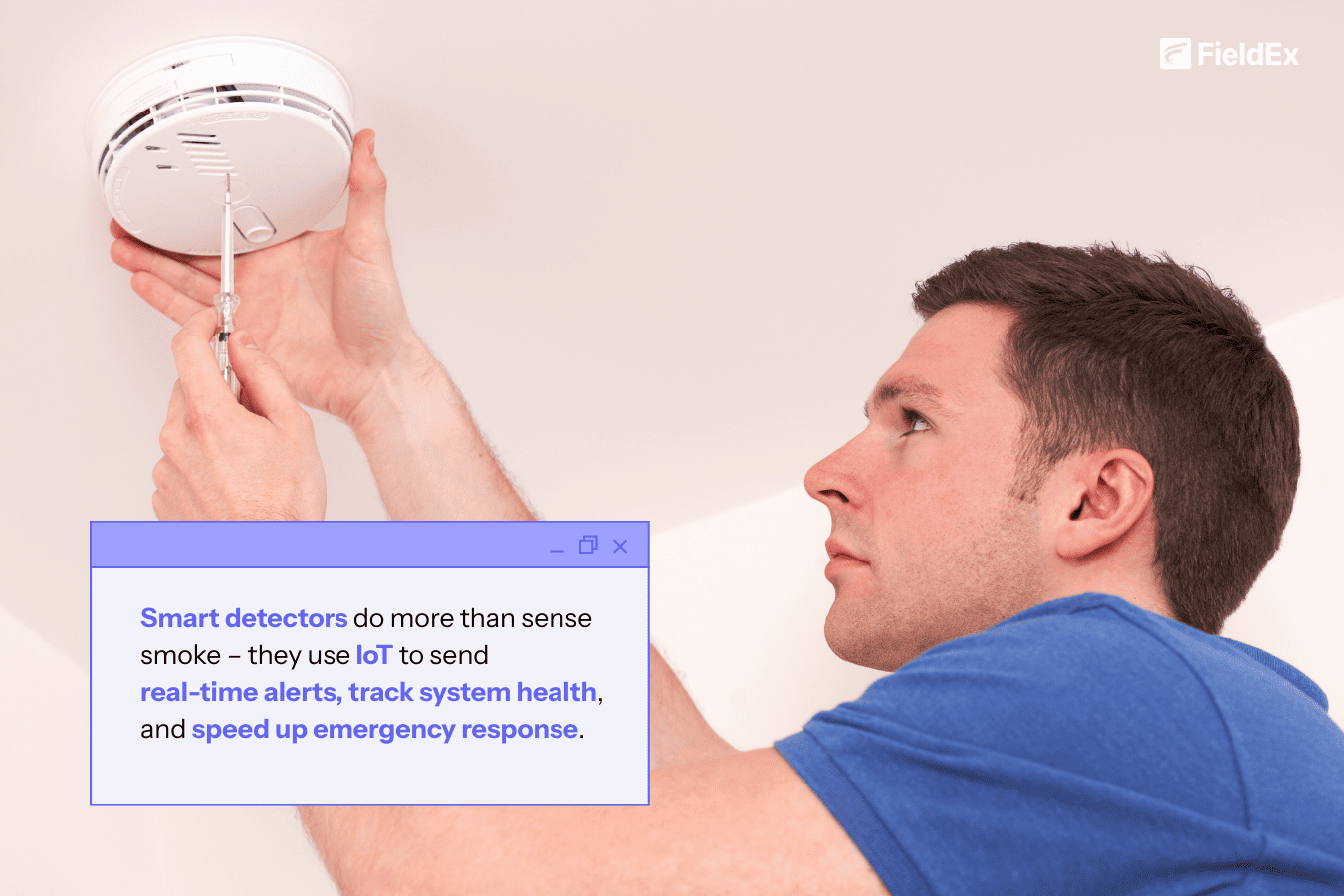
Connected pressure transducers and ultrasonic liquid-level monitors now track suppression cylinder pressure and agent weight continuously. If a clean agent cylinder loses pressure slowly, the system alerts maintenance automatically rather than waiting six months for the next manual inspection. Connecting those readings to a CMMS like FieldEx turns raw sensor alerts and routine checks into immediate action. When a pressure gauge drops or an inspection deadline approaches, FieldEx automatically generates a work order, assigns the right technician, and logs every cylinder check and repair in one compliance record. (FieldEx Fire Inspection Software)
Hybrid systems that mix fine water mist with nitrogen are gaining ground in data centers, semiconductor fabs, and archives. They deliver rapid cooling with minimal water runoff and zero global warming potential.
Suppression panels increasingly tie directly into HVAC dampers, fire doors, and access control. When a suppression zone triggers, the BMS automatically shuts down air handlers to contain smoke and unlocks emergency exit doors.
Fires do not wait until your maintenance binder is organized. Selecting the right system for your facility is only the first step: sprinklers protect offices and warehouses, clean agents and inert gases safeguard server rooms, foam blankets flammable liquid hazards, and wet chemical systems protect commercial kitchens.
Even the best hardware will fail an audit or malfunction during an emergency if valve checks, cylinder weight logs, and semi-annual tests fall behind schedule. As suppression systems become more connected and environmental rules tighten in 2027, tracking agent types, cylinder weights, and inspection deadlines across multiple sites gets harder on spreadsheets.
FieldEx brings your fire suppression asset records, recurring NFPA inspection schedules, and corrective work orders into one system:
You can try FieldEx free for 14 days with no credit card required, or book a demo to see how your facility assets and NFPA checklists run inside the platform.
The most common type is the water-based sprinkler system. They’re reliable, cost-effective, and work well in offices, schools, warehouses and residential buildings. In fact, NFPA reports show sprinklers control about 96% of fires when activated. Simple doesn’t mean outdated, it means trusted.
Think of protection as the early warning system, and suppression as the actual muscle that knocks flames down.
Yes, clean agents like FK-5-1-12 fluoroketone and inert gas blends are designed to be safe in occupied spaces. They extinguish fires by removing heat or disrupting chemical reactions, not by displacing oxygen. They’re especially useful in data centers, hospitals and museums where water damage would be a disaster.
It depends on the system, but NFPA standards usually require:
Pro tip: Tools like FieldEx can automate inspection schedules and send reminders so nothing slips through the cracks.
That’s a Hollywood myth. In real life, sprinkler heads activate individually when exposed to high heat. So if a fire starts in one corner of a warehouse, only the heads in that area open up, not the whole building. No surprise indoor waterfalls.
Foam systems are best for industries dealing with flammable liquids: oil & gas, aviation hangars and chemical plants. Foam blankets the fuel, cutting off oxygen and preventing re-ignition, something water alone can’t handle.
Two things: (1) Your risk skyrockets. Systems fail more often from neglect than from defects. (2) You’ll probably fail compliance checks, and your insurance company may refuse claims after a fire. Maintenance isn’t optional; it’s essential.
If you’re protecting high-value assets (like data centers, museums or semiconductor plants), yes. Hybrid systems combine water mist with gases, using less water while being eco-friendly and highly effective. They’re pricier upfront but can save millions in asset protection.
FieldEx is a digital maintenance and compliance platform built for various types of industries, including fire protection and safety. It helps by:
Basically, FieldEx makes sure your fire suppression system isn’t just installed, but also maintained, documented and ready when you need it most.

