
Targets
- A target for each stage, such as response or completion.
- Days, hours and minutes for each target.
- An at-risk point ahead of the target.
Every contract job timed against its response and completion targets, warnings before a breach, and each contract linked to its assets and PPM.
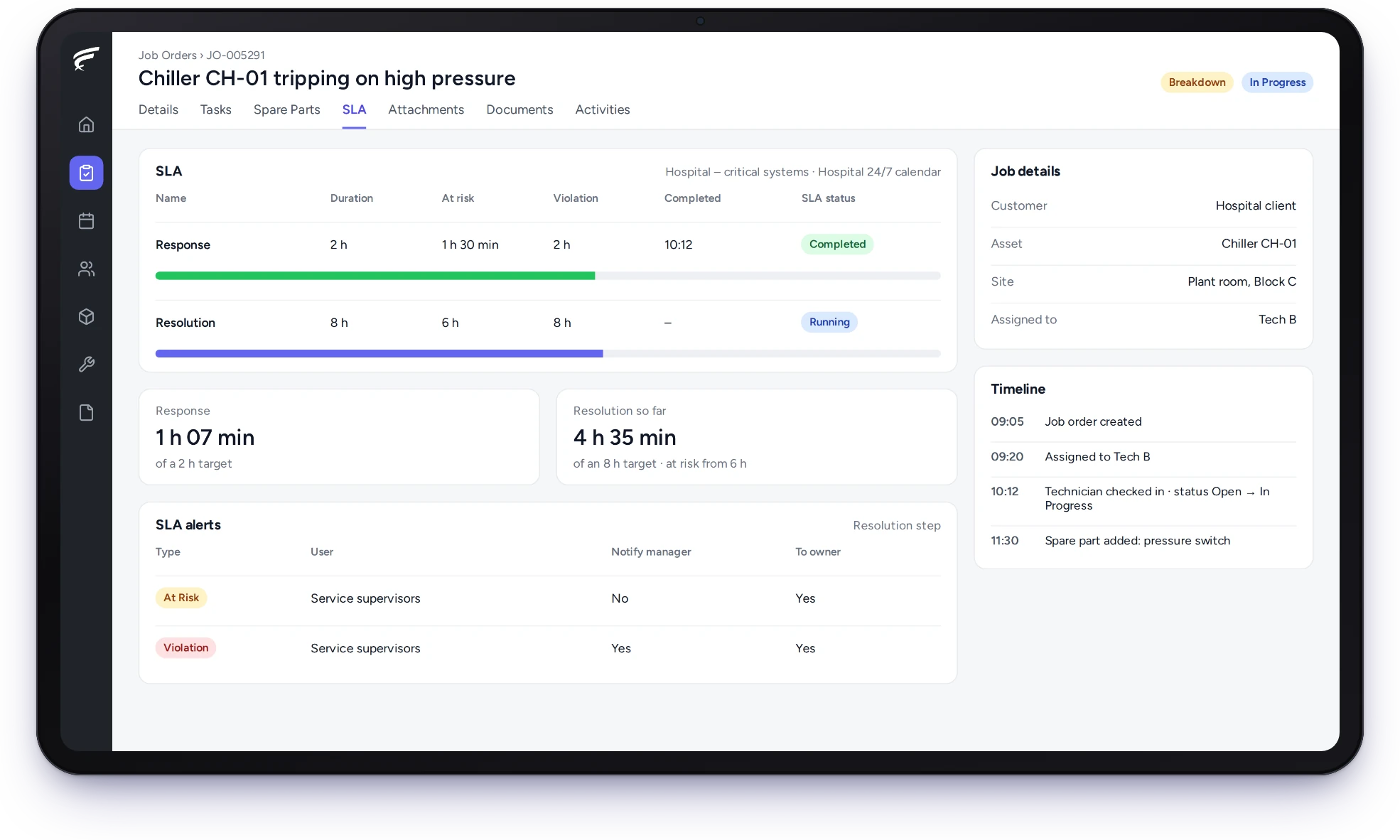
FieldEx brings field service management and a CMMS (computerised maintenance management system) together. Its service level agreement software times each contract job against its response and completion targets in the client's working hours, warns supervisors before a breach, and links every maintenance contract to the assets and PPM plans it covers.
Response and completion timers on contract jobs.
Warnings before a target is missed.
Contracts tied to their assets and PPM.
FieldEx carries the terms of each maintenance contract onto its jobs, so supervisors can see which targets are safe and which are at risk.
Contracts, machines and PPM plans stay connected.
Give each stage of a job its own target, and every contract job carries the response and completion times you agreed.
A written SLA turns "reasonable" into a number. In FieldEx, each SLA is made of stages, such as response and completion, each with a target in days, hours and minutes and an earlier at-risk point.
When a job falls under the SLA, its timer starts automatically, and the status shows on the job.
Where a contract is silent on timing, Malaysian consumer law steps in. Section 55 of the Consumer Protection Act 1999 implies a guarantee that a service supplied to a consumer will be completed within a reasonable time, unless the contract fixes the time.
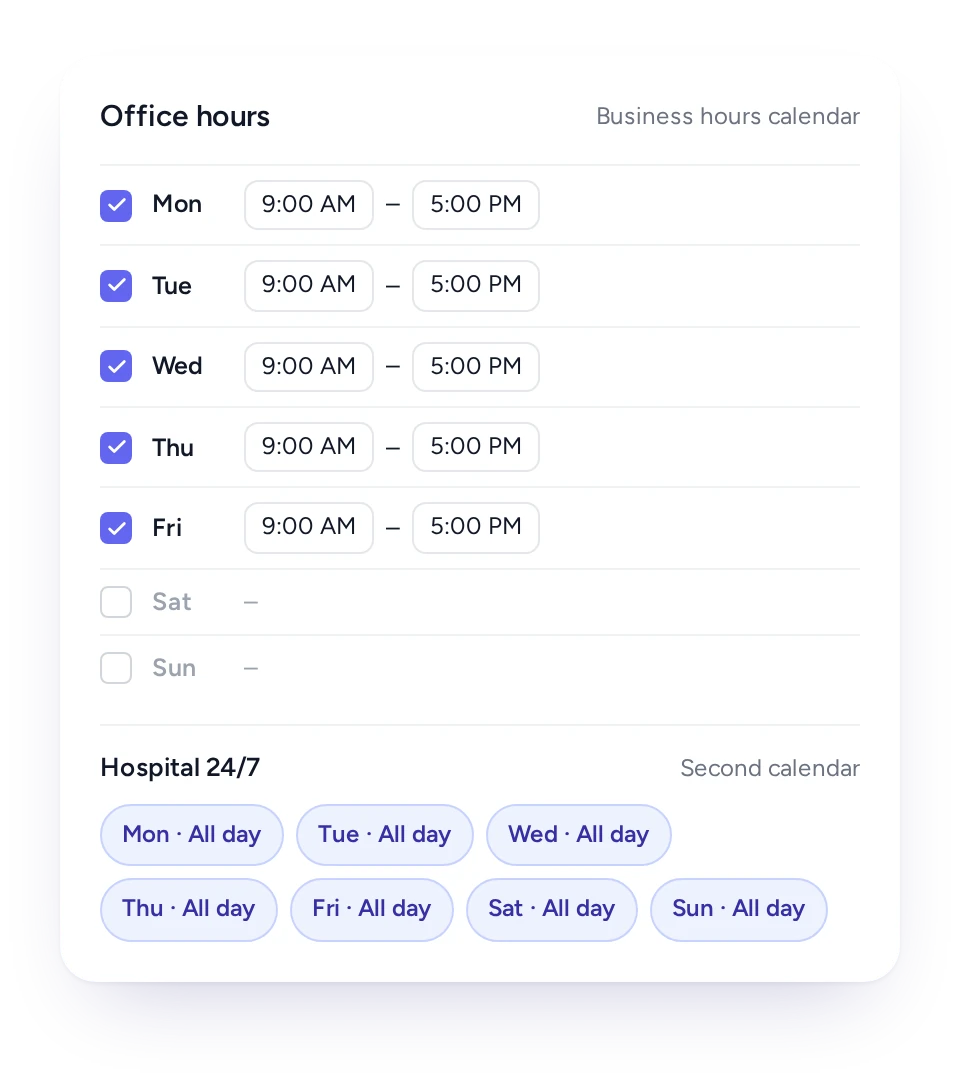
Give each SLA its own working-hours calendar, so a four-hour response target means four working hours where the contract says so.
In FieldEx, business-hours calendars are set day by day, with start and end times or all day for each day, and weekends switched on or off. Each SLA uses the calendar that matches its contract, so a 24-hour hospital contract and an office-hours retail contract run side by side.
Clocks can also pause and restart as the job's status changes, for example while waiting for a client.
Some duties run around the clock. Under regulation 7 of the Fire Safety (England) Regulations 2022, a fault with a firefighting lift that can't be fixed within 24 hours must be reported to the fire and rescue service. Others don't: a weekday contract's request logged at 6 pm on Friday shouldn't breach by Saturday.
Each SLA uses its own calendar, so a four-hour response under an office-hours contract counts four working hours.
A fault logged at 7 pm on a Friday under a Monday-to-Friday contract shouldn't count as breached by Saturday. Timers that ignore working hours make reports nobody believes.
In FieldEx, calendars are built per weekday, each with its own hours or set to all day, and weekends included or not. A 24-hour hospital contract and an office-hours bank contract can run side by side, each on its own calendar.
Timers can also pause and resume as the job's status changes, for example while waiting for site access.
FieldEx alerts chosen staff at the at-risk point and on breach, while there is still time to act.
In FieldEx, each SLA stage can warn a chosen person or role at the at-risk point and on breach, copying their manager or the job owner if you wish. The warning arrives while the job can still be saved.
On the schedule, the job's SLA status shows which jobs to move up.
Penalty clauses are common in Malaysian maintenance contracts. Under section 75 of the Contracts Act 1950, where a contract names a sum payable on breach, the injured party is entitled to reasonable compensation not exceeding that sum, whether or not actual loss is proved.
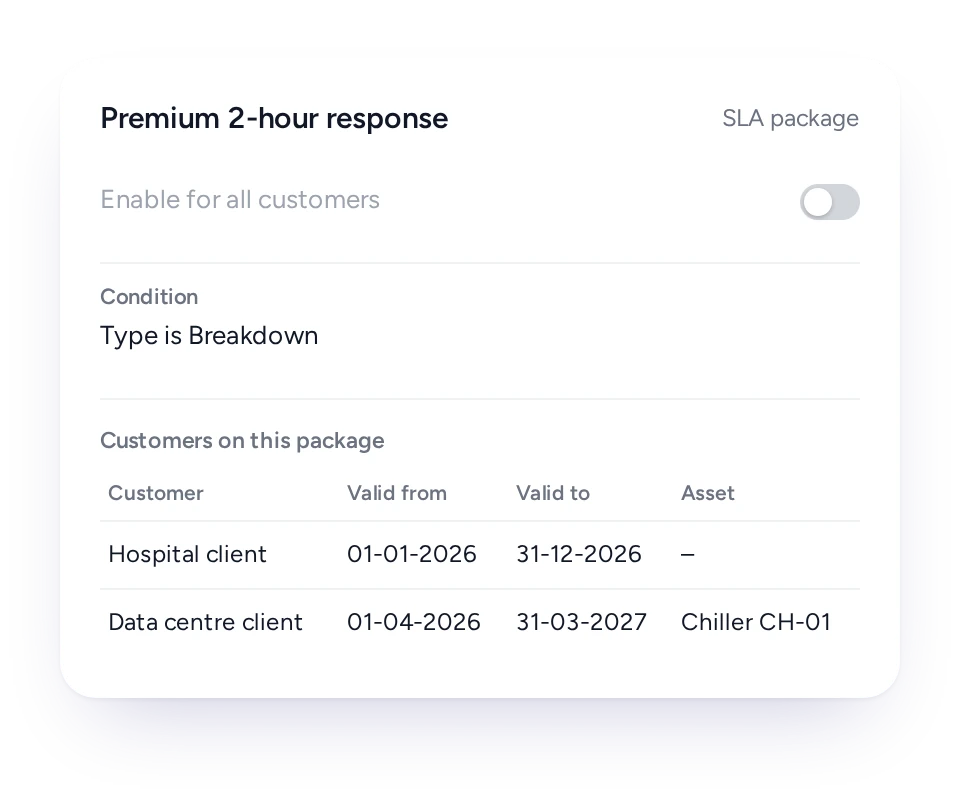
An SLA can cover all clients or named ones, with valid-from and valid-to dates, and can be limited to one machine.
A hospital chiller may need someone on site within two hours, while office clients of the same contractor are happy with a next-day visit.
In FieldEx, an SLA applies to every client or only to named clients, each with dates matching their contract. It can also be tied to one machine, so a premium chiller gets the faster target while other equipment on the same site follows the standard one.
Conditions such as job type or fault type decide which jobs an SLA covers.
A FieldEx contract records the client, dates, machines and PPM plans, so the office knows what is in scope.
In FieldEx, a contract holds the client and their contact person, the contract type you define, a reference number, and the start and end dates. Machines are listed with quantities, and PPM plans can be attached, so the visits the contract promises are scheduled from it.
Each machine's record also shows the contracts it falls under.
Some contracts are required by law. Regulation 8(3) of the Occupational Safety and Health (Plant Requiring Certificate of Fitness) Regulations 2024 requires the owner of a lift, escalator or walkalator to have a servicing agreement of at least one year with a competent person.
SLA results are recorded on every contract job and available in reports, so monthly meetings work from evidence.
In FieldEx, each job under an SLA records whether each stage was met, became at risk or breached. Reports group results by client, site, job type or month, and a schedule can send them to the client automatically.
Both sides then bring the same figures to the review.
Property managers serving strata buildings work under written terms. Regulation 21 of the Strata Management (Maintenance and Management) Regulations 2015 requires a joint management body that engages a person or agent for maintenance and management to enter into a management agreement.
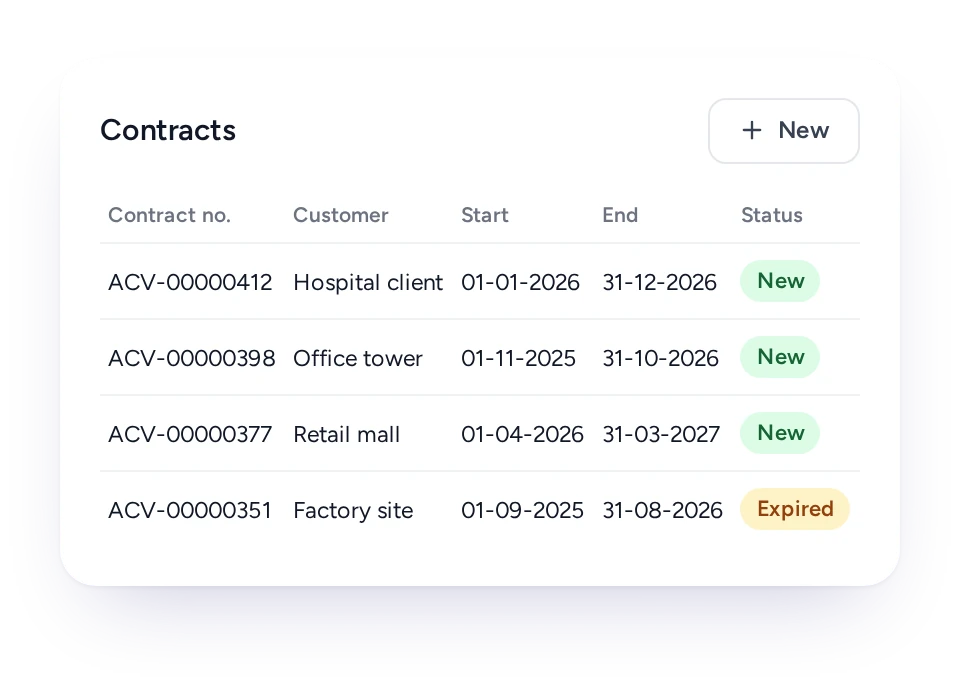
Each contract carries its start and end dates, and email reminders, such as an end-of-contract notice, can be set up, so renewals are planned.
Renewals get missed when end dates sit in an Excel file. A lapsed contract can mean months of service without a valid agreement or rates.
In FieldEx, each contract shows its dates and status. You can set up an email notice for contracts, such as one sent before the end date, in your own words.
The contract list shows dates and status side by side, so contracts ending this quarter are easy to spot.
A sales order records what the client bought, with products and prices, and connects it to the contract and its jobs.
Many contracts begin as a commercial order: a number of PPM visits, an installation, a set of spare parts.
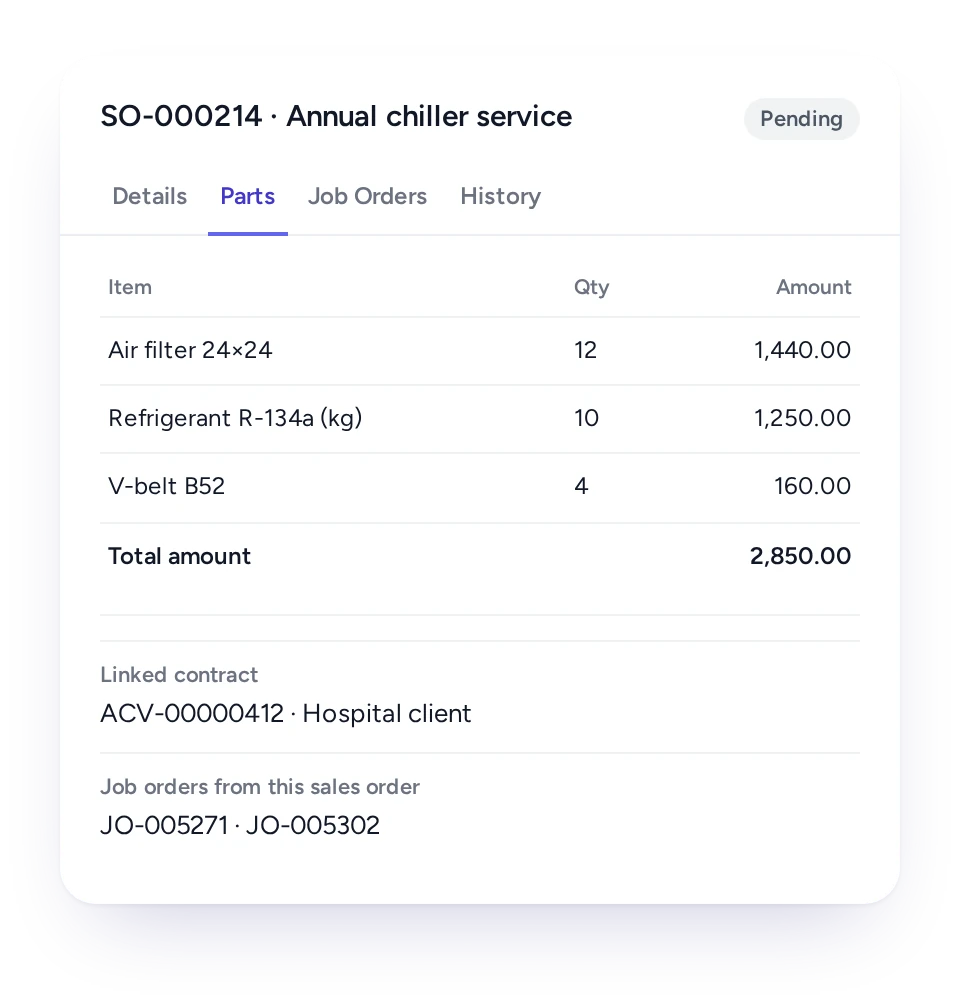
In FieldEx, sales orders sit on each client with products, pricing and billing details. Each can be linked to its contract and to the jobs that fulfil it, so every job can be traced back to the original sale.
FieldEx can connect to any open system through REST APIs and has connectors for QuickBooks and Xero.
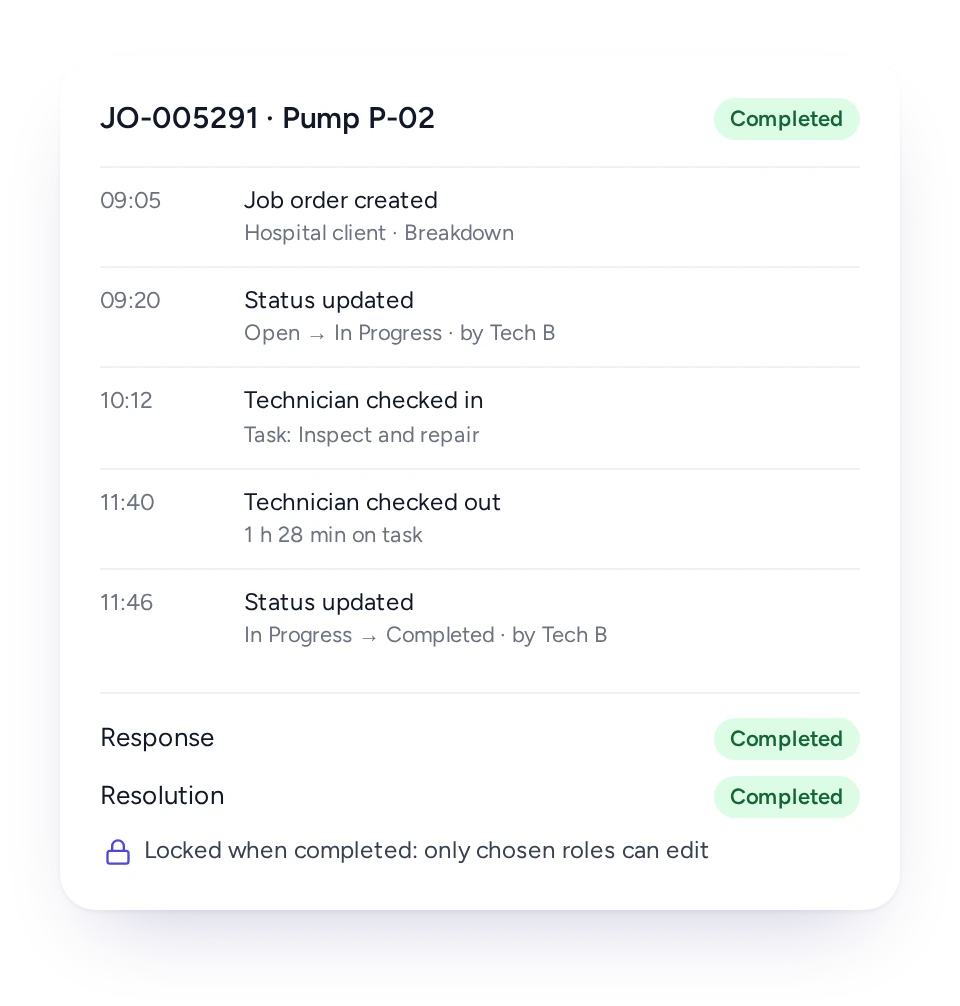
If a client disputes a response time, the job shows when it was logged, when the technician checked in and every change made since.
Arguments over SLAs are usually about times, and about whether the work was done properly. Section 53 of the Consumer Protection Act 1999 implies that services are carried out with reasonable care and skill, and WhatsApp threads rarely prove either.
In FieldEx, each job records when it was created, and every task logs the technician's check-in and check-out. The change log shows each edit, with the earlier and new values, the person and the time, and finished jobs can be locked to nominated roles.
With the SLA status on the same job, both sides look at one timeline.
Contract managers see which targets are at risk, supervisors get warnings in time, and clients see the same SLA results at review.
Contract manager
Each contract's machines, PPM, dates and SLA results.
Supervisor
Warnings before and on breach.
Dispatcher
SLA status on scheduled jobs.
Operations manager
SLA results by client and month.
Accounts
Sales orders tied to contracts and jobs.
Client
SLA reports emailed on schedule.
Because FieldEx is field service management and a CMMS in one, one contract can time breakdown response and schedule the PPM it includes.
Most maintenance contracts promise both a fast response to breakdowns and regular PPM. In FieldEx, the SLA timers run on breakdown jobs and the PPM plans attached to the contract create the planned visits, all on the same machines.
The machine's history then shows both under the contract.
Related pages: service requests and the customer portal, preventive maintenance, reports and insights, asset management, our guide to choosing field service management software, and scheduling and dispatch.
Royal Facilities Management (facilities management, Oman) needed property owners to be able to follow the progress of a job and view completed work, which was critical for assessing performance and supporting contract renewals.
With FieldEx, a dedicated portal gives property owners access to log issues, track technician progress and review completed service reports, and maintenance work orders are created automatically before a deadline is missed.
Magnum, a Malaysian leisure and entertainment brand since 1968, moved its maintenance operations from paper to FieldEx.
FieldEx centralises SLA management and notifies the team when deadlines approach, helping them stay on target. "With FieldEx's SLA feature, our team completes tasks more efficiently, keeping us on track with our key performance index."
Yes. FieldEx times contract jobs against response and completion targets in each client's working hours, warns supervisors before a breach, and links contracts to their machines and PPM plans. As a CMMS too, it schedules the PPM the contract promises.
FieldEx warns the people you choose when a job reaches its at-risk point and again on breach, so there is time to act before a penalty applies.
Yes. Each SLA uses a day-by-day working-hours calendar or a 24-hour calendar.
Yes. Timers start, pause and stop as the job's status changes.
Yes. An SLA covers all clients or named ones, each with valid-from and valid-to dates, and can be tied to one machine.
Yes. SLA results appear in reports, and a report can go to the client by email on a schedule.
FieldEx can connect to any open system through REST APIs and has connectors for QuickBooks and Xero.
Yes. PPM plans can be attached to a contract, so its planned visits are scheduled from the same record.
Yes. Contracts list their machines with quantities, and each machine's record shows its contracts.
Yes. Contract email notifications, such as a notice before the end date, can be set up.
Yes. Contracts can be classified by your own contract types.
Yes. The app is available in English, Bahasa Malaysia and Chinese, and each user chooses their language.
There's no setup fee. Training is at your office or online, in Bahasa Malaysia or English, and your team can learn as it goes with guides, videos and the in-app AI assistant.
Customers, sites, assets and past jobs can be uploaded. FieldEx helps with setup, and training is included.
Once we know your requirements and your data is ready, FieldEx can be implemented in as little as a week with standard features for small businesses. Larger setups and custom work take longer.
FieldEx can connect to any open system through REST APIs and has connectors for QuickBooks and Xero.
There's no setup fee. Customers, sites, assets and past jobs can be uploaded. FieldEx helps with setup, and training is included.
You can also set FieldEx up yourself with guides, videos and the in-app AI assistant, which answers questions as you go.
Once we know your requirements and your data is ready, FieldEx can be implemented in as little as a week with standard features for small businesses. Larger setups and custom work take longer.
