

.png)
Commercial DC Fast Chargers and BESS (Battery Energy Storage Systems) push a staggering 400 to 1,000+ volts of direct current. At that level of voltage, a maintenance shortcut won't just trip a breaker – it can cause a lethal electrocution or an arc flash hotter than the surface of the sun.
To keep field technicians safe and protect your operation from massive OSHA fines, a rigorous Lockout/Tagout (LOTO) protocol is completely non-negotiable. Here’s the fast breakdown of what you need to know:
If you think maintaining commercial electric vehicle infrastructure is like fixing a broken toaster, or wiring a residential house, well, you’re dead wrong (pun unintended; keep reading – you’ll see why).
When we talk about commercial DC Fast Chargers and the massive BESS that often back them up, we’re talking about equipment pushing anywhere from 400 to over 1,000 volts of electricity. That’s an unfathomable amount of power. A single misstep, a distracted technician, or a rushed procedure could potentially lead to an arc flash, thermal runaway (a chemical battery fire that is notoriously difficult to extinguish), or severe electrocution. Zero margin for error. None.
And right now, technicians are under more pressure than ever. According to the ChargerHelp 2025 Annual Reliability Report, only 71% of public EV charging attempts actually succeed – and incredibly, over a third of those failures happen on chargers that look perfectly operational on the screen. This massive failure rate means field technicians are constantly being scrambled to fix high-voltage equipment while frustrated drivers and fleet managers breathe down their necks.
Because the stakes and the stress levels are so terrifyingly high, strict adherence to OSHA’s Lockout/Tagout standards isn't just bureaucratic red tape – it’s the literal lifeline keeping your field technicians alive.
At its core, Lockout/Tagout (LOTO) is a critical safety practice that involves isolating a piece of equipment from its energy source and placing a physical lock and a warning tag on the disconnect switch. This ensures that the machinery cannot be accidentally re-energized while a technician is actively working with their hands inside the casing.
In a standard factory, LOTO might mean simply flipping a giant breaker and slapping a padlock on it so a coworker doesn't turn the conveyor belt back on. But in the EV context? It’s a lot more complicated.
Commercial EV chargers don't just pull from the local municipal power grid. They’re often integrated with on-site solar canopies or massive battery banks. LOTO for an EV charger requires isolating the unit from the main grid, disconnecting the battery storage, and ensuring the system is completely "dead" from all possible directions.
.png)
If you ever need a little light reading to keep you awake at night, look into the federal regulations governing hazardous energy. Here’s the plain-English translation of the two major standards you need to care about:
Fun (or not so fun) fact: Lockout/Tagout violations consistently rank in the top 5 most frequently cited OSHA violations. In a 2024 annual wrap-up, OSHA recorded over 2,400 LOTO citations across general industry. Ignoring this standard is a great way to earn a six-figure fine.
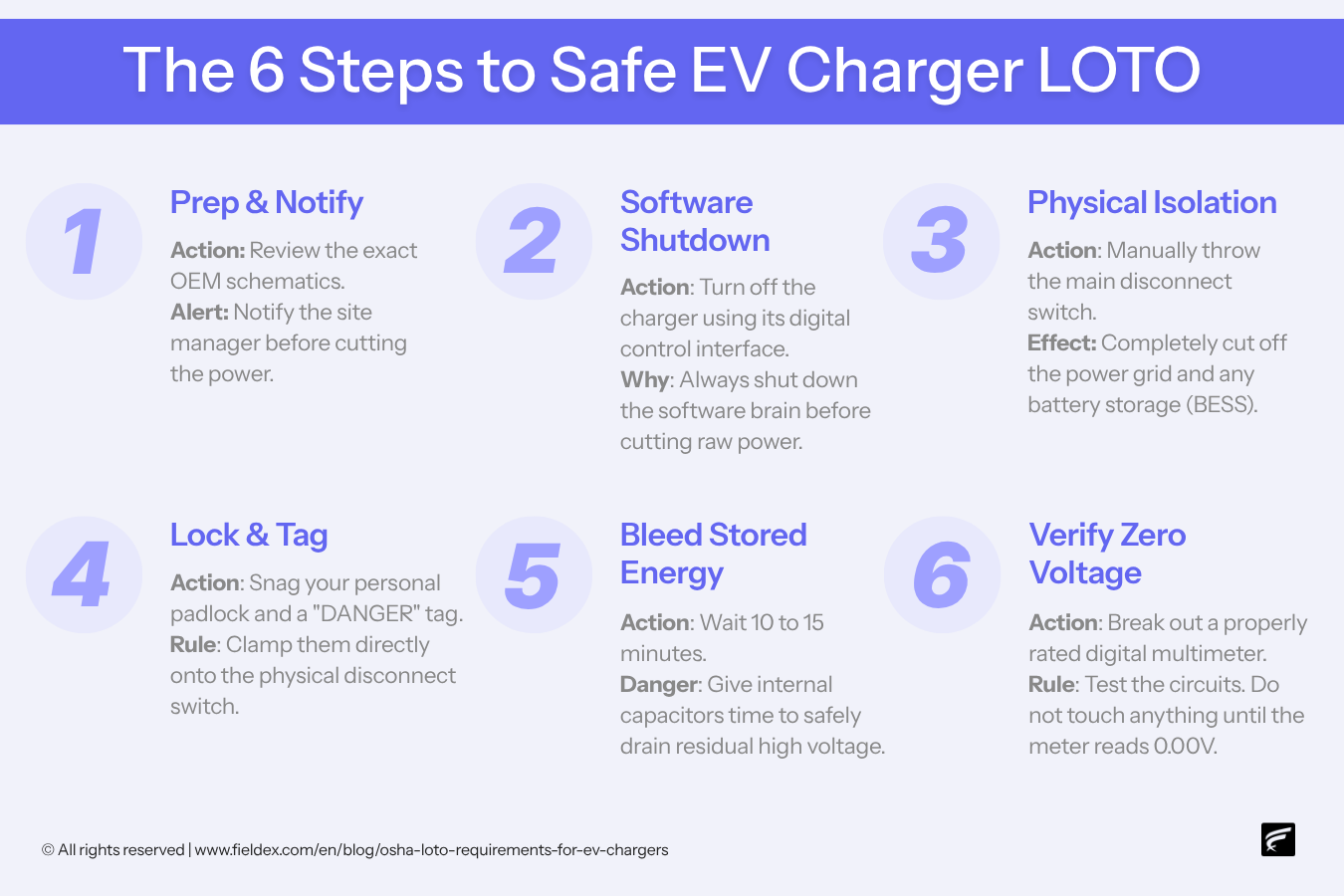
If your technicians are opening up a commercial charging pedestal, this is the standard sequence they must absolutely follow.
Before a wrench is even lifted, the technician needs to review the specific OEM (Original Equipment Manufacturer) schematics for that exact charger model. Every brand is a little different. They also need to notify the facility manager or site host that power will be cut so nobody panics when the screens suddenly go dark.
Power down the EV charger safely via its internal software interface or physical control panel. You always want to shut down the software brain before cutting the raw power, much like shutting down a laptop properly before ripping the battery out.
The tech manually throws the main disconnect switch or breaker. This physically separates the charging pedestal from the municipal grid and any local battery storage systems.
The technician attaches their personal, key-controlled padlock and a highly visible warning tag (usually reading "DANGER: DO NOT OPERATE") directly to the physical disconnect switch. Only the person who put the lock on has the key to take it off.
This is crucial for EVs. Even after the power is cut, massive capacitors inside the charger hold residual, stored high-voltage energy. It’s a bit of a tangent, but think of it like those old, heavy tube televisions from the 90s – if you unplugged them and opened the back immediately, they could still shock the life out of you.
If this residual energy arcs through the air, the results are catastrophic. According to the Centers for Disease Control and Prevention (CDC), an electrical arc flash can instantly release immense amounts of energy, reaching temperatures up to 36,000°F – which is literally hotter than the surface of the sun. Technicians must wait a manufacturer-specified amount of time (often 10 to 15 minutes) for the capacitors to safely bleed off that energy.
This is the most important step. Trust, but verify. Using a properly rated multimeter, the tech must test the circuits to prove the system has zero electrical pressure. Once the meter reads zero, the work can finally begin.
So, you have the procedures written down in a binder. Great. But out in the real world – where it’s raining, the tech is running behind schedule, and a fleet manager is yelling about a broken charger – that binder is utterly useless.
Working on commercial EV chargers leaves absolutely zero room for error. A robust, strictly enforced Lockout/Tagout program isn't just about avoiding federal fines – it is fundamentally about ensuring your technicians make it home to their families at the end of their shift.
But you can't enforce what you can't control, and paper checklists offer an illusion of control. To genuinely protect your people and your business, you need software that treats safety as a mandatory gatekeeper, not an optional afterthought.
FieldEx is the hybrid FSM (Field Service Management) and CMMS (Computerized Maintenance Management System) platform built specifically for the high-voltage realities of the modern grid. With FieldEx, your technicians physically cannot unlock their maintenance work order in the mobile app until they have checked off every single step of the LOTO procedure and provided a time-stamped digital signature.
Because we understand complex EV infrastructure, our CMMS asset hierarchy ensures your tech is always looking at the correct, most up-to-date shutdown schematic for that specific charging pedestal and battery bank. And since chargers are often buried in subterranean garages with zero cell service, our true offline capability means your crews can complete the entire safety workflow without a signal, automatically syncing a bulletproof record of compliance the second they hit Wi-Fi.
Stop gambling your fleet’s safety on a damp piece of paper. Book a free demo today to see how easy it is to digitize your OSHA compliance with FieldEx, and keep your techs out of harm's way. Or simply reach out to learn more. We’re here to help.
LOTO stands for Lockout/Tagout. It is a critical safety procedure used in industry and electrical maintenance to ensure that dangerous machines are properly shut off and completely isolated from their power source prior to the completion of repair work.
Yes. Any equipment that stores or uses hazardous energy – which absolutely includes high-voltage EV chargers and battery systems – falls under OSHA Standard 1910.147 regarding the control of hazardous energy.
NFPA 70E is the Standard for Electrical Safety in the Workplace, created by the National Fire Protection Association. It provides detailed guidelines on how to protect workers from electrical hazards, including arc flashes and shocks, and dictates exactly what Personal Protective Equipment (PPE) is required for high-voltage work.
Commercial EV chargers convert AC (Alternating Current) from the grid into DC (Direct Current) for the vehicle. This conversion process uses large electrical components called capacitors, which act like temporary energy storage tanks. Even when the main power is cut, these capacitors hold a lethal electrical charge that must be given time to safely dissipate or "bleed off."
A DC (Direct Current) Fast Charger is a commercial-grade electric vehicle charger. Unlike the Level 1 or Level 2 chargers you might have at home (which use AC power and take hours to charge a car), DC Fast Chargers bypass the car's onboard converter to deliver immense amounts of power directly to the battery, charging vehicles in minutes.
Absolutely. Modern FSM software like FieldEx digitizes Job Safety Analyses (JSAs) and LOTO checklists, making them mandatory. The software physically restricts the technician from seeing the repair instructions until the safety protocols are digitally signed and time-stamped, providing undeniable proof of compliance for any future audits.
BESS stands for Battery Energy Storage System. In the context of EV charging, a BESS is a large bank of stationary batteries on-site that stores energy (often from solar panels or from the grid during off-peak hours) to help power the EV chargers during periods of high demand without overwhelming the local municipal grid.
According to OSHA and NFPA standards, only an "Authorized Employee" or "Qualified Electrical Worker" who has received specific, documented training on the exact equipment and hazardous energy control procedures is permitted to perform Lockout/Tagout.
An arc flash is a sudden, explosive release of electrical energy through the air when a high-voltage gap is shorted. It produces intense heat, blinding light, and a concussive blast wave. Strict LOTO procedures, energy dissipation and proper PPE are designed to prevent arc flashes and protect workers if one somehow occurs.
Commercial EV chargers are frequently installed in cellular "dead zones", such as underground parking garages, remote highway rest stops, or thick concrete industrial depots. If a safety app requires an internet connection to load LOTO instructions, it becomes useless exactly when the technician needs it most. True offline functionality solves this problem by storing the data locally on the device.
Why EV charging networks need a field service management tool like FieldEx
Why 55% of your EV chargers are failing (and it’s not the hardware)
Does fast charging ruin your battery? A data-backed truth
Can you install an EV charger in the rain?
How to manage EV infrastructure with a modern CMMS (like FieldEx)

.avif)


This website and its content are the property of FieldEx and are protected by copyright laws. © 2026 FieldEx. Any redistribution or reproduction of part or all of the contents in any form is prohibited, except with our express written permission.
FieldEx Pte Ltd Singapore