

.png)
When you manage a multi-million-dollar electric vehicle charging network, the most expensive assumption you can make is treating a digital asset like a purely mechanical one.
When a public charger drops offline, the immediate instinct for many operators is to dispatch a technician to the site. They assume a dropped connector pin, a smashed screen or a severed cable. But dispatching an OEM-certified, high-voltage technician to fix what is essentially an API handshake error is the fastest way to burn through your operational capital.
The data is clear: the hardware is rarely the primary enemy. The software is.
Here’s the data-driven reality of what is actually breaking your EV chargers, and the exact digital-first protocol you need to implement to fix it.
.png)
We must address the elephant in the room: public EV infrastructure is currently failing drivers at an unacceptable rate. A May 2023 J.D. Power report highlighted that through the end of Q1 2023, 20.8% of EV drivers using public charging stations experienced charging failures or equipment malfunctions that left them unable to charge their vehicles.
You cannot scale a profitable, enterprise-grade commercial network when 1 in 5 customers cannot successfully initiate a charging session. Your brand reputation, your municipal partnerships, and your stringent Service Level Agreements (SLAs) are directly on the line.
To fix the uptime crisis, you have to know exactly what is broken. And the reality completely flips the standard narrative of "vandalism and wear-and-tear".
According to unreleased national data from EV Connect featured in Qmerit's white paper, the root causes of unsuccessful EV charging sessions break down into the following categories:
Combine those numbers: a staggering 93% of your charging failures originate inside the software and network communication layers, not the physical interface the driver touches.
If you use generic field service software, your dispatchers are operating blind. When a fault code triggers, they generate a work order and send a truck.
Consider the fully loaded cost of an OEM-certified technician. You’re paying for their hourly rate, vehicle wear-and-tear, fuel, and the opportunity cost of pulling them away from a legitimate high-voltage repair. Dispatching that technician to reboot a modem or cycle power on a unit that simply lost its cellular connection destroys your margins.
If your operations team is not intercepting these digital faults and reviewing the Open Charge Point Interface (OCPI) logs before rolling a truck, your maintenance budget is bleeding.
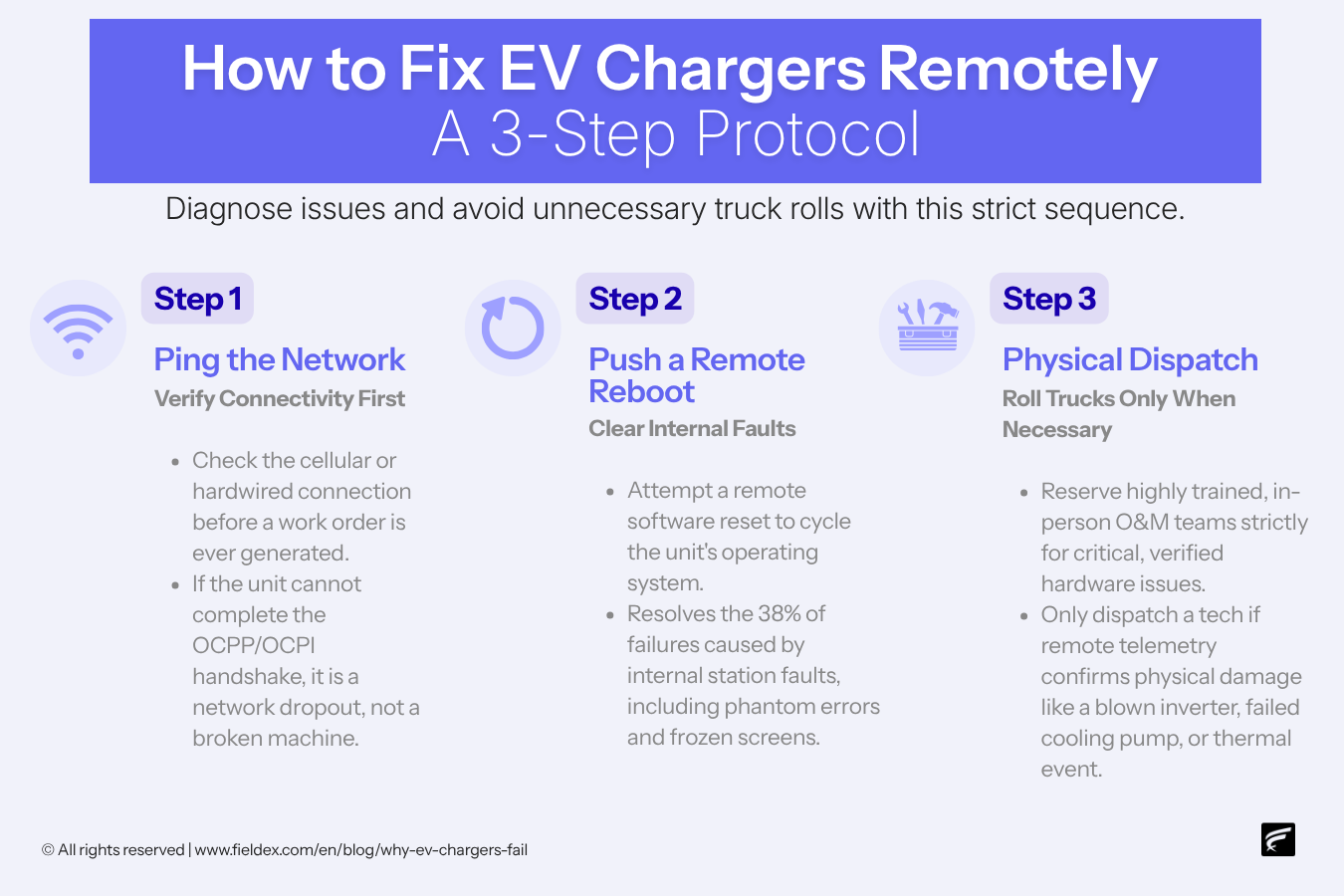
With a sophisticated technology platform and support services, nearly all EV charging session issues can be diagnosed and solved remotely to ensure driver uptime while avoiding the need for a truck roll. Charge Point Operators (CPOs) must implement a strict, 3-step diagnostic protocol:
Before a work order is ever generated, your backend system must verify the cellular or hardwired connection to the unit. If the unit cannot complete the OCPP/OCPI handshake, you have a network dropout, not a broken machine.
For the 38% of failures caused by internal station faults, attempt a remote software reset. Just like a standard server, cycling the unit's operating system remotely clears the majority of phantom errors and frozen screens.
Reserve your highly trained, in-person operations and maintenance (O&M) teams strictly for critical, verified hardware issues. If the remote telemetry confirms a blown inverter, a failed cooling pump, or a thermal event, then you dispatch the tech.
Generic field service apps assume every broken asset simply requires a wrench. But scaling a multi-million-dollar EV network requires specialized software that understands both the digital complexity of the charger and the logistical reality of the workforce.
To achieve this, operators need the functionality of both a CMMS and an FSM – two distinct systems that serve different operational purposes:
The FieldEx Advantage: FieldEx is a natively hybrid platform that merges both systems into a single source of truth. It acts as the bridge between your remote telemetry and your physical workforce.
FieldEx’s CMMS capabilities intercept the digital fault codes and trigger remote diagnostic protocols first. If – and only if – a physical repair is explicitly verified, the FSM capabilities take over. FieldEx automatically dispatches the right high-voltage technician, equipped with the exact proprietary part and mandatory safety checklists required to fix the machine. This eliminates blind dispatching, defends your First-Time Fix Rates (FTFR), and protects your bottom line.
Ready to stop dispatching blind and maximize your EV network's uptime? Book a free demo to see how FieldEx helps you eliminate wasted truck rolls and fix chargers on the first try. Or simply reach out. We’re here to help.
The most common cause of failure is not physical hardware damage. National data from EV Connect (as mentioned in QMerit’s Electrification 2030 whitepaper) shows that 55% of all unsuccessful EV charging sessions are caused by station connectivity issues, such as network dropouts or API handshake failures.
Despite being the most heavily handled component, physical damage to the connector or the charging cable accounts for only 4% of total charging failures.
Yes. With a sophisticated technology platform, nearly all EV charging session issues can be diagnosed and solved remotely. Because 38% of failures are due to internal station faults or software errors, pushing a remote system reboot can often bring the charger back online without requiring a technician to visit the site.
OCPI stands for Open Charge Point Interface, which is an open protocol used to connect EV charge station operators with service providers. Reviewing OCPI logs and error messages allows networks to use proactive remote monitoring to solve common EV charging issues faster.
The electrical workforce is actively shrinking by 2% a year, leading to a projected 14% decline in the available labor pool by 2030. For Charge Point Operators (CPOs), this scarcity drives up hourly labor costs and delays physical repairs. It makes achieving a 100% First-Time Fix Rate absolutely critical, as you simply do not have the workforce bandwidth to dispatch a high-voltage technician to the same site twice.
When an OEM-certified, high-voltage technician is dispatched to a site, the operational costs – including vehicle wear-and-tear, fuel and opportunity costs – are massive. If the technician arrives without the correct proprietary replacement part or the specific digital fault code, the truck roll is completely wasted. A high FTFR proves that the problem was accurately diagnosed via remote telemetry and physically repaired on the very first visit, preserving your profit margins.
Generic field service applications are built for traditional, mechanical assets; they operate on the assumption that every generated ticket requires a physical tool. EV chargers, however, are highly complex digital assets where 93% of charging session failures are due to network connectivity or internal software faults. Managing them requires a hybrid FSM+CMMS platform like FieldEx that intercepts the digital fault code and forces a remote reboot before physical dispatch is ever authorized.
Software and network failures plague both tiers equally. While Level 3 DC Fast Chargers operate at much higher capacities of 400 to 900 volts compared to Level 2 chargers, both heavily rely on the same network protocols to process payments, verify user authorization, and communicate with the grid. A cellular network dropout will take a massive commercial DCFC offline just as quickly as a standard Level 2 unit, making remote diagnostic capabilities mandatory across your entire asset hierarchy.

.avif)


This website and its content are the property of FieldEx and are protected by copyright laws. © 2026 FieldEx. Any redistribution or reproduction of part or all of the contents in any form is prohibited, except with our express written permission.
FieldEx Pte Ltd Singapore