

.png)
Can an electrician safely install an outdoor EV charger in the rain, or will wet weather delay your installation schedule?
If you've been waiting weeks for permits to clear and your scheduled installation day finally arrives under a downpour, this is exactly what you are probably wondering. We completely get the frustration. You just want your site up and running. But when it comes to mixing high voltage with pooling water, Mother Nature always gets the final say.
As experienced folks in the field service industry, we’ve seen schedules completely derailed by bad weather. It’s incredibly stressful for everyone involved. We also know there is zero room for compromise when dealing with 240V to 480V of electricity.
.png)
Here’s an honest look at why installing an EV charger in the rain is usually a bad idea, and how modern service teams manage the inevitable weather delays.
A common question we hear is, "But isn't the charger waterproof?" It’s a fair point! Commercial EV chargers are tough. They carry NEMA 3R, NEMA 4 or IP65 ratings, meaning they’re designed to easily survive heavy rain, sleet and snow.
However, there’s a catch: those ratings only apply to the sealed, fully assembled product.
During the installation process, the protective outer covers are completely removed. This exposes the highly sensitive "guts" of the machine:
If a technician tries to install the unit during a rainstorm, water droplets or even just heavy humidity can easily get trapped inside the enclosure before they seal the front panel back on.
Over time, that trapped moisture will cause internal corrosion. It can trigger nuisance ground faults that constantly take the charger offline, and worst of all, it gives the manufacturer a perfectly valid reason to void your warranty.
Beyond the hardware, we have got to talk about the man or woman doing the actual installation work. Water is an excellent conductor of electricity, and commercial EV chargers pull a massive amount of power.
Asking an electrician to stand in a puddle while pulling thick-gauge wire for a DC fast charger is asking them to risk a fatal arc flash or severe electrocution. Standard safety protocols strictly prohibit working on exposed electrical circuits in wet or damp conditions.
At the end of the day, we want every single technician to go home safely to their families. Right? A delayed installation is an annoyance, sure – but an injured technician? That’s an unnecessary tragedy you’d want to avoid. Respect the weather, respect the voltage, respect human life.
.png)
So, what happens if the project is on a brutally tight deadline and the installation absolutely must make progress? While electricians won't work on live, exposed outdoor wires in the rain, there are a few safe workarounds:
When the skies open up and a truck roll is cancelled, it can throw an operations manager's entire week into chaos. How do you handle a sudden downpour without losing track of the job or frustrating the customer?
This is exactly where a specialized field service management (FSM) and computerized maintenance management system (CMMS) like FieldEx saves the day. Instead of relying on frantic phone calls and messy spreadsheets , modern teams rely on structured digital workflows.
Here is how smart teams handle weather delays:
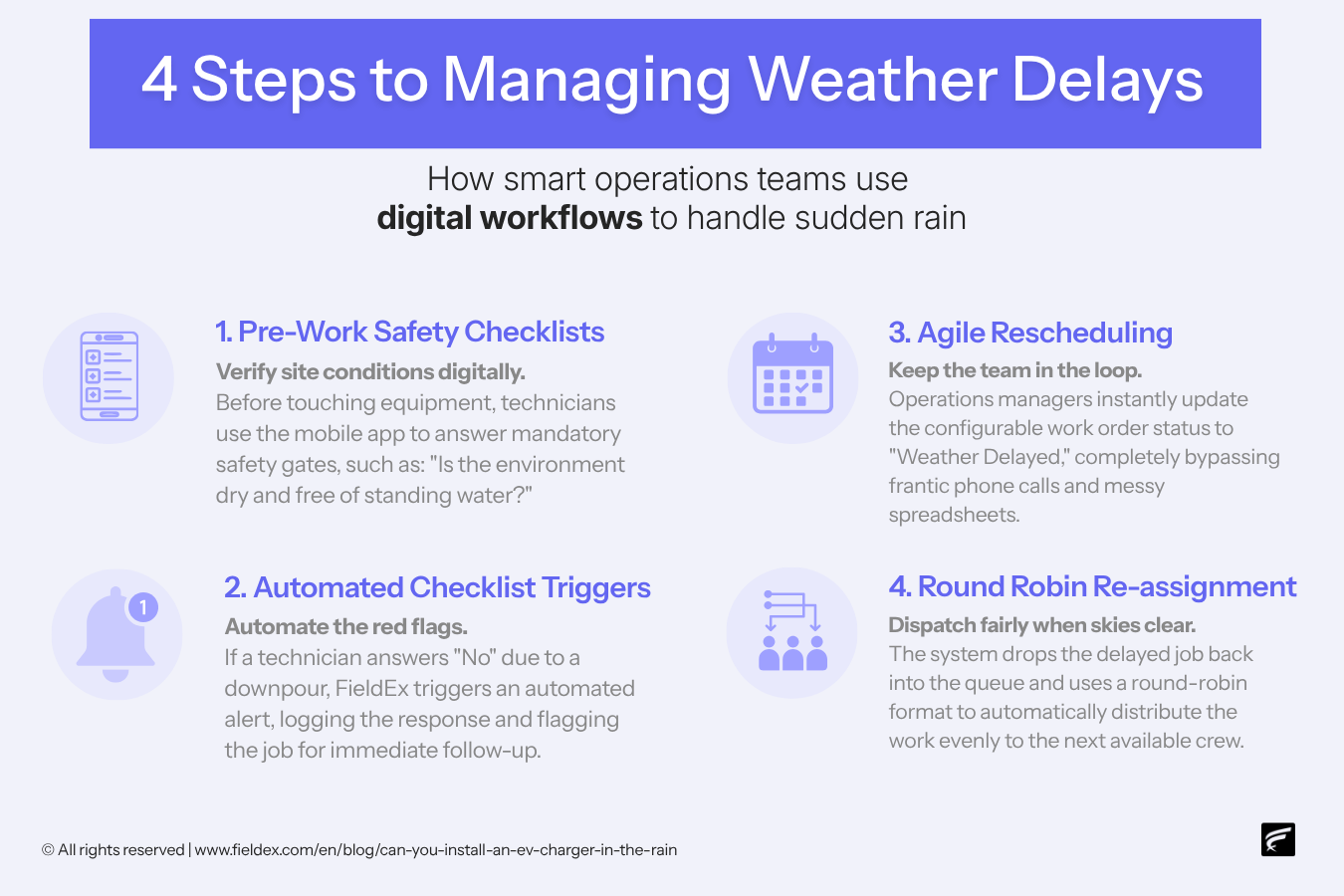
Dealing with weather delays is never fun, but it is a normal part of building out the world's green infrastructure. By prioritizing safety and using the right software to manage the schedule, you can ensure that when your chargers do go live, they are safe, reliable and built to last.
Generally, no. Safety standards like OSHA and NFPA 70E strictly govern working with live electrical components in damp or wet environments. Unless a crew can deploy an elaborate, completely waterproof temporary shelter, exposing 240V or 480V circuits to rainfall is a severe safety violation and a massive arc-flash hazard. Safety always trumps the schedule.
Those heavy-duty weatherproof ratings only protect the charger after it is completely sealed and bolted together. During the installation process, the protective outer casing is removed. This leaves the sensitive internal circuit boards, contactors and uninsulated copper completely exposed to moisture. Trapping water inside the unit before sealing it can lead to immediate ground faults, long-term corrosion and voided warranties.
Yes, but with strict caveats. A heavy-duty commercial tent can occasionally be used, but only if it completely shields the equipment, the technician, and the tools from blowing rain. However, if there is standing water or pooling on the ground where the technician is standing, the risk of electrocution is simply too high, and the installation must be paused regardless of the tent.
Relying on a technician's memory isn't enough for compliance audits. Smart operations teams use field service software to enforce physical safety protocols. For example, FieldEx utilizes digital checklists that are attached directly to a work order, allowing technicians to complete structured compliance documentation right in the field. Tasks can be set as mandatory, meaning the system physically prevents the work order from being marked as complete until the technician verifies the site is dry and safe.
A rained-out job will be delayed until the weather clears and the ground is free of pooling water. Modern service providers use a computerized maintenance management system (CMMS) like FieldEx to handle these disruptions gracefully. Instead of losing your job in a messy spreadsheet, the system can pause the work and use round-robin assignment to automatically distribute the job to the next available crew once the weather clears.

.avif)


This website and its content are the property of FieldEx and are protected by copyright laws. © 2026 FieldEx. Any redistribution or reproduction of part or all of the contents in any form is prohibited, except with our express written permission.
FieldEx Pte Ltd Singapore