
.png)
.png)
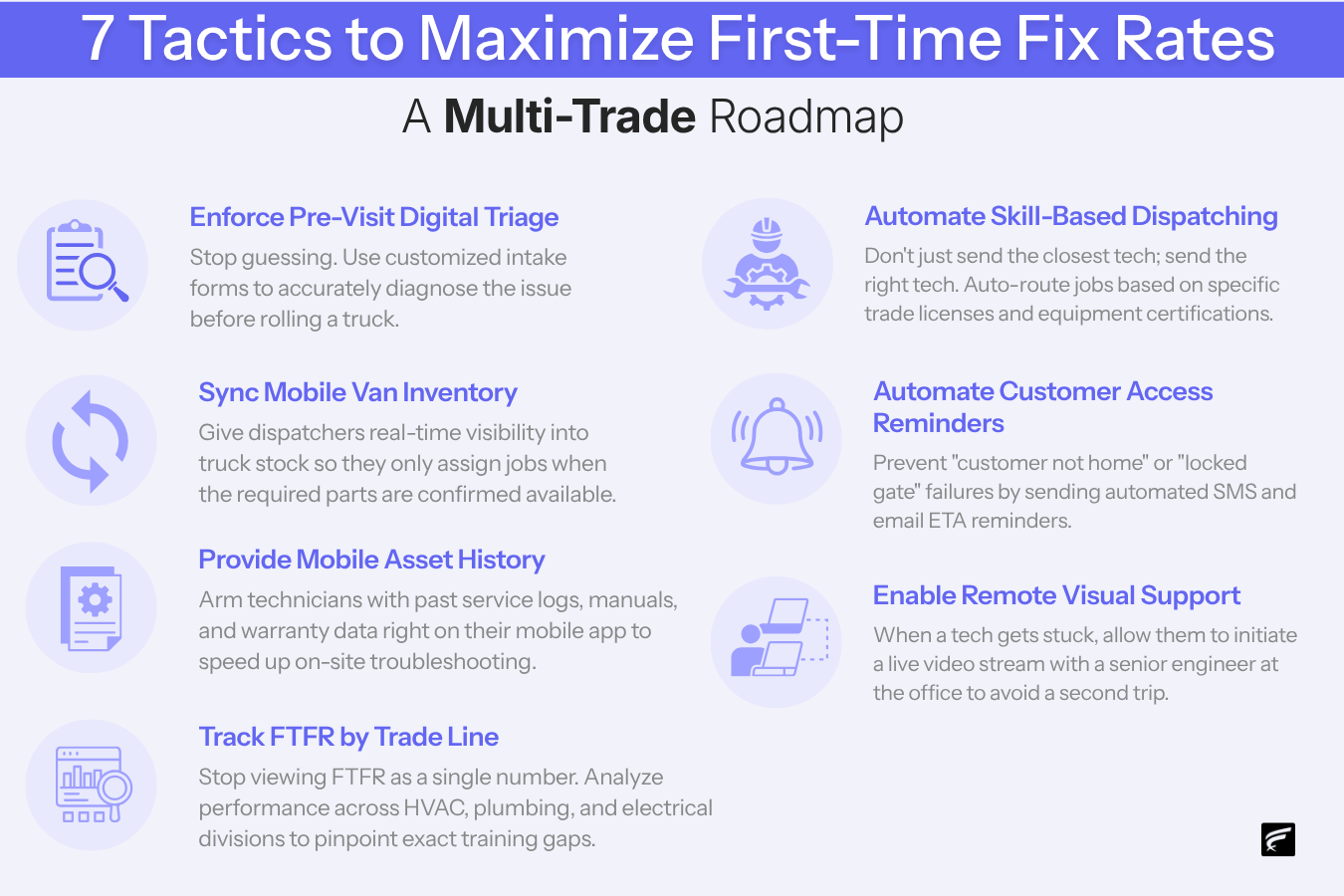
To improve First-Time Fix Rates (FTFR), multi-trade contractors must use field service software to ensure technicians arrive with the correct parts, skills and information. The 7 most effective tactics include:
Customers today don't care how fast your technician arrived if they couldn't actually fix the problem. For multi-trade contractors running HVAC, plumbing and electrical divisions, the cost of fuel, labor and vehicle wear-and-tear means a "return trip" instantly wipes out the profit margin of a standard service call.
If you’re constantly sending technicians back to a site because they didn't have the right part, lacked the specific license, or couldn't get through a locked gate, you aren't just losing time – you’re bleeding cash.
To understand why First-Time Fix Rates (FTFR) is the ultimate "North Star" metric for Operations Managers, we have to look at the math behind a wasted truck roll.
According to an Aberdeen research, the average first-time fix performance across all respondents is at the 75% level, indicating that three out of every four service calls in the field are resolved on a first-visit basis. However, Best-in-Class organizations achieve an 89% first-time fix rate. What happens when you fall below that standard?
Research reveals the operating cost of a single truck roll falls between $200 and $300. For those calls not resolved on a first-visit, an average of 1.6 additional dispatches are required to ensure complete resolution. You just turned a highly profitable repair into a financial loss – and you lost the opportunity to send that technician to new paying customers. In fact, organizations with a greater than 80% first-time fix experienced a 6.2% increase in service revenues over the previous 12 months, whereas service revenue decreased 2.8% for organizations with a less than 50% first-time fix.

To implement the tactics below, you need the right digital infrastructure. Most multi-trade contractors operate using one of two systems, but maximizing your FTFR requires understanding the difference between them.
The FTFR Connection: The reason First-Time Fix Rates fail is that these two systems usually do not talk to each other. When you unify your FSM (the technician) with your CMMS (the equipment's history and parts inventory), you guarantee the right person arrives with the right context.
The Cause: Part unavailability (incorrect or no parts) is the leading cause for secondary visits, responsible for 51% of return trips. A technician arrives, diagnoses the problem correctly, but has to leave because their van stock is depleted.
The Tactic: Stop relying on the honor system. You must integrate your warehouse inventory directly with your dispatching software. Best-in-Class organizations report that the necessary parts are available in the technician's truck 58% of the time, compared to only 45% for all other organizations. When a dispatcher assigns a ticket, the system should automatically verify that the specific tech has the required parts in their assigned van before they leave the shop.
The Cause: In a multi-trade business, sending a junior plumbing apprentice to diagnose a complex commercial boiler issue guarantees a second visit from a senior technician. The technician not having the necessary experience accounts for 25% of secondary visits.
The Tactic: Implement automated Skill-Based Routing. Your dispatch software should automatically filter your board based on technician tags (eg "Journeyman Electrician", "Commercial Boiler Tech"). Scheduling processes should prioritize technician familiarity with the equipment being serviced and technician skills to improve first-time fix.
The Cause: Technicians frequently arrive "blind" to a job site with only a vague dispatcher note. This leads to lengthy on-site diagnosis times and discovered part shortages.
The Tactic: Shift your operations to digital pre-visit triage. Incoming service calls should go through a basic level of triage to determine if the service request can be resolved via customer self-service, remote resolution, or direct technician dispatch. The results are massive: organizations that route all calls through triage experience an 86% level of first-time fix when compared to 62% for those who have no triage at all.
The Cause: A technician spends two hours diagnosing an intermittent electrical fault because they didn't know another technician from your company replaced the exact same breaker six months ago.
The Tactic: Merge your FSM (scheduling) with a CMMS (equipment tracking). Past service history can help technicians identify if similar issues have been resolved on a particular piece of equipment and therefore locate the necessary resolution steps. A history of service repairs can also help the technician identify if the equipment or product is in need of replacement.
.png)
The Cause: A notable percentage of failed first-time fixes occur simply because the technician ran out of time on the job site. Insufficient time to complete a task is responsible for 13% of all secondary visits.
The Tactic: Automate intelligent scheduling constraints. Do not overbook your dispatch board based on overly optimistic timeframes. When an incoming call goes through triage, your software should estimate the accurate repair window based on the asset's history and the specific fault, ensuring the technician is given an adequate time block to finish the repair on the first attempt.
The Cause: A technician encounters an unfamiliar, legacy HVAC system. Rather than risking a mistake, they pack up their tools to schedule a senior tech for a return visit. Customers are highly sensitive to this; 57% of top field service complaints state the technician did not resolve the issue.
The Tactic: Equip technicians with a searchable knowledgebase that provides resolution steps based on inputted diagnostic information to aid them in supplementing their own expertise. Providing more detailed replacement and repair instructions represented in a step-by-step and graphical manner can greatly assist service technicians resolve service issues.
The Cause: A business owner looks at a blended FTFR on their dashboard and thinks the company is healthy, completely blind to the fact that their newly acquired electrical division is bleeding cash due to high return-trip rates.
The Tactic: Segment your data ruthlessly. Information on service activity tied to the type of service delivered, the nature of product or part failure, or the performance of field workers can be used to make strategic adjustments. In fact, workforce planning is a top workforce management area of focus for 68% of Best-in-Class organizations.
Hitting an 89%+ First-Time Fix Rate is nearly impossible if you’re duct-taping three different software programs together to run your multi-trade business. You cannot sync van inventory to a schedule if the two systems don't communicate perfectly.
This is why FieldEx was built. FieldEx is a native FSM and CMMS hybrid designed specifically to eliminate wasted truck rolls. By combining automated skill-based dispatching, real-time van inventory tracking, and deep CMMS asset history into one powerful mobile app, FieldEx equips your technicians with everything they need to fix the issue on the very first try.
In today’s highly competitive market, you simply can’t afford to do the same job twice. Every return trip is a direct hit to your bottom line and a blow to your customer's confidence. Improving your First-Time Fix Rate is the fastest, most effective way to increase your operational capacity without hiring a single new technician.
Stop paying for return trips and wasted truck rolls. Book a free demo with FieldEx today to see how our unified field service platform can permanently protect your multi-trade profit margins. Or just reach out. We’re here to help.
While the industry average for field service sits around 75%, best-in-class multi-trade contractors operate at an 89% FTFR or higher. Falling below 70% typically results in severe profit leaks and negative customer reviews due to repeated, wasted truck rolls.
Industry data shows that missing parts and depleted van inventory are the leading causes of a failed first-time fix. A technician may perfectly diagnose the issue, but if they do not have the required part in their truck, a costly return trip is inevitable.
Skill-based routing automates your dispatch board to match the specific requirements of a job with a technician's verified certifications. It prevents a dispatcher from accidentally sending a junior plumber to diagnose a complex commercial boiler, which would otherwise guarantee a failed first visit.
Pre-visit triage involves using automated SMS or customer portals to collect information – such as photos of a broken unit or an error code – before the technician is dispatched. This allows the tech to pull the correct parts from the warehouse rather than arriving at the site completely blind.
While an FSM (Field Service Management) schedules the technician, a CMMS (Computerized Maintenance Management System) holds the service history and warranty data of the physical equipment. Giving a tech mobile access to a commercial asset's CMMS history helps them diagnose complex, recurring faults instantly instead of guessing.
Not all failed fixes are technical. Roughly 10% occur because the technician arrives at a locked gate or the customer forgot the appointment. Automated SMS reminders and "Uber-style" technician tracking links ensure the customer is present and ready to grant access.
If a junior technician encounters an unfamiliar legacy system, remote visual support allows them to open a live video feed with a senior Master Technician back at the shop. The senior tech can guide them through the repair in real-time, salvaging the visit and turning it into a successful first-time fix.
A blended metric hides departmental failures. Your company-wide FTFR might look healthy at 80%, but segmenting the data could reveal that your plumbing division is at a stellar 95% while your newly acquired electrical division is bleeding cash at 65%.
Absolutely. Today, convenience is the ultimate currency. Customers are highly frustrated by the disruption of scheduling multiple service windows for a single repair. Fixing the issue on the first try is the fastest way to build trust and guarantee repeat business.
FieldEx acts as a native FSM and CMMS hybrid. Instead of duct-taping a scheduling app to a separate inventory spreadsheet, FieldEx centralizes skill-based dispatching, real-time van stock verification, and deep asset history into one platform, giving your technicians everything they need before they ever turn the ignition.

.avif)


This website and its content are the property of FieldEx and are protected by copyright laws. © 2026 FieldEx. Any redistribution or reproduction of part or all of the contents in any form is prohibited, except with our express written permission.
FieldEx Pte Ltd Singapore