

.png)
You need a 200-amp panel upgrade if a mandatory "NEC Load Calculation" proves that your home's existing electrical service cannot safely handle the additional continuous electrical draw of your new appliances.
Let's clear up a massive misconception right out of the gate. An electrical panel isn't just a box where you count the empty slots. Having two physical spaces left for new circuit breakers does not mean you have the actual capacity to add a 50-amp EV charger. It’s about total power capacity, not real estate.
If you have a standard 100-amp main breaker, you’re probably already pushing the absolute limits of your home's capacity if you run these appliances simultaneously:
.png)
If you were to plug in a massive EV charger on top of that, you would trip the main breaker – or, in a worst-case scenario, create a severe fire hazard by melting the insulation right off the wires.
To figure this out, electricians perform an NEC Load Calculation. This is a strict formula required by the National Electrical Code (NEC) – the benchmark for safe electrical design and installation in the United States. They add up the square footage of your house, the baseline lighting, and the "nameplate rating" (the maximum power draw) of every major appliance fastened in place. If the math says you’re over your 100-amp limit, the Authority Having Jurisdiction (AHJ) – basically your local city or county building inspector – will not legally allow the permit to pass without an upgrade.
Because EV chargers typically run for more than three hours at a time, the NEC classifies them as "continuous loads". Historically, the code dictated that the circuit breaker, the wiring, and the home's overall electrical panel load calculation had to be inflated to 125% of the charger's actual draw. For example, a 48-amp charger forced a massive 60-amp footprint onto your panel's math, which is usually what broke the camel's back on an older 100-amp panel.
However, there is massive news for homeowners. The newly released 2026 NEC (specifically Section 120.5(E)) has removed the requirement to calculate continuous loads at 125% for the overall service load calculation. While you still physically must install a 60-amp circuit breaker and thick 6-gauge wire for a 48-amp charger (to safely manage heat on that specific branch circuit), the charger's impact on your whole-home math is now much more forgiving, making it significantly easier to pass a permit inspection without a panel upgrade.
There’s one absolute non-negotiable exception here. If your house has an old Federal Pacific or Zinsco brand electrical panel, you need an upgrade immediately, regardless of your load calculation. These outdated panels have a notoriously high failure rate where the breakers simply refuse to trip during an overload, making them a massive, documented fire hazard. (Bremray Electrical, Whitney Services)
Before we talk about how to avoid the upgrade, we need to have an honest conversation about your long-term plans.
If you’re only ever going to install an EV charger and keep your gas furnace and gas stove forever, utilizing a workaround is a brilliant idea. But what if you plan to fully electrify your home within the next 5 years? Your electrical load is going to skyrocket if you add:
In these scenarios, a 200-amp panel upgrade is the mandatory foundation. Trying to avoid it now is just kicking the can down the road, and you’ll end up paying for the same electrician to come back to your house twice. Don't be penny-wise and pound-foolish!
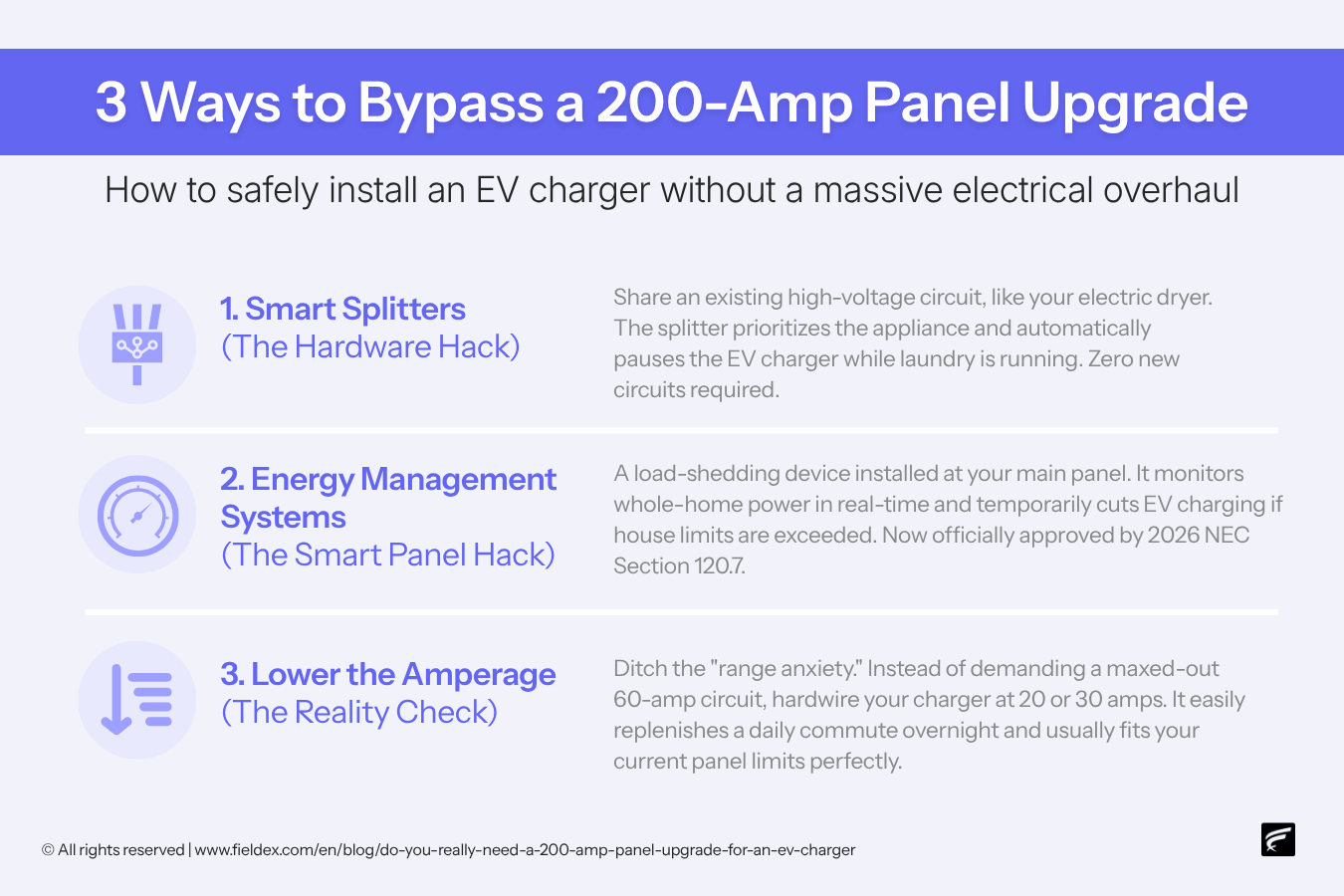
If your load calculation comes back maxed out and you aren't planning a massive whole-home electrification project, don't panic. You don't necessarily have to start digging up your front yard to pull new wires from the street. Technology has caught up, and there are some incredibly clever ways to squeeze an EV charger into an older electrical panel.
This is often called the "Dryer Buddy" or "NeoCharge" approach. Let's say you have an electric dryer sitting in your garage right next to where you want to park your car. A smart splitter is a small device that plugs into that existing 30-amp or 50-amp circuit, allowing you to plug in both the dryer and the EV charger. The device prioritizes the dryer; if someone turns the dryer on to do a load of laundry, the splitter automatically pauses the EV charger. Once the clothes are dry, power routes back to the car. No new circuits required!
If you're hardwiring a charger and need a more robust solution, an energy management system (like a DCC or SPAN device) is a game-changer. In fact, the 2026 NEC Section 120.7 now officially recognizes these as Power Control Systems (PCS) and explicitly allows them to be used in load calculations.
This load-shedding device is installed directly at your main electrical panel and reads the total power draw of your entire house in real-time. If you turn on the oven and the AC, and the house suddenly exceeds its safe capacity, the EMS temporarily cuts power to the EV charger. As soon as the house load drops back down, the charger fires right back up. Because the EMS physically prevents an overload, city inspectors will gladly approve it without requiring a 200-amp upgrade.
We need to have a heart-to-heart about "range anxiety." Most people do not need to charge their car from 0 to 100% every single night. Instead of demanding a maxed-out 60-amp circuit, you can simply have your electrician hardwire the charger to run at 20 or 30 amps. A 20-amp Level 2 charger will easily replenish the average daily commute while you sleep, and it often squeezes perfectly into a 100-amp panel's load calculation without requiring an expensive upgrade.
If the workarounds above won't cut it, you’re looking at a full upgrade. We need to define the difference between a "panel upgrade" and a "service upgrade," because the costs are wildly different.
Here’s the massive silver lining: you don't have to foot the entire bill yourself. Thanks to federal programs like the Inflation Reduction Act, there’s literally free money on the table to help offset the pain.
Always check with your CPA or local utility provider, because many states and cities offer secondary rebates that stack directly on top of these federal credits!
Whether you decide to drop the money on a full 200-amp service upgrade or creatively use a smart load-shedding device to protect your 100-amp panel, the final decision must be made by a licensed, qualified electrician doing real math.
Electricity is the one area of home improvement where "winging it" or watching a five-minute DIY video has catastrophic, life-threatening consequences.
Do it right, do it safely, take advantage of those tax credits, and make sure you hire contractors who have their operations dialed in.
The amperage (amp) rating refers to the total electrical capacity your home can draw from the utility grid at one time. A 100-amp panel can handle roughly 24,000 watts of continuous power, which was standard for older homes. A 200-amp panel handles roughly 48,000 watts, making it the modern standard required to safely run large electric loads like EV chargers, heat pumps, and induction stoves simultaneously.
The NEC (National Electrical Code) Load Calculation is a strict mathematical formula used by electricians and city inspectors. It calculates the total power demand of your home by adding up the lighting, square footage, and the maximum draw of all hardwired appliances to determine if your electrical panel has enough capacity to safely add a new device without causing an overload.
Because EV chargers draw high amounts of power for more than three hours, they are classified as a continuous load. Historically, this meant both the dedicated circuit and the home's overall load calculation had to be inflated by 125%. However, the 2026 NEC Section 120.5(E) removes the requirement to calculate continuous loads at 125% for the home's overall load calculation. You still must upsize your individual branch circuit breaker (eg a 48-amp charger requires a 60-amp circuit to manage heat), but it is now much easier to pass a whole-home load calculation without a 200-amp upgrade.
If you install a high-amperage EV charger on a 100-amp panel without doing a proper load calculation or installing a smart energy management system, yes. If your AC, oven and dryer are running simultaneously while the car charges, the total draw will likely exceed your panel's limit, tripping the main breaker to prevent the wires from overheating and catching fire.
An EMS (like a DCC device or a SPAN panel) is a smart load-shedding hardware device installed near your electrical panel. It monitors your home's total power usage in real-time. If the home approaches its maximum capacity, the EMS automatically temporarily cuts power to the EV charger until the house load drops, physically preventing an overload and often allowing you to avoid a panel upgrade.
A smart circuit splitter (often referred to by brand names like NeoCharge or Dryer Buddy) is a device that allows two heavy appliances to safely share a single electrical circuit. For example, it allows you to plug both your electric dryer and your EV charger into the same 30-amp outlet. It prioritizes the dryer, automatically pausing the car's charge whenever the dryer is turned on.
Absolutely! This is one of the easiest workarounds. While many people want a 60-amp circuit for lightning-fast home charging, a 20-amp or 30-amp Level 2 charger draws significantly less power and is much more likely to pass a load calculation on an older 100-amp panel.
Yes. Under the IRS 25C Energy Efficient Home Improvement Credit, households who pay federal income taxes can claim up to $600 for the installation of a qualifying electrical panel, provided it is installed along with another qualified home appliance like a heat pump.
Yes. Under the IRS 30C Alternative Fuel Vehicle Refueling Property Tax Credit, consumers installing an EV charger at their principal residence can claim a tax credit equal to 30% of the cost, up to $1,000 per charging port, provided the home is located in an eligible low-income or non-urban census tract.
Zinsco and Federal Pacific Electric (FPE) panels have documented design flaws. Their circuit breakers frequently fail to trip during an electrical overload or short circuit. If the breaker doesn't trip, the wires overheat and start a fire. If you have one of these panels, an upgrade is a mandatory safety requirement, regardless of your load calculation. (Drummond Electric)

.avif)


This website and its content are the property of FieldEx and are protected by copyright laws. © 2026 FieldEx. Any redistribution or reproduction of part or all of the contents in any form is prohibited, except with our express written permission.
FieldEx Pte Ltd Singapore