
.png)
%20(1).png)
In the oil and gas (O&G) industry, a missed maintenance check doesn't just cause a headache – it causes million-dollar shutdowns and massive OSHA fines. You cannot manage that level of risk with fragile spreadsheets or basic routing apps.
The best way to track maintenance in the oilfield is by using a hybrid FSM and CMMS platform like FieldEx. Here is exactly what a rugged, hybrid system gives you that standard software won't:
The Bottom Line: Ditching paper for a hybrid FSM/CMMS maximizes your uptime, makes you bulletproof during sudden EPA audits, and extends the lifespan of your million-dollar capital assets.
Let’s be honest. In some industries, a missed maintenance interval means a customer gets a little warm because their air conditioning went out. It's a bummer, but life goes on. In the oil and gas (O&G) industry? A missed maintenance check is a totally different beast. It isn't just an operational headache – it is a potential environmental catastrophe waiting to happen, a guaranteed way to make OSHA (Occupational Safety and Health Administration) very angry, and a multi-million dollar halt in production.
Despite the fact that we are dealing with massive, high-stakes capital investments, it is wild how many mid-stream and up-stream operators are still tracking pipeline valves, pump jacks, and compressor stations using a disjointed mess of spreadsheets, grease-stained paper forms, or legacy ERPs (Enterprise Resource Planning systems – the giant, clunky business management software) that field workers absolutely despise. Think about it: how many times have you watched a tough, experienced technician tap a rugged tablet screen 10 times, sigh heavily, and just reach for a pen instead? It happens more often than anyone wants to admit.
.png)
According to a study by Kimberlite research, just 3.65 days of unplanned downtime a year can cost an oil and gas company $5.037 million. And if you look at the broader picture, a comprehensive report by Siemens found that an hour of downtime in the O&G sector can cost upwards of $500,000 during peak market conditions.
So, what is the best way to track maintenance in oil and gas? The answer isn't choosing between a rigid asset management tool and a basic routing app. It is using a rugged, hybrid platform that unites FSM (field service management – software that tracks your people and schedules) and CMMS (computerized maintenance management system – the digital brain that tracks your physical assets and inventory). A system like FieldEx brings deep asset intelligence directly to the rugged edge of the oilfield.
Before we dive into the ultimate solution, we have to talk about why the tools you might be using right now are failing you. Out in the dirt, operators are typically forced to choose between two flawed systems:
The magic happens when you stop treating your people and your equipment like two separate problems. FieldEx unites the "What and When" (CMMS asset tracking and predictive scheduling) with the "Who and Where" (FSM dispatching and mobile field execution).
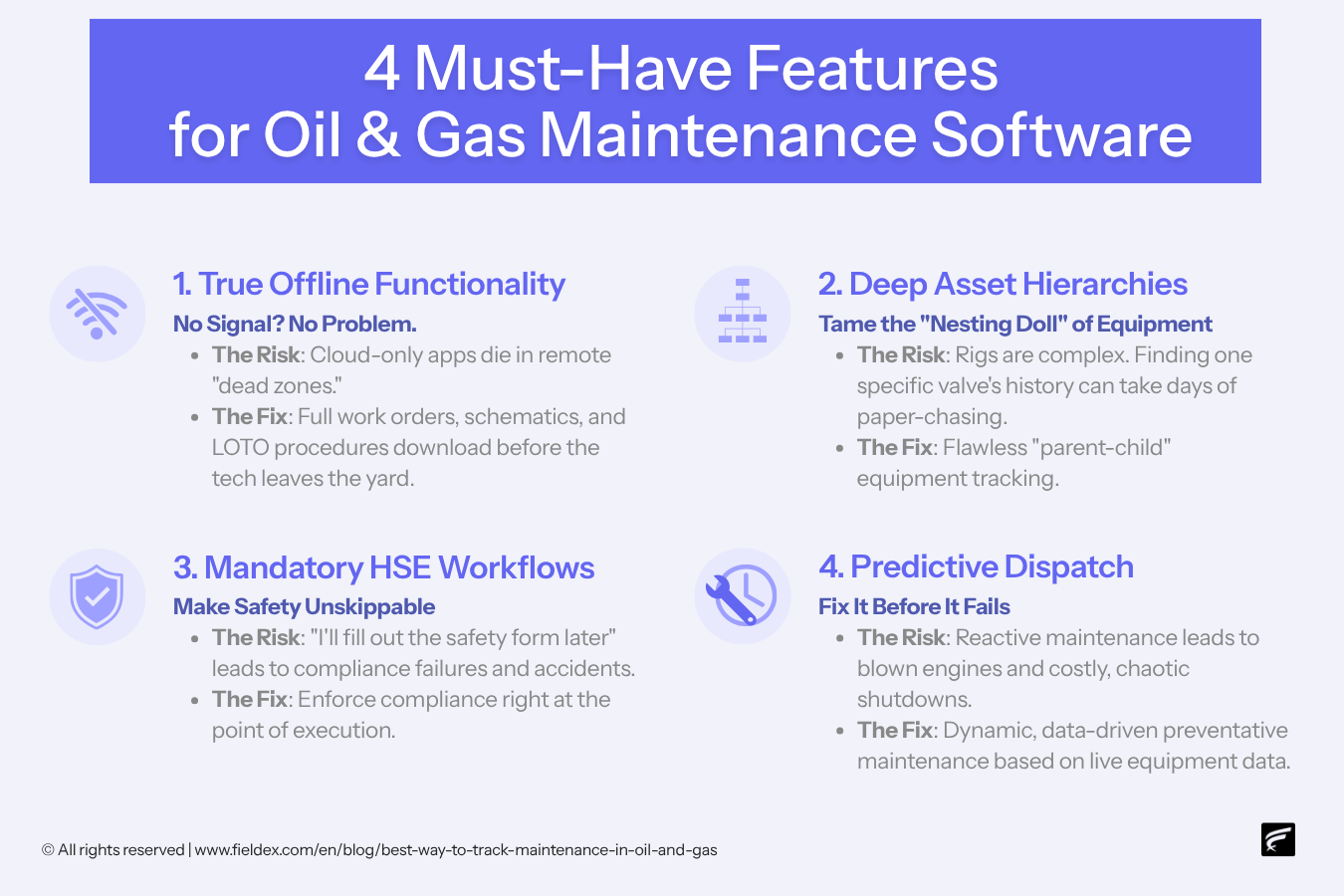
If you’re evaluating software for your operation, here’s exactly what you need to look for. If a software doesn't have these four things, it belongs nowhere near a rig.
If your software turns into a shiny, expensive brick the moment you lose cellular coverage, it is useless.
Let's say a pipeline technician is dispatched to a remote metering station in West Texas with zero cell service. Because FieldEx synced before he left the yard, he arrives with the full work order, the site’s schematic, and the exact LOTO (Lockout/Tagout – the critical safety procedure ensuring machinery is completely powered off and secured during maintenance) procedure already downloaded to his tablet. He completes a complex 40-point inspection offline, snaps photos of a corroded flange, and signs off. The second his truck hits a coverage zone on the drive back, the app automatically pushes the completed report to the office. It isn't magic; it is just good engineering.
An oil rig isn't just one big machine; it is a Russian nesting doll of complex parts. Your software must understand "parent-child" relationships flawlessly.
Imagine an EPA (Environmental Protection Agency) inspector shows up unannounced. They want the maintenance history of one specific pressure relief valve on a multi-stage compressor unit. Instead of a site manager spending three frantic days digging through dusty filing cabinets hoping a paper job safety analysis (JSA) – a mandatory risk assessment checklist) wasn't lost, they just open FieldEx. They type in the valve’s unique ID, and instantly export a PDF showing every time it was serviced, complete with time-stamped photos and digital signatures of the techs who authorized it. Audit passed. Crisis averted.
In this industry, safety is THE LAW, not merely a suggestion. FieldEx allows you to build mandatory HSE (Health, Safety, and Environment) workflows right into the app. Technicians physically cannot unlock the actual maintenance work order on their screen until they have filled out and digitally signed their safety checklists. It forces compliance right at the point of execution, completely eliminating the "I'll fill out the safety form later" excuse.
We need to stop waiting for things to break. We need to shift from reactive maintenance to predictive maintenance (using data to service assets right before they fail).
Instead of a pump jack engine violently failing and halting production entirely, FieldEx’s CMMS brain tracks the exact engine hours based on live meter readings. When it hits 9,500 hours, the system automatically triggers the FSM brain to create a work order and dispatch a tech for a preventative overhaul. You replace a chaotic, highly expensive two-day shutdown with a calm, planned two-hour maintenance window.
Transitioning to digital isn't just about making life easier for your field crews (though they will thank you for it eventually). It is about protecting the company’s bottom line and delivering a massive ROI (ie the financial benefit you get back from spending money on the software).
You simply cannot manage 21st-century energy assets with 20th-century paperwork or fragmented, office-bound software. Migrating to a hybrid platform gives you the deep asset intelligence of a CMMS combined with the rugged mobility of an FSM. It is the only way to gain the visibility, safety, and operational control required to survive and thrive in today's demanding oil and gas landscape.
FieldEx is the hybrid FSM and CMMS platform built specifically for the real world – the messy, offline, heavy-duty real world.
With FieldEx, you get:
Stop fighting your software and start optimizing your fleet. Book a free demo with FieldEx today, and see what happens when your tech works as hard as your crew does. Or simply get in touch to learn more. We’re here to help.
CMMS (computerized maintenance management system) focuses on the physical assets – tracking equipment history, parts inventory, and maintenance schedules. FSM (field service management) focuses on the people – dispatching technicians, routing trucks and mobile execution. A hybrid system like FieldEx does both simultaneously.
Oil and gas assets are frequently located in remote areas without reliable cellular or Wi-Fi coverage. If a mobile app requires an internet connection to load work orders or save safety forms, technicians cannot do their jobs. True offline functionality allows full app usage without a signal, syncing data automatically later.
An asset hierarchy is a way of organizing equipment in a "parent-child" structure. For example, a pipeline (parent) has a compressor station (child), which has a pump (grandchild), which has a relief valve (great-grandchild). Tracking at this granular level ensures you know exactly which tiny part is causing systemic failures.
Predictive maintenance uses data (like engine hours or pressure readings) to fix machinery right before it breaks. It is infinitely cheaper to replace a $50 worn belt during a planned outage than it is to replace a $50,000 engine block that was destroyed because the belt snapped during active production.
Absolutely. Modern software enforces compliance by making safety checklists mandatory. It physically prevents a technician from accessing their maintenance instructions until they have signed off on their hazard assessments, creating an undeniable, timestamped digital trail for OSHA inspectors.
LOTO stands for Lockout/Tagout, a safety procedure to ensure dangerous machines are fully shut down and cannot be turned on during maintenance. An app manages this by storing the specific, step-by-step LOTO instructions for every unique piece of equipment, requiring the technician to check off each step digitally.
Don't do it all at once! Run a pilot program first. Give the software to a few of your most tech-savvy mechanics to test in the field alongside their paper forms. Gather their feedback, fix any workflow bottlenecks, and then set a firm "go-live" date where paper is completely removed from the trucks.
They shouldn't be. The best platforms (like FieldEx) keep the complexity hidden in the office dashboard while keeping the mobile app clean, visual, and highly intuitive. If your technicians can use a smartphone to navigate or check their bank accounts, they can use a well-designed FSM app.
Because the data is continuously synced to the cloud whenever a signal is available, almost nothing is lost. You simply hand the technician a new tablet, they log in securely with their credentials, and their entire schedule, asset history, and pending work orders instantly repopulate on the new device.
Yes. A robust hybrid platform is designed to talk to your ERP (Enterprise Resource Planning software, like SAP or Oracle). This means when a technician uses a spare part in the field, the CMMS deducts it from inventory, and the ERP instantly updates your corporate accounting ledgers without any manual data entry.

.avif)


This website and its content are the property of FieldEx and are protected by copyright laws. © 2026 FieldEx. Any redistribution or reproduction of part or all of the contents in any form is prohibited, except with our express written permission.
FieldEx Pte Ltd Singapore