
Reactive Maintenance is a maintenance strategy where repairs are performed only AFTER equipment or systems fail.
In this approach, no action is taken until a breakdown occurs. Once a failure happens, maintenance teams respond to diagnose, repair and restore the asset to working condition.
Reactive maintenance is also commonly referred to as:
Reactive maintenance is one of the simplest maintenance strategies to implement, as it requires minimal planning and upfront investment.
In certain situations, it can be appropriate – especially for:
However, relying heavily on reactive maintenance can lead to:
Understanding when to use reactive maintenance is key to maintaining operational efficiency and reliability.
Reactive maintenance follows a straightforward process:
Because there is no prior planning, response time and repair efficiency depend heavily on resource availability and readiness.
Reactive maintenance is often compared with preventive maintenance, which involves scheduled servicing before failures occur.
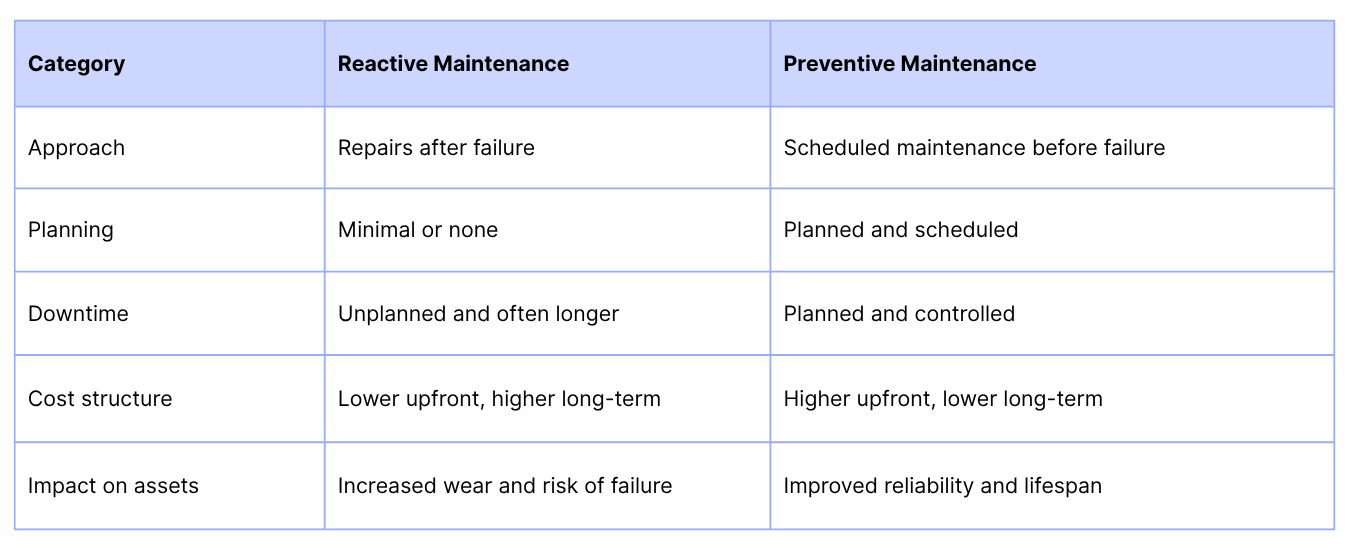
In general:
Reactive maintenance responds to problems. Preventive maintenance aims to prevent them.
Reactive maintenance can be effective in specific scenarios:
For example, non-essential components or backup systems may be managed using a reactive approach.
Despite its limitations, reactive maintenance has some benefits:
Reactive maintenance also comes with significant drawbacks:
Reactive maintenance differs significantly from predictive maintenance, which uses data to anticipate failures.
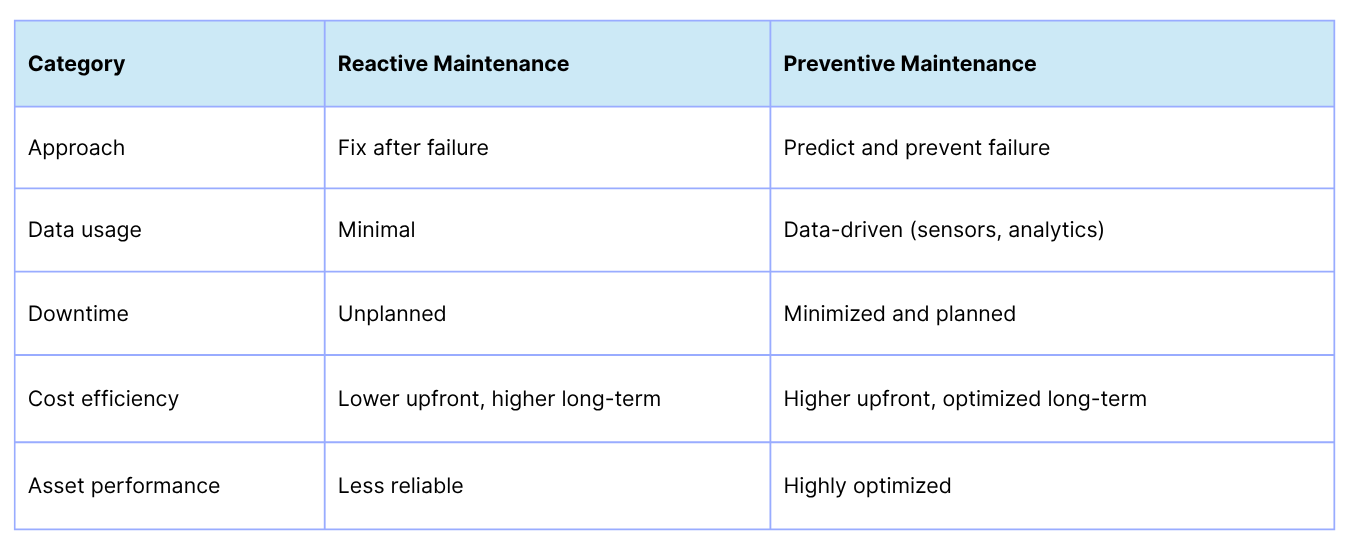
Predictive maintenance helps organizations shift from reactive responses to proactive decision-making.
Reactive Maintenance is the most basic form of maintenance strategy, focused on responding to failures after they occur.
While it can be suitable for non-critical assets, relying on it for essential systems can lead to:
Most organizations adopt a balanced maintenance strategy, combining reactive, preventive, and predictive approaches to optimize performance and cost.

This website and its content are the property of FieldEx and are protected by copyright laws. © 2026 FieldEx. Any redistribution or reproduction of part or all of the contents in any form is prohibited, except with our express written permission.
FieldEx Pte Ltd Singapore