
.png)
.png)
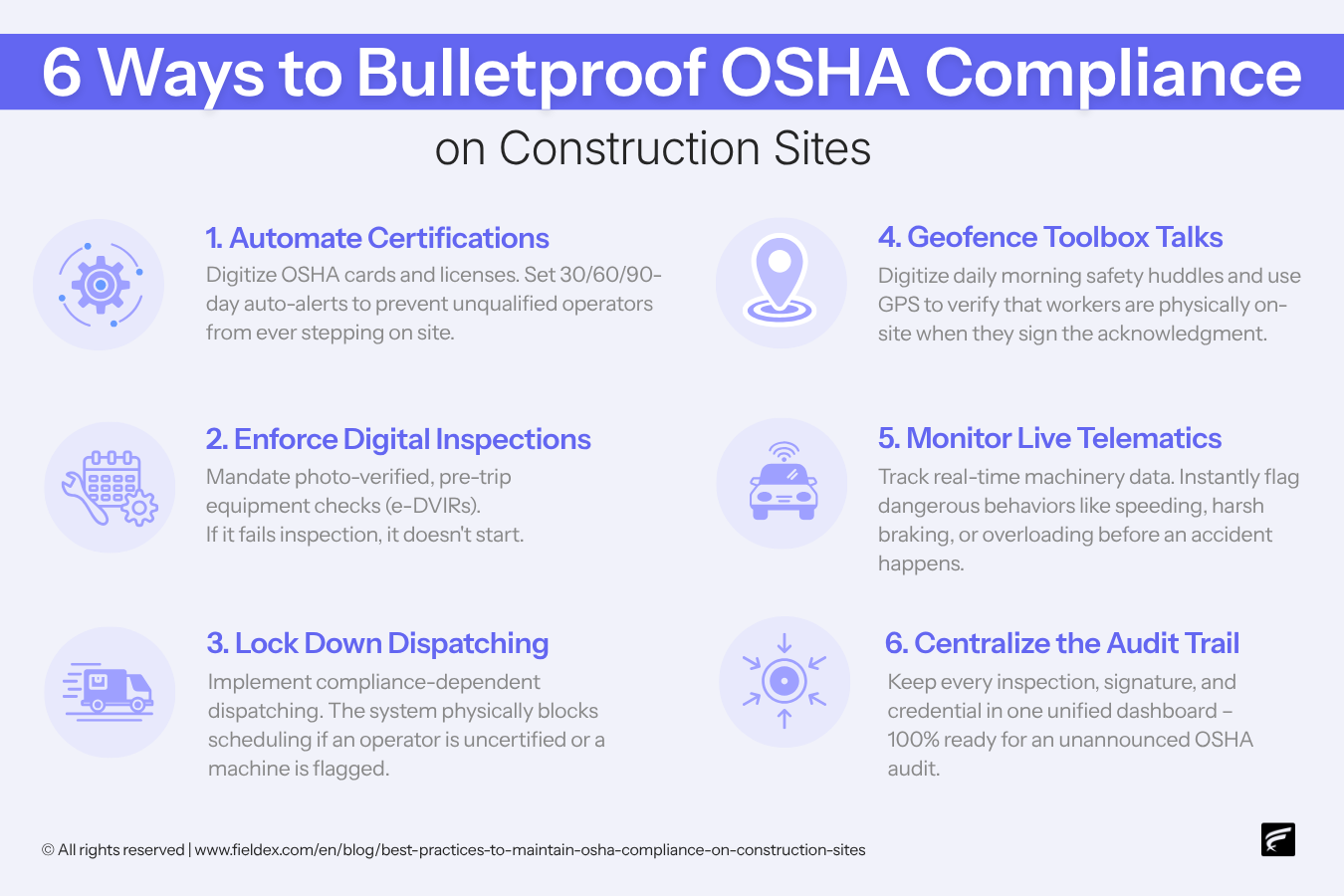
To maintain strict OSHA compliance, construction businesses must digitize their safety protocols using field service software. The 6 best practices include: automating employee certification tracking, enforcing digital pre-trip equipment inspections, implementing compliance-dependent dispatching, standardizing geofenced toolbox talks, monitoring live equipment telematics for unsafe operation, and centralizing a digital audit trail for instant OSHA reporting.
In the heavy construction industry, safety is not just a moral obligation – it is the financial bedrock of your business. In 2026, the Occupational Safety and Health Administration (OSHA) – the federal agency responsible for ensuring safe working conditions – has aggressively increased enforcement. Today, a single willful or repeated OSHA violation can cost a contractor upwards of $161,000 in penalties per citation.
But the true cost of non-compliance isn't just the federal fine. It is the skyrocketing workers' compensation insurance premiums, the immediate halting of project timelines, and, most importantly, the devastating risk to human life. The National Safety Council estimates that a single medically consulted workplace injury costs an average of $42,000. Managing this level of risk with paper clipboards and filing cabinets is no longer an option; it is a massive, company-ending liability.
To achieve total compliance on a heavy job site, construction companies must track two entirely different, constantly moving targets: the qualifications of the human and the mechanical safety of the iron.
Historically, tracking these elements was a chaotic, manual process. Safety Managers relied on physical binders to hold operator certifications and scattered paper checklists for equipment inspections. When operations run on paper, critical data falls through the cracks. A foreman "pencil-whips" a daily inspection report (checking the boxes without actually inspecting the machine), or a dispatcher accidentally assigns a crane operator whose license expired three days ago.
Digitization removes human error from the safety equation.
To implement the safety practices below, you need the right digital infrastructure. Most construction contractors operate using one of two software systems, but achieving total OSHA compliance requires understanding the critical difference between them.
The Compliance Connection: The fundamental reason safety breaches occur is that these two systems usually do not talk to each other. When you unify your FSM (the human operator) with your CMMS (the heavy equipment), you create a closed-loop system where an unqualified worker can never be scheduled to operate a dangerous or uninspected machine.
.png)
The Challenge: Keeping track of varying expiration dates for a 100-person crew is an administrative nightmare. You have operators holding OSHA 10 or OSHA 30 cards (10-hour or 30-hour foundational safety training programs), CPR (Cardiopulmonary Resuscitation) certifications, forklift credentials, and specialized commercial driver's licenses.
The Best Practice: Move all employee credentials out of physical HR filing cabinets and into a centralized FSM dashboard.
By digitizing credentials, you can set up automated software alerts that notify both the Safety Manager and the employee 30, 60 or 90 days before a mandatory certification expires. If the operator does not renew their credential in time, the software automatically removes their "active" tag, ensuring no unqualified worker can legally be assigned to the site.
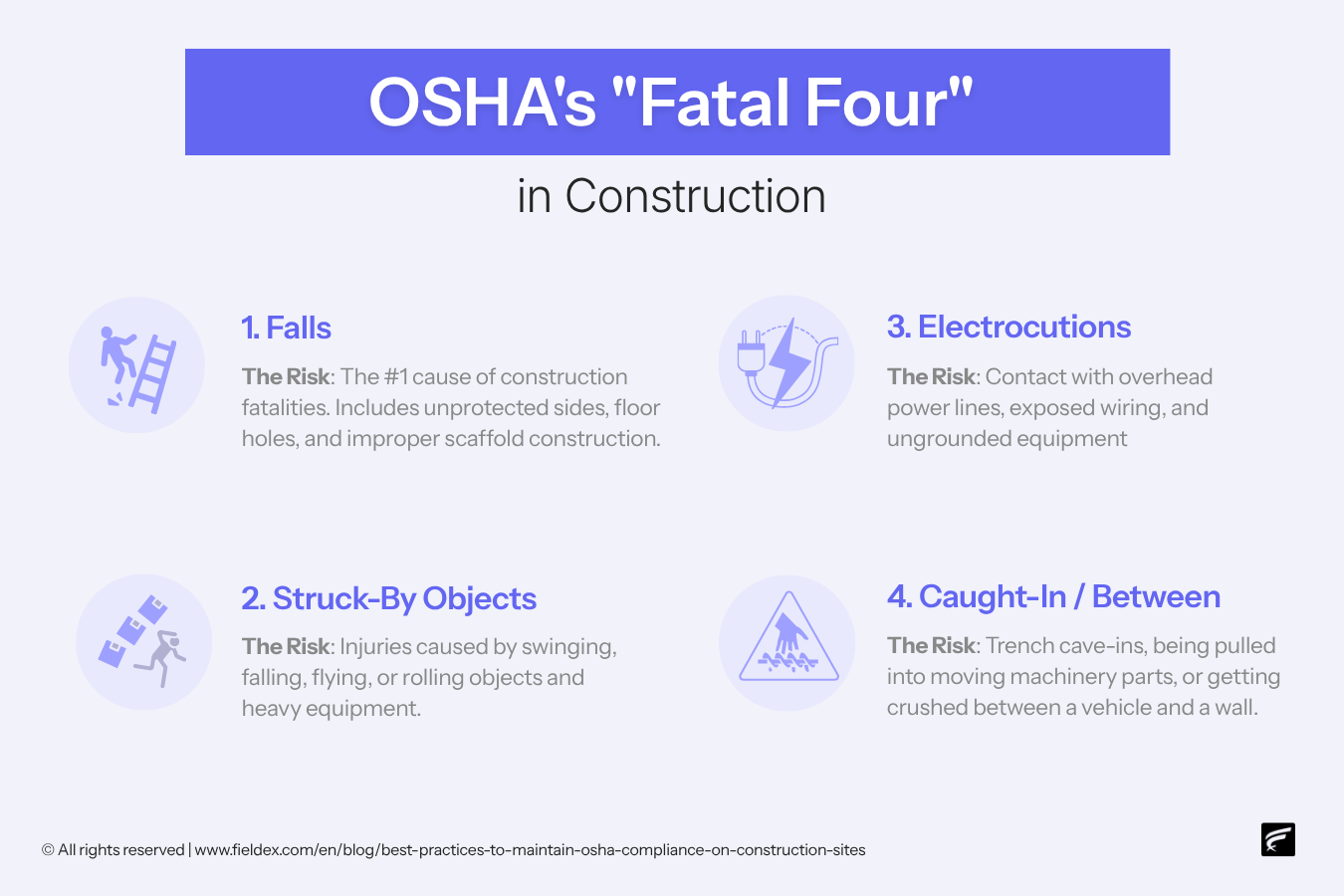
The Challenge: Heavy machinery is inherently dangerous. According to OSHA, the "Fatal Four" – falls, being struck by objects, electrocutions, and being caught in/between equipment – account for over 60% of all construction worker fatalities. Failing to properly inspect an excavator or bulldozer before a shift dramatically increases this risk.
The Best Practice: Utilize your CMMS to mandate digital inspections.
Specifically, you must enforce e-DVIRs (Electronic Driver Vehicle Inspection Reports). Before an operator can physically turn the ignition on a piece of yellow iron, they must open their mobile app, complete a randomized digital checklist, and take timestamped photos of critical components like hydraulic lines, tires and tracks. Because the checklist requires real-time photos, operators cannot fake the inspection. If a defect is flagged, the CMMS instantly alerts the shop mechanic, effectively grounding the machine before a catastrophic failure occurs.
The Challenge: In siloed operations, the office scheduler mapping out the week's phases doesn't always know that a machine was flagged as unsafe by the shop, or that an assigned worker's license has lapsed. They send the crew anyway, immediately violating compliance protocols.
The Best Practice: This is where FSM (people) and CMMS (equipment) must collide. You need to enforce a digital lock on your schedule known as compliance-dependent dispatching.
The software must be programmed to physically prevent a Project Manager from finalizing a crew dispatch if the assigned operator lacks the correct, active certification tag, OR if the required heavy equipment has a failed safety inspection currently logged in the system. This creates an automated firewall that makes it technologically impossible to dispatch a non-compliant crew.
The Challenge: ‘Toolbox Talks’ are informal, daily or weekly safety huddles focused on specific site hazards (like trenching safety or fall protection). The challenge is proving to an OSHA inspector that these briefings actually occurred, rather than just having a foreman forge a sign-in sheet on Friday afternoon to cover their tracks.
The Best Practice: Digitize your morning safety huddles. Your safety department should push a digital ‘Toolbox Talk’ document directly to the crew's mobile devices each morning.
To guarantee compliance, use Geofencing – a technology that creates a virtual geographic boundary around a real-world location using GPS. Configure your app so that workers can only electronically sign the safety acknowledgment if their mobile device's GPS verifies they are physically standing within the perimeter of the active job site.
The Challenge: A bulldozer might pass its morning inspection flawlessly, but if the operator drives it recklessly all day, they risk severe rollovers, structural damage, or site collisions. Static morning checklists cannot track mid-day behavioral safety.
The Best Practice: Modern CMMS software integrates directly with heavy equipment telematics. Telematics is the onboard technology that tracks and transmits live data from a machine's engine and onboard computers back to the office.
If an operator is speeding, overloading a crane past its weight limits, or braking harshly, the machine automatically sends an instantaneous alert to the Safety Manager's dashboard. This allows for immediate, targeted safety intervention, pulling the operator off the machine before an accident happens.
The Challenge: When a safety incident occurs, an OSHA inspector will arrive on site demanding immediate access to training logs, equipment maintenance histories, and daily inspection reports. The site supervisor is forced to spend hours frantically digging through dirty truck cabs and muddy binders trying to find the required documents, which instantly sets a tone of negligence with the inspector.
The Best Practice: Create a single pane of glass for all compliance data. By using a unified, cloud-based platform, every inspection photo, every digital signature on a ‘Toolbox Talk’, and every telematics maintenance record is securely stored and searchable. When an inspector asks for the logs for Excavator #4, your site supervisor simply pulls out an iPad and generates an immaculate, timestamped digital history in less than three seconds.
You can’t maintain rigorous, 360-degree OSHA compliance if your HR software, your dispatch board, and your mechanic's maintenance logs are housed in three different, disconnected programs.
FieldEx was engineered from the ground up as a native FSM and CMMS hybrid. It serves as the ultimate safety net for heavy construction. By centralizing the compliance of your human operators and the mechanical safety of your heavy equipment into one flawless, automated system, FieldEx makes legal compliance an automatic byproduct of doing your daily work.
In the heavy construction industry, safety is not merely an ethical obligation; it’s the absolute foundation of your operational profitability. A single severe OSHA violation, a sidelined project, or an injured worker can wipe out a year's worth of profit margins and permanently damage your firm's reputation.
Digitize your safety protocols today, equip your crews with the right tools, and guarantee that everyone who walks onto your site walks home safely at the end of the shift.
Ready to eliminate safety blind spots and bulletproof your job sites? Book a free demo with FieldEx today to see how our unified FSM and CMMS platform automates OSHA compliance. Or simply get in touch. We’re here to help.
Manual tracking relies on physical binders and clipboards, making it incredibly easy for critical data to fall through the cracks. It leads to dangerous practices like "pencil-whipping" (checking off inspection boxes without actually looking at the equipment) and makes it nearly impossible for dispatchers to instantly verify if an operator's safety certifications are valid before they arrive on site.
An e-DVIR stands for Electronic Driver Vehicle Inspection Report. It is a digital checklist housed within a CMMS (computerized maintenance management system) that requires operators to complete their pre-trip inspections on a mobile device. Because the system can mandate timestamped photos of critical components (like tracks or hydraulic lines) before the ignition is turned, it prevents operators from faking the inspection.
This is an automated software safeguard that acts as a digital lock on a Project Manager's schedule. It physically prevents a dispatcher from assigning a crew to a project phase if the operator's required safety certifications (like an OSHA 30 card) are expired, or if the assigned heavy machinery currently has a failed safety inspection logged in the system.
Geofencing uses GPS technology to create a virtual boundary around a physical job site. By applying geofencing to your digital ‘Toolbox Talks’ (brief, daily safety meetings), the software ensures that workers can only electronically sign and acknowledge the day's safety briefing if their mobile device confirms they are physically standing within the perimeter of the site.
While morning inspections ensure the machine starts the day safely, telematics – the onboard technology that transmits live engine and operational data – monitors behavioral safety throughout the shift. If an operator speeds, brakes harshly, or overloads a crane, the telematics system instantly sends an alert to the Safety Manager, allowing them to intervene immediately before an accident occurs.
FSM (field service management) tracks your people and their credentials, while CMMS tracks your equipment and its maintenance history. When these systems are unified, they create a single, cloud-based digital paper trail. If an OSHA inspector requests safety logs following an incident, a site supervisor can instantly pull up an immaculate, timestamped history on a tablet, demonstrating total compliance without frantic paperwork searches.
FieldEx is a native FSM and CMMS hybrid platform designed specifically for complex field operations. Instead of using disconnected apps for HR, scheduling and fleet maintenance, FieldEx centralizes human safety certifications and heavy equipment inspections into one dashboard. It completely automates compliance alerts, prevents unsafe dispatching, and keeps your job sites audit-ready 24/7.

.avif)


This website and its content are the property of FieldEx and are protected by copyright laws. © 2026 FieldEx. Any redistribution or reproduction of part or all of the contents in any form is prohibited, except with our express written permission.
FieldEx Pte Ltd Singapore