
.png)
.png)
So, you’re juggling HVAC technicians, plumbers, electricians, and maybe some general contractors, all under one roof. The problem is, as multi-trade companies grow, they almost always fall into the trap of "siloed operations". The electrical department runs their schedules on a massive whiteboard, the HVAC guys rely on a messy, shared spreadsheet, and the front office is stuck in the middle, ripping their hair out trying to figure out who is where, what parts were used, and how to actually bill the customer.
You simply cannot scale a multi-trade operation using fragmented, old-school tools. Trying to bridge the gap between different departments with group texts and paper forms is a surefire way to leak profit margins.
In this guide, we’re going to break down the specific, chaotic reality of running multiple service lines and explain exactly why a unified field service management (FSM) platform is the only way to protect your sanity – and your bottom line – in 2026.
If you’re researching tools to run your multi-trade business, you’ll constantly see "FSM" and "CMMS”. In the simplest terms:
For a multi-trade business to actually scale without going crazy, you need a system that handles both. After all, having a perfectly optimized schedule for your field crews doesn't mean much if the van they are driving breaks down on the way to the jobsite.
.png)
Multi-trade businesses need field service management (FSM) software to centralize operations across entirely different service lines. It allows dispatchers to:
If you run a multi-trade shop, these 4 headaches are probably happening in your business right now:
A customer needs a new commercial water heater installed. This requires a plumber to pipe it and an electrician to wire it. Coordinating those two schedules on a whiteboard usually results in one tech standing around a jobsite for two hours waiting for the other to finish. That is expensive idle time.
An HVAC van carries entirely different, highly expensive parts than a plumbing van. Tracking exactly what is sitting in which truck without a digital system is physically impossible, leading to mid-day supply house runs that kill productivity.
Your electrical division just finished a panel upgrade at a commercial building. A week later, your HVAC division gets called to the same building but has absolutely no record of the electrical work that was just done. To the customer, you look completely disorganized.
The safety checklist for working on a high-voltage commercial electrical panel is totally different than the checklist for hydro-jetting a sewer line. Managing 50 distinct paper forms in the cab of a muddy truck usually ends in lost documentation and massive liability.
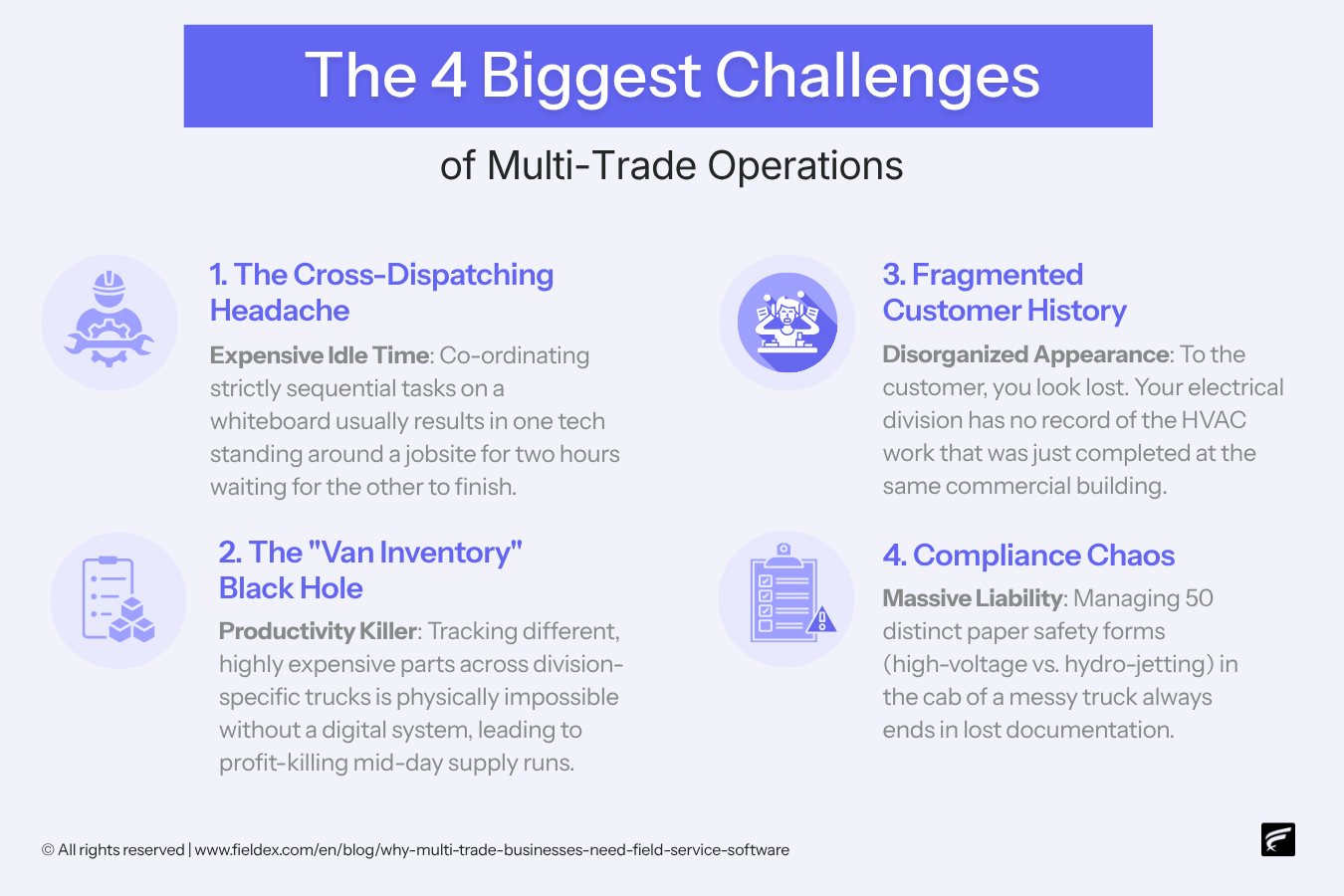
If those daily operational nightmares hit a little too close to home, don't panic. The solution isn't to hire three more dispatchers, and it definitely isn't to hold a mandatory two-hour sync meeting every morning just to figure out where your trucks are. The fix is simply upgrading your digital infrastructure.
When you finally strip away the disconnected spreadsheets, the frantic group texts, and the messy whiteboards, and replace them with a single, unified FSM platform, the chaos disappears. Instead of your electrical and plumbing divisions operating in totally different worlds, they get on the exact same page.
Here are the 5 core ways modern FSM software transforms a scattered multi-trade business into a highly profitable, well-oiled machine:
Adding more service lines to your construction or service business should multiply your profits, not your daily headaches.
If you’re running multiple trades and are exhausted from trying to bridge the massive gaps between siloed departments, it’s time for a digital upgrade. You need a platform that puts everyone – from the master electrician to the front office dispatcher – on the exact same page.
That is exactly why modern contractors are moving to a hybrid FSM and CMMS platform like FieldEx. Instead of forcing your crew to learn clunky corporate software, FieldEx adapts to your business. It lets you swap out rigid tech jargon for your shop's actual lingo, track expensive spare parts down to the exact van, and seamlessly unite your dispatchers, field techs, and heavy iron under one organized digital roof. Stop surviving the daily chaos, and start scaling your profit.
Want to see FieldEx in action? Book a free demo today, or just reach out. We're here to help.
Standard calendar apps completely lack "dependencies". If you send a plumber to rough-in a kitchen, the drywaller cannot start until the plumber finishes. Generic software cannot link those two jobs. True FSM software uses phase scheduling, ensuring Trade B doesn't show up and stand around until Trade A is officially done.
It gives your technicians full visibility. If your HVAC tech is on-site fixing an AC unit and notices a dangerously outdated electrical panel, they can instantly flag it in the FSM app and shoot a lead directly over to your electrical division. Whiteboards and spreadsheets can't do that.
Yes, but only if you choose a platform built for the field. If the app requires 20 clicks just to close a simple job, they will rebel. To ensure high adoption rates across all your trades, pick an app with big buttons, simple QR code scanning, and true offline capabilities so they aren't fighting a bad cell signal in a concrete basement.
Field service management (FSM) focuses on managing the work you do for others – dispatching crews, tracking billable hours, and invoicing customers. A computerized maintenance management system (CMMS) focuses on managing your own gear – tracking the oil changes, DOT inspections, and maintenance on your fleet of trucks and heavy equipment. The absolute best software for multi-trade businesses blends both into one unified platform.
It depends entirely on the software. If you buy a clunky, legacy enterprise system, you’re looking at months of painful training and a lot of pushback. But if you choose a modern, "mobile-first" app with an intuitive design, most field techs can learn the basics in a single afternoon. The smartest approach is to get your management team fully bought in first, and then roll the software out trade-by-trade (eg start with HVAC, then move to plumbing) rather than forcing the entire company to switch overnight.
No, and you really don't want it to. FSM handles the operational heavy lifting out in the mud – dispatching, tracking billable hours, logging parts, and generating the final invoice. Your accounting software (like QuickBooks, Sage, or Foundation) handles the taxes, payroll, and the IRS. The best FSM tools seamlessly integrate with your accounting software, pushing the completed invoice data over with a single click so your office manager never has to double-enter data again.
Absolutely. Most growing multi-trade businesses rely heavily on specialty subs to keep up with demand. A solid FSM platform allows you to grant limited, secure access to your subcontractors. They can log in, see their specific phase of the schedule, clock their hours, and submit their required compliance checklists through the app – all without ever seeing your internal financial data, profit margins, or master customer lists.
Customers today expect Uber-level transparency. They absolutely hate sitting around during a vague "four-hour window" waiting for a technician to show up. Modern FSM software sends automated text messages when the tech is en route, provides clear digital quotes they can approve on the spot, and allows them to pay the final invoice right from their phone. It elevates your brand, making you look like a top-tier professional operation rather than a guy running a business out of a dusty glovebox.

.avif)


This website and its content are the property of FieldEx and are protected by copyright laws. © 2026 FieldEx. Any redistribution or reproduction of part or all of the contents in any form is prohibited, except with our express written permission.
FieldEx Pte Ltd Singapore