How to schedule multi-trade crews in 2026: 9 key steps
Still relying on whiteboards? Learn 9 key steps to eliminate scheduling chaos, automate phase dependencies, and route multi-trade crews efficiently in 2026.
TL;DR: What is the best way to schedule multi-trade crews?
The best way to schedule multi-trade crews is by utilizing a unified field service management (FSM) platform that automates phase dependencies, matches specific trade certifications to job requirements, and synchronizes technician availability with heavy equipment maintenance (CMMS) in real-time. This eliminates dispatcher bottlenecks and prevents overlapping schedule conflicts.
The contracting landscape has evolved rapidly, but too many multi-trade businesses are still trying to manage 2026 job volumes with 2010 tools. If your dispatchers are still relying on dry-erase whiteboards, color-coded spreadsheets and frantic phone calls to coordinate commercial projects, your scheduling process isn't just inefficient – it is actively capping your revenue.
You cannot scale a multi-trade empire on the back of manual data entry. To take on more complex commercial contracts, you need a system that thrives on complexity.
Why do traditional scheduling methods fail multi-trade contractors?
To fix the chaos, you must first understand why your current tools are breaking under pressure. It comes down to two massive operational blind spots:
The "Linear vs Multi-Dimensional" Problem: Standard digital calendars work perfectly for single-trade businesses because the math is linear: match one technician to one open time slot. Multi-trade scheduling is multi-dimensional. You have to coordinate a strict sequence of trades – demo, framing, electrical rough-in, drywall and finish plumbing. If one piece moves, the entire board must adapt.
The Blind Spots of Spreadsheets: Spreadsheets and generic calendars are static; they do not update in real-time. If your commercial HVAC crew gets delayed by two hours on a rooftop unit, a spreadsheet will not automatically alert the structural crew scheduled for the afternoon. That lack of dynamic communication creates immediate, costly chaos.
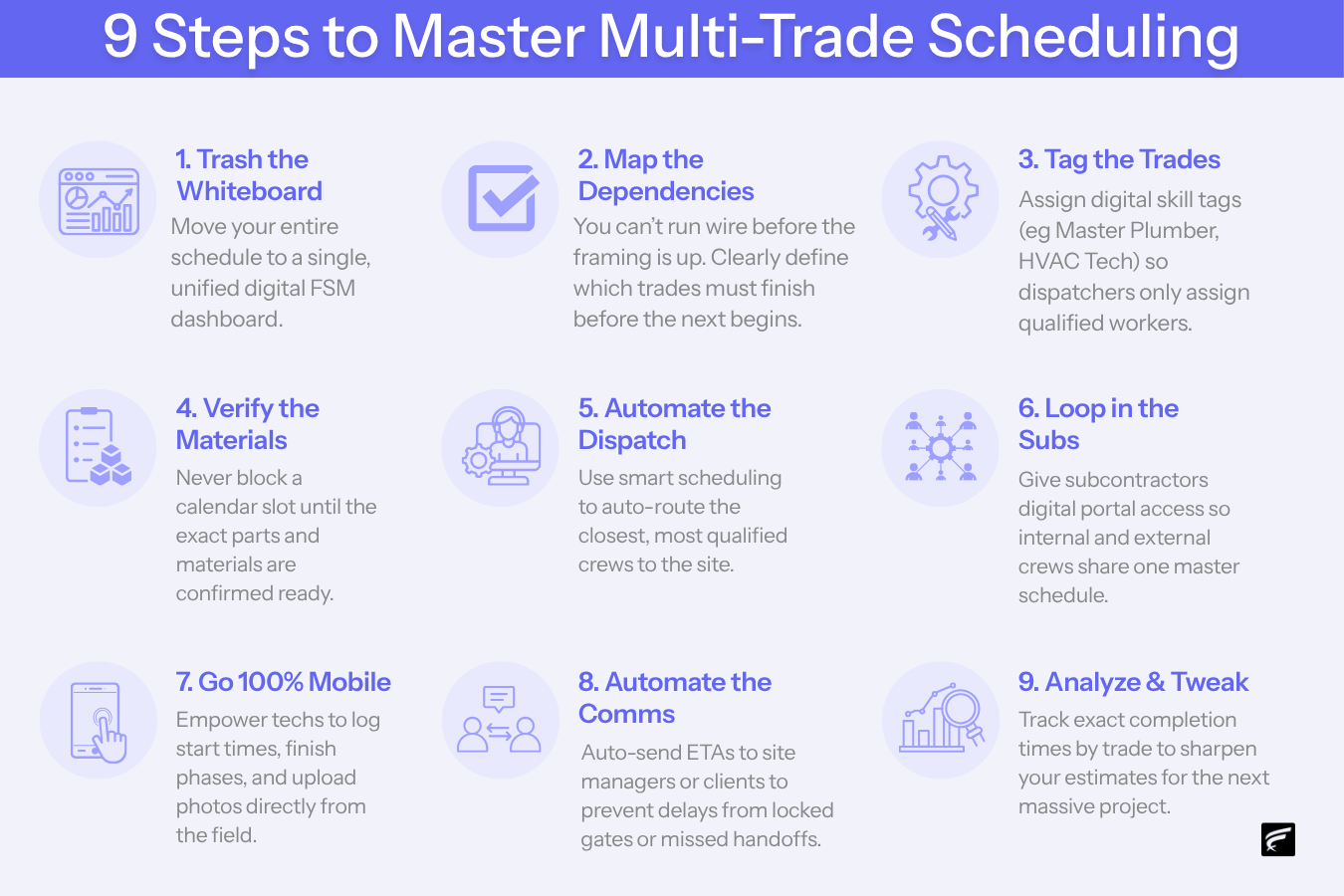
Here are the 9 key steps to build a bulletproof dispatch operation.
Step 1: Establish a "single source of truth"
You cannot coordinate a multi-trade team if your data lives in different ZIP codes.
Eliminate Dispatch Silos: The quickest way to ruin a commercial project is having the electrical division track their schedules on one software app while the plumbing division uses another. This forces your back office into double data entry and guarantees that overlapping teams will step on each other's toes.
The Unified Dashboard: You must move your entire operation to a single, cloud-based dispatch board. A unified dashboard ensures that every division manager, dispatcher, warehouse worker and field technician is operating from the exact same real-time data. When the silos collapse, true cross-trade coordination begins.
Step 2: Automate phase dependencies to cut windshield time
Wasted "windshield time" – paying a technician to drive to a site only to realize they can't work yet – is the ultimate margin killer in multi-trade construction.
Manage the Domino Effect: In a multi-trade project, dependencies rule everything. The drywall crew physically cannot close a ceiling until the electricians have run the conduit. If the electrician is delayed, the drywall crew's schedule must be instantly adjusted.
The Digital Lock Solution: Modern FSM software allows you to automate this domino effect using digital locks. You can configure the system so that "Phase 2" (Drywall) remains digitally locked and un-dispatchable until "Phase 1" (Electrical) is marked complete and signed off in the field. This guarantees that your technicians never waste unbilled hours driving to a commercial site that isn't ready for them.
Step 3: Implement skill-based and "round robin" routing
Commercial facility managers do not just want a warm body on site; they require strict compliance.
Skill Matching: Commercial jobs dictate specific license classes. A job might legally require a Master Electrician, rendering a Journeyman useless for that specific task. Your scheduling software must automatically filter your dispatch board to only show technicians who hold the legally required certifications for the work order, protecting your company from massive compliance liabilities.
Round Robin Automation: For high-volume emergency break-fix calls, human dispatchers become bottlenecks. By implementing auto-routing or "round robin" logic, the software instantly distributes incoming emergency calls to the next available, qualified technician. This bypasses manual dragging-and-dropping and gets crews on-site drastically faster.
Step 4: Sync your technicians with your heavy iron (FSM + CMMS)
This is where generic field service software completely fails the multi-trade contractor. You’re not just dispatching people; you’re dispatching heavy equipment.
The Equipment Blind Spot: A perfectly scheduled plumbing crew is entirely useless if the commercial excavator they need to trench a line is currently red-tagged in the shop with a blown hydraulic hose.
The Hybrid Solution: You must integrate your heavy equipment fleet maintenance directly into your dispatch board. By utilizing a hybrid FSM and CMMS (computerized maintenance management system) platform, you bridge the gap between your people and your iron. This ensures your dispatchers only assign complex jobs when both the highly skilled personnel and the specialized machinery are fully operational and available.
Step 5: Validate inventory readiness before dispatching
Scheduling the perfect technician at the perfect time means nothing if they show up without the necessary materials to complete the job.
The Missing Parts Bottleneck: Far too often, dispatchers assign a job based purely on a technician's availability, only for the technician to arrive on-site and realize the required commercial contactor or custom pipe fitting is out of stock in the warehouse.
Integrated Inventory Tracking: Your dispatch software must communicate directly with your inventory software. Before a work order is officially assigned to a schedule, the system should verify that the required parts are physically available and allocate them to that specific technician’s vehicle (often tracked via digital "User Bins"). If the part is missing, the job doesn't hit the active board.
Step 6: Master emergency triage with buffer zones
Multi-trade businesses don't just handle planned construction; they also manage chaotic, high-priority break-fix calls (like a flooded commercial server room) that can derail a perfectly planned week.
The Brittle Schedule: If your dispatch board is booked to 100% capacity from 8 am to 5 pm, a single emergency call will force you to cancel on existing clients, damaging your reputation.
Strategic Buffers: Advanced scheduling software allows dispatchers to auto-schedule "buffer zones" or reserve specific floating technicians entirely for emergency triage. This ensures you can immediately dispatch a rapid-response team to a high-margin emergency without cannibalizing your planned multi-trade project schedules.
Step 7: Enforce real-time, field-to-office communication
A dispatch board is only as accurate as the data feeding into it. You must close the communication loop between the field and the office.
Mobile Empowerment: Your field technicians must be equipped with a mobile app that allows them to instantly log status updates with a single tap – such as "En Route" "On Site" or "Delayed".
Proactive Pivoting: When a technician taps "Delayed" because a commercial repair is taking longer than expected, the system should instantly and visually flag the main office dispatch board. This gives your dispatchers the crucial lead time needed to proactively shuffle the afternoon schedules or assign a backup crew before the schedule completely derails.
Step 8: Automate the commercial client experience (CX)
Commercial facility managers and project owners do not just want the work done; they demand total visibility.
Live Visibility: The days of telling a commercial client "we’ll be there between 8 am and 12 pm" are over. Keeping high-value B2B clients in the dark leads to frustrated phone calls that tie up your dispatchers' time.
Automated ETAs: Modern scheduling software automatically triggers SMS notifications and emails with accurate ETAs and live technician tracking links. By giving your clients a high level of visibility into their project, you elevate your brand's professionalism while simultaneously freeing your dispatchers from fielding angry "where are you?" calls.
Step 9: Measure your dispatch KPIs
You cannot improve a process that you don’t measure. Transitioning to a digital dispatch board finally gives you the data to optimize your margins.
Data-Driven Dispatching: A unified platform acts as a data goldmine. Owners and operations managers should monitor automated dashboards to track the health of their dispatching efforts.
Top Metrics to Track: Pay close attention to your First-Time Fix Rate (are we sending the right skills and parts the first time?), Technician Utilization Rate (how much of the day is actually billable?), and your overall reduction in Windshield Time. Tracking these Key Performance Indicators (KPIs) ensures your new scheduling system is actively padding your bottom line.
Uniting FSM and CMMS with FieldEx
Knowing the steps to eliminate dispatch chaos is only half the battle; executing them requires a platform explicitly designed for the complexities of multi-trade operations. This is where FieldEx steps in to replace your fragmented, siloed tech stack.
Unlike generic field service software built for single-trade residential contractors, FieldEx was engineered from the ground up to handle multi-dimensional commercial scheduling.
Here’s how FieldEx acts as the ultimate multi-trade solution to scale your business in 2026:
The Unified FSM + CMMS Advantage: FieldEx is one of the only platforms that seamlesslyintegrates your workforce scheduling with your heavy equipment fleet maintenance. You will never dispatch a highly paid crew to a site without the operational machinery they need to do the job.
Automated Phase Dependencies: Stop relying on your dispatchers' memories. FieldEx’s digital locks ensure that your Phase 2 work orders remain un-dispatchable until Phase 1 is physically signed off in the field, automatically eliminating wasted windshield time.
Real-Time Inventory Validation: FieldEx ties your warehouse directly to your dispatch board. The system actively checks for required commercial parts and allocates them to specific technician "User Bins" before a job is ever assigned to the active schedule.
Intelligent Skill-Based Routing: When high-priority commercial break-fix calls come in, FieldEx instantly filters your workforce by specific license classes and auto-routes the ticket to the next available, qualified technician, bypassing the human bottleneck.
By consolidating your operations into a single, cloud-based source of truth, FieldEx doesn't just digitize your scheduling – it weaponizes it, turning your dispatch board from an administrative headache into your company's greatest competitive advantage.
Future-proof your dispatch board
Scheduling multi-trade crews in 2026 requires automation, not more administrative headcount. As your business scales and takes on more complex commercial contracts, the companies that win will be the ones that digitize their dependencies, validate their inventory, and unite their field data.
If you’re ready to eliminate the chaos, bridge the gap between your personnel and your heavy iron, and maximize your billable hours, it's time to upgrade your tech stack.
Want to see how FieldEx unites your workforce, inventory, and heavy equipment on one seamless dispatch board? Book a free demo today, or get in touch. We’re here to help you future-proof your multi-trade business.
Frequently asked questions
1. What makes multi-trade scheduling fundamentally harder than single-trade scheduling?
Single-trade scheduling is linear – you simply match an available technician to an open time slot (Time + Tech = Job Done). Multi-trade scheduling is multi-dimensional. It requires coordinating a strict, overlapping sequence of trades where one department physically cannot start their work until another department finishes theirs, creating a massive logistical puzzle.
2. What are "phase dependencies" in construction and service scheduling?
Phase dependencies refer to tasks that are strictly reliant on the completion of a prerequisite task. For example, your structural team cannot close a ceiling (Phase 2) until the commercial electricians have finished running their conduit (Phase 1). If Phase 1 is delayed, Phase 2 must be automatically rescheduled.
3. What does it mean to establish a "single source of truth" in your dispatch office?
A "single source of truth" means abandoning fragmented tech stacks – like one division using spreadsheets and another using a legacy app. It involves centralizing all your operational data into a single, cloud-based dashboard so every dispatcher, manager and technician is looking at the exact same real-time schedule.
4. How does automated scheduling software reduce "windshield time"?
Windshield time is the unbilled hours technicians spend driving. Advanced field service management (FSM) software utilizes "digital locks" on phase dependencies. It prevents dispatchers from assigning a crew to a site if the prerequisite work hasn't been digitally signed off in the field, completely eliminating wasted, unbillable trips to unready commercial sites.
5. What is "skill-based routing" and why is it critical for commercial contracts?
Commercial jobs have strict compliance rules; you cannot simply dispatch the closest "warm body". A job might legally require a Master Electrician rather than a Journeyman. Skill-based routing automatically filters your available workforce, ensuring you only assign technicians who hold the legally required certifications for that specific work order.
6. Why do multi-trade contractors need a hybrid FSM and CMMS platform?
Standard FSM software only schedules your people. A CMMS (computerized maintenance management system) tracks your heavy equipment. Multi-trade businesses need both because a perfectly scheduled crew is useless if the excavator or bucket truck they require is broken down. A hybrid platform ensures you only dispatch when both the personnel and the machinery are ready.
7. How does inventory tracking impact the dispatch board?
Dispatching a technician who doesn't have the required commercial contactor or custom pipe fitting results in a wasted trip. By integrating your inventory tracking with your dispatch board, the system can verify that all necessary materials are in stock and allocated to the technician's "User Bin" before the job is officially scheduled.
8. What are "buffer zones" and how do they handle emergency triage?
If your dispatch board is booked to 100% capacity, a single commercial emergency (like a burst pipe in a server room) will completely derail your week. Buffer zones are intentionally unscheduled blocks of time, or designated "float" technicians, kept in reserve to handle high-margin, rapid-response break-fix calls without cannibalizing your planned project schedules.
9. How do automated ETAs improve the commercial client experience (CX)?
Commercial facility managers demand transparency and cannot afford to wait around during vague four-hour arrival windows. Automated ETAs send SMS notifications and live tracking links directly to the client. This Uber-style visibility keeps the client happy and stops them from flooding your dispatchers with angry "where are you?" phone calls.
10. What are the most important dispatch KPIs to track in 2026?
To ensure your scheduling operation is actually profitable, you should track your First-Time Fix Rate (did we send the right tech with the right parts?), your Technician Utilization Rate (what percentage of the day is actually billable?), and your total reduction in Windshield Time. Measuring these KPIs proves the ROI of your digital dispatch board.
Hi there! I'm Sophie Liu from FieldEx. I love finding simple and smart solutions to the tricky problems field service teams face every day. My background in tackling everything from various field service industries helps me write content that's not just easy to read, but useful for improving your business. Whether you're looking to make your day-to-day operations smoother or aiming to grow, I'm here to help with advice that works. Let's make things better together!
Don’t just take our word for it
Hear from some of our amazing customers who used FieldEx
"If you want to solve your paper record problems and you want to digitize your operations and you want to elevate your customer experience go and use FieldEx"

.png)
.png)
.png)
.png)
.png)

.avif)

