

.png)
The Short Answer: Transitioning from paper forms to fire safety inspection software improves compliance by enforcing mandatory digital checklists, standardizing data collection to meet National Fire Protection Association (NFPA) codes, and creating unalterable digital audit trails. Software like FieldEx eliminates common compliance failures like missing signatures, illegible handwriting, and skipped inspection steps, ensuring facilities remain continuously audit-ready and protected from crippling liability.
When you’re managing fire and life safety systems, compliance is a legal and moral imperative. Failing an audit or missing a deficiency doesn't just result in a fine; it opens your organization up to catastrophic liability and puts lives at risk.
According to the National Fire Protection Association (NFPA), local fire departments responded to an estimated 125,500 non-residential fires in 2021 alone, causing $3.6 billion in property damage. When these incidents occur, the first thing investigators look for is the inspection paper trail.
If your technicians are still using carbon-copy paper forms and clipboards, your compliance strategy is entirely dependent on human memory and legible handwriting. It is an operational vulnerability you can no longer afford. Here’s how modern fire safety inspection software acts as your ultimate safeguard.
.png)
In the fire protection industry, human error is your biggest operational liability. Paper-based inspections rely entirely on the diligence of the technician on site. Paper allows technicians to accidentally skip critical questions, rush through visual checks, or lose forms entirely in the back of a service van.
Furthermore, relying on paper assumes your field team is always operating on the most current codes. Fire codes – like NFPA 25 for water-based systems or NFPA 72 for fire alarms – are frequently updated. Updating physical paper forms across a fleet of technicians leads to version control nightmares.
The consequences of missed maintenance are stark. The NFPA reports that when sprinkler systems fail to operate during a fire, 59% of the time it is because the system was shut off, and 17% of the time it is due directly to a lack of maintenance. Paper forms simply cannot guarantee that maintenance actually took place.
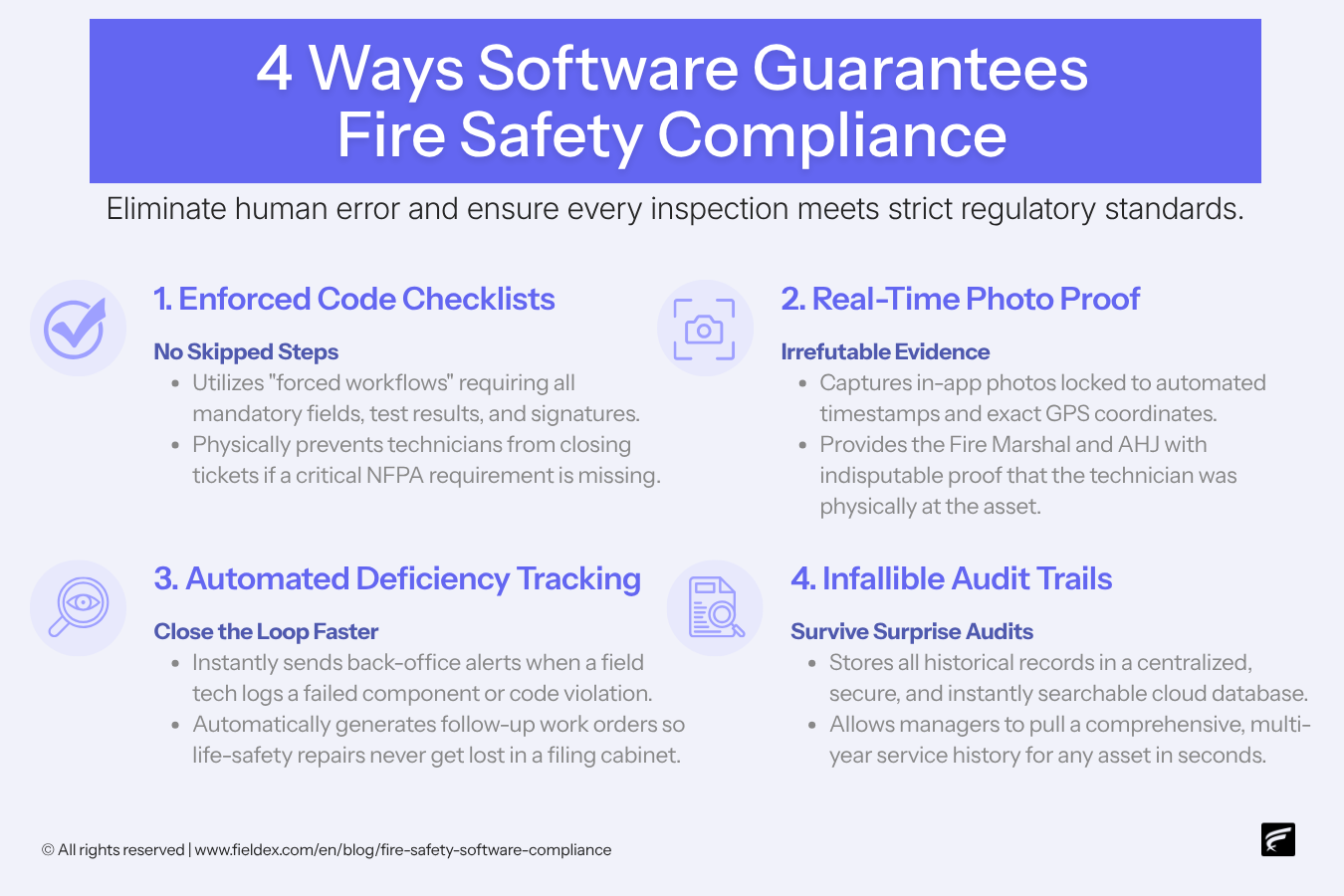
Modern fire safety software relies on "forced workflows". The system prevents a technician from submitting an inspection report until every mandatory field, test result, and signature required by specific NFPA standards is filled out. If a technician checks a fire extinguisher (NFPA 10) but forgets to log the hydro-test date, the software simply will not let them close the ticket.
Software captures irrefutable "proof of work". Technicians can snap photos of extinguisher gauges, alarm panels and sprinkler heads, which the software automatically pins to the exact timestamp and GPS location of the inspection. This provides the authority having jurisdiction (AHJ) and the fire marshal with indisputable proof that your technician was physically standing in front of the asset.
When a technician logs a failed component or a code violation (a deficiency) in the field, paper forms require an admin to read the notes, type up a quote, and schedule a repair. Software like FieldEx automates this. When a deficiency is flagged digitally, the software instantly alerts the back office and generates a follow-up work order. This ensures critical life-safety repairs never get lost in a filing cabinet, permanently closing the compliance loop.
Fire marshals and insurance auditors expect immediate access to historical records. Instead of digging through bankers boxes, software stores all past inspections in a centralized, secure, and searchable cloud database. A facility manager or service contractor can pull a comprehensive 5-year service history for any specific asset in seconds during a surprise audit.
Upgrading to inspection software isn't just about risk mitigation; it is about protecting your bottom line and expanding your business.
Passing critical life-safety inspections should never rely on a ballpoint pen. Software like FieldEx digitizes your entire NFPA library, forces compliance in the field, and generates professional, audit-ready reports before your technician even puts their truck in drive.
FieldEx gives you the asset intelligence to track every sprinkler head, fire panel and extinguisher, while automatically catching deficiencies so you can quote and fix them faster.
Ready to make failed audits a thing of the past? Book a free demo today to see how FieldEx helps you eliminate paper-based liability and guarantee 100% NFPA compliance in the field, or simply reach out. We’re here to help.
Fire safety inspection software is a digital platform used by fire protection contractors and facility managers to conduct, record, and manage safety inspections for fire alarms, extinguishers, and sprinkler systems using mobile devices in the field.
Yes. Leading fire safety software platforms (like FieldEx) are built directly around National Fire Protection Association (NFPA) codes, ensuring that all digital forms, drop-downs and required fields align seamlessly with current legal standards.
Digital checklists prevent violations by utilizing forced workflows. They require technicians to input specific data, take mandatory photos, and capture customer signatures before a report can be finalized, guaranteeing that no regulatory steps or visual checks are skipped.
Yes. In fact, most authorities having jurisdiction (AHJs) and local fire marshals strongly prefer digital reports. Digital records provide clean, legible data backed by timestamped photos and verified signatures, making their auditing process faster and far more reliable than deciphering handwritten, carbon-copy paper forms.
Yes. Fire safety inspection software includes native offline capabilities. Technicians frequently work in concrete pump rooms, basements, or high-rises where cell service drops. The software allows them to complete their forced-workflow checklists, take photos, and capture signatures offline. The system automatically syncs the data to the cloud the moment the mobile device reconnects to a network.
When a technician marks a system component as deficient or non-compliant, the software automatically flags it in the digital report. It instantly notifies the back office and can seamlessly generate a quote or a follow-up work order. This automated tracking ensures that critical life-safety repairs are resolved quickly and never fall through the cracks.
Yes. While reputable platforms come pre-loaded with standard NFPA templates (such as NFPA 25 for sprinklers or NFPA 72 for alarms), enterprise-grade software allows administrators to customize checklists. You can easily add specific questions or steps to comply with unique state, county, or municipal fire code amendments.
Transitioning to a modern software platform (like FieldEx) is highly streamlined. Implementation typically involves importing your existing customer and asset data and outfitting your field team with mobile tablets or smartphones. Because the software guides the technician step-by-step through a forced workflow, field training is actually much faster and easier than teaching a new hire how to navigate a complex physical codebook.

.avif)


This website and its content are the property of FieldEx and are protected by copyright laws. © 2026 FieldEx. Any redistribution or reproduction of part or all of the contents in any form is prohibited, except with our express written permission.
FieldEx Pte Ltd Singapore