What is a multi-trade business? (+ real-world examples)
What is a multi-trade business? We break down the ultimate contracting business model with 5 real-world examples and how to manage the operational chaos.
A multi-trade business is a contracting company that operates multiple specialized service divisions – such as plumbing, HVAC and electrical – under a single corporate entity. This model maximizes customer lifetime value by allowing the company to cross-sell diverse services and consolidate administrative overhead into ONE highly profitable operation.
Let’s face facts. The drive to start your own service business didn't come from a deep desire to manage siloed inventories and complex phase-scheduling. It came from being exceptional at your trade. You started out because you knew how to fix a pipe, pull wire, or repair a compressor better than the guy you used to work for.
But then, you realized something painful: every time you finished a job, your customer was picking up the phone to hire a competitor for a different service. Why let them call someone else to fix their AC when you just rebuilt their pipes?
So, you hired an HVAC tech. Then, maybe an electrician or a solar installer. Congratulations – you’ve built a multi-trade business.
On paper, your revenue has never looked better. You’re cross-selling, dominating the local market, and becoming the ultimate "one-stop-shop" for your customers. But behind the scenes? Your dispatch board looks like a war zone. Your specialized commercial parts are getting mixed up in the wrong vans, your office manager is threatening to quit, and you’re working 70-hour weeks just to keep the wheels from falling off.
The multi-trade model is the undisputed king of contracting profitability – but it’s also an operational nightmare that will eat you alive if you try to run it on basic spreadsheets and whiteboards.
Multi-Trade vs Single-Trade: What’s the catch?
Before you rush to add three new divisions to your company, you need to understand the trade-offs.
The Single-Trade Model: You do one thing, and you do it well. Your inventory is streamlined, your dispatching is straightforward, and your software requirements are basic. However, your growth is hard-capped by your specific market share, and if your specific trade sees a seasonal or economic downturn, your entire cash flow stalls.
The Multi-Trade Model: You own the customer completely. If one division is slow, another picks up the slack. The catch? The operational complexity multiplies. You’re now managing drastically different safety compliances, massive cross-trade warehouses, and competing technician schedules.
Feature
The Single-Trade Model
The Multi-Trade Model
The Promise
Do one thing, and do it perfectly.
Own the customer completely.
The Good (Pros)
✔Streamlined Operations: Simple dispatching and basic software needs.
✔Lean Inventory: Only stock exactly what your specific trade needs.
✔Uncapped Revenue: Easily cross-sell new services to your existing client base.
✔Ironclad Cash Flow: If one division (like HVAC) is slow, another picks up the slack.
The Catch (Cons)
✖Capped Growth: Your revenue hits a ceiling based on your local market share.
✖High Vulnerability: A seasonal slump in your specific trade stalls your entire cash flow.
✖Heavy Overhead: You must manage massive, cross-trade warehouses and diverse safety compliances.
Why are multi-trade businesses so profitable?
Why deal with the headache of running multiple complex divisions? Because when executed correctly, it creates an unbeatable business model.
Frictionless Customer Experience: If a homeowner is building an addition, they don't have to mediate a scheduling argument between an independent plumber and an independent electrician. The multi-trade company handles all the dependencies internally, delivering a premium, frictionless experience.
Maximum Customer Lifetime Value (LTV): You pay the customer acquisition cost (CAC) to acquire a lead exactly once, and then you cross-sell that exact same client for a decade.
Consolidated Administrative Overhead: Running three trades with one HR team, one centralized dispatch office, and one main warehouse dramatically lowers your operating expenses and increases net profit margins.
What do multi-trade operations look like? (with real-world examples)
1. The "Whole-Home" Residential Powerhouse
The Profile: High-volume residential service providers that aim to be the only number a homeowner ever calls.
The Profile: Commercial maintenance partners that manage the ongoing health and compliance of massive corporate campuses, hospitals, and retail chains.
How to transition to a multi-trade model (without going bankrupt)
If you’re currently a single-trade business looking to expand, do not try to launch three new divisions overnight. Follow this proven roadmap:
Dominate Your Core: Ensure your foundational trade is running on autopilot with healthy, predictable margins before you distract yourself with a new venture.
Acquire, Don't Build: The fastest way to add a trade is to acquire a smaller, established company in an adjacent field (eg a large HVAC company buying a smaller, retiring plumber's route). You acquire their licenses, their technicians and their customer list instantly.
Upgrade Your Tech Stack First: Do not bring a newly acquired electrical team into an office running on an old HVAC software system. Upgrade to a multi-trade software platformbefore you merge the teams to ensure a smooth transition.
What are the biggest challenges of multi-trade businesses?
While the financial upside is massive, the multi-trade model is an operational nightmare that will eat you alive if you try to run it on basic spreadsheets and whiteboards. Here are the four biggest roadblocks you will face as you scale:
Phase-Dependency Scheduling: In a single-trade business, your dispatching is relatively straightforward. In a multi-trade business, dependencies rule everything. You cannot dispatch a drywall repair team until the electrical team has finished running their conduit. Managing these competing technician schedules manually almost always leads to wasted travel time and idle crews.
Inventory Bleeding and Cross-Contamination: When you operate multiple divisions out of one main warehouse, things get messy fast. Mixed budgets and cross-contamination of expensive commercial parts between departments can completely destroy your project margins. If a $500 HVAC blower motor accidentally gets logged under the plumbing division's budget, your job costing becomes useless.
Siloed Safety and Compliance Requirements: You’re no longer managing one set of rules; you’re managing drasticallydifferent safety compliances. A generic safety form simply will not work when a solar installer's checklist requires completely different hazard assessments and procedural steps than a commercial plumber's checklist.
Fragmented Data: The quickest way to bottleneck your back office is forcing your team to use one app for field routing, another for fleet maintenance, and a third for invoicing. This siloed approach leaves your dispatch board looking like a war zone and traps your business in the chaos of fragmented data.
How a unified FSM platform like FieldEx solves the chaos
To survive the multi-trade tipping points, you must abandon fragmented software and adopt a unified "single source of truth". Here’s how a purpose-built field service management (FSM) platform like FieldEx neutralizes those operational bottlenecks:
Automated, conflict-free dispatching
Instead of relying on a dispatcher's memory to manage phase dependencies, an advanced FSM uses automated routing. For high-volume work, systems rely on "Round Robin" assignment logic to auto-route jobs fairly across different trade groups. The system automatically recognizes leave schedules, skipping over technicians who are off the clock and assigning the job to the next available person.
Granular inventory control
To prevent cross-contamination of expensive commercial parts, modern FSM solutions require intense inventory control using "User Bins" for every technician. This ensures every part moved from the warehouse to a specific van is tracked and consumed accurately against the right trade's work order.
Enforced trade-specific compliance
You ensure work is done correctly across different trades by using 'Procedures' – reusable templates of grouped tasks. Instead of generic safety forms, tasks can be set as mandatory, meaning the work order cannot be closed until they are finished, enforcing strict sequential completion based on the specific trade being performed.
Capturing lost revenue
The biggest leak in multi-trade revenue is a technician finding a secondary issue but failing to report it. With “Checklist Triggers”, if a technician provides a negative response to a safety question, the system automatically logs the issue, generates a new work order from a template, and assigns it to the proper trade group – all without the dispatcher lifting a finger.
Eliminating fragmented data
You need a platform that handles both your field staff and your equipment. A true unified system acts as both a FSM platform and a CMMS, bringing your people and your heavy iron under one digital roof.
Why is a "single source of truth" crucial?
When your company operates multiple service divisions, data silos are your biggest enemy. A "single source of truth" means that every piece of operational data – from technician schedules and warehouse inventory to compliance forms and fleet maintenance – lives in one centralized database.
To survive the multi-trade tipping points, you must abandon fragmented software and adopt this unified approach. Here’s why establishing a single source of truth is critical to scaling your business:
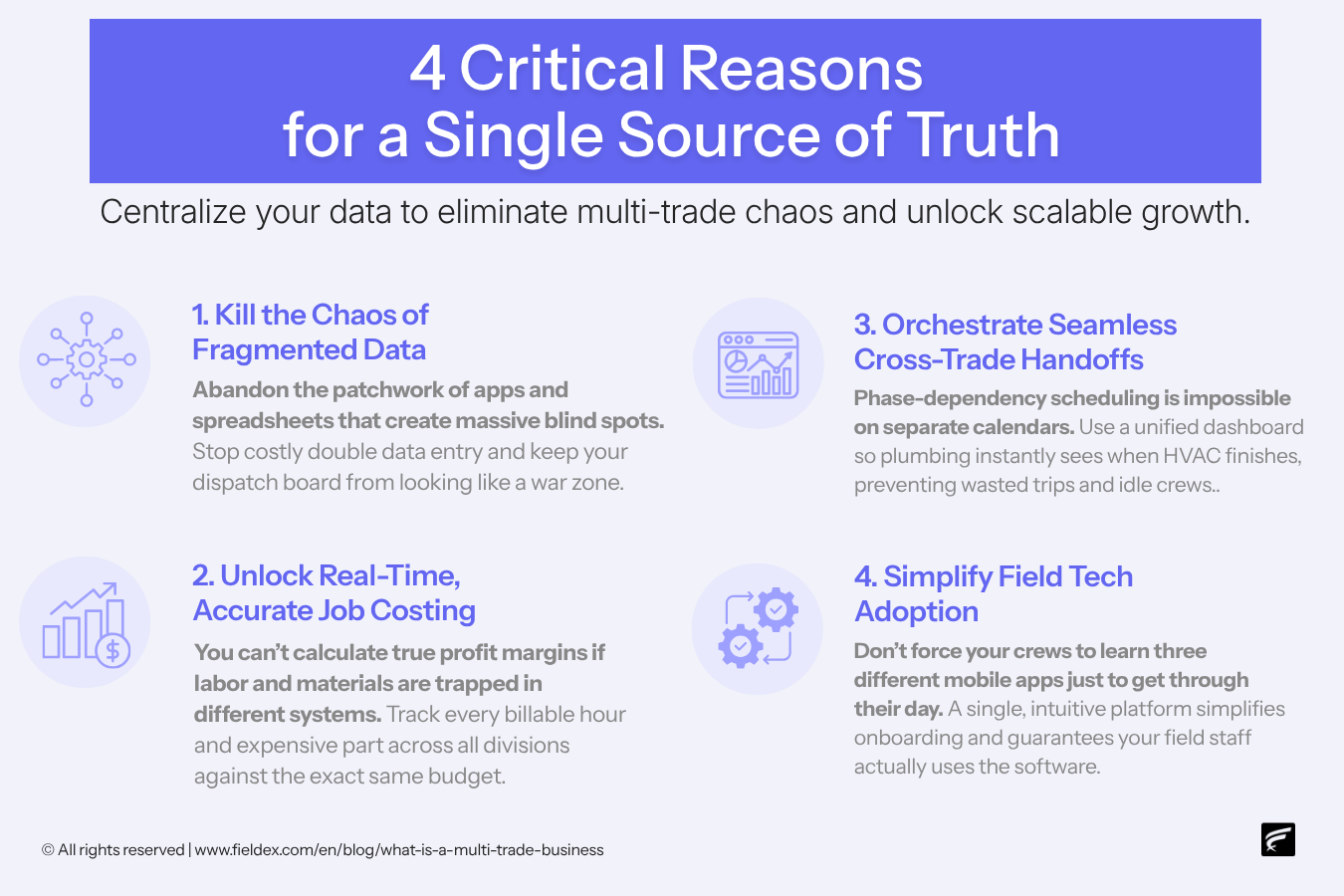
Eliminates the Chaos of Fragmented Data: Running your business on a patchwork of different apps creates massive blind spots. If your dispatch board is on one software, your inventory is in a spreadsheet, and your fleet maintenance is on a whiteboard, your office team is forced to do double data entry, which inevitably leads to costly mistakes and a dispatch board that looks like a war zone.
Real-Time, Accurate Job Costing: You cannot calculate your true profit margins if your labor hours and material costs are trapped in different systems. A single source of truth ensures that every hour worked and every expensive commercial part consumed – regardless of the trade division – is tracked accurately against the exact same project budget.
Seamless Cross-Trade Handoffs: Phase-dependency scheduling is impossible if your teams aren't looking at the same calendar. When everyone operates from a single, unified dashboard, the plumbing division can instantly see when the HVAC division has finished their phase of the project, preventing wasted trips and idle crews.
Simplified Tech Adoption: Upgrading your tech stack is hard enough without forcing your newly acquired technicians to learn three different mobile apps just to get through their day. A unified platform simplifies onboarding, ensuring your field staff actually adopts the software instead of falling back on paper forms and messy text messages.
Master the chaos or get swallowed by it
The multi-trade model is the undeniable future of contracting. The companies that figure out how to manage multiple divisions under one roof will inevitably buy out the competitors who refuse to evolve.
Don't let operational friction hold back your growth. Explore how a hybrid FSM and CMMS like FieldEx adapts to your specific multi-trade lingo, automates your cross-selling opportunities, and tracks your heavy equipment so you can scale your business without the daily headache.
Want to see FieldEx in action? Book a free demo today, or simply get in touch. Let us help you scale your business without the chaos of fragmented-data.
Frequently asked questions
1. What exactly is a multi-trade business?
A multi-trade business is a contracting company that operates multiple specialized service divisions – such as plumbing, HVAC and electrical – under a single corporate entity.
2. Why are multi-trade businesses generally more profitable than single-trade shops?
This model maximizes customer lifetime value by allowing the company to cross-sell diverse services. Furthermore, running three trades with one HR team, one centralized dispatch office, and one main warehouse dramatically lowers your operating expenses and increases net profit margins.
3. What is the biggest operational hurdle when transitioning to a multi-trade model?
The operational complexity multiplies. Instead of straightforward dispatching, you’re now managing drastically different safety compliances, massive cross-trade warehouses, and competing technician schedules.
4. What is the fastest, safest way to transition from a single-trade to a multi-trade model?
The fastest way to add a trade is to acquire a smaller, established company in an adjacent field. This allows you to acquire their licenses, their technicians and their customer list instantly.
5. Why is a "single source of truth" important for multi-trade companies?
Hi there! I'm Sophie Liu from FieldEx. I love finding simple and smart solutions to the tricky problems field service teams face every day. My background in tackling everything from various field service industries helps me write content that's not just easy to read, but useful for improving your business. Whether you're looking to make your day-to-day operations smoother or aiming to grow, I'm here to help with advice that works. Let's make things better together!
Don’t just take our word for it
Hear from some of our amazing customers who used FieldEx
"If you want to solve your paper record problems and you want to digitize your operations and you want to elevate your customer experience go and use FieldEx"

.png)
.png)
.png)

%20(1).png)

.avif)

