
.png)

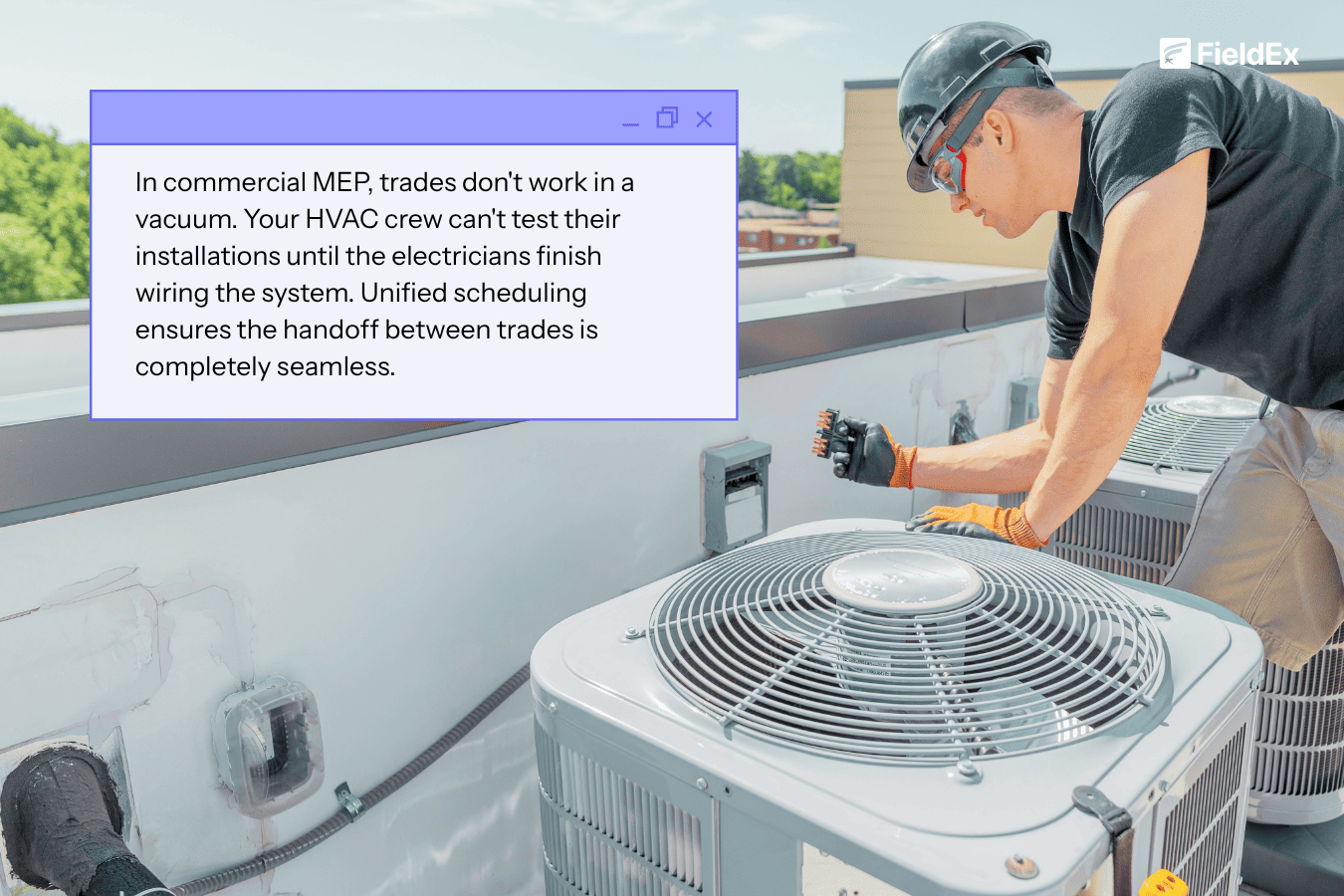
While single-trade scheduling involves matching one technician to one time slot, multi-trade scheduling requires orchestrating complex phase dependencies across entirely different departments. If the electrical team is delayed, the drywall team cannot start. This cascading domino effect makes multi-trade dispatching exponentially more difficult to manage without automated field service management (FSM) software.
Picture your dispatch office on a Tuesday morning. The whiteboard is a chaotic web of red markers, overlapping sticky notes, and frantic erasures. The commercial electrical team is running an hour behind on a major facility retrofit, which means the structural team scheduled for the afternoon is now blocked. Because the structural team is blocked, the HVAC crew scheduled for Wednesday can't run their ductwork.
In the span of sixty minutes, a single electrical delay has completely nuked your entire week’s schedule, leaving highly paid technicians sitting idle and project margins bleeding out.
The multi-trade model is the undisputed king of contracting profitability – but only if you can master the chaos of cross-trade dispatching.

To truly understand the gap between single-trade and multi-trade operations, here’s a look at how two different dispatchers handle a morning emergency.
A call comes in for a burst pipe at a retail store. The dispatcher opens a map, finds the closest available plumber, drags the job onto their calendar, and sends a notification. The crisis is handled in three minutes.
A call comes in for a massive commercial water heater failure that has flooded a server room.
But there’s a catch: The electrician cannot safely enter until the water is cleared. The HVAC team needs the heavy lift-gate truck to move the new heater, but the solar division took that truck to a site three towns over. The dispatcher is now making 10 different phone calls just to get the job started. Total chaos ensues.
At its core, the difference comes down to linear versus multi-dimensional logistics.
If you’re trying to scale a multi-trade operation on generic software, you’ll inevitably smash into these 5 operational roadblocks:
You cannot send the structural team in to close a ceiling before the commercial electricians have finished running their conduit. In a multi-trade business, a single parts delay in "Phase One" creates a ripple effect that forces your dispatchers to manually call, cancel, and reschedule three other technicians assigned to subsequent phases.
In the commercial sector, you aren't just looking for a warm body to put in a truck. A complex job might require a master electrician for the first two hours to handle the main panel, and a journeyman to finish the conduit in the afternoon. If your software just looks for "available time" without verifying specific trade certifications, you risk massive compliance failures on commercial sites.
Scheduling isn't just about managing time; it's about managing parts. Imagine perfectly scheduling your top HVAC tech for an 8 am compressor replacement. However, the night before, a technician from your plumbing division raided the shared warehouse and used the exact copper fittings your HVAC tech needed. Now, your scheduled tech is sitting idle in a parking lot.
When division managers use different spreadsheets or legacy apps, the right hand has no idea what the left hand is doing. The electrical dispatcher might think a commercial site is ready for wiring, but the mechanical team hasn't updated the master calendar to show they are running a day behind.
You aren't just dispatching human beings; you’re dispatching heavy equipment. If your master electrician is available, but the bucket truck they need is sitting in the shop for an overdue hydraulic repair, your schedule still blows up. If your scheduling software doesn't talk to your fleet maintenance software, you’re operating with a massive blind spot.
Scheduling failures don't just cause office headaches; they actively destroy your bottom line.

The solution is simple – adopt a unified digital platform that automates the complexity. Here’s how modern systems fix the multi-trade scheduling nightmare:
Scheduling shouldn't be the hardest part of running your business. If your dispatchers are constantly stressed, your field crews will be frustrated, and your commercial clients will notice the lack of coordination.
The multi-trade businesses that dominate their markets aren't the ones working the hardest – they’re the ones with the smartest digital infrastructure. It’s time to ditch the fragmented calendars, whiteboards and messy spreadsheets. Unify your entire operation with a hybrid FSM and CMMS platform like FieldEx that handles complex dependencies automatically, keeping your multi-trade teams moving flawlessly from phase one to final sign-off.
Single-trade scheduling is linear; it simply involves matching an available technician to an open calendar slot. Multi-trade scheduling is multi-dimensional; it requires coordinating phase prerequisites, specific license classes, shared inventories, and overlapping departmental timelines to get a single project to the finish line.
Phase dependencies mean one job physically cannot start until another is finished. For example, a drywall crew cannot close a ceiling until the electrical division has finished running their conduit. If the first phase is delayed, every subsequent phase must be rescheduled.
When multiple divisions share a single warehouse without granular tracking, one trade (like plumbing) might accidentally consume the parts reserved for another trade's (like HVAC) upcoming job. This means a perfectly scheduled technician might arrive at a site without the required materials, wasting non-billable hours.
"Windshield time" refers to the hours technicians spend driving instead of working. In multi-trade operations with poor communication, technicians often drive to a commercial site only to realize the prerequisite work from another division isn't finished yet, resulting in a wasted trip that eats directly into your profit margins.
Basic calendars and spreadsheets don't communicate with your inventory, track your fleet maintenance, or enforce job prerequisites. They rely entirely on a dispatcher's memory to avoid overlapping jobs, matching specific certifications, or double-booking specialized equipment.
You aren't just scheduling human beings; you’re scheduling iron. If you dispatch your best master electrician to a commercial site, but the bucket truck they need is in the shop for an overdue hydraulic repair, the schedule blows up. A unified FSM and CMMS platform ensures you only dispatch when both the people and the equipment are ready.
Round Robin routing eliminates the need to manually drag and drop appointments. The software automatically cycles through available technicians in a specific trade group, skipping anyone who is on leave or off the clock, ensuring emergency jobs are distributed fairly and instantly.
It means all of your operational data lives in one centralized digital platform. When your dispatchers, warehouse managers, and field techs are all looking at the exact same dashboard, communication silos instantly collapse and costly double-data entry is eliminated.
Advanced FSM software digitally locks subsequent work orders until the prerequisite phase is marked "Complete" and signed off in the field. Once the first team captures their digital signature, the system automatically notifies the next trade group that the site is ready for them.
In commercial work, compliance is incredibly strict. You can't just dispatch the closest "warm body"; a job might legally require a master electrician rather than a journeyman. Automated software matches the exact certification required to the job requirements, preventing massive compliance failures and legal liabilities.

.avif)


This website and its content are the property of FieldEx and are protected by copyright laws. © 2026 FieldEx. Any redistribution or reproduction of part or all of the contents in any form is prohibited, except with our express written permission.
FieldEx Pte Ltd Singapore