

.png)
For a long time, managing commercial solar felt like a breeze. You’d slap some panels on a commercial roof or out in a dusty field, wire up an inverter, and as long as someone remembered to occasionally mow the grass underneath them, the system mostly took care of itself.
Those days are over. Today, commercial developments, logistics depots, and municipal microgrids are increasingly deploying integrated systems where solar generation, battery storage, and even electric vehicle (EV) charging infrastructure coexist directly behind the same meter. It makes perfect economic sense. But operationally? It's a completely different beast.
You’re no longer just managing a passive generation asset; you are managing a highly volatile, high-voltage chemical power plant right next to it. This introduces a massive "maintenance gap" for operations and maintenance (O&M) teams. Your digital monitors – often part of a supervisory control and data acquisition (SCADA) system – might ping you that a battery rack is overheating. But an alert is entirely useless if your software doesn't automatically trigger a work order, dispatch a qualified technician, and reserve the massive cooling pump required to fix it.
.png)
Commercial solar and battery systems (BESS) are managed together because they function as a single, interdependent microgrid behind the same meter. The solar panels generate the renewable power, while the battery system stores and stabilizes that energy for dispatch when grid demand or market prices are highest.
When these assets converge, the maintenance strategy has to evolve. You can't just fix the solar array and ignore the storage container humming loudly next to it. They rely on each other to meet the financial targets of the site, which means your O&M approach has to treat them as a unified ecosystem.
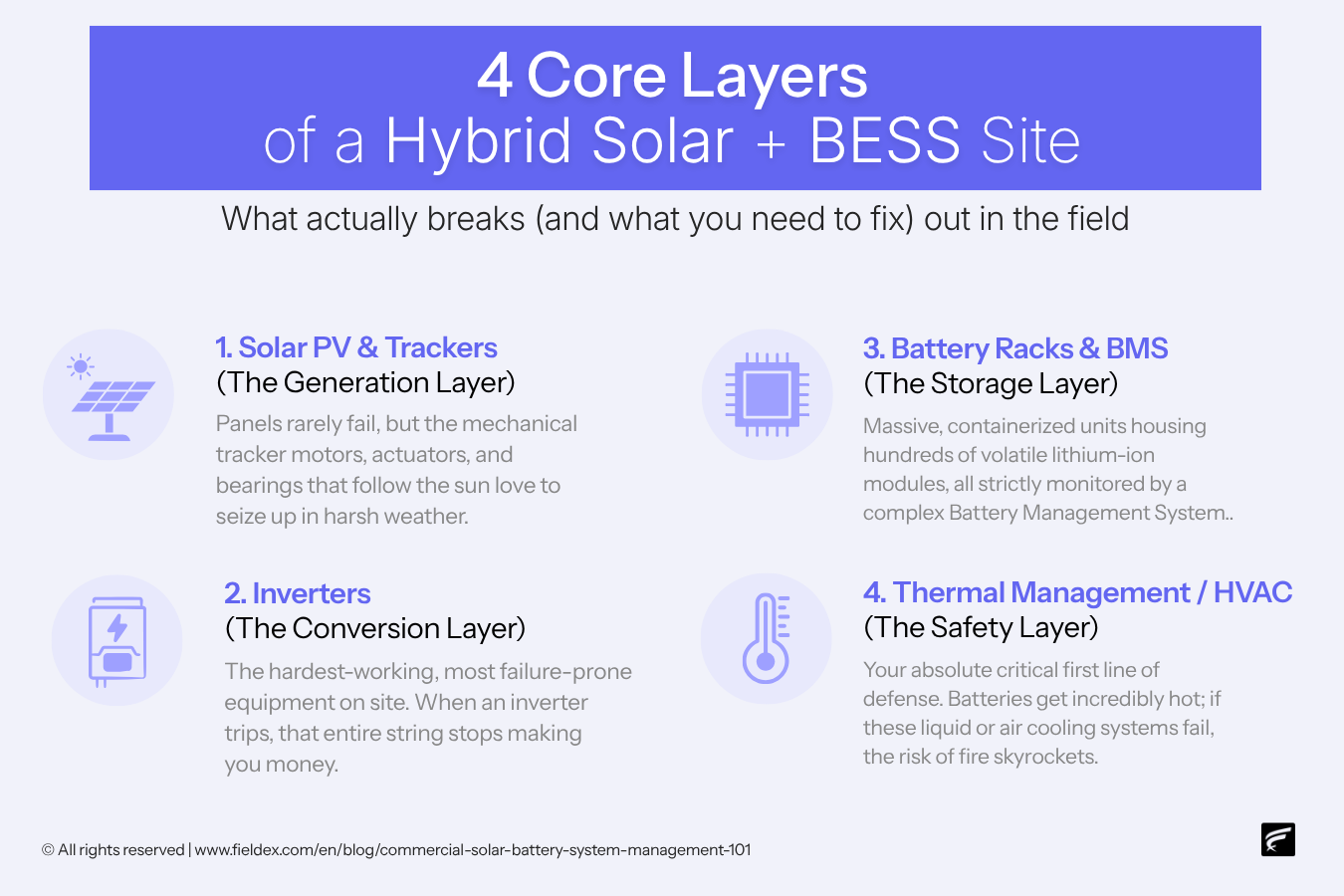
The core components of a hybrid solar and BESS site include the solar photovoltaic (PV) arrays for generation, string or central inverters for DC-to-AC power conversion, lithium-ion battery racks for storage, and critical thermal management (HVAC) systems to prevent overheating.
To manage these sites without losing your mind, we need to speak the same language. Here is a quick breakdown of what actually breaks and needs fixing out in the field:
The biggest operational risks in commercial solar and battery management are thermal runaway fires in lithium-ion batteries, unplanned inverter downtime that immediately halts Power Purchase Agreement (PPA) revenues, and voided OEM warranties due to poorly documented maintenance.
When you combine passive solar with volatile chemical storage, the stakes go through the roof. Here’s what keeps chief engineers awake at night:
A lithium-ion battery fire isn't just a regular fire; it’s a "thermal runaway" event that produces its own oxygen and is notoriously difficult to extinguish. In fact, a recent report by the Electric Power Research Institute (EPRI) concluded that sub-standard integration, assembly, and construction work – particularly involving HVAC and Balance of System components – was the root cause in 36% of BESS failures. Because of this extreme risk, the industry is heavily governed by rigorous safety codes like NFPA 855. This standard mandates documented Hazard Mitigation Analysis (HMA) and recurring, stringent inspections of fire suppression and ventilation systems. Failing a fire marshal audit here isn't a slap on the wrist; it's a shutdown order.
In commercial solar, downtime results in direct, unrecoverable revenue loss and potential breach of PPAs – the contracts that dictate how much power you promised to sell to the grid. Every minute an inverter is offline, you are literally bleeding cash.
Original equipment manufacturers (OEMs) look for any excuse to void a warranty. If a massive central inverter blows a capacitor and you cannot provide an immutable, digital log proving that a certified technician changed the air filters exactly when the manual said to, you are paying out of pocket.
.png)
To successfully manage a hybrid solar and battery site, operators must implement granular asset genealogy tracking, execute dynamic meter-based preventive maintenance, enforce mandatory digital safety compliance workflows (like Lockout/Tagout), and maintain a highly accurate 3-tier inventory system for high-voltage spare parts.
You can't run a modern site on spreadsheets, casual text threads, and good vibes. It just doesn't work. To protect your assets, your maintenance operations need to be built on these four pillars:
You can't just track "Battery Container A" and call it a day. You need software that supports multi-level asset hierarchies. This allows you to track a massive system down to the specific inverter string or the exact serial number of a replacement battery module (known as child assets under a parent asset).
Starting strictly on February 18, 2027, every industrial battery and electric vehicle (EV) battery with a capacity greater than 2 kWh placed on the EU market is legally required to have a digital battery passport. This isn't just a basic label; it requires a persistent digital record – accessible via a physical QR code – that captures the battery's real-time state of health, carbon footprint, precise material composition (like recycled cobalt, nickel and lithium thresholds), and complete maintenance history from cradle to grave. If your maintenance software cannot track granular asset genealogy down to the individual module's serial number, your BESS operation simply won't be compliant.
Calendar-based maintenance is practically a dinosaur. Modern O&M requires dynamic scheduling that adapts to actual wear and tear. You should be utilizing two main strategies:
You cannot trust human memory when high voltage is involved. Your software should act as a rigid compliance mechanism, taking the guesswork out of the field:
Parts consumption on a hybrid site is a logistical nightmare. You need a deeply granular three-tier inventory structure that tracks an expensive spare part across its entire lifecycle:
When a tech uses a part on a job, they log it directly within the work order on their mobile app. This instantly creates a fully auditable paper trail from the warehouse to the broken inverter, ensuring you never lose track of a $5,000 component again.
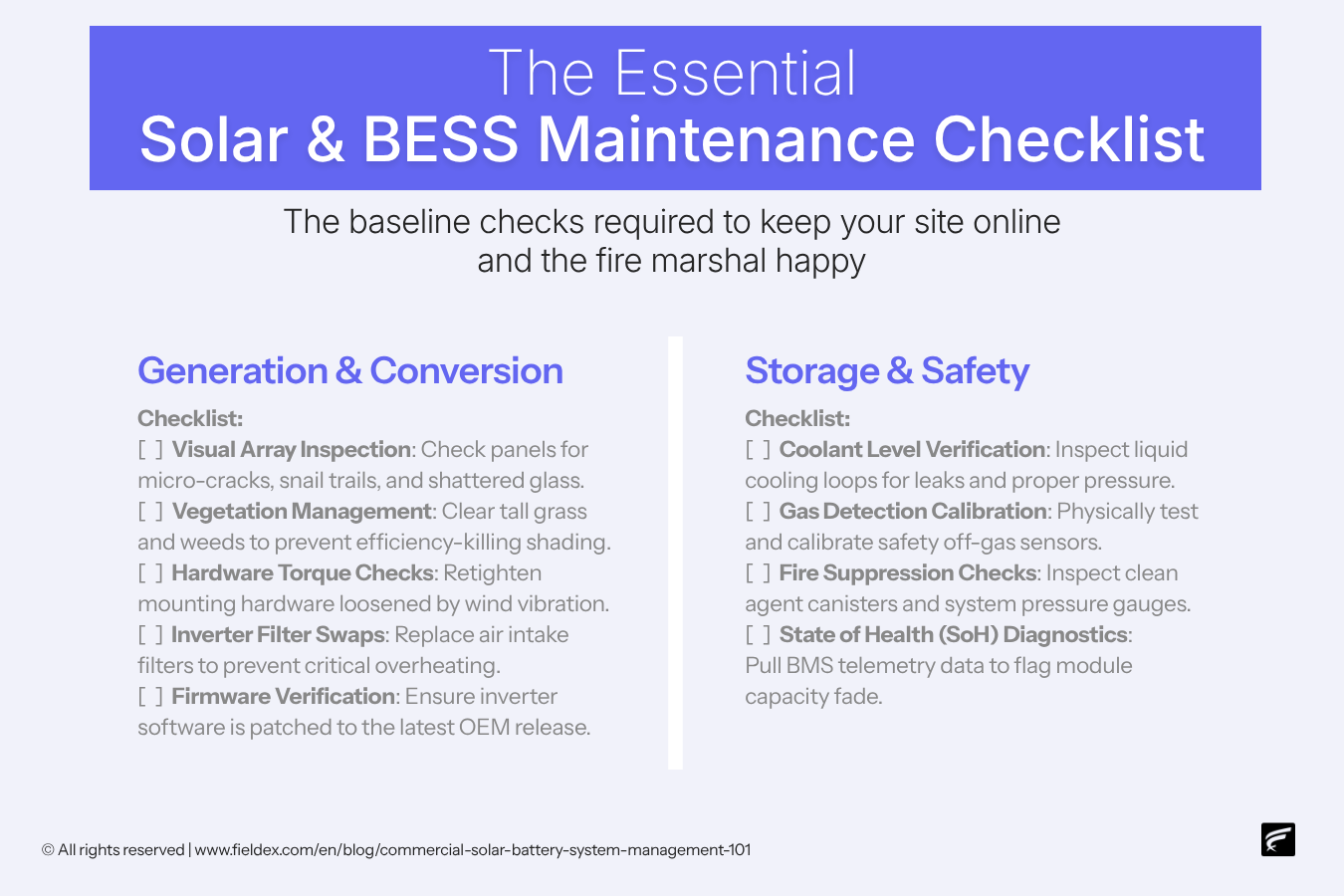
A commercial solar and battery preventive maintenance checklist should include visual array inspections, vegetation management, inverter filter replacements, firmware updates, and rigorous BESS checks covering coolant levels, gas detection sensor calibration, and State of Health (SoH) diagnostics.
Want to keep your site online and the fire marshal happy? Steal this baseline checklist:
The best software stack for commercial solar and BESS management pairs an asset performance management (APM) tool to digitally monitor telemetry data and predict yield, with a specialized Computerized Maintenance Management System (CMMS) to physically dispatch technicians, track spare parts, and enforce safety compliance.
The biggest mistake operators make is buying the wrong type of software. Let's clear up the alphabet soup.
Tools like Power Factors or Radian are your APMs. They focus on data analytics, predict yield, analyze power curves, and detect underperformance. However, they are "brains without hands". They won't schedule a guy to mow the grass or swap a part.
This is where platforms like FieldEx come in. A CMMS combined with field service management (FSM) acts as the "hands". It’s a structured, end-to-end digital workflow that manages the people, the work, the parts, the compliance, and the offline mobile documentation.
You can't run a profitable portfolio with just one. You need the APM to detect the fault, and the CMMS to actually dispatch the technician and document the repair. A modern operation integrates the two via API, creating a closed-loop system where an alert instantly becomes a dispatched truck roll.
Mastering solar and battery system management isn't just about preserving your physical assets; it's about preserving your bottom line. The transition to decentralized energy is chaotic, and the days of treating commercial solar like a "set it and forget it" investment are long behind us.
By implementing strict asset genealogy, automating your safety compliance, and closing the gap between your digital monitoring tools and your physical field technicians, you build an operation that doesn't just react to fires (literally or figuratively) – you prevent them.
Your APM tells you something is broken, but relying on the chaos of WhatsApp groups and endless spreadsheets to actually get it fixed is a recipe for disaster. If you're tired of chasing down technicians for compliance paperwork or losing track of $5,000 inverter parts, we need to talk. FieldEx is the purpose-built execution layer that actually gets the wrench turned safely – automating your dispatch, enforcing compliance, and tracking your high-voltage parts down to the technician's van.
Want to see how FieldEx works in the real world? Book a free demo today, or get in touch. We’re here to help.
It depends entirely on the OEM manual, but generally, visual inspections and vegetation management happen quarterly, while deep inverter and battery HVAC maintenance occurs bi-annually or annually.
Solar O&M is largely mechanical and electrical (cleaning panels, checking torque, testing string voltage). BESS O&M is highly focused on thermal management, strict fire code compliance, and complex software (BMS) diagnostics.
You use an asset performance management (APM) tool to ingest data directly from the battery's internal management system, allowing you to see capacity fade and cell degradation over time.
Solar panels are wired in series. If a tall weed shades even a tiny corner of one panel, it acts like a kink in a hose, dragging down the power output of the entire string of panels connected to it. It is a purely "field service" task that sophisticated APM tools ignore but a CMMS handles natively.
You need an APM for data analytics, paired seamlessly with a specialized CMMS to handle the physical field execution, inventory tracking, and safety compliance.
It is a formal, documented engineering analysis required by fire codes like NFPA 855. It evaluates the consequences of a battery failure (like a fire or explosion) and proves that the system's safety designs can safely mitigate those risks.
Instead of scheduling maintenance on a calendar date, the CMMS triggers a work order when the asset hits a specific usage metric – such as when a battery reaches 500 charge cycles or a solar tracker motor hits 1,000 hours of runtime.
Yes. A robust CMMS allows you to set up customized work order types and asset categories, meaning the same technician can log an EV charger repair and a solar inverter inspection within the same mobile app.
The DC electricity generated by the panels can no longer be converted to AC power for the grid. The entire section of the solar array connected to that inverter goes completely offline, instantly halting revenue generation.
They act as a forced compliance mechanism. By setting critical safety steps (like testing fire suppression) as mandatory within a digital procedure, technicians are physically blocked from closing out a job until the checklist is complete, ensuring an auditable paper trail.

.avif)


This website and its content are the property of FieldEx and are protected by copyright laws. © 2026 FieldEx. Any redistribution or reproduction of part or all of the contents in any form is prohibited, except with our express written permission.
FieldEx Pte Ltd