

.png)
While solar panels technically have no moving parts, they are not immune to physics. In 2026, micro-cracks, blown bypass diodes, soiling and vegetation shading are costing independent power producers (IPPs) millions in lost yield.
Asset owners are increasingly aggregating diverse portfolios of assets acquired from different developers, meaning a single IPP might own 50 solar sites with inverters from five different manufacturers. This creates a critical "maintenance gap". Legacy operations and maintenance (O&M) software is often proprietary to the hardware, forcing asset managers to log into a dozen different systems.
Furthermore, the software landscape is dominated by monitoring tools that generate data but do not drive action. Asset managers are drowning in diagnostic data; an alert from a SCADA system that an inverter is down is useless if it doesn't automatically trigger a work order, assign a technician, and reserve the necessary spare part.
To manage decentralized green energy infrastructure effectively, you need an "execution layer" to bridge the gap between digital monitoring (Detection) and physical field service (Resolution).
The defining characteristic of modern green infrastructure is not efficiency, but operational resilience. In the context of critical infrastructure, downtime is a regulatory violation and a safety hazard. Downtime results in direct, unrecoverable revenue loss and potential breach of power purchase agreements (PPAs).
When evaluating these platforms, we looked past AI marketing hype and focused on concrete industrial capabilities. We prioritized software that enforces rigorous safety checks, mitigates direct revenue loss, and successfully consolidates the "execution layer" across solar, BESS and EV infrastructure.
Because solar arrays are critical energy assets, their financial viability relies heavily on strict uptime contracts, commonly framed as equipment availability guarantees within operations and maintenance (O&M) and power purchase agreements (PPAs). If a system underperforms or fails to deliver power as promised, the operator is often required to pay liquidated damages to the energy buyer. Managing thousands of distributed panels using generic facility tools or manual spreadsheets leads to unrecoverable revenue loss, voided hardware warranties, and costly PPA penalties. Dedicated O&M software translates complex yield data into immediate, auditable field action.
While a single residential solar setup can be monitored with a smartphone app, managing commercial or utility-scale portfolios is a completely different operational challenge. As your portfolio scales, the "Cost of Inaction" (COI) compounds rapidly.
Here is exactly why relying on manual spreadsheets is failing modern Independent Power Producers (IPPs):
Buying standalone CMMS software just for solar is a strategic vulnerability. The technician required to service a high-voltage solar inverter is often the exact same profile of electrician required to fix a DC fast charger. The workflow must be unified.
By adopting a consolidated 'execution layer', operators consolidate this physical workflow. A single mobile app manages the labor, inventory and compliance across the entire mixed portfolio.
If you're evaluating software in 2026, ensure it possesses these 3 core capabilities:
This category bridges the critical gap between digital alerts and physical fieldwork. These are the operational engines that actually get the wrenches turning – dispatching technicians, managing complex multi-tier spare parts inventory, and enforcing strict safety compliance on the ground.
Best for: Operators who want one dedicated system for field maintenance, safety and mixed-asset portfolios.

FieldEx is the premier 'execution layer' designed to act as the central operating system for distributed energy resources (DERs). Unlike legacy CMMS platforms built for static factory environments, FieldEx is explicitly engineered for the "green umbrella" – natively managing integrated, multi-asset portfolios of commercial solar, battery storage (BESS), and EV charging infrastructure. It's a mobile-first platform built to handle the complex, decentralized logistics of field engineers working across vast geographic territories.
Why it made the list: It earned the top spot because it effectively eliminates the "maintenance gap" between digital detection and physical resolution. While standard APM software stops at generating a fault alert, FieldEx is designed to ingest that data and automatically translate it into compliance-driven field execution. It guarantees that a dispatched technician arrives on-site with the exact required components, significantly reducing wasted truck rolls.
Best Paired With: Power Factors, Radian, Microsoft Power BI, and any CPMS/CSMS system via RESTful API and OAuth.

Built by solar veterans David Penalva and James Nagel, SolarGrade evolved out of their technical advisory firm, HelioVolta. Having logged thousands of hours on-site as field engineers and NABCEP-certified inspectors, they designed a purpose-built field mobility app to address workmanship errors and QA/QC bottlenecks. In 2022, SolarGrade won the American-Made Solar Challenge for Software.
Why it made the list: It excels at standardizing site audits and punch lists, making it the ideal tool for QA/QC processes.
Best Paired With: A comprehensive execution layer and APM software.

60Hertz Energy was created to solve the unique maintenance challenges of off-grid and remote energy assets. It's a niche CMMS built specifically for extreme off-grid environments. If your solar array is paired with diesel generators in a location where Wi-Fi and cellular networks do not exist, 60Hertz provides exceptional offline-sync capabilities. Its mobile-first, "glove-friendly" design makes it the preferred tool for operators working in rugged locations like Alaska or emerging minigrid markets.
Why it made the list: It solves the specific problem of maintaining assets in environments with zero cellular connectivity.
Best Paired With: Off-grid inverter hardware portals and localized SCADA.
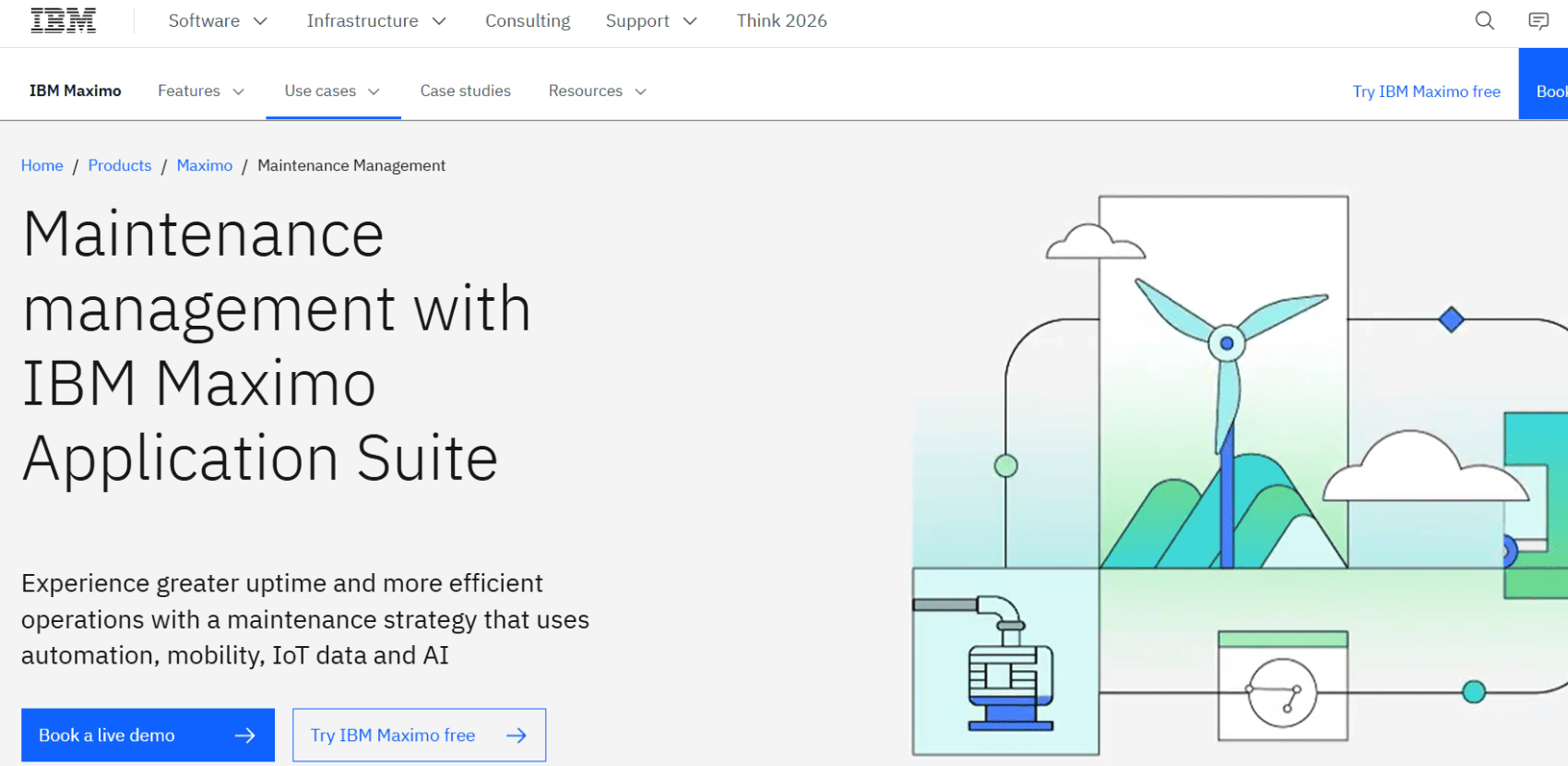
Maximo is the old guard of enterprise software, with a legacy stretching back to 1985 before being acquired by IBM in 2006. Today, it is the heavyweight champion of enterprise asset management (EAM) built to manage immense, centralized enterprise infrastructure. While it is incredibly expensive and notoriously lacks mobile usability for field technicians executing modern, distributed work, it is strictly necessary for major utilities that need to tie multi-decade asset depreciation directly into global ERP systems.
Why it made the list: Maximo excels at enterprise-level grid integration and tracking the depreciation of assets over multi-decade lifecycles.
Best Paired With: Heavy enterprise ERPs (like SAP), utility SCADA systems.
This category serves as the analytical nervous system of your solar portfolio. While these tools will not dispatch a truck or track a spare part, they ingest massive amounts of SCADA and telemetry data to pinpoint exact yield losses and detect underperforming hardware before a critical failure occurs.
Best for: Centralized control rooms analyzing data, performance and hardware alerts.
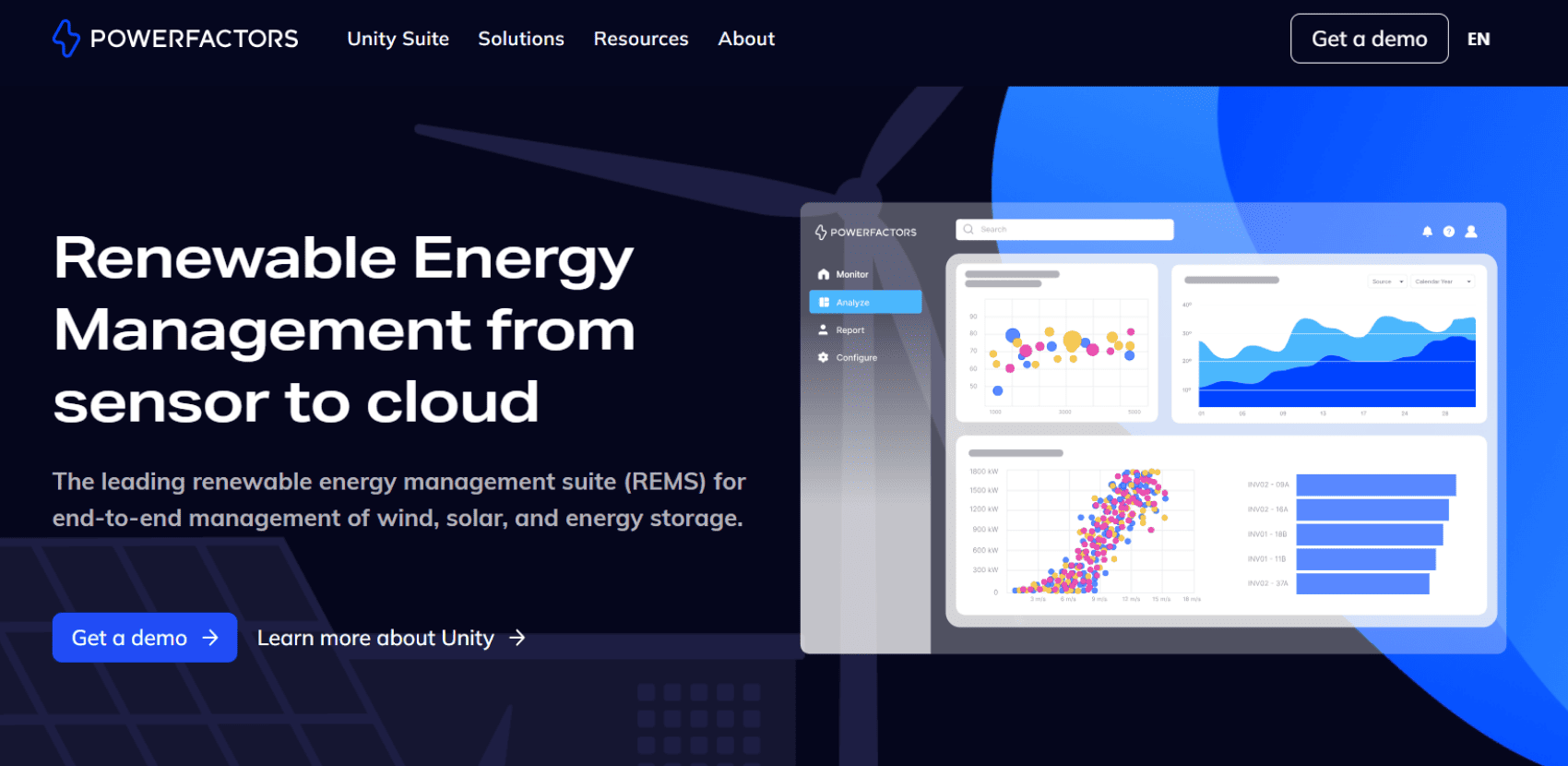
Power Factors is an absolute behemoth in the renewables space, managing nearly 200 GW of global wind, solar and storage assets. The company rapidly expanded its technological footprint through strategic acquisitions, notably acquiring Greenbyte in 2021 and the hybrid SCADA provider Inaccess in 2022. It focuses on the data analytics side of renewable energy, predicting yield, analyzing power curves and detecting underperformance.
Why it made the list: It is the industry standard for deep data analytics and SCADA monitoring, serving as the "brains" of an operation.
Best Paired With: FieldEx (to act as the 'execution layer' for dispatched truck rolls), and OEM hardware monitoring portals.
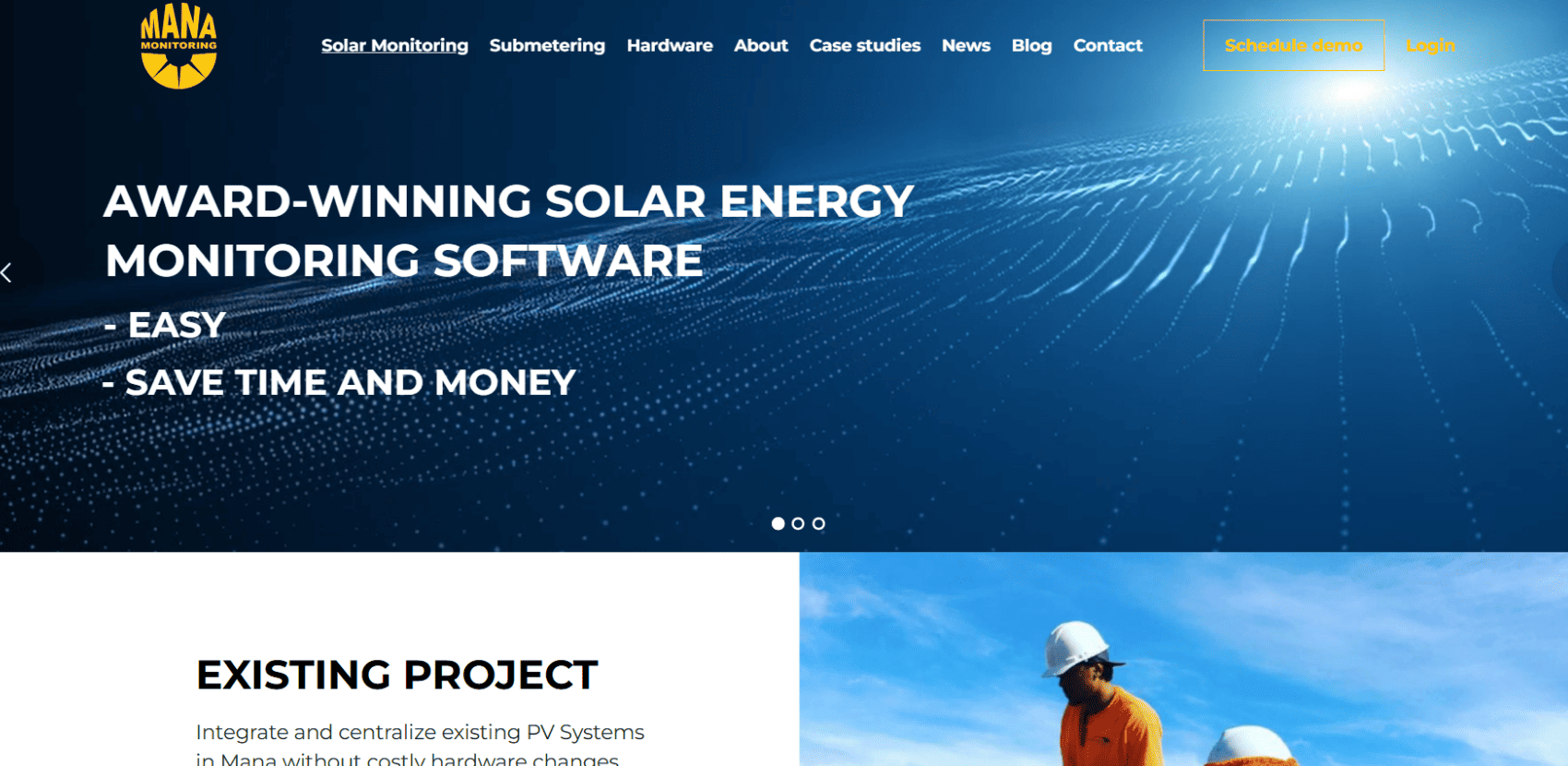
Originally based in Hawaii, Mana Monitoring cut its teeth managing complex, highly volatile island grids before expanding. This unique history translates perfectly to the mainland Commercial & Industrial (C&I) sector, where it excels as an agile, hardware-agnostic alternative to massive utility APMs. It aggregates data from various inverter brands across multi-tenant commercial sites into a single, unified dashboard, drastically simplifying energy management and billing for property managers.
Why it made the list: It is the agile, C&I-focused alternative to massive utility APMs, capable of aggregating data from various inverter brands into a unified dashboard.
Best Paired With: Execution layer software for dispatching technicians.
AlsoEnergy provides an edge-to-cloud clean energy monitoring and SCADA platform, heavily utilized in the commercial & industrial solar sector. Acquired by the smart energy storage company Stem Inc in 2022, its flagship application, PowerTrack, is a powerhouse for remote troubleshooting and hardware telemetry monitoring. It gives control room engineers the ability to remotely troubleshoot inverter faults and string-level anomalies before authorizing a physical truck roll.
Why it made the list: Its flagship application, PowerTrack, is a powerhouse for remote troubleshooting and hardware telemetry monitoring.
Best Paired With: FieldEx, legacy enterprise CMMS platforms, and accounting software.
Solar panels frequently fail visually and thermally long before they fail electrically. This category provides the "eyes" of your operation, leveraging AI and drone thermography to map physical anomalies – like micro-cracking and diode failures – directly to a highly accurate digital twin of your site.
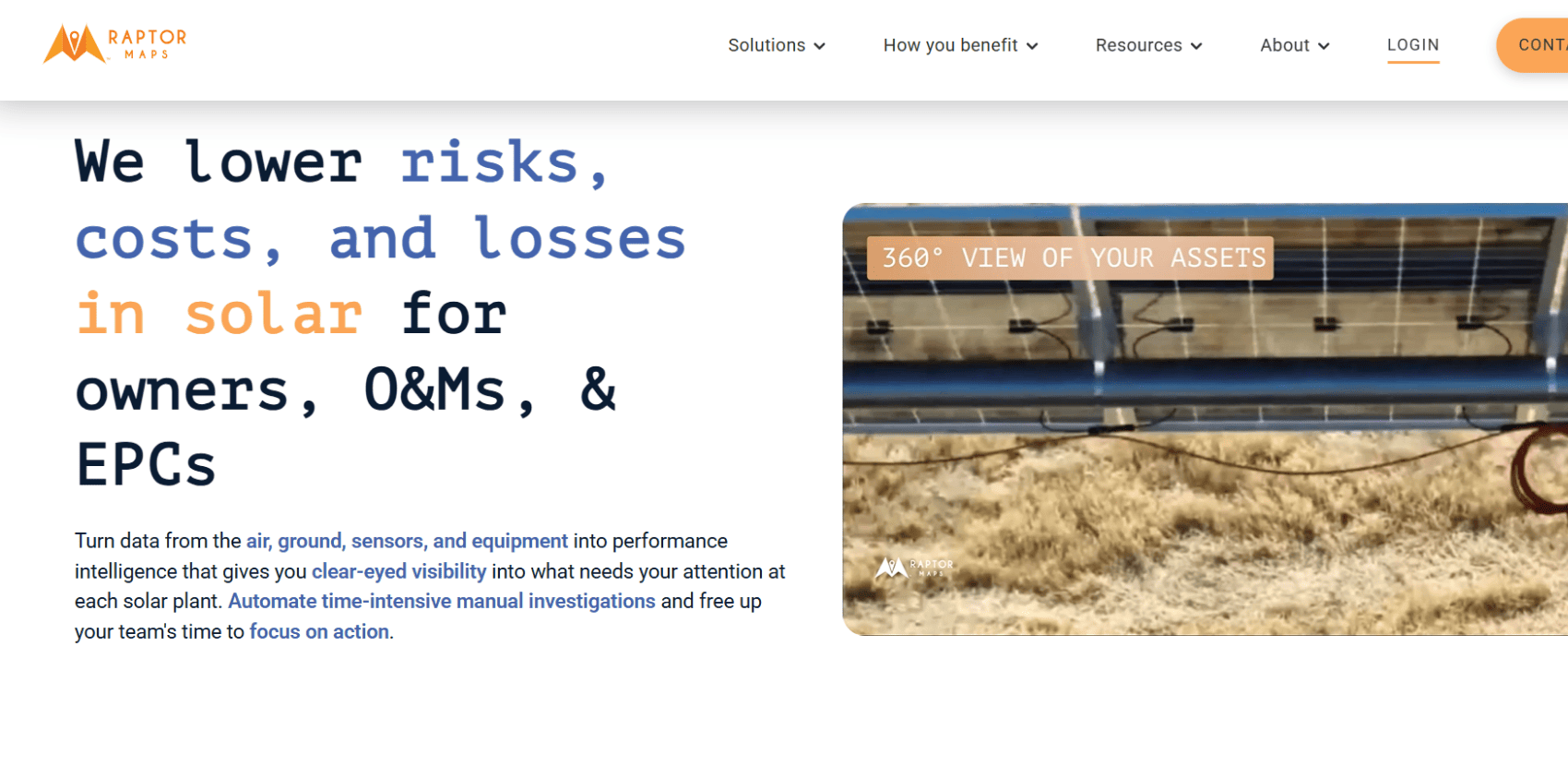
Born out of the Massachusetts Institute of Technology (MIT) by aerospace engineers Nikhil Vadhavkar and Eddie Obropta, Raptor Maps is the absolute industry standard for drone-enabled solar inspections. It uses AI to ingest thermal drone imagery, identifying specific panel anomalies (micro-cracking, severe soiling, blown bypass diodes) and mapping them precisely to a digital twin of your solar site.
Why it made the list: It uses AI to analyze thermal drone imagery, identifying specific panel anomalies (cracking, soiling, diode failures) and mapping them precisely to a digital twin.
Best Paired With: FieldEx, Power Factors.
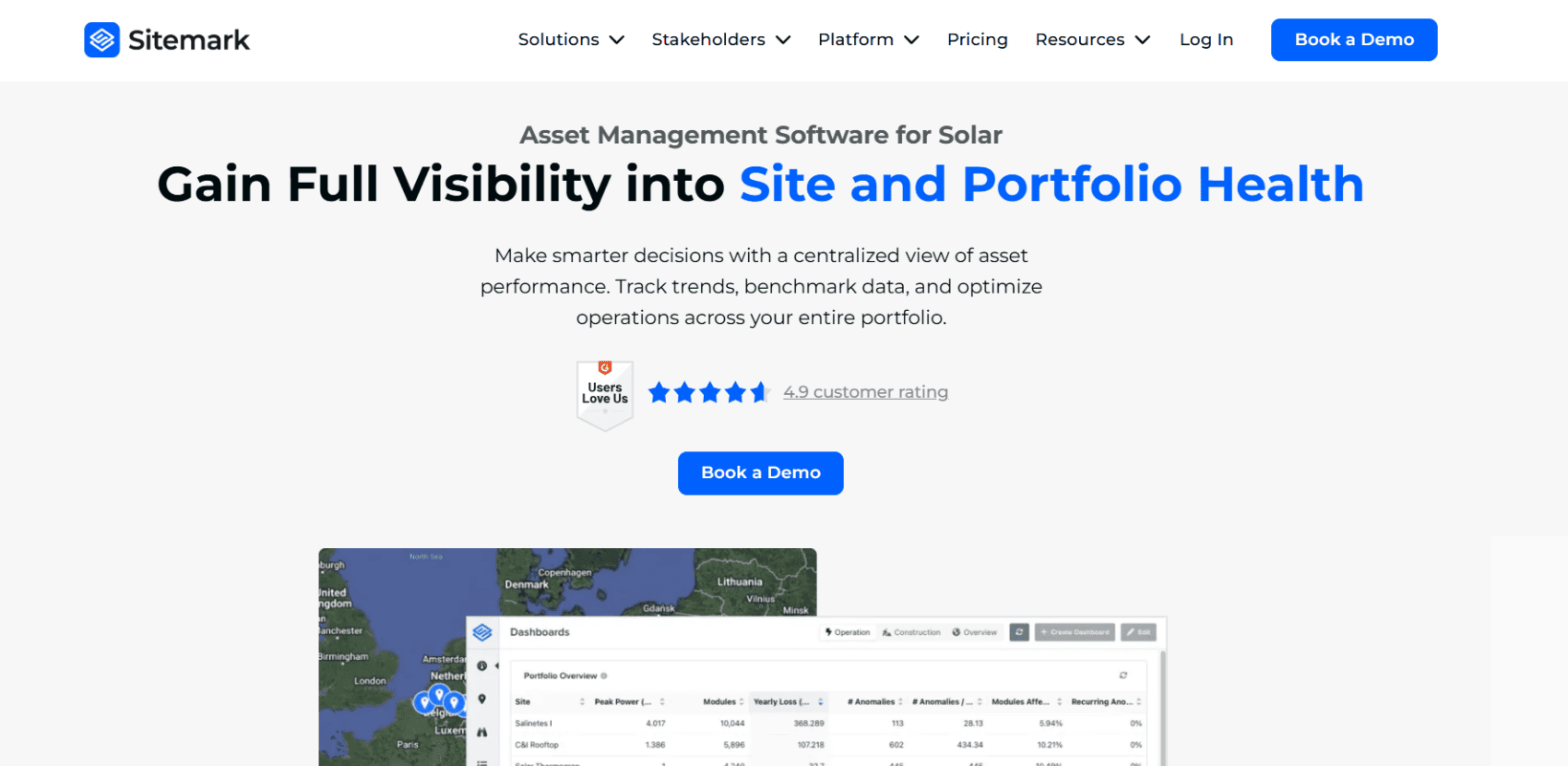
Sitemark, a prominent European software provider, initially focused heavily on generalized drone surveying and earthworks before pivoting specifically to solar. This topographical DNA makes it uniquely powerful for tracking a solar site's entire lifecycle. Sitemark excels at utilizing aerial data from the initial topographical surveying and earthworks phase all the way through to operational thermal inspections years later.
Why it made the list: It is exceptional at tracking a solar site from the initial topographical surveying phase all the way through to operational thermal inspections.
Best Paired With: Enterprise ERP and APM tools.
This category represents a fundamental shift from buying software to buying outcomes. Instead of licensing a tool for your internal team to use, these platforms act as technology-enabled service providers that absorb the operational risk entirely.
Best for: Solar investors, fund managers and asset owners who want to completely offload operational execution.
Founded by solar industry veterans, including former SunPower executives, Omnidian pioneered a radical new model: Performance Assurance. They are unique because they operate as a technology-enabled service provider rather than a pure SaaS tool you operate yourself. They use proprietary software to monitor your assets and offer strict performance guarantees. If a panel goes down, Omnidian manages the dispatch of their own nationwide third-party contractor network to fix it, completely absorbing the performance risk for the asset owner.
Why it made the list: They offer performance guarantees by monitoring your assets and managing the dispatch of third-party contractor networks.
Best Paired With: Internal financial reporting software.
This category pulls operations out of the field and directly into the boardroom. Rather than focusing on physical wrenches or drone flights, these heavyweight platforms are designed to track complex billing structures, streamline investor reporting, and ensure absolute compliance with the uptime guarantees outlined in your Power Purchase Agreements (PPAs).
Best for: Solar investors, fund managers and asset owners.
.png)
Founded in 2013 and headquartered in Charlotte, North Carolina, Radian Generation has scaled from a specialized startup into a global leader in renewable asset management, regulatory compliance, and cybersecurity. Supported by a worldwide team, the company recently executed a major evolution of its software strategy. They consolidated their legacy suite – LENS, GREEN IT and GAR – into one unified, full-lifecycle platform known as Radian Digital.
Why it made the list: Built specifically for the boardroom rather than the toolbelt, it centralizes financial reporting, project development, and critical regulatory compliance for owners, operators, and investors.
Best Paired With: FieldEx (for the physical 'execution layer') and deep SCADA monitoring systems.
Developed by Alectris, a global solar operations and maintenance service provider, Actis holds the distinction of being recognized as the world's first certified Solar ERP (Enterprise Resource Planning) platform. It is a heavyweight tool tailored specifically for solar operations. Actis brings technical, operational, and financial data into one platform, heavily favoring the administrative, compliance and accounting side of solar asset management.
Why it made the list: It brings technical, operational, and financial data into one platform, heavily favoring administrative compliance.
Best Paired With: APM software, SCADA.
The biggest operational bottleneck in 2026 is the disconnect between digital monitoring and physical repair.
The defining characteristic of modern green infrastructure is operational resilience. As solar portfolios scale, relying on standalone software creates dangerous data silos and fragmented workflows.
Effective O&M requires a complete ecosystem: aerial diagnostics to spot physical anomalies, APM tools to quantify the financial impact, and an "execution layer" to bridge the gap between digital monitoring and physical field service.
Monitoring tools that generate data but do not drive action are insufficient. An inverter alert is useless if it doesn't automatically trigger a work order, assign a technician, and reserve the necessary spare part. To prevent unrecoverable revenue loss and PPA breaches, choose software not just for the data it generates, but for the physical work it executes.
Asset Performance Management (APM) tools (like Power Factors or Radian) are the "brains". They focus on data analytics, predicting yield, analyzing power curves, and detecting underperformance. A CMMS or Field Service Management platform (like FieldEx) is the 'execution layer'. It handles the physical logistics: dispatching technicians, tracking inventory, and enforcing safety checklists.
While legacy CMMS tools are powerful, they are incredibly expensive and lack mobile usability for field technicians. The modern green infrastructure market requires agile, mobile-first SaaS platforms that can operate offline and track complex multi-tier inventory across technician vehicles.
Generic software typically tracks inventory in a single, centralized warehouse. However, solar O&M requires tracking expensive sub-components (like inverter modules or tracker motors) across regional depots, storage zones, and the specific vehicles driven by your technicians. Multi-tier inventory tracking ensures a dispatcher knows exactly what parts are in a specific technician's "user bin" before a truck is rolled, preventing wasted trips and drastically improving the first-time fix rate.
A standard checklist is just a digital piece of paper; a technician can often bypass it to close a ticket. A "mandatory procedure" physically prevents the work order from being marked as complete until specific, sequential tasks are finished. In critical infrastructure, this distinction is the difference between a compliant, audit-ready maintenance log and a costly liability risk.

.avif)


This website and its content are the property of FieldEx and are protected by copyright laws. © 2026 FieldEx. Any redistribution or reproduction of part or all of the contents in any form is prohibited, except with our express written permission.
FieldEx Pte Ltd