7 best solar O&M compliance software (2026 guide)

Generalist CMMS tools can't handle green infrastructure. Compare the top 7 solar O&M software platforms of 2026 and bridge the gap between detection and execution.
The FieldEx Team
March 16, 2026
Header image

Renewable energy has surpassed coal as the largest source of electricity generation globally. However, the fleet is aging. Asset owners are increasingly aggregating diverse portfolios of assets acquired from different developers, meaning a single Independent Power Producer (IPP) might own 50 solar sites with inverters from five different manufacturers.

This creates a critical "maintenance gap". Legacy operations and maintenance (O&M) software is often proprietary to the hardware, forcing asset managers to log into a dozen different systems. Furthermore, the software landscape is dominated by monitoring tools that generate data but do not drive action. An alert from a SCADA system that an inverter is down is useless if it doesn't automatically trigger a work order, assign a technician, and reserve the necessary spare part.

To manage decentralized green energy infrastructure effectively, you need an "execution layer" to bridge the gap between digital monitoring (detection) and physical field service (resolution).

TL;DR: Top solar O&M software at a glance

Software Primary Category Best For Best Paired With
1. FieldEx The Execution Layer O&M contractors & asset managers managing mixed DER portfolios. Power Factors, AlsoEnergy
2. WIZSP Solar The Execution Layer Operators heavily entrenched in the Microsoft 365 ecosystem. Microsoft Power BI
3. Power Factors The APM Leader Centralized control rooms needing deep yield analytics. FieldEx (for physical truck rolls)
4. AlsoEnergy The APM Leader C&I solar operators requiring robust SCADA monitoring. FieldEx, 3rd Party CMMS
5. IBM Maximo Grid-Scale Enterprise Major utilities managing multi-billion dollar portfolios. Utility SCADA systems
6. 60Hertz Energy Grid-Scale Enterprise Highly remote microgrids with zero cellular connectivity. Off-grid hardware portals
7. Radian Generation Financial Specialist Investors focused on PPA compliance and financial reporting. Accounting & ERP software

How we evaluated these platforms

The defining characteristic of modern green infrastructure is not efficiency, but operational resilience. In the context of critical infrastructure, downtime is a regulatory violation and a safety hazard. Downtime results in direct, unrecoverable revenue loss and potential breach of Power Purchase Agreements (PPAs).

When evaluating these platforms, we looked past AI marketing hype and focused on concrete industrial capabilities. We prioritized software that enforces rigorous safety checks, mitigates direct revenue loss, and successfully consolidates the “execution layer” across solar, BESS and EV infrastructure.

What are the "must-haves" for solar O&M compliance?

If you’re evaluating software in 2026, ensure it possesses these 3 core capabilities:

  • Parent-Child Asset Genealogy: The software must support multi-level asset hierarchies, allowing components to be tracked as child assets under a parent asset. This enables granular maintenance tracking and parts management down to the individual module level.
  • Mandatory Compliance Checklists: You need an immutable digital paper trail. The system must support procedures where tasks are set as mandatory, meaning the work order cannot be marked as complete until those tasks are finished in a specific, sequential order.
  • Preventive Maintenance (PM) Engine: A significant portion of solar O&M is vegetation management (eg mowing grass to prevent shading). This is a purely "field service" task that sophisticated asset performance management (APM) tools ignore but one which software like FieldEx handles natively through its PM scheduling engine utilizing time-based and meter-based triggers.

Why do operators need multi-asset O&M software? 

Because modern energy sites integrate solar generation, battery storage (BESS) and EV chargers behind a single meter. Using standalone software for each asset creates dangerous data silos and fragmented workflows. A unified ‘execution layer’ allows one technician to manage maintenance, compliance and spare parts across the entire mixed portfolio.

The modern energy asset manager is rarely a specialist in just one technology. Commercial developments, logistics depots and municipal microgrids are increasingly deploying integrated systems where these assets coexist.

The problem: Fragmentation pain

Currently, operators suffer from severe data silos. A facility manager might be forced to juggle multiple specialized tools:

  • For Solar Yield: Power Factors or Radian.
  • For EV Billing: ChargePoint or Driivz.
  • For Battery Dispatch: Stem or Fluence.
  • The Execution Gap: Relying on basic spreadsheets or WhatsApp to coordinate the actual physical maintenance and truck rolls for all three.

The solution: The unified ‘execution layer’ 

Buying standalone CMMS software just for solar is a strategic vulnerability.

  • Converged Workforces: The technician required to service a high-voltage solar inverter is often the exact same profile of electrician required to fix a DC fast charger. The workflow must be unified.
  • One App, Every Asset: By adopting a consolidated ‘execution layer’ (like FieldEx), operators consolidate this physical workflow. A single mobile app manages the labor, inventory and compliance across the entire mixed portfolio.

Category 1: The "Execution Layer" (Vertical Specialists)

Best for: Operators who want one dedicated system for field maintenance, safety and mixed-asset portfolios.

1. FieldEx | www.fieldex.com

FieldEx is the premier ‘execution layer’ designed to be the operating system for distributed energy resources (DERs). It natively manages the "green umbrella" of EV charging infrastructure, BESS and commercial & industrial solar.

Why it made the list: It is a powerful all-in-one platform for O&M contractors and asset managers who need to translate APM alerts into automated, compliance-driven field execution. It acts as the bridge between digital monitoring and physical work.

Key Features

  • Multi-Level Asset Genealogy: Track complex installations down to the component level. Every work order completed against an asset is logged in the asset's history as a chronological timeline, providing a full maintenance and service history for compliance audits and warranty management.
  • Preventive Maintenance (PM) Scheduling: Natively handles routine site visits via site sweep plans and asset-based maintenance with hybrid scheduling (time and meter-based triggers).
  • Three-Tier Inventory Tracking: Track physical inventory precisely by location, zone, and bin . The system manages the complex supply chain of transferring parts to a technician's user bin and triggers a consumption workflow when parts are logged on a job.

Pros & Cons

  • Pros: Enforces sequential completion of mandatory tasks before a job can be closed; features a native mobile application designed to be functional in field conditions ; supports public-facing issue reporting via QR codes.
  • Cons: It is an execution tool, not an APM tool; it requires integration with an APM for predictive yield analytics.

Best Paired With: Power Factors, Radian, Microsoft Power BI, and any CPMS/CSMS system via RESTful API and OAuth.
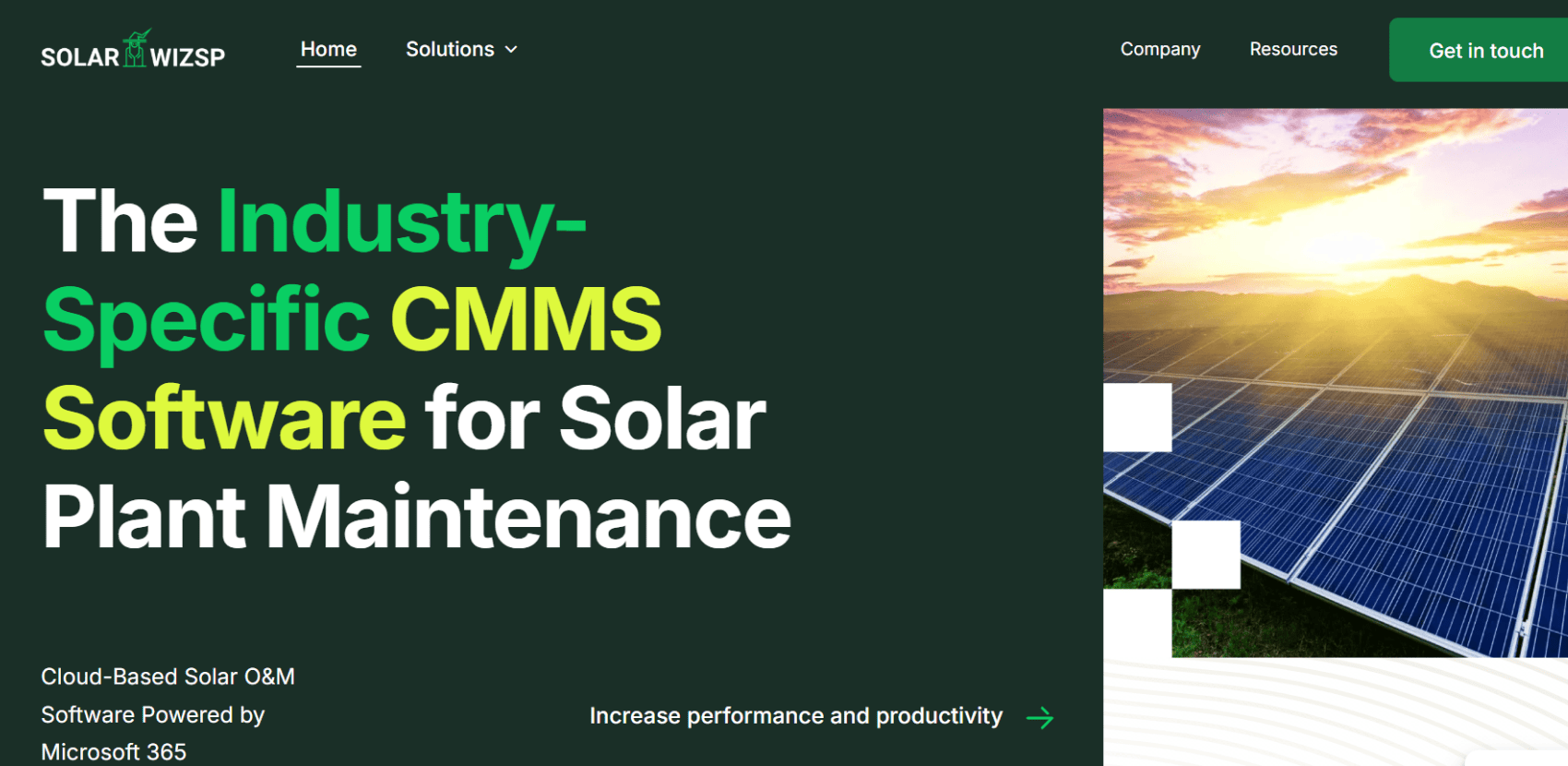
2. WIZSP Solar | www.wizsp.com

WIZSP is a cloud-based, industry-specific CMMS designed entirely around solar plant maintenance, built natively on the Microsoft 365/SharePoint ecosystem.

Why it made the list: WIZSP focuses heavily on standardizing workflows and handling environmental health and safety (EHS) compliance for solar parks.

Key Features

  • EHS Protocol Management: Digitizes safety audits and compliance protocols specific to solar installations.
  • Microsoft 365 Native: Built directly into the SharePoint architecture, allowing for seamless document management for existing MS enterprise users.
  • Automated Ticketing: Converts identified solar plant faults into standardized digital tickets.

Pros & Cons

  • Pros: Deeply integrated for Microsoft-heavy organizations; strong focus on specific solar park safety protocols.
  • Cons: Lacks the broader "green umbrella" capabilities for managing integrated EV and BESS assets; highly reliant on the SharePoint infrastructure rather than a standalone, mobile-first native architecture.

Best Paired With: Microsoft Power BI, Microsoft Teams, and enterprise SCADA systems.

Category 2: The "APM" Leaders (Monitoring & Yield)

Best for: Centralized control rooms analyzing data, performance and hardware alerts.
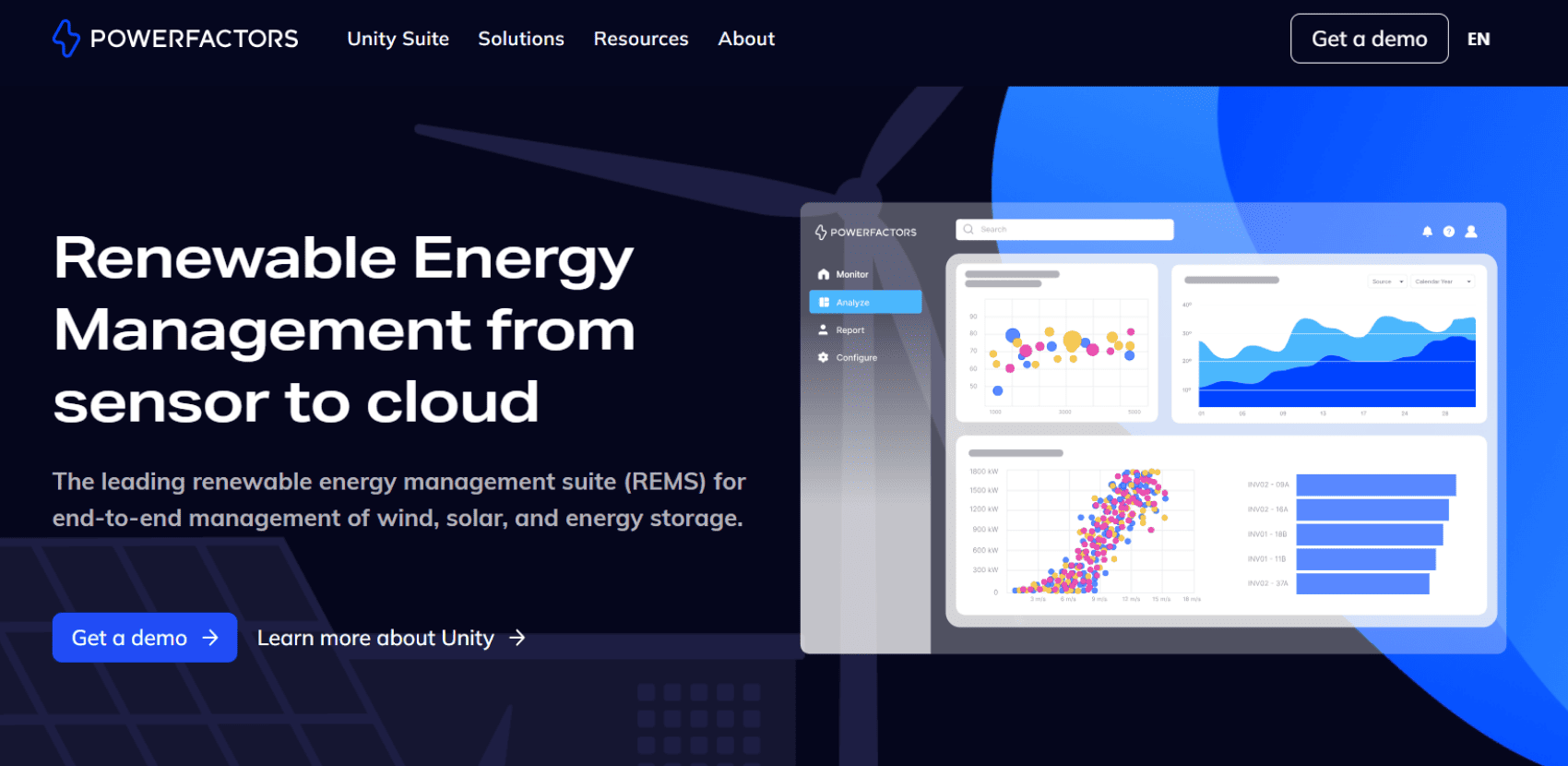
3. Power Factors | www.powerfactors.com

Power Factors is an APM tool. It focuses on the data analytics side of renewable energy, predicting yield, analyzing power curves and detecting underperformance.

Why it made the list: It is the industry standard for deep data analytics and SCADA monitoring, serving as the "brains" of an operation.

Key Features

  • Yield Analytics: Analyzes power curves to predict yield and detect generation anomalies.
  • Underperformance Detection: Flags hardware that is not meeting its expected power output based on environmental and historical data.
  • Single Pane of Glass: Consolidates data from diverse, mixed-hardware portfolios.

Pros & Cons

  • Pros: Unmatched for predicting solar yield and analyzing complex power curves across massive portfolios.
  • Cons: It is a "brain" without "hands". It cannot dispatch a truck roll, track a technician's mobile inventory, or natively enforce physical safety checklists.

Best Paired With: FieldEx (to act as the ‘execution layer’ for dispatched truck rolls), and OEM hardware monitoring portals.
4. AlsoEnergy | www.alsoenergy.com

AlsoEnergy provides an edge-to-cloud clean energy monitoring and SCADA platform, heavily utilized in the Commercial & Industrial (C&I) solar sector.

Why it made the list: Its flagship application, PowerTrack, is a powerhouse for remote troubleshooting and hardware telemetry monitoring.

Key Features

  • SCADA Monitoring: Deep data ingestion directly from on-site edge devices and inverters.
  • Remote Diagnostics: Allows operators to remotely troubleshoot inverter faults before rolling a truck.
  • Financial Reporting: Aggregates energy production data to support billing and PPA reporting.

Pros & Cons

  • Pros: Exceptional edge connectivity; robust remote troubleshooting capabilities; highly dominant in the C&I sector.
  • Cons: Like other APMs, it monitors the problem but relies on third-party CMMS integrations to manage the physical repair logistics, labor scheduling, and spare parts.

Best Paired With: FieldEx, legacy enterprise CMMS platforms, and accounting software.

Category 3: The "Grid-Scale" Enterprise (Utilities & Remote)

Best for: Massive infrastructure, power plants and highly remote microgrids.
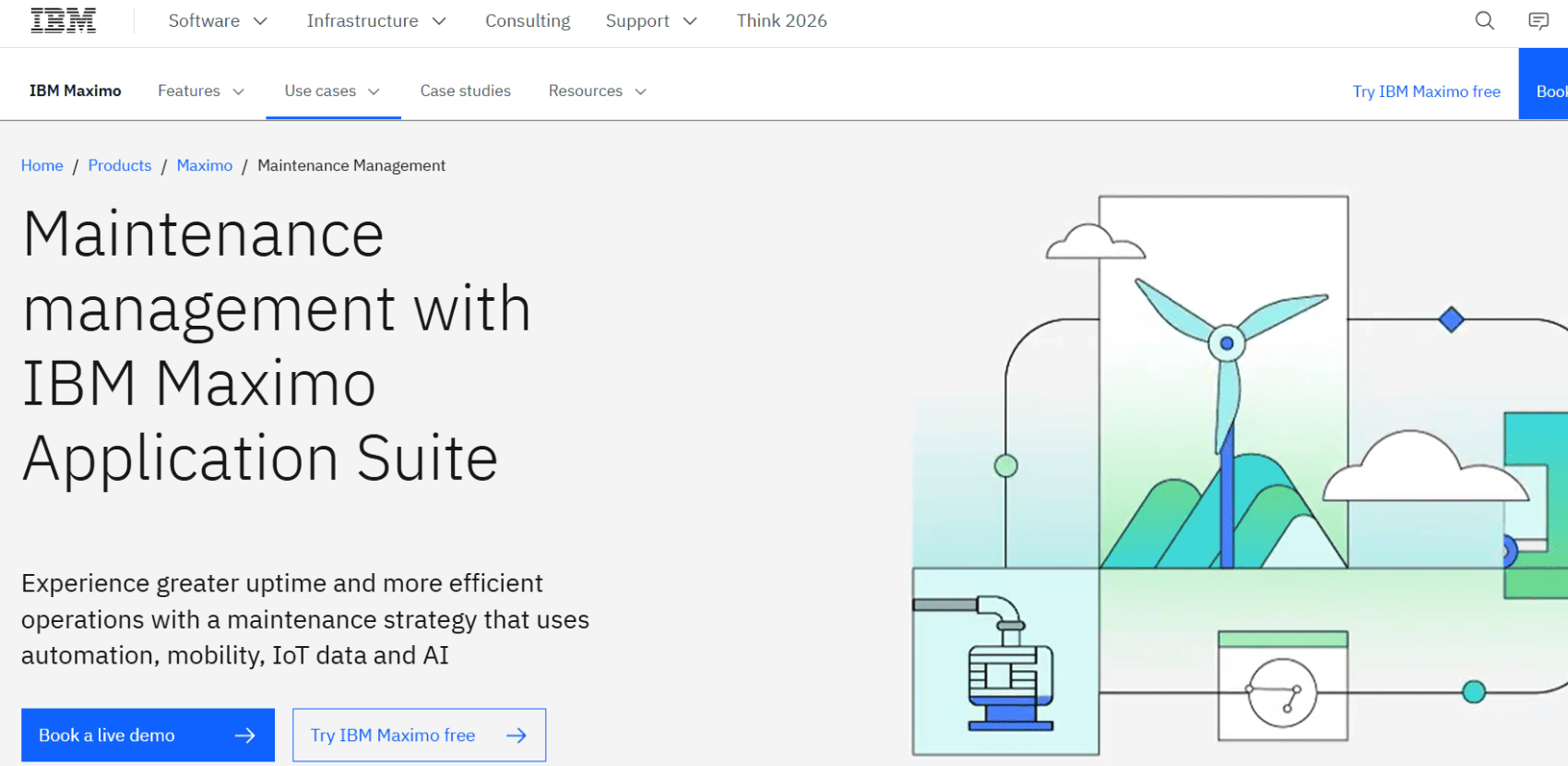
5. IBM Maximo | www.ibm.com/maximo

Maximo is a legacy CMMS. It is the old guard, built to manage immense, centralized enterprise infrastructure.

Why it made the list: Maximo excels at enterprise-level grid integration and tracking the depreciation of assets over multi-decade lifecycles.

Key Features

  • Enterprise Asset Tracking: Capable of logging massive, grid-scale asset hierarchies.
  • Financial Modeling: Deep integration with enterprise resource planning (ERP) for tracking depreciation and capital expenditure.
  • Supply Chain Management: Heavyweight procurement and vendor management modules.

Pros & Cons

  • Pros: Extremely powerful; deeply entrenched in the utility sector; handles unparalleled volumes of enterprise data.
  • Cons: Incredibly expensive and notoriously lacks mobile usability for field technicians executing modern, distributed work.

Best Paired With: Heavy enterprise ERPs (like SAP), utility SCADA systems.

6. 60Hertz Energy | www.60hertzenergy.com

60Hertz Energy is a niche CMMS designed specifically for off-grid distributed energy and remote microgrids.

Why it made the list: It solves the specific problem of maintaining assets in environments with zero cellular connectivity.

Key Features

  • Extreme Offline Mode: Built specifically to function without Wi-Fi or cellular reception for days at a time.
  • Microgrid Focus: Tailored workflows for remote diesel-solar hybrid microgrids.
  • Simplified UI: Designed for local operators who may not be highly technical engineers.

Pros & Cons

  • Pros: The best option for highly remote, off-grid locations; excellent offline sync capabilities.
  • Cons: Too narrow and lightweight for major commercial C&I operators connected to the main grid who require complex APM integrations and multi-tier inventory.

Best Paired With: Off-grid inverter hardware portals and localized SCADA.

Category 4: The "Financial & Contract" Specialists

Best for: Solar investors, fund managers and asset owners.

7. Radian Generation | www.radiangen.com

Radian Generation is a software platform focused on data analytics, yield prediction and underperformance detection.

Why it made the list: It centralizes financial reporting and PPA contract compliance, making it ideal for the boardroom rather than the toolbelt.

Key Features

  • Contract Management: Tracks compliance against Power Purchase Agreements (PPAs).
  • Financial Reporting: Aggregates generation data to streamline investor reporting and billing.
  • Yield Analytics: Detects underperformance to protect asset ROI.

Pros & Cons

  • Pros: Excellent for solar investors and asset owners focused on the financial health and regulatory standing of their portfolio.
  • Cons: It is an APM tool, a "brain" without "hands", and does not manage physical work orders, dispatch or parts inventory.

Best Paired With: FieldEx (for the ‘execution layer’), enterprise accounting software.

How to calculate the ROI of an O&M ‘execution layer’

For C-level executives and asset managers, deploying new software is a capital allocation decision. Fortunately, the financial benchmarks for green infrastructure software strongly favor agile execution platforms.

Software spending benchmarks indicate that solar O&M software budgets are typically under $300/MW, while wind is higher at $550-$750/MW. When evaluating your tech stack, you must weigh this relatively low software spend against the massive "Cost of Inaction" (COI) in the field.

In the renewable sector, downtime results in direct, unrecoverable revenue loss and potential breaches of Power Purchase Agreements (PPAs). Relying on manual dispatch and reactive maintenance leads to:

  • Wasted Truck Rolls: Sending a technician to a site without verifying the fault code or ensuring the correct spare part is in their vehicle bin.
  • Compliance Penalties: Failing to produce an audit-ready, immutable digital history of safety checks and maintenance events.
  • Warranty Leakage: Paying out-of-pocket for third-party repairs because your generic ticketing system couldn't track the exact warranty status of a specific inverter string.

An ‘execution layer’ pays for itself rapidly. Agile platforms like FieldEx demonstrate clear ROI by reducing labor and automating reporting, ensuring that your assets generate revenue rather than draining your O&M budget.

APM (Detection) vs CMMS (Execution) in Solar

The biggest operational bottleneck in 2026 is the disconnect between digital monitoring and physical repair.

  • Detection (The APM Way): Tools like Power Factors analyze data and predict yield. When an inverter fails, it generates an alert. If that alert sits in an inbox, the asset bleeds revenue.
  • Reactive (The Manual Way): A dispatcher manually reads the alert, calls a technician, and hopes they have the right spare part.
  • Execution (The CMMS Way): A dedicated ‘execution layer’ (like FieldEx) ingests the underperformance alert via API and automatically turns it into a dispatched truck roll. The software generates a work order, assigns a qualified technician via round-robin logic, reserves the exact spare part from their vehicle inventory, and enforces a mandatory compliance procedure before the job can be closed.

Frequently asked questions

1. What is the actual difference between APM and CMMS in solar? 

Asset Performance Management (APM) tools (like Power Factors or Radian) are the "brains". They focus on data analytics, predicting yield, analyzing power curves, and detecting underperformance. 

A CMMS or Field Service Management platform (like FieldEx) is the ‘execution layer’. It handles the physical logistics: dispatching technicians, tracking inventory, and enforcing safety checklists.

2. Why can't I just use my existing enterprise CMMS (like SAP or Maximo)? 

While legacy CMMS tools are powerful, they are incredibly expensive and lack mobile usability for field technicians. The modern green infrastructure market requires agile, mobile-first SaaS platforms that can operate offline and track complex multi-tier inventory across technician vehicles.

3. How does O&M software help with PPA compliance? 

Power Purchase Agreements (PPAs) have strict uptime and generation guarantees. Downtime results in direct, unrecoverable revenue loss and potential breaches of these agreements. 

A specialized ‘execution layer’ ensures that preventive maintenance (like vegetation management or meter-based servicing) is scheduled accurately and that corrective repairs are dispatched automatically, minimizing downtime and maintaining compliance.

4. How does multi-tier inventory tracking reduce solar O&M costs? 

Generic software typically tracks inventory in a single, centralized warehouse. However, solar O&M requires tracking expensive sub-components (like inverter modules or tracker motors) across regional depots, storage zones, and the specific vehicles driven by your technicians. Multi-tier inventory tracking ensures a dispatcher knows exactly what parts are in a specific technician's "user bin" before a truck is rolled, preventing wasted trips and drastically improving the first-time fix rate.

5. Can solar O&M software also handle battery energy storage systems (BESS)? 

It can, provided you choose a unified ‘execution layer’ rather than standalone solar software. BESS introduces extreme safety and thermal management risks governed by strict fire codes, such as NFPA 855. To manage both, your software must be capable of enforcing mandatory hazard mitigation checklists and tracking the "genealogy" (warranty and chemistry) of individual battery modules in the exact same system used for your solar arrays.

6. What is the difference between simple checklists and mandatory procedures? 

A standard checklist is just a digital piece of paper; a technician can often bypass it to close a ticket. A "mandatory procedure" physically prevents the work order from being marked as complete until specific, sequential tasks are finished. In critical infrastructure, this distinction is the difference between a compliant, audit-ready maintenance log and a costly liability risk.

About the Author

Dashboard mockup

The FieldEx Team

FieldEx is a B2B field service management software designed to streamline operations, scheduling, and tracking for industries like equipment rental, facilities management, and EV charging, helping businesses improve efficiency and service delivery.

Complex operations simplified with one software.

No paperwork. No spreadsheets. No blindspots. Just one solution that simplifies your field service operations.
Header image