
.png)
.png)
Watching a massive commercial high-rise or a heavy civil highway emerge from the dirt looks like magic to the people driving by. But to the folks in the hardhats, it's a daily, grueling exercise in organized chaos.
Bringing a blueprint to life involves wrangling hundreds of moving parts. You're dealing with architects, volatile supply chains, temperamental heavy machinery, tight-fisted owners, and third-party subcontractors who all have their own agendas. Without a master plan and a heavy dose of discipline, it takes exactly one bad weather week or one broken excavator to cause budgets to explode and deadlines to completely vanish.
This is exactly where construction management steps in. It is the invisible scaffolding that holds the entire circus together.
In this guide, we're stripping away the academic fluff and the Silicon Valley corporate jargon. We're going to explain exactly what construction management is, how the core phases work, and why adopting a solid management framework is the only thing keeping your jobsite from turning into an expensive, chaotic nightmare. Ready? Let's get crackin'.
Simply put, construction management is a professional service that uses specialized project management techniques to oversee the planning, design and physical construction of a project from its beginning to its end.
The ultimate objective of construction management is to control a project's time, cost and quality. A construction manager (CM) acts as the owner's representative, ensuring that the architects, the engineers, and the guys swinging the hammers are all working off the same playbook and not burning through cash unnecessarily.
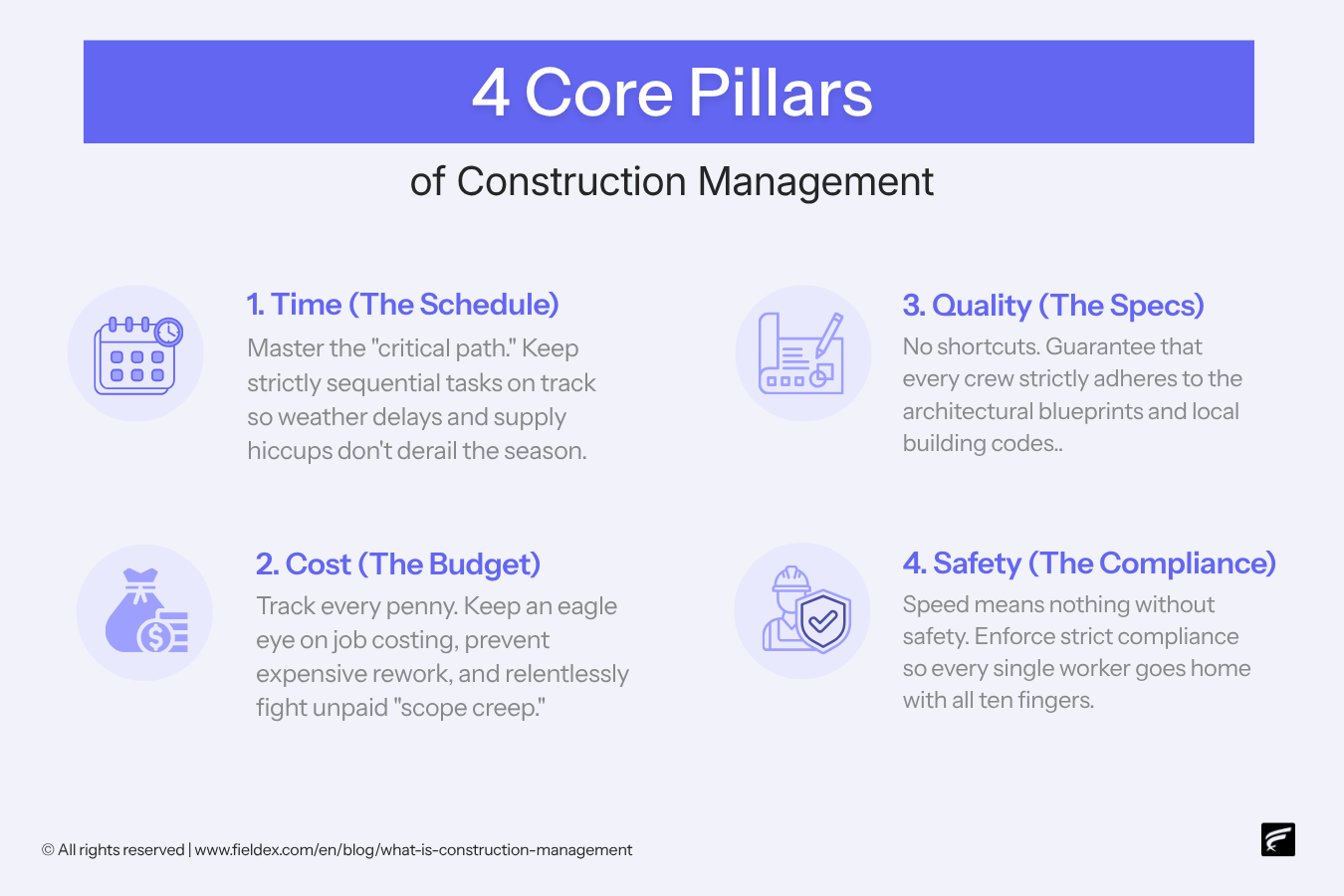
Every successful project rests on four foundational pillars. If a manager loses sight of even one, the project will lean, crack and eventually collapse.
This is the most common point of confusion in the industry. While they both work on the same jobsite, a construction manager (CM) and a general contractor (GC) have completely different roles, financial structures and goals.
A project isn't just "building”. It is a carefully orchestrated sequence of events.
This is the brainstorming phase. The manager runs feasibility studies, looks at conceptual blueprints, and helps the owner decide if the project actually makes financial and logistical sense before breaking ground.
Once the project gets the green light, the real planning begins. The manager procures building permits, finalizes the master budget, sets the critical path schedule, and assembles the core team of engineers and architects.
This is the buying phase. The management team sources and orders the massive quantities of raw materials needed (lumber, steel, concrete), locks in the heavy equipment rentals, and officially hires the General Contractor and specialty subcontractors.
.png)
This is where the plan hits reality, and it is universally considered the most difficult phase of management. Execution is where profit margins are either secured or lost completely. The management team must dispatch crews, turn wrenches, manage daily field operations, and keep the heavy iron running.
The stakes here are incredibly high. A report states that equipment downtime costs construction operations anywhere from $300 to $1,000 per idle hour per machine. If a manager fails to enforce preventive maintenance on an excavator and it blows a hydraulic line during a critical trenching phase, the financial bleed is catastrophic.
Furthermore, poor execution leads to rework – the absolute enemy of profitability. Studies show that rework (tearing down bad work and doing it over) consumes between 5% and 12% of total project costs, with over 50% of those errors caused by poor communication and bad data between the field and the office. A massive part of the execution phase is ensuring the guy pouring the concrete has the exact same data as the architect sitting in the office trailer.
The finish line. The manager walks the site to create final "punch lists" (fixing minor snags like scuffed drywall), handles the final financial audits, hands the keys over to the owner, and officially demobilizes the jobsite.
Ten years ago, managing these five phases involved clipboards, whiteboards and mountains of paper in the passenger seat of a pickup truck. Today, relying on paper is a massive liability. It leads to missing data, skipped maintenance and catastrophic communication delays.
Modern construction management requires a digital infrastructure. While project management (PM) tools are fantastic for handling the master budgets and architectural blueprints, you still need field service management (FSM) and computerized maintenance management systems (CMMS) to manage the gritty reality of the execution phase.
DID YOU KNOW? The construction management software market size is projected to expand from $11.58 billion in 2026 to $17.81 billion by 2031.
If your team’s in the mud, they need tools that actually work offline, allow them to scan equipment QR codes to pull up maintenance checklists, and log spare parts in real-time. Systems like FieldEx bridge that gap perfectly, ensuring the mechanics and the machinery are operating efficiently while the PM software handles the high-level math.
Construction management is part art, part science, and a whole lot of logistics. It is the rigorous discipline of turning chaotic variables – weather, machinery, supply chains, and human error – into a finished, profitable structure.
The best construction managers know that they are only as good as the systems and data they rely on. When you combine solid management principles with digital tools that actually work for the guys in the dirt, you stop putting out fires and start scaling your business.
Think of it this way: PM software is for the office, and a CMMS is for the iron. PM tools (like Procore) handle the master budgets, the 3D blueprints, and the long-term schedules. A CMMS focuses entirely on your physical assets – tracking engine hours, scheduling oil changes, and managing spare parts inventory so your excavators don't break down halfway through digging the foundation.
If you have mechanics, technicians or subcontractors moving between multiple active jobsites, you need FSM. While a CMMS tracks the health of the machines, an FSM platform tracks the people. It handles the mobile dispatching, digital safety checklists, and time tracking. It’s the digital bridge between your dispatcher's whiteboard and the guys out in the mud.
Return on Investment (ROI) in construction software isn't just about saving money on printer paper. It's about avoiding catastrophic costs. If software prevents just one $10,000 engine failure because an oil change was automatically scheduled, or saves you from a massive liability lawsuit because a digital safety checklist was time-stamped and signed, the software just paid for itself for the next five years.
The financial bleed is staggering. Unplanned downtime can cost between $300 and $1,000 per hour per machine. But remember, the cost isn't just the broken hydraulic pump. You're paying for the five crew members standing around doing nothing, the premium rush-shipping for the replacement part, and the delay penalties from the project owner.
Preventive maintenance means fixing things based on engine hours or elapsed time before they explode. Emergency repairs carry a cost multiplier – meaning they cost 3 to 5 times more than planned maintenance. Staying ahead of the breakdown is the easiest, most predictable way to protect your project's profit margins.
Yes, but you have to look for a hybrid system (like FieldEx). Most legacy tools do one or the other. To truly streamline your operations, you want a platform that blends FSM (managing the people and work orders) with CMMS (managing the machines and parts inventory) so your dispatcher and your lead mechanic are finally looking at the exact same data in real-time.
Most experts agree that the execution phase is the most difficult. This is when the plan hits the mud. The manager must simultaneously juggle unpredictable weather delays, broken equipment, subcontractor schedules, and strict safety compliance, all while ensuring the project doesn't bleed cash due to rework or idle labor.
The harsh truth is that you can buy the most expensive, feature-packed software on the planet, but if the guys in the hardhats hate using it, you just bought a very expensive digital paperweight. To get your team on board, you have to completely remove the friction. First, pick a "mobile-first" tool that was actually built for the field – meaning it has big buttons, true offline capabilities for dead zones, and QR code scanning so they don't have to manually type out 14-digit serial numbers with dirty gloves. Second, adapt the software to them. If the platform lets you relabel corporate jargon to match your actual shop lingo (like changing "Assets" to "Iron" or "Locations" to "Sites"), do it. Finally, show them the immediate benefit: less time fighting with muddy paperwork and group texts means they get to clock out and go home on time.
No, and it shouldn't. In the software world, a "jack of all trades" is usually a master of none. Let your heavy-duty accounting software handle the IRS, and let your enterprise PM software handle the massive 3D blueprints. FieldEx is designed to step in and aggressively manage your physical assets, your spare parts inventory, and your mobile workforce out in the dirt.
Take a look at your biggest daily bottlenecks. If your headaches involve tracking heavy equipment maintenance, wrangling messy subcontractor compliance, or trying to figure out where your expensive spare parts went, then FieldEx is exactly what you need.
If you’re ready to ditch the whiteboards, stop reacting to broken machinery, and digitize your field operations, book a free demo today, or simply get in touch. Let’s chat.

.avif)


This website and its content are the property of FieldEx and are protected by copyright laws. © 2026 FieldEx. Any redistribution or reproduction of part or all of the contents in any form is prohibited, except with our express written permission.
FieldEx Pte Ltd Singapore