

.png)
Electrifying Peru is a battle of extreme geographic diversity and complex grid logistics. A successful commercial EV rollout here means outfitting dense corporate headquarters in Lima's San Isidro district and engineering ruggedized, high-altitude infrastructure for the heavy-duty mining fleets operating in the Andes.
Beyond the rugged terrain, developers must navigate strict local compliance. Every commercial installation must adhere to the rigorous technical parameters set by OSINERGMIN and the Norma Técnica Peruana (NTP) or Peruvian Technical Standards for charging infrastructure. Because upgrading a primary transformer on a remote provincial grid is often physically impossible – and prohibitively expensive – integrating smart load management systems is an absolute necessity.
To survive the Peruvian B2B market, you need supply chain partners with deep local inventory, smart grid integration capabilities, and heavy electrical expertise. Below, we break down the top 5 EV charger distributors commanding the Peruvian market in 2026.
Why they made the list: Promelsa is an absolute giant in the Peruvian electrical sector. Operating heavily out of Lima with massive distribution centers, they supply everything from low-voltage components to heavy commercial EV infrastructure. They are the go-to independent wholesaler for contractors who need top-tier hardware without logistical bottlenecks.
Did you know? Promelsa operates as a primary authorized B2B distributor for ABB's electromobility hardware in Peru, heavily promoting ABB's massive global footprint of fast chargers to the local industrial market.
Why they made the list: Sonepar brings staggering global supply chain muscle to the Peruvian market. With major logistical hubs, they are the ultimate safety net for mid-to-large commercial electrical contractors executing complex retrofits.
Did you know? Sonepar Perú actively partners with global manufacturing giants like Legrand and Nexans (through their INDECO by Nexans brand) to drive professional electromobility standards, product availability, and safety training across the country's electrical workforce.
Why they made the list: When it comes to massive corporate partnerships and nationwide public charging networks, Enel X Way is the undisputed heavyweight. They don't just distribute hardware; they establish major national corridors, such as their strategic alliance with Petroperú to build 60 kW DC fast-charging hubs along the Panamericana Sur.
Did you know? The route between Lima and Ica has become the first national charging corridor for EVs, driven by Petroperú and Enel X Way installing advanced CCS2 and CHAdeMO fast-charging units that can power up vehicles in under 50 minutes.

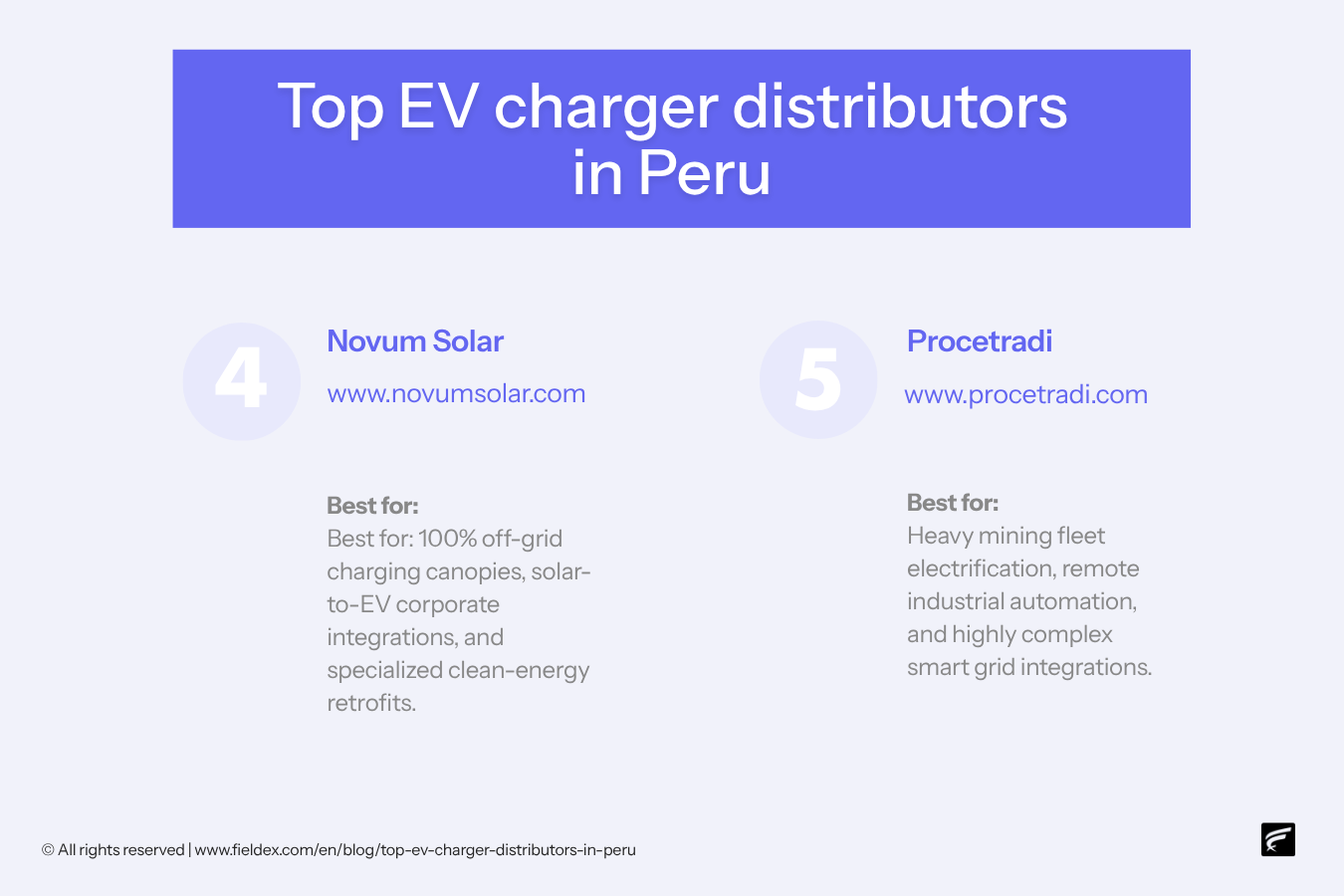
Why they made the list: Novum Solar bridges the critical gap between Peru's electromobility boom and its renewable energy goals. As a specialized B2B distributor and EPC, they provide the hardware and engineering required to power commercial EV hubs entirely through solar generation.
Did you know? Through a massive strategic distribution alliance, Novum Solar officially brought the world-renowned Wallbox EV chargers to the Peruvian B2B market to help decarbonize the national energy matrix.
Why they made the list: Peru's economy is heavily anchored by massive, high-altitude mining operations. Procetradi specializes in complex "Smart Grid" and "Smart Mining" technologies, providing the highly technical electromobility solutions required for heavy industrial fleets that operate far beyond the traditional utility grid.
Did you know? Procetradi doesn't just sell basic components; they provide the deep automation, telemetry, and smart grid Microgrid software necessary to ensure high-voltage EV charging doesn't cripple a remote mining site's delicate electrical infrastructure.
Sourcing the heavy iron is only day one. If you don't have elite, certified EPC (Engineering, Procurement and Construction) partners to execute the civil and electrical works, your project will never clear local inspections. Here are the top-tier execution partners in Peru:
Peru is a highly complex market. Ignoring national standards or the harsh reality of the Andes will instantly destroy your project's ROI. Here is your survival guide for commercial EV deployments.
Peru actively regulates electrical infrastructure through the Supervisory Agency for Investment in Energy and Mining (OSINERGMIN). The primary framework governing the installation of EV charging stations (electrolineras) is the Norma Técnica Peruana (NTP) 321.164.
Electrifying the massive copper and industrial fleets requires operating at extreme altitudes, often exceeding 4,000 meters above sea level.
You cannot easily drop a bank of 150kW DC fast chargers onto an aging provincial grid outside of Lima.
Getting the right pedestals into the ground and navigating the Peruvian grid connections is a massive achievement, but it is only day one of a ten-year lifecycle. Once that commercial EV hub is commissioned, your biggest enemy shifts from supply chain delays to unexpected downtime. An offline charger isn't just an inconvenience; it is a dead asset bleeding revenue and damaging your reputation.
The only way to win the long game in the Peruvian market is to catch failures before they happen. That means rigid, scheduled preventive maintenance – checking the torque on high-voltage terminals, testing the load management relays, and cleaning thermal filters before a unit overheats in the summer sun and trips the breaker.
You simply cannot manage that kind of recurring complexity across hundreds of decentralized sites with a whiteboard and a calendar app.
FieldEx quietly automates the preventive maintenance schedules, dispatches the right certified tech before a critical fault code ever triggers, and ensures the multi-million-sol infrastructure you just built actually stays online. It replaces spreadsheet guesswork and WhatsApp scavenger hunts with real-time, barcode-scanned inventory tracking built specifically for renewable O&M.
Ready to bulletproof your uptime and protect your ROI? Book a free FieldEx demo today, or get in touch. We’re here to help.
In Peru and across Latin America, "electrolinera" is the official term used for a public or commercial EV charging station (equivalent to a traditional gas station).
Standard indoor-rated chargers will rapidly corrode due to Lima's extreme winter humidity and coastal salt spray. Commercial buyers must demand IP65 and IK10 rated hardware to ensure the enclosure remains sealed against moisture and physical impacts.
Yes. Retrofitting older corporate towers in dense business districts like San Isidro pushes existing electrical capacities to the limit. DLM actively throttles EV charging speeds during peak building hours to prevent catastrophic main breaker trips.
Peru operates with a mix of standards due to diverse vehicle imports. However, for commercial fast-charging (DC), CCS2 and CHAdeMO are the dominant standards utilized in public networks like those built by Enel X Way.

.avif)


This website and its content are the property of FieldEx and are protected by copyright laws. © 2026 FieldEx. Any redistribution or reproduction of part or all of the contents in any form is prohibited, except with our express written permission.
FieldEx Pte Ltd Singapore