

.png)
The push to electrify New Zealand's commercial sector is entirely unique. This isn't just about trenching cable in a predictable suburban sprawl; contractors here are tasked with retrofitting dense commercial properties in Wellington while simultaneously engineering rugged, weather-hardened charging hubs that can survive the coastal and alpine extremes of the South Island.
Today, navigating the Kiwi B2B landscape requires a deep understanding of local compliance. Every commercial installation must rigorously adhere to the AS/NZS 3000 Wiring Rules and the exacting electrical safety standards dictated by WorkSafe New Zealand. Furthermore, developers are heavily incentivized to source hardware that aligns with the government's Low Emission Transport Fund (LETF), which has historically deployed millions of dollars to co-fund charging infrastructure.
To win commercial contracts here, you need supply chain partners with localized inventory, deep knowledge of Dynamic Load Management (DLM), and robust industrial switchgear. Here are the top 9 B2B EV charger distributors dominating the New Zealand market today.
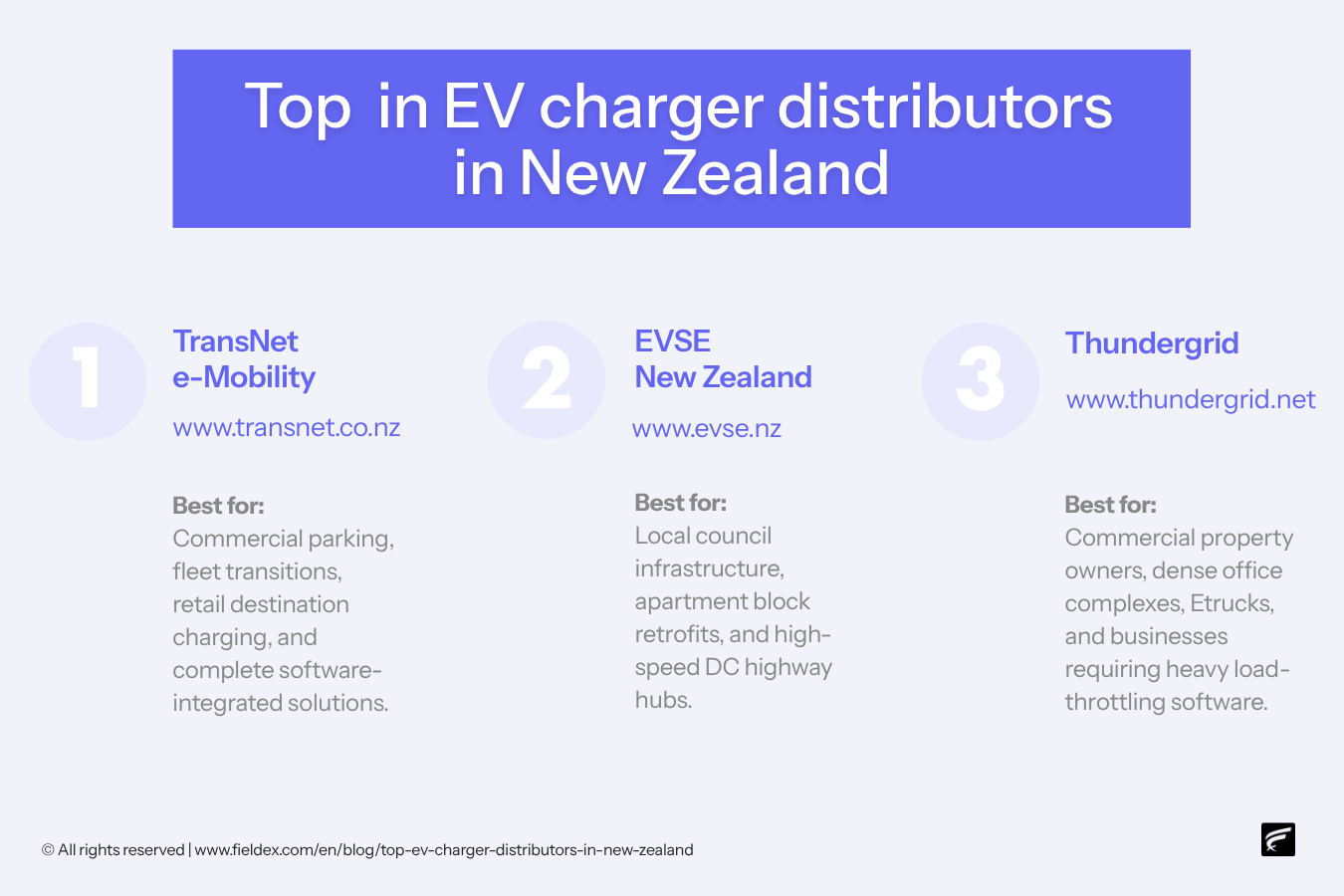
Why they made the list: Operating as a 100% privately owned New Zealand company with over 20 years of experience supplying the electricity industry across NZ and the South Pacific, TransNet is a true B2B powerhouse. They provide a complete end-to-end solution for developers, handling everything from initial site concepts to hardware deployment and after-sales service.
Did you know? TransNet refuses to distribute generic, untested imports. They rigorously test all products to ensure they are explicitly fit for New Zealand's unique electrical network, giving contractors peace of mind against grid instability.
Why they made the list: EVSE brings massive cross-Tasman operational weight to the local market, operating as a true one-stop shop that offers hardware, software, and end-to-end fleet solutions.
Did you know? EVSE is highly active in the government sector, providing specialized, scalable charging solutions to local councils and government departments across the region.
Why they made the list: Thundergrid attacks the commercial market from a software-first perspective. They describe themselves as EV charging experts in transport electrification, supplying smart chargers specifically designed to enable clients to scale their fleet charging or heavy EV transport needs without upgrading their facility's power connections.
Did you know? In October 2023, Thundergrid was acquired by the Swiss giant Landis+Gyr. This powerful merger combines Thundergrid's local innovation with over 128 years of global expertise in flexible energy management and grid decarbonization.
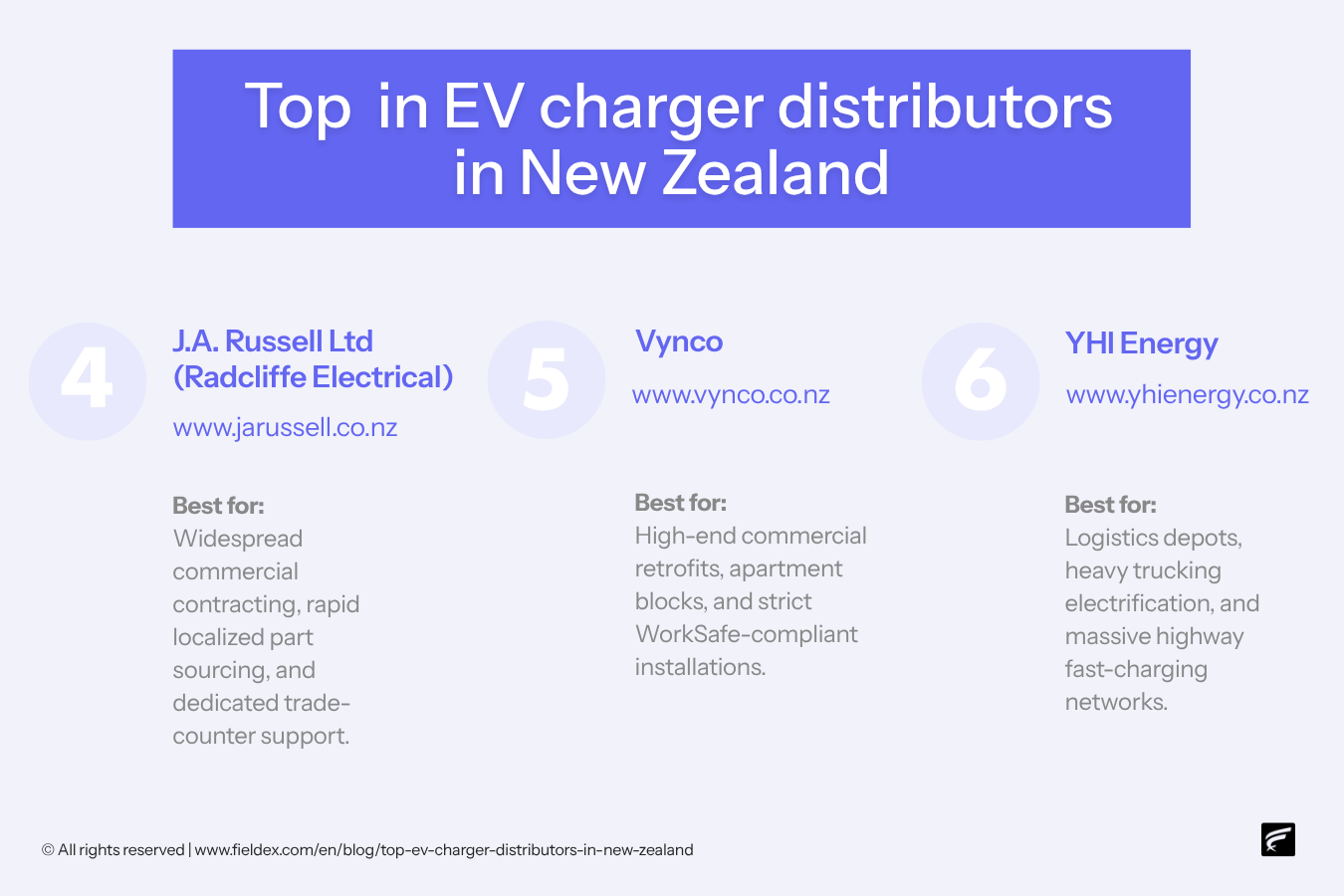
Why they made the list: J.A. Russell Ltd is an absolute force of nature in the local supply chain, operating a staggering 78 branches across the country. They provide contractors with unparalleled localized inventory, ensuring that a commercial project in a remote region isn't stalled waiting on hardware shipments.
Did you know? Trading as both J.A. Russell Ltd and Radcliffe Electrical, they are a premier distributor for global giants like Schneider Electric, supplying the advanced PDL switchgear and final distribution boards required to safely wire EV hubs.
Why they made the list: Vynco is a highly specialized local distributor and manufacturer hyper-focused on safety and aesthetics. They supply hardware built specifically to navigate the strict AS/NZS 3000 Wiring Rules and WorkSafe New Zealand’s Electric Vehicle Charging Safety Guidelines.
Did you know? Founded 30 years ago by the Vale family, Vynco is a 100% New Zealand-owned business boasting over 70 years of electrical industry lineage – operating out of Auckland, Christchurch, and Wellington.
Why they made the list: YHI Energy targets the heavy end of the transport spectrum. They are the experts that corporate fleets and heavy transport operators turn to when planning massive, high-uptime logistics depots.
Did you know? YHI Energy is officially a Certified Kempower Partner in New Zealand, allowing them to supply and support Kempower's elite, modular DC fast-charging systems – capable of delivering up to 600 kW of total power across dynamic charging satellites.
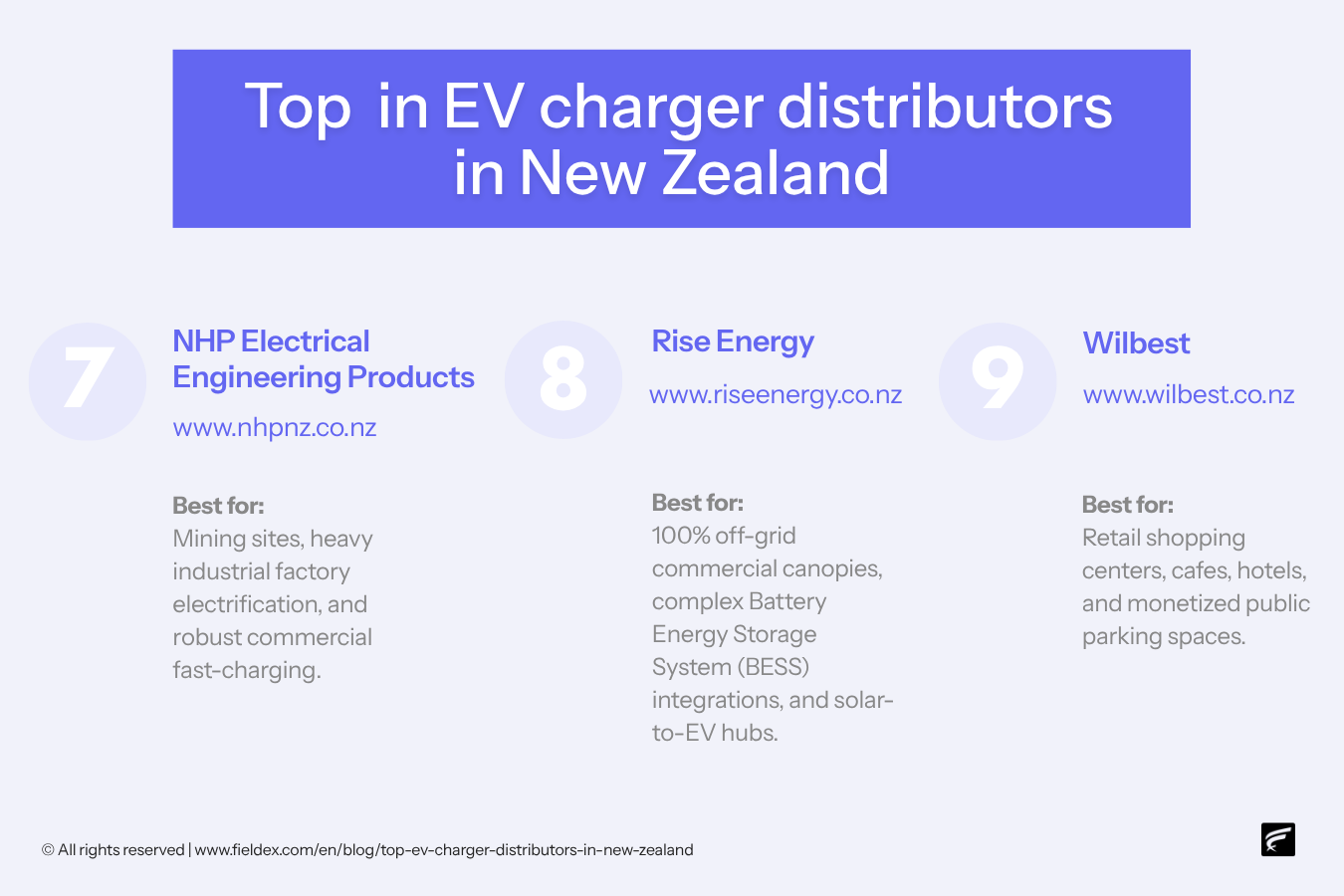
Why they made the list: For heavy industrial environments, NHP supplies the absolute toughest gear on the market. They partner directly with Delta, one of the world's largest EV charger manufacturers, to bring exceptionally rugged hardware into New Zealand.
Did you know? Founded in 1968 by Nigel Hugh Peck, NHP expanded its operations into New Zealand in 1998. Today, they remain a 100% locally and family-owned organization dedicated to bringing the best global technology, such as acting as the exclusive distributor for Allen-Bradley in the South Pacific.
Why they made the list: Rise Energy is perfectly positioned for developers looking to integrate EV infrastructure directly with commercial solar and battery storage. They provide hardware tailored for future-ready, energy-intensive sites.
Did you know? Rise Energy operates as an authorized distributor for Sungrow – the world's most-installed inverter brand. They offer in-country stock and localized NZ-based technical support to help contractors seamlessly bridge solar generation with electromobility.
Why they made the list: Monetizing a commercial charger can often become a software and administrative headache. Wilbest solves this by supplying EV chargers equipped with integrated PayWave contactless payment systems. This allows retail outlets, hotels, and commercial car parks to seamlessly generate revenue using standard credit or debit cards.
Did you know? Based out of Auckland but offering nationwide service, Wilbest actively targets the retail and hospitality sectors by providing "Plug, Pay and Charge" hardware that completely removes the barrier of mandatory app downloads for the end user.
Even the best hardware is entirely useless without elite execution partners. If a commercial project fails to meet WorkSafe or local lines company requirements, the grid connection will be denied. Here are two of the heaviest hitters executing B2B infrastructure locally:
You cannot cut corners with electrical safety in New Zealand. The AS/NZS 3000 standard (widely known as the Wiring Rules) strictly dictates the installation parameters for electric vehicle socket-outlets and protective devices.
The Energy Efficiency and Conservation Authority (EECA) launched the LETF to offset the heavy upfront capital expenditure of B2B infrastructure.
Adding twenty 22kW chargers to an older Wellington office block will catastrophically overwhelm the local transformer. Instead of waiting years for local lines companies (like Vector or Orion) to upgrade the grid, commercial developers rely on DLM software. This tech monitors the building's real-time consumption and aggressively throttles power to the EV pedestals during peak usage, averting blackouts.
Successfully sourcing compliant, high-voltage hardware and securing an EECA grant is a massive operational victory. But the day the site is commissioned is merely the first day of a grueling decade-long lifecycle.
A high-speed transit hub in the South Island doesn't care about the hardware's brand name once the alpine winter hits or a contactor relay inevitably wears down. When a commercial charger drops offline, the impact on fleet logistics and revenue is immediate. Managing a decentralized network of high-voltage assets utilizing reactive maintenance and frantic phone calls to local sparkies will completely obliterate your ROI.
To survive and scale in the commercial sector elite operators are abandoning manual maintenance tracking and transitioning to proactive systems like FieldEx.
FieldEx acts as your dedicated operational backbone, automatically scheduling preventive compliance checks, managing specialized high-voltage inventory, and dispatching certified local technicians exactly when they are needed. By predicting failures before they trigger grid faults, FieldEx ensures the heavy infrastructure you just built actually remains online and profitable.
Stop letting unexpected downtime dictate your operational costs. Book a free FieldEx demo today, or get in touch. We’re here to help.
Launched by the EECA, the LETF is a government initiative designed to offset the upfront costs of adopting zero-emission vehicles and charging infrastructure for New Zealand organizations.
According to WorkSafe guidelines and AS/NZS 3000 rules, chargers must be protected against direct current (DC) fault leakage. This typically requires either a Type B RCD or a Type A RCD paired with internal 6mA DC detection to ensure grid safety.
Yes. Unless a commercial property has virtually unlimited incoming electrical capacity, adding multiple high-voltage EV chargers will exceed the site's maximum demand limit. Load-balancing software (DLM) safely throttles charging speeds to prevent the main breaker from tripping.
New Zealand fleets consist of diverse imports. However, public and commercial rapid-charging networks (like Z Energy) commonly provide both CHAdeMO and CCS2 DC plug types to ensure maximum vehicle compatibility.
Charging speed depends on the vehicle's battery management system, but ultra-fast chargers (such as 180kW units) can deliver roughly 100km of range in approximately 8 minutes.

.avif)


This website and its content are the property of FieldEx and are protected by copyright laws. © 2026 FieldEx. Any redistribution or reproduction of part or all of the contents in any form is prohibited, except with our express written permission.
FieldEx Pte Ltd Singapore