

.png)
Electrifying the Republic of Ireland is not just about trenching cables across sprawling, open parking lots. It is a battle of historical infrastructure and severe grid limitations. A successful commercial EV rollout in Ireland means retrofitting dense, older buildings in Dublin's city center and navigating the complex realities of rural charging hubs across the Wild Atlantic Way.
Beyond the brickwork, developers face strict ESB Networks grid constraints. Because upgrading a primary transformer on an aging grid is often physically impossible – and prohibitively expensive – integrating dynamic load management systems (DLM) is an absolute necessity.
Furthermore, you’re operating in a heavily regulated jurisdiction. Every single conduit run must meet the rigorous standards of Safe Electric (RECI) and adhere to the National Rules for Electrical Installations (I.S. 10101). If you're building out residential or public charging, you also have to navigate the paperwork required to secure Sustainable Energy Authority of Ireland (SEAI) grants.
To survive the Irish market, you need supply chain partners who understand ESB compliance, advanced load-sharing software, and deep inventory logistics. Below, we break down the top 11 EV charger distributors commanding the Irish market in 2026.
Why they made the list: Operating under the massive global Rexel banner, Kellihers (which also trades as CT Electric in regions like Athlone and Galway) is deeply embedded in the Irish commercial and residential markets. They are the undeniable go-to supplier for mid-to-large commercial contractors building out office parking, retail centers, and residential developments. Their logistics network is highly optimized to deliver a massive range of EV hardware across their 23 branches nationwide without crippling lead times.
Did you know? Kellihers was acquired by the Rexel Group in 2006, massively strengthening their global buying power. Today, they operate a dedicated Renewable Energy division that specifically handles complex EV and Solar PV project sizing for contractors.
Why they made the list: Backed by over 40 years of family-run expertise, Meteor Electrical is built to solve one major field headache: wasting billable hours standing in line at a trade counter. Operating out of a massive 200,000-square-foot facility in Cookstown, County Tyrone, they hold over 5,000 branded products in stock.
Did you know? Meteor Electrical guarantees same-day dispatch and next-day delivery across the entire island of Ireland (along with 2-day service to the rest of the UK). Because they physically stock everything from heavy distribution gear to cable management in-house, you never have to worry about third-party drop-shipping delays paralyzing your job site
Why they made the list: With a massive footprint of local branches, CEF is the ultimate safety net for electrical contractors on the ground. If an electrician is retrofitting an underground garage in Cork and realizes they are short on 60A RCBOs, specialized conduit fittings, or a 22kW charging pedestal, a CEF branch is always just minutes away.
Did you know? CEF Ireland recently celebrated its 20-year anniversary. Since launching in 2005, the company has expanded its network to 17 branches across the Republic and 10 in Northern Ireland.

Why they made the list: When massive new-build facilities go up, Demesne Electrical is usually supplying the critical gear behind the scenes. They aren't just selling the charging pedestals; they are the undisputed masters of the high-voltage "Make-Ready" space. They supply the heavy surge protection, industrial switchgear, and complex power distribution units required to tap directly into an aging ESB grid without causing a catastrophic blackout.
Did you know? Founded in 1977 by brothers Noel and Cyril McLoughlin, Demesne is the premier independent importer and distributor of industrial and electrical components in Ireland. They have held the Deloitte Best Managed Company status and pride themselves on early adoption of modern industrial technology.
Why they made the list: Core Electrical is a heavy hitter when it comes to the deep infrastructure required for multi-charger sites. What makes them a critical partner for Irish developers is their technical muscle in power distribution. If you’re building a 50-space charging hub, Core provides the bespoke, customized distribution cabinets and specialized RCBO consumer units required to manage that massive power draw safely.
Did you know? Founded in 1981, the name "Core" actually has a brilliant dual meaning: it refers to the copper core found in electrical cables, but it also pays homage to their original (and current) headquarters in Inchicore, Dublin.
Why they made the list: Operating as part of the massive Edmundson Electrical group, EWL excels at large-scale institutional and government projects. If a university in Dublin or a municipal public works yard in Galway is electrifying its fleet, EWL is typically involved. They bring serious engineering muscle and massive supply chain stability to simplify complex, multi-trade commercial projects.
Did you know? The Edmundson name commands serious historical weight. The company's roots in Dublin trace all the way back to the early 1800s with founder Joshua Edmundson. In fact, his brother-in-law, John Wigham, actually engineered the original gas lighting used in Ireland’s principal lighthouses and erected the famous 1879 gas lamps on Grafton Street.

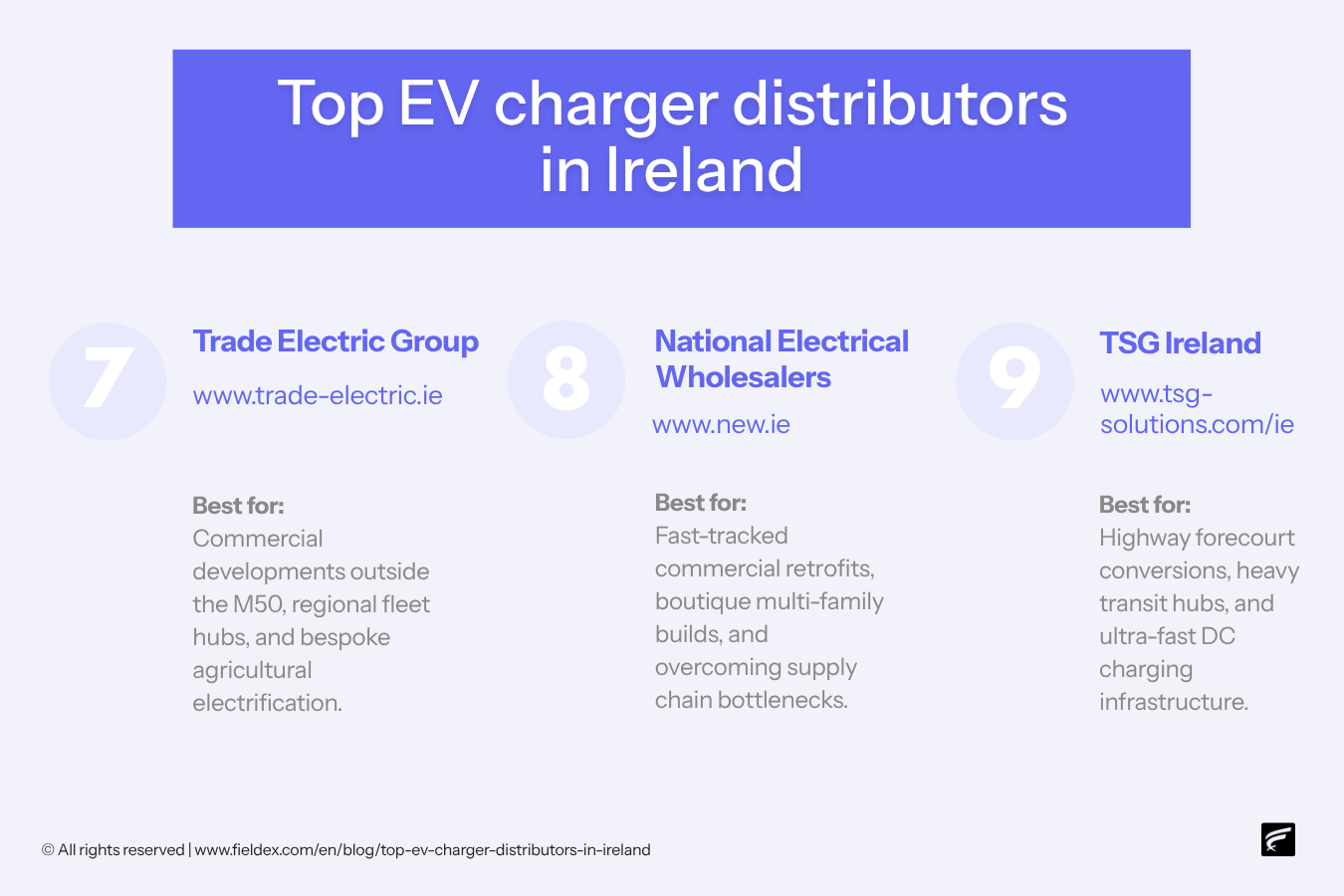
Why they made the list: While the massive national chains fight over the Dublin gridlock, Trade Electric Group dominates the Munster and Mid-West regions. Operating out of Limerick, Kerry and Waterford, they provide localized, highly technical support for contractors electrifying the southern half of the country.
Did you know? Founded in 1971 by Paul Costelloe in Limerick, Trade Electric is a fiercely independent business operating across 11 branches. They have built an incredibly loyal customer base by prioritizing deep, technical counter knowledge over generic transactional sales.
Why they made the list: When national supply chains bottleneck or don't stock the exact smart-charging switchgear you need for a tight timeline, local contractors turn to N.E.W. Operating out of multiple branches in the Greater Dublin Area (including Ballymount, Swords and Marino), they’re the absolute kings of sourcing hard-to-find EV infrastructure items on the fly to keep your commercial project moving.
Did you know? N.E.W. traces its roots back to 1935 and is wholly Irish-owned. They hold ISO 9001, 14001, and 45001 accreditations, and their logistical footprint around Dublin means contractors rarely have to wait on backordered parts holding up a multi-million-euro site commission.
Why they made the list: When developers are building out massive 150kW to 400kW Hypercharger hubs for heavy transit fleets or converting highway forecourts, they bypass traditional wholesalers and go to TSG. They are an absolute powerhouse in the Irish commercial space, offering full EPC (Engineering, Procurement, and Construction) solutions alongside top-tier DC hardware distribution.
Did you know? TSG is the European leader in technical services for mobility solutions. In Ireland, they don't just drop off a charger; they act as the specialized bridge between the hardware manufacturer and the local civil contractor, managing the entire lifecycle of complex EV infrastructure and supplying elite hardware like the Alpitronic HYC series [Source].
Why they made the list: While Garo is technically a Nordic manufacturer, they operate a massive facility in Dublin (Ballycoolin) and act as a direct B2B distributor for electrical contractors across the Republic. Because they bypass third-party middlemen for their own products, their stock availability and direct technical support in Ireland are virtually unmatched.
Did you know? Garo’s roots go back to 1939 Gnosjö, Småland. The Garo group includes sales companies in seven countries: Sweden, Norway, Finland, Ireland, the United Kingdom, Poland and Germany.
Why they made the list: Based out of Bray, Co. Wicklow, Randridge Technologies operates as a highly specialized distributor and turnkey integration partner. They are uniquely positioned because they not only supply high-capacity charging hardware from elite brands, but they also deploy their own backend management platform and mobile app (StopNTop), allowing developers and drivers to seamlessly interact and monetize their new chargers.
Did you know? Randridge takes the headache out of the SEAI grant process for both commercial and residential installers. Because they are deeply embedded in the compliance side of Safe Electric and SEAI regulations, they ensure their hardware and software bundles are grant-ready out of the box.

Having the exact right charging hardware is only half the battle. If you don't have an elite, certified crew to actually get the pedestals into the ground, pull the heavy armored cable, and commission the software, your project is dead in the water.
Here are the top installation and EPC (Engineering, Procurement and Construction) partners dominating the Irish commercial space in 2026:
Building on the massive legacy of EasyGo, EZO is an absolute powerhouse in the Irish market. They don't just install; they operate one of the most connected public and private EV charging networks on the island, making them the ultimate turnkey partner for high-density public spaces and private fleets.
A dominant force in commercial and public infrastructure. If you see a bank of modern chargers at a major Irish hotel, a railway station, or a commercial corporate headquarters, there is a very high probability ePower engineered and installed it.
As mentioned in our distributor list, TSG is the undisputed king of high-voltage EPC. They handle the massive civil works, the heavy trenching, and the ultra-fast DC hypercharger installations for major highway forecourts and heavy transit fleets.
A highly reliable, RECI-approved installer handling everything from workplace charging solutions to complex residential and civil projects. They are deeply versed in ensuring all commercial installations remain strictly compliant for grant funding.
A leading dedicated installer known for bridging the gap between high-end domestic and mid-tier commercial workplace charging. They heavily utilize government grant schemes to drive down capital expenditure for developers.
Ireland is a highly regulated, technically challenging electrical market. Ignoring the legal authority of Safe Electric or the aging reality of the ESB grid will instantly destroy your project's ROI.
Here’s your survival guide for commercial EV deployments in the Republic.
Ireland does not mess around with electrical safety. Under the National Rules for Electrical Installations (I.S. 10101), only a Safe Electric Registered Electrical Contractor is legally permitted to install and certify an EV charge point [Source].
You cannot simply bolt twenty 22kW chargers onto an existing commercial building in Dublin. Every commercial site in Ireland has a strictly contracted Maximum Import Capacity (MIC) with ESB Networks.
The Sustainable Energy Authority of Ireland (SEAI) provides critical funding to offset infrastructure costs for both home and commercial installations. However, the bureaucracy is rigid.
Do you need local authority planning permission to install EV chargers in Ireland? It depends entirely on the zoning [Source].
Getting the right pedestals into the ground and navigating the ESB grid connections is a massive achievement, but it is only day one of a ten-year lifecycle. Once that commercial EV hub is commissioned, your biggest enemy shifts from supply chain delays to unexpected downtime. An offline charger isn't just an inconvenience; it is a dead asset bleeding revenue and damaging your reputation.
The only way to win the long game in the Irish market is to catch failures before they happen. That means rigid, scheduled preventive maintenance – checking the torque on high-voltage terminals, testing the DLM relays, and cleaning thermal filters before a unit overheats and trips the breaker.
You simply cannot manage that kind of recurring complexity across hundreds of decentralized sites with a whiteboard and a calendar app.
FieldEx quietly automates the preventive maintenance schedules, dispatches the right RECI-certified tech before a critical fault code ever triggers, and ensures the multi-million-euro infrastructure you just built actually stays online.
It replaces spreadsheet guesswork and WhatsApp scavenger hunts with real-time, barcode-scanned inventory tracking built specifically for renewable O&M.
Ready to bulletproof your uptime and protect your ROI? Book a free FieldEx demo today, or get in touch. We’re here to help.
OCPP (Open Charge Point Protocol) is the universal open-source software language that allows EV chargers to communicate with backend billing and management networks. It is absolutely critical for commercial sites because it ensures you aren't locked into a single vendor's proprietary software. If you install OCPP-compliant hardware, you can easily switch billing network providers in the future without having to rip out and replace all your physical chargers.
Yes, unless your commercial property has unlimited electrical capacity (which practically none do). DLM is a smart software feature that monitors the real-time electrical draw of your building. If the building approaches its Maximum Import Capacity (MIC) limit with ESB Networks during peak hours, the DLM system automatically throttles down the power going to the EV chargers, preventing a catastrophic main breaker trip and massive utility penalty fees.
Yes, but purchasing the hardware is only step one. To successfully claim the Sustainable Energy Authority of Ireland (SEAI) commercial or apartment block grant funds, the charging hardware must be on the SEAI's approved register, and the actual installation must be completed, tested, and certified by a Safe Electric (RECI) registered electrical contractor.
AC (Alternating Current) chargers rely on the vehicle's onboard converter to change the power to DC for the battery. They are slower (typically 7kW to 22kW in Ireland) but highly cost-effective, making them perfect for long-dwell locations like office parks or residential condos. DC (Direct Current) Fast Chargers bypass the car's converter to push massive power (50kW to 400kW+) directly into the battery. They are expensive and require heavy grid infrastructure, making them strictly suited for highway forecourts and heavy transit fleets.
Absolutely not. Under the National Rules for Electrical Installations (I.S. 10101), only a Safe Electric Registered Electrical Contractor is legally permitted to install, test, and certify an EV charge point. Hiring an uncertified "handyman" or unregistered electrician will instantly void your commercial property insurance and guarantee your project is rejected for any SEAI grant funding.

.avif)


This website and its content are the property of FieldEx and are protected by copyright laws. © 2026 FieldEx. Any redistribution or reproduction of part or all of the contents in any form is prohibited, except with our express written permission.
FieldEx Pte Ltd Singapore