

.png)
Picture this: Your lead technician just drove three and a half hours down a dirt road to a remote commercial solar site. The asset performance management (APM) system flagged a tripped central inverter. The tech diagnoses the issue – a blown 50A DC fuse and a fried control board. No big deal, right? He walks back to his transit van, opens the rear doors, and starts digging through a mountain of cardboard boxes, zip-ties and safety vests.
The control board isn't there.
The master spreadsheet said it was in his van. The frantic WhatsApp group text confirms that someone took it two weeks ago for a different site and forgot to log it. Now, the tech has to drive three hours back empty-handed, the inverter stays offline for another week while you wait on supply chain logistics, and your PPA revenue continues to crater.
Managing commercial solar assets means you are managing a moving, decentralized supply chain. If your inventory tracking relies on human memory and static spreadsheets, you aren't just inefficient – you are losing money. Let's talk about how to actually fix this.
.png)
Spare parts tracking in solar O&M is difficult because high-value components are decentralized – scattered across remote project sites, regional warehouses and individual technician vans – making manual spreadsheet tracking virtually impossible.
You aren't managing inventory on a well-lit, highly controlled factory floor. You’re managing parts that are constantly moving at 70 miles per hour down the interstate.
In a typical field service environment, inventory is highly fluid:
If you’re using a spreadsheet, that document is out of date the second a technician pulls a part off a shelf. By the time Friday rolls around, your inventory data is pure fiction.
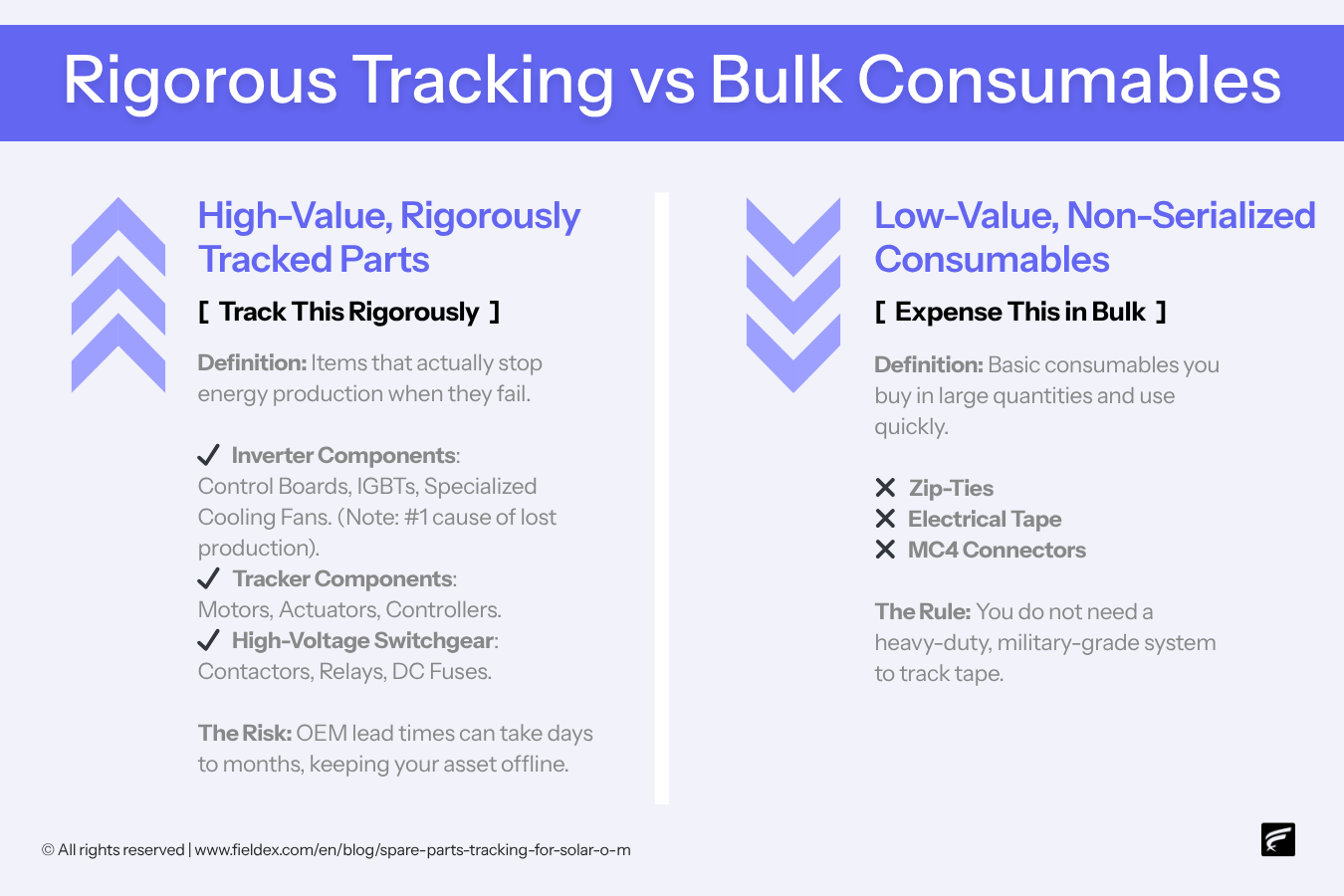
The most critical solar spare parts to track are central and string inverter components (control boards, IGBTs, filters), mechanical single-axis tracker parts (motors, actuators), and high-voltage electrical components (contactors and relays).
You don't need a heavy-duty, military-grade tracking system for zip-ties, electrical tape, or MC4 connectors. Those are basic consumables. You buy them in bulk and expense them. The items that demand rigorous tracking are the ones that actually stop energy production when they fail:
If an IGBT fails and you don't have a spare, you're at the mercy of the OEM's lead times. Sometimes that means waiting days; sometimes, it means waiting months.
O&M managers balance inventory costs by calculating the exact revenue lost per day of system downtime against the annual warehousing and depreciation costs of holding expensive spare components.
This is the ultimate financial tightrope.
The Solution: You find the sweet spot by tracking historical failure rates. A robust CMMS will tell you exactly how many tracker actuators you burned through last year. You use that data to set intelligent, automated Minimum/Maximum reorder thresholds. When your stock drops to two, the software automatically pings the procurement team to order more. You never overbuy, but you never stock out.
The warranty trap occurs when an O&M provider cannot digitally prove they used OEM-approved spare parts or completed required preventive maintenance, giving manufacturers a legal loophole to void expensive equipment warranties.
Original equipment manufacturers (OEMs) are not your friends when it comes to warranty claims. They will look for any reason to deny a payout. If you swap a busted cooling fan in an inverter, you need to prove exactly what part went into that machine.
You need software that creates a parent-child relationship between the main asset (the inverter) and the spare part (the fan). If you just toss a third-party, aftermarket fan in there and the whole inverter overheats and catches fire six months later ... congratulations, you just bought a new inverter out of your own pocket.
Keeping a pristine digital paper trail of exactly what serial number went into what machine is the only way to bulletproof your warranty claims.
.png)
Managing reverse logistics and RMAs requires tracking the defective high-value part from the site back to the warehouse, processing the manufacturer warranty claim, and legally logging the refurbished unit back into active inventory.
Most O&M teams are completely blind to reverse logistics. When a $5,000 power module blows, it doesn't just go in the dumpster. It gets sent back to the manufacturer for repair or replacement via a return merchandise authorization (RMA), also known as 'return goods authorization'.
This creates "phantom inventory". A proper tracking system manages the status of a part across its entire lifecycle:
If you aren't tracking RMAs, you’re literally throwing cash in the trash.
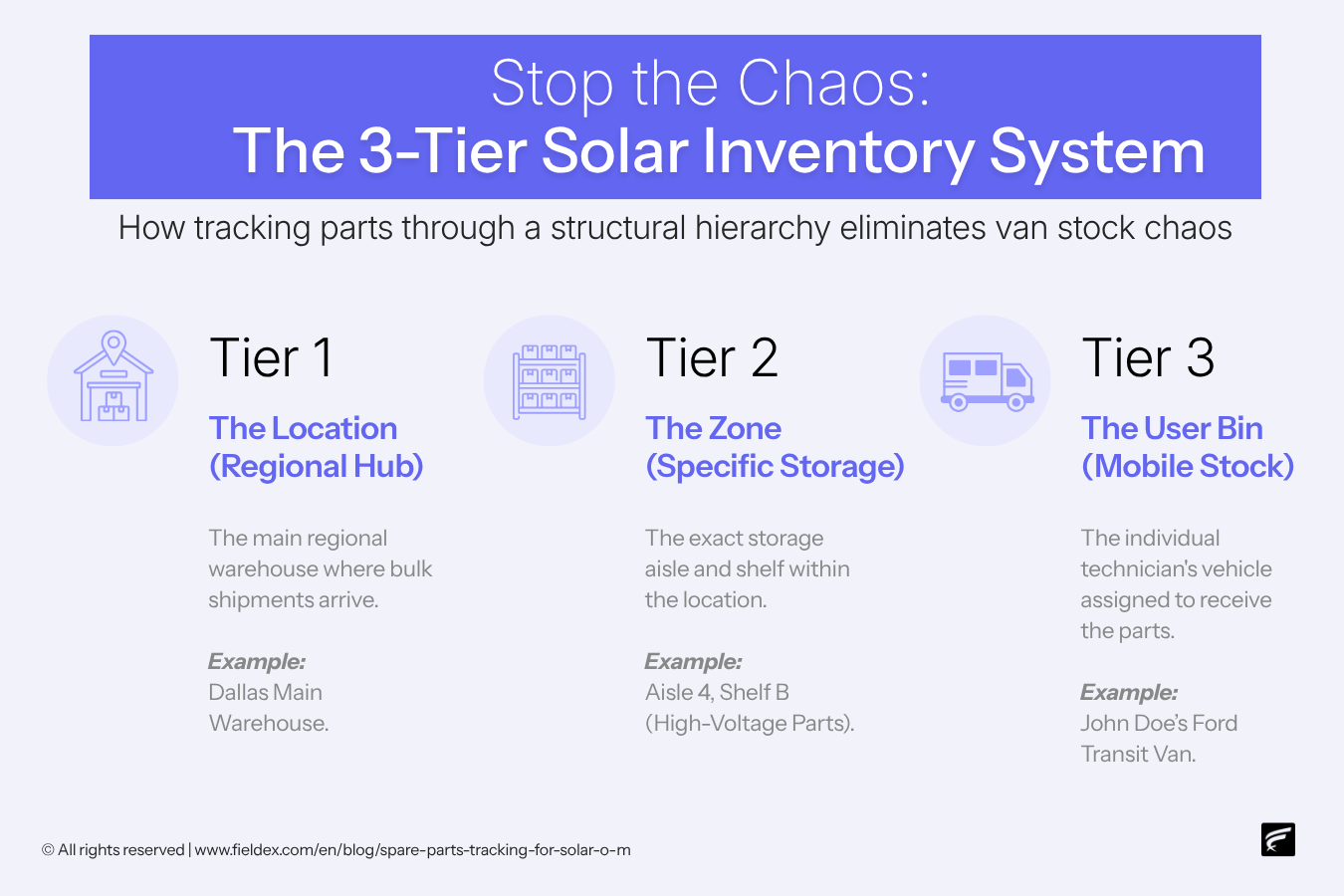
A 3-tier inventory system fixes van stock chaos by tracking a spare part through three distinct levels: the main regional warehouse (Location), the specific storage shelf (Zone), and the individual technician's vehicle (User Bin).
Here’s how the pros do it. They don't just assign parts to "The Texas Team". They assign parts to a specific structural hierarchy:
When John Doe is out in the field and replaces a contactor, he pulls out his phone, opens his field service app, and scans the barcode on the part box. The system instantly deducts that contactor from his specific van and attaches the cost directly to the work order.
Now, the dispatcher back at the office has 100% visibility. Before they roll a truck for the next ticket, they can look at the system and say, "John doesn't have the part, but Sarah's van does. Route Sarah instead". Your first-time fix rates will skyrocket.
Spare parts kitting is the process of pre-assembling all the necessary consumables – such as inverter air filters, specific fuses and coolant – into a single, trackable package required for a standard preventive maintenance work order.
Stop making your highest-paid lead technician spend two hours walking around the warehouse with a shopping cart, trying to gather 15 different small items for an annual inverter preventive maintenance (PM) run.
The best software for solar spare parts is a specialized computerized maintenance management system (CMMS) that natively integrates multi-level asset genealogy, automated reorder thresholds, and mobile-first inventory tracking.
Spreadsheets lie. They only update when a tired, overworked human remembers to manually type in a number at the end of a 12-hour shift.
If you’re serious about scaling a solar portfolio, adopting a CMMS with built-in field service management (FSM) capabilities isn't a luxury; it's a foundational requirement.
Mastering inventory isn't just some boring administrative chore for the procurement department. It is a critical revenue protection strategy. You simply cannot maximize energy generation if your crews are constantly waiting on parts, driving back and forth to supply houses, or playing guessing games with van stock.
Get your parts out of WhatsApp, get them off the spreadsheets, and put them into a system that actually works as hard as your field crews do.
FieldEx replaces spreadsheet guesswork and WhatsApp scavenger hunts with real-time, barcode-scanned inventory tracking built specifically for renewable O&M.
Want to see how FieldEx works in the real world? Book a free demo today, or get in touch. We’re here to help.
It stands for operations and maintenance. It encompasses all the physical and digital tasks required to keep a solar power plant running safely and efficiently after it has been built.
Inverters are the hardest-working component on a solar site. They are constantly converting high-voltage DC power to AC power while being exposed to extreme heat, cold, and grid voltage fluctuations, which wears down their internal power electronics.
It depends on the scale of the portfolio and OEM lead times. Generally, operators keep a 3% to 5% buffer of highly critical components (like inverter power modules) and automate the restocking of cheaper consumables.
A computerized maintenance management system (CMMS) is software used to schedule field technicians, track work orders, manage spare parts inventory, and ensure safety compliance across distributed energy assets.
It uses mobile applications. Technicians scan barcodes or QR codes on parts using their smartphones, which instantly updates the central database and deducts the item from their specific vehicle's inventory.
Preventive maintenance parts are predictable consumables (like air filters and coolant) replaced on a schedule. Corrective maintenance parts are unexpected replacements (like a blown fuse or shattered panel) needed to fix a breakdown.
If a critical part is delayed by months, the broken equipment stays offline. Because solar sites generate revenue by selling power to the grid via a Power Purchase Agreement (PPA), every hour offline is permanently lost income.
It is the digital tracking of parent-child relationships between equipment. For example, tracking exactly which serial number of a replacement battery cell (the child) went into which specific battery rack (the parent).
Yes. Modern field service software allows technicians to use their smartphone cameras to scan part barcodes, instantly linking the consumed inventory to the digital work order they are completing.
If a dispatcher knows exactly what parts are in a technician's van, they can assign the right tech to the right job. This ensures the tech can fix the issue on their first visit, rather than diagnosing it and having to return days later with the correct part.

.avif)


This website and its content are the property of FieldEx and are protected by copyright laws. © 2026 FieldEx. Any redistribution or reproduction of part or all of the contents in any form is prohibited, except with our express written permission.
FieldEx Pte Ltd