

.png)
The electric vehicle (EV) transition is no longer just about putting flashy hardware in the ground; it’s about keeping that hardware alive. According to recent data,14% of EV drivers who visit a public charger leave without successfully charging, and the majority of the time, it's simply because the charger is broken or out of service. It’s a bit like building a state-of-the-art airport and then forgetting to hire mechanics for the planes.
If you’re a charge point operator (CPO) or an electrical contractor managing these sites, those aren't just frustrating statistics – they are bleeding wounds in your revenue stream. Every minute a DC fast charger sits offline, you’re losing direct charging dollars. More importantly, you risk severe financial clawbacks if you fail to meet the strict 97% uptime mandate required by the National Electric Vehicle Infrastructure (NEVI) program.
.png)
Faced with the threat of federal clawbacks, it’s tempting to trust that your existing network management software has you fully covered. After all, it gives you a beautiful dashboard full of diagnostic data. But here’s a frustrating reality: data doesn't turn a wrench. Knowing a charger is offline is only 10% of the battle; the other 90% is the physical logistics of getting it fixed.
You might think you have this maintenance gap under control because you use a top-tier Charge Point Management System (CPMS). But let's be clear: a CPMS – as brilliant as it is for handling driver authentication, payment processing and remote diagnostics – cannot physically fix a broken connector cable. It might successfully detect an issue and throw an "Error 404: Connector Lock Failure", but the CPMS alone won't tell you which technician has the high-voltage certification required to open the cabinet. Nor will it ensure they actually have the correct spare part in their truck before driving out to the site.
To actually protect your revenue and hit those regulatory uptime mandates, you need a dedicated "execution layer" that bridges the gap between digital error codes and physical field repairs.
Let's break down exactly how to execute the 7 field service strategies required to bulletproof your EV charging network.
Ever notice how a dashboard full of green lights can be the biggest lie in operations?
Your CPMS is designed to detect issues, and it does that well. But what happens after the alert fires? If that alert just sits in an inbox waiting for a facility manager to check it on a Monday morning, or if it gets manually copied into a spreadsheet to coordinate a repair, you are losing money.
You need to integrate your CPMS directly with a Field Service Management (FSM) platform via an API (Application Programming Interface). Think of an API as a digital bridge that allows two software systems to talk to each other seamlessly. When the CPMS detects a fault, your FSM should instantly:
Removing the human bottleneck in the dispatch process drastically reduces your Mean Time to Repair (MTTR) – an engineering metric that basically means "how fast you get the thing working again after it breaks”. By automating dispatch, you turn a 24-hour administrative delay into a 24-millisecond routing decision. Faster dispatch equals faster revenue recovery.
.png)
You cannot send a generic facilities maintenance worker out to pry open a high-voltage charging cabinet. Not only is it a massive safety hazard (we’re talking about deadly amounts of electricity here), but it also guarantees a wasted truck roll when the technician realizes they’re completely out of their depth.
Utilize robust skill-tagging within your scheduling software. Your dispatch board shouldn't just show who is available; it needs to show who is qualified.
The system must automatically:
Getting the right brain on-site the first time protects your First-Time Fix Rate (FTFR). A high FTFR means your tech solves the issue on visit number one. Since rolling a truck can easily cost hundreds of dollars in labor and fuel, preventing secondary visits is one of the easiest ways to protect your profit margins.
Imagine this: your certified technician arrives on-site. They complete all the necessary safety protocols so they don't touch live wires, pop open the cabinet ... and realize they don't have the replacement connector cable or the specific cooling fan in their van stock.
Infuriating, right? You just paid a highly skilled electrician to drive out there, look at the problem, and shrug their shoulders.
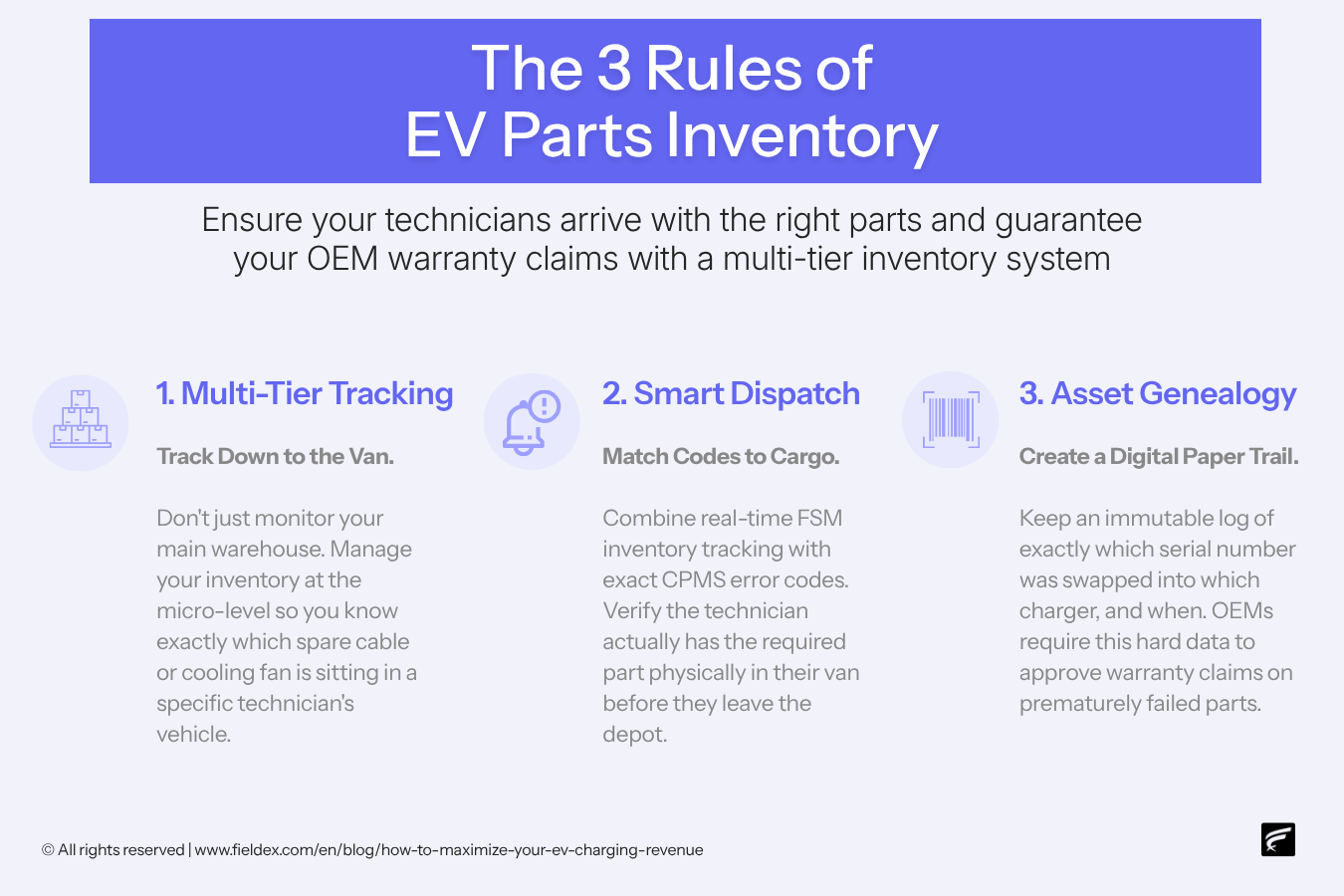
Implement a rigid, multi-tier inventory system. You need to:
A robust FSM provides the exact digital paper trail needed to execute manufacturer warranty claims, turning a sunk maintenance cost into recovered capital.
Let’s talk about compliance. Under NEVI regulations, keeping the charger running isn't enough. You’re legally required to provide detailed data reporting on your maintenance activities. You have to prove why a station was down, exactly how it was fixed, and how long it took.
Move away from paper forms. Paper gets lost, coffee gets spilled on it, handwriting can be illegible.
This creates an automated "compliance engine". By capturing this granular data in the field, your back office can auto-generate the complex data submittals required by the government. It takes compliance from being a massive administrative headache to a streamlined operational advantage.
Treating EV chargers as isolated, standalone units is old-school thinking. The modern energy site is rapidly converging. Walk onto a commercial logistics depot or a big-box retail parking lot today, and you’ll likely see EV charging infrastructure co-located with a Battery Energy Storage System (BESS) and a Commercial & Industrial (C&I) Solar array, all sitting behind the same utility meter.
Maximizing the technician's time on-site prevents catastrophic downtime and extends the lifecycle of the entire decentralized grid.
Not all downtime is created equal. A fault at a high-traffic highway corridor station that is bleeding $50 an hour in lost revenue – and is only hours away from triggering a federal NEVI penalty – is vastly more critical than a dead screen on a free Level 2 charger at a corporate office.
If your dispatch board operates on a simple "first-in, first-out" basis, you are actively losing money. Treating every broken charger with the exact same urgency guarantees that high-revenue sites will eventually fall out of compliance.
Move away from proximity-only dispatching and implement dynamic SLA (Service Level Agreement) routing. Your software shouldn't just dispatch the closest technician; it must weigh the financial and regulatory risk of every open ticket. Your FSM system must:
By prioritizing jobs based on financial impact rather than just a chronological queue, you protect your most lucrative assets first.
.png)
Copper theft and physical vandalism (like smashed payment screens) are surging across public charging networks. The problem? A cleanly severed connector cable often just registers on a CPMS dashboard as a generic "Communication Loss" or "Vehicle Not Connected" status.
If your digital dashboard assumes it’s a software glitch, and you dispatch a technician equipped only a laptop, they will arrive to find a severed cable. You have just wasted a highly expensive truck roll, and the charger remains broken.
Integrate physical triage into your fault-intake process to bridge the gap between what the software "sees" and what is actually happening in the parking lot. You need to:
When you eliminate the guesswork between digital errors and physical damage, your first-time fix rate skyrockets.
If you're reading through these strategies and thinking, "Great, but my current software can't do half of this", you aren't alone. The gap between digital monitoring and physical field execution is the biggest operational hurdle in the industry right now.
That's where FieldEx comes in, the dedicated execution layer for green infrastructure. Rather than replacing your CPMS, FieldEx integrates with it. When your monitoring tool catches a fault, FieldEx takes over the physical reality of the repair, ensuring:
Want to see FieldEx in action? Book a free demo today, or just reach out with your queries. We’re here to help.
Scaling a reliable, profitable EV charging network isn't about hype, flashy consumer apps or marketing buzzwords. It’s about operational resilience. In the context of critical infrastructure, downtime is not just an inconvenience – it’s a regulatory violation, a safety hazard, and a massive drain on your bottom line.
By bridging the gap between digital monitoring and physical execution, and putting the right workflows in the hands of your technicians, you can stop bleeding revenue, hit your uptime targets, and ensure this energy transition actually works.
A Charge Point Management System (CPMS) handles the digital side of EV charging, such as driver payment processing, energy load management, and remote diagnostics. Field Service Management (FSM) software handles the physical execution: dispatching technicians, managing spare parts inventory, and documenting on-site safety compliance.
EV chargers are highly complex, high-voltage computers exposed to harsh environmental conditions year-round. They suffer from software glitches, telecommunications drops, physical wear-and-tear on heavy cables, and require specialized certified labor to safely repair.
The National Electric Vehicle Infrastructure (NEVI) program mandates that federally funded charging stations maintain a 97% uptime standard. Crucially, operators must also submit detailed, standardized quarterly data reports proving this uptime and documenting the root causes of any outages.
By connecting your CPMS to an FSM via an API (Application Programming Interface), a detected software or hardware fault instantly generates a work order and routes it to the correct, certified technician. This eliminates manual data entry and drastically reduces the Mean Time to Repair (MTTR).
DC fast chargers operate at incredibly high voltages (often 400V to 800V or higher). Servicing them safely requires specialized training and certifications, such as the EVITP (Electric Vehicle Infrastructure Training Program), to protect both the technician and the highly sensitive equipment.
FTFR measures the percentage of times a technician successfully repairs an asset on their very first visit to the site. A low FTFR means you are paying for multiple truck rolls (labor and travel costs) for a single problem, which destroys service profitability.
Robust FSM software tracks "asset genealogy", maintaining an immutable digital record of every single part swapped and every maintenance event logged. This detailed history provides the exact proof needed by Original Equipment Manufacturers (OEMs) to honor warranty claims for prematurely failed parts.
Unlike traditional maintenance that focuses purely on cost efficiency, operational resilience treats downtime as an existential risk. It focuses on rigorous compliance, mandatory safety checklists, and proactive, preventive maintenance to ensure critical infrastructure never goes offline in the first place.
Commercial properties are increasingly combining EV chargers, Commercial & Industrial (C&I) solar generation, and Battery Energy Storage Systems (BESS) behind the same utility meter to optimize energy costs. Because these are all high-voltage assets, the same specialized profile of electrician is often required to maintain all of them.
Lockout/Tagout is a critical, legally required safety protocol used to ensure that dangerous machines (like high-voltage electrical cabinets) are properly shut off, de-energized, and literally locked so they cannot be started up again prior to the completion of maintenance or repair work.

.avif)


This website and its content are the property of FieldEx and are protected by copyright laws. © 2026 FieldEx. Any redistribution or reproduction of part or all of the contents in any form is prohibited, except with our express written permission.
FieldEx Pte Ltd Singapore