

.png)
In the North American EV industry, the standards war is officially over. With the formalization of SAE J3400, the North American Charging Standard (NACS) has won the OEM battle. Now, almost every major automaker – from Ford and GM to Rivian and Hyundai – is rolling native NACS ports off the assembly line.
But if you’re a charge point operator (CPO) or an electrical contractor, stop celebrating. The "Plug War" might be over, but the "Adapter Era" has just begun.
There are still millions of pre-2025 legacy CCS1 vehicles on the road, and they will be charging for the next decade. The present operational reality is not a clean, overnight switch to a single cable. It’s a messy, bifurcated network of dual-cable dispensers, heavy adapters, and complex NEVI compliance rules.
Here’s the no-nonsense engineering, safety and field maintenance guide to surviving the NACS transition.
While the physical footprint of NACS and CCS1 is visibly different, the true divergence lies in their electromechanical architecture. For operations teams and site engineers, the distinction goes far beyond the size of the plastic housing. The core engineering of each standard fundamentally dictates how charging stations distribute power, manage thermal loads, and define preventive maintenance schedules in the field.
.png)
For commercial site developers, NACS isn't just about a smaller plug; it’s a massive cost-saving mechanism for Level 2 destination charging.
While NACS is structurally superior, CCS1 actually holds a slight passive thermal advantage at mid-tier speeds (150kW) due to the sheer mass and surface area of its DC pins. However, as 2026 pushes charging speeds well beyond 350kW, passive cooling is irrelevant. Both standards now require aggressive liquid-cooled cables to prevent hardware meltdown.
.png)
We’re currently living in a high-risk transitional period. Drivers are heavily relying on NACS-to-CCS (and CCS-to-NACS) adapters to bridge the gap between their older vehicles and new infrastructure. From an O&M standpoint, adapters are an uncontrolled variable.
In electrical engineering, every physical connection point introduces contact resistance. When you introduce a heavy adapter between the dispenser handle and the vehicle port, you add a new interface. Under the laws of Joule heating, increased resistance under high amperage equals extreme heat.
The market is currently flooded with uncertified, cheap third-party adapters bought online. These are severe operational liabilities.
Backend CPMS software must actively monitor temperature at the pin level. If abnormal heat is detected, the software must instantly throttle the current (derate the charger) and auto-dispatch a field technician to inspect the pins for heat scoring.

Securing federal National Electric Vehicle Infrastructure (NEVI) funding requires strict adherence to accessibility standards. You cannot build a NACS-only "walled garden" and receive government reimbursement.
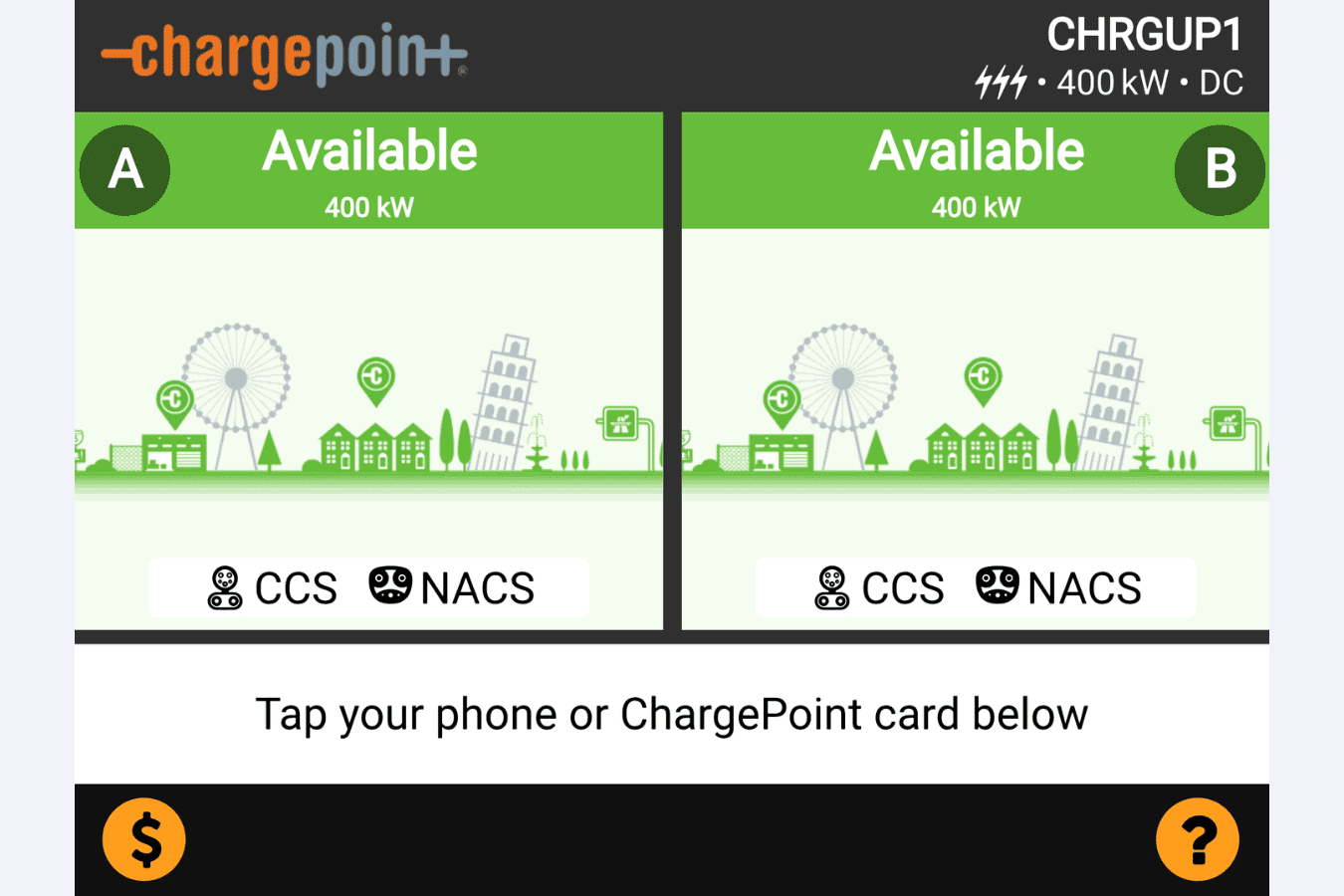
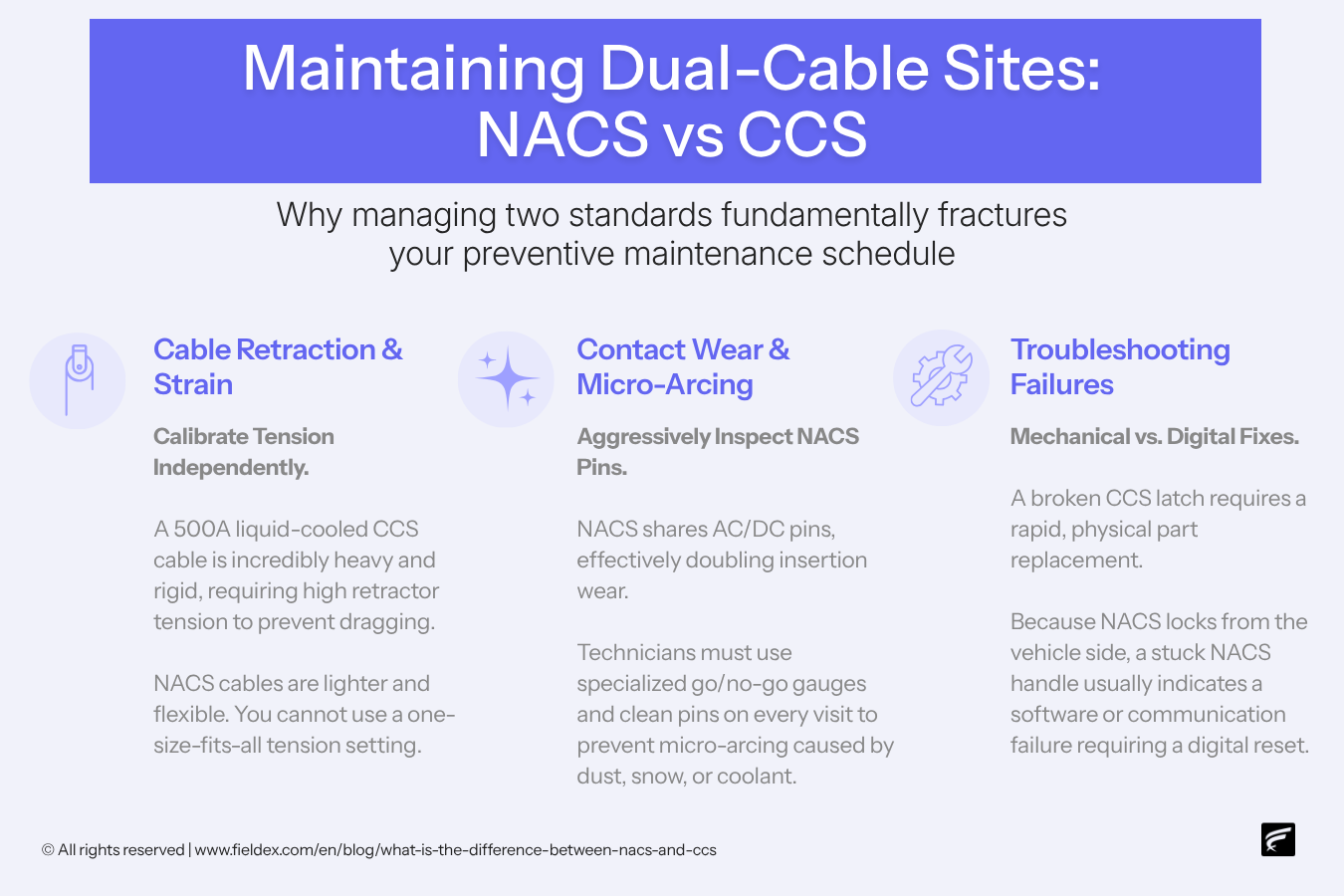
Managing a dual-cable site fundamentally fractures your preventive maintenance (PM) schedules. The physical wear-and-tear profiles of NACS and CCS hardware are entirely different.
A 500A liquid-cooled CCS cable is incredibly heavy and rigid, placing immense physical strain on mechanical retractors and spring balancers. NACS cables, carrying the same current, are significantly lighter and more flexible. Maintenance teams cannot use a one-size-fits-all tension setting. Technicians must calibrate retractor tension independently for each cable type to prevent heavy CCS cables from dragging on the concrete and shattering the plastic latch.
Because NACS shares its AC and DC pins, those specific contacts see double the insertion cycles compared to a CCS vehicle. Furthermore, if dust, dielectric coolant, or snow enters the NACS plug, the transition between AC and DC current can cause micro-arcing. Field technicians must aggressively inspect NACS pins using specialized go/no-go gauges and clean them during every routine site visit to prevent resistance buildup.
A broken plastic latch on a CCS handle renders the entire charger inoperable, requiring a rapid mechanical fix. NACS, however, locks from the vehicle side. If a NACS handle gets stuck, it is often a software or proximity-pilot communication failure, requiring a digital reset or contactor inspection rather than a plastic part replacement.
The industry consensus is absolute: NACS is the future of North American EV charging. But CCS remains the gritty, operational present. Ripping out legacy CCS infrastructure today is a guaranteed way to alienate millions of drivers, lose charging revenue, and violate federal NEVI funding terms.
The operators who dominate the current landscape will be the ones who meticulously manage dual-cable sites, aggressively track connector wear, and monitor thermal adapter faults before they cause catastrophic site downtime.
Managing dual-cable inventory, tracking thermal derating events, and dispatching technicians for broken CCS latches is impossible on a spreadsheet. FieldEx is the dedicated field service management (FSM) platform built to handle the engineering complexities of the 2026 EV transition.
From tracking van-level replacement parts to automating the exact NEVI compliance data required for mixed-hardware sites, FieldEx acts as your operational liability shield.
Book a free demo to see exactly how FieldEx works, or simply get in touch. We’re here to help.
NACS uses a compact 5-pin layout that shares the same pins for AC and DC power via time-division multiplexing. CCS1 uses a larger "sandwich" design that physically separates the AC port from two dedicated, high-voltage DC fast-charging pins.
Yes. NACS (North American Charging Standard) was the proprietary name coined by Tesla. SAE J3400 is the formalized, peer-reviewed engineering standard published by the Society of Automotive Engineers, making it an open framework for all manufacturers.
Yes, but it requires a compatible, UL-certified NACS-to-CCS adapter. Additionally, the specific charging network must have their software backend open to non-native vehicles to initiate the handshake and payment protocols.
Adapters are only safe if they are UL 2252 certified. Uncertified knockoff adapters lack critical 85°C thermal cut-off thermistors. Under high-amperage DC loads, these adapters can overheat, melt, and weld themselves to the charging equipment.
Automakers switched primarily for user experience and reliability. NACS cables are vastly lighter, more ergonomic in freezing temperatures, mechanically simpler (no fragile latches on the handle), and granted drivers native access to the highly reliable Tesla Supercharger network.
Yes. To receive and retain federal NEVI funding in 2026, charging stations are still required to support legacy vehicles. This typically mandates at least one permanently attached CCS Type 1 connector per DC Fast Charging port.
No. Adapters are internally wired specifically for either AC charging or DC fast charging. Forcing an AC adapter onto a DC fast charger will fail the proximity pilot handshake and can physically damage the pins.
Cheap adapters increase electrical contact resistance without communicating thermal data back to the dispenser. Operators ban them because they bypass the charger's safety derating protocols, posing a severe fire and equipment damage risk.
While NACS is the standard for vehicles produced from 2025 onward, CCS infrastructure must remain fully operational for at least another decade to support the millions of legacy CCS vehicles currently on the road.
Commercial properties typically run on 480V three-phase power. Because 277V is simply one leg of a 480V supply, SAE J3400 Level 2 chargers can be wired directly to the panel, eliminating the need to purchase and install heavy, expensive step-down transformers.

.avif)


This website and its content are the property of FieldEx and are protected by copyright laws. © 2026 FieldEx. Any redistribution or reproduction of part or all of the contents in any form is prohibited, except with our express written permission.
FieldEx Pte Ltd Singapore