

.png)
Let’s be real for a second – most software demos are theater. Agreed? You sit in a boardroom, watch a salesperson click through beautiful dashboards showing revenue spikes and green "Online" indicators, and you sign the contract. Six months down the road, you’re standing in a muddy parking lot in the rain, staring at a $100,000 DC Fast Charger that’s offline for the third time this week, realizing your fancy dashboard can’t tell you if the technician has the right Torx driver to open the cabinet.
Welcome to the "maintenance gap".
In 2026, the REAL challenge of the energy transition is keeping the machines running. With federal NEVI mandates requiring 97% uptime and "clawback" penalties looming for non-compliance, operation and maintenance (O&M) is no longer a back-office afterthought – it’s your entire business model.
.png)
If you’re a charge point operator (CPO) or an electrical contractor, you don't need another billing platform. You need an operating system for your field crews. Here’s the no-nonsense guide to choosing software that actually fixes broken chargers.
Before we look at features, we need to clear up the biggest misconception in the industry: Your CPMS is not a maintenance tool.
Think of your technology stack like a human body:
Trying to fix a 480V cabinet using only your CPMS is like trying to repair a car engine using only the check-engine light on the dashboard. You need a mechanic’s toolset. To hit 97% uptime, you need a dedicated execution layer that integrates seamlessly with your CPMS.
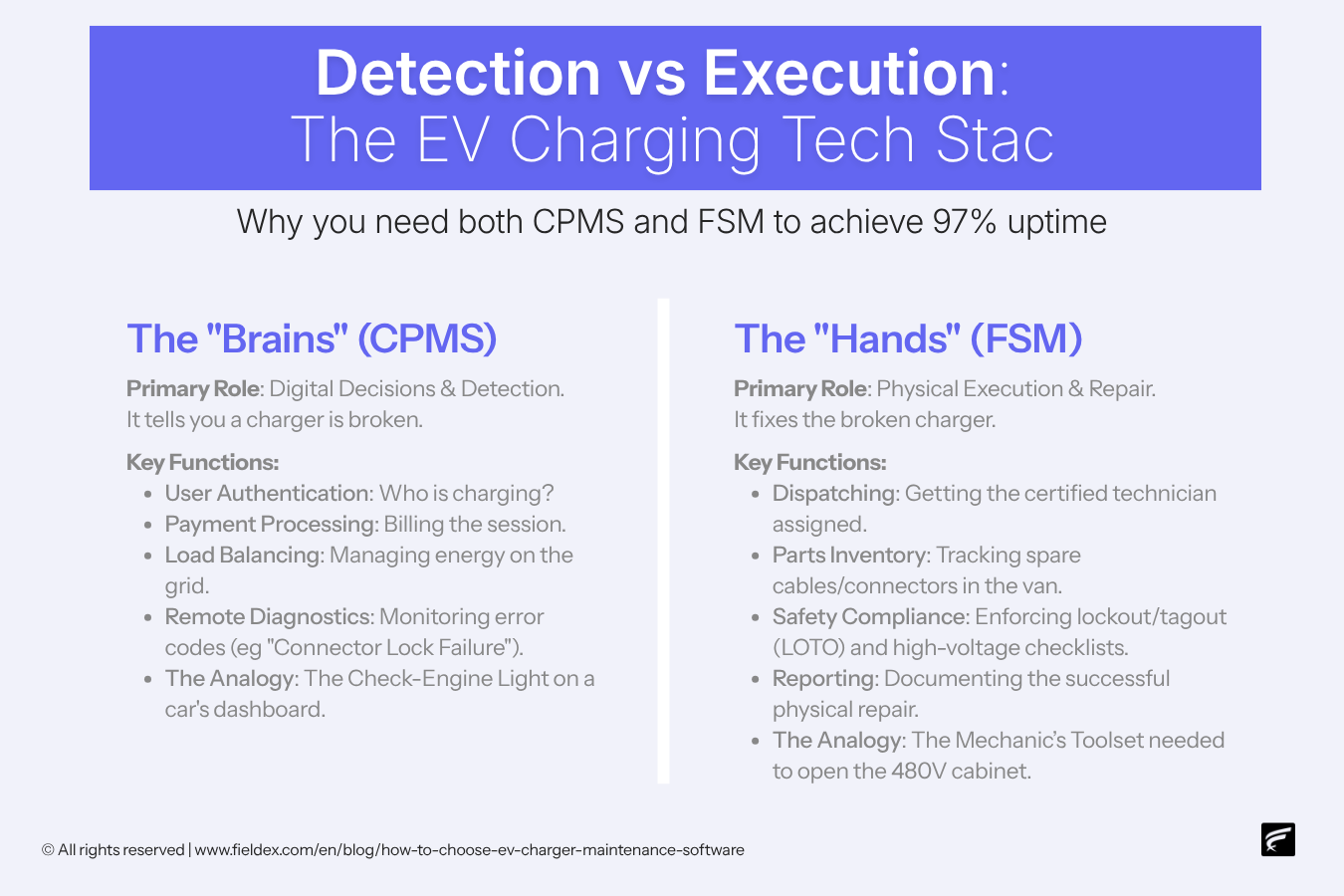
If you’re evaluating software vendors, ignore the shiny UI and ask about these five specific capabilities.
Bottom line: If you can't see what is in the truck, you’re just guessing. And guessing costs hundreds of dollars per truck roll.
Bottom line: Your schedule should act as a digital liability shield. If the cert is expired, the software shouldn't let the technician touch the job.
.png)
A common question I get from operations directors is, "Can't we just use the field service platform we already have?"
The short answer is: No. A 150kW DC Fast Charger is not a boiler or a sprinkler system.
Generalist field service management (FSM) platforms are built for "trades" where the asset is simple, but the scheduling is hard. They treat every piece of equipment as a generic "Asset ID". To a generalist platform, a 480V Tritium charger is effectively the same as a toaster. It doesn't know that the charger has five internal power modules that can be swapped independently, or that the technician needs a specific expired EVITP certification to open the cabinet safely.
When you use generic tools for high-voltage infrastructure, you’re relying on manual workarounds to handle critical safety and compliance tasks. Here is the operational reality of where those tools break down:
You don't need to "rip and replace" your existing systems to fix this. The smartest engineering teams use an API strategy.
Dedicated FSM software acts as the "action layer" that sits seamlessly underneath your CPMS.
In the gold rush of the energy transition, the winners won't be the companies with the flashiest consumer apps or the sleekest marketing. The winners will be the ones with the most boring, reliable operations.
You need software that works when it's offline, that prevents your technicians from making safety errors, and that handles the messy reality of physical inventory.
At FieldEx, we call this the "operating system for distributed energy resources". We built it specifically to handle the high-voltage complexity that generic tools ignore. If you’re ready to stop managing critical infrastructure with spreadsheets and start automating your NEVI compliance, it might be time to look at a dedicated execution layer.
Want to see FieldEx in action? Book a free demo today, or just reach out with your queries. We’re here to help.
A CPMS (Charge Point Management System) handles the "digital" side: payments, user access, and remote monitoring. O&M (Operations & Maintenance) software, or FSM, handles the "physical" side: dispatching technicians, tracking spare parts, and documenting safety compliance.
While some CPMS platforms have basic ticketing, they lack critical field features like van-level inventory tracking, complex asset genealogy (tracking part swaps), and offline mobile capabilities for technicians working in underground garages.
To comply with NEVI, your software must track downtime with extreme precision, categorizing outages into specific buckets like "T_outage" (hardware failure) versus "T_excluded" (grid outages or vandalism) to calculate the 97% uptime formula accurately.
Generic CMMS platforms are great for plumbing or HVAC but often struggle with the specific regulatory requirements of EV infrastructure, such as EVITP certification tracking, NEVI reporting codes, and the complex parent-child relationships of charger modules.
Specialized software tracks "Asset Genealogy" – an immutable history of every part. If a power module is swapped from one station to another, the software preserves its history, allowing you to prove to the manufacturer that the specific serial number is still under warranty.
Asset Genealogy is the digital record of an equipment's life. It tracks every maintenance event, part replacement, and location change for every component (down to the serial number) from installation to decommissioning.
Yes, absolutely. EV chargers are frequently installed in connectivity "dead zones" like underground parking garages or remote highway corridors. An offline-first app ensures technicians can still access safety checklists and complete work orders without a signal.
Software like FieldEx improves FTFR by ensuring two things before a truck rolls: 1) The assigned technician has the correct certification (eg EVITP), and 2) The specific spare part required for the repair is currently in their van stock.
Yes. By integrating your CPMS with FSM software via API, you can automate the entire workflow. When the CPMS detects a specific error code, the FSM can automatically create a ticket and route it to the nearest qualified technician without human intervention.
Look for "Skill-Gating" (preventing uncertified techs from receiving dangerous jobs) and "Mandatory Logic" (forcing technicians to complete Lockout/Tagout checklists before they can proceed with a repair) to ensure compliance with NFPA 70E and NFPA 855.

.avif)


This website and its content are the property of FieldEx and are protected by copyright laws. © 2026 FieldEx. Any redistribution or reproduction of part or all of the contents in any form is prohibited, except with our express written permission.
FieldEx Pte Ltd Singapore